by Kelly Nurge | Sep 26, 2016 | Buzz, September 2016
A typical college student will likely roll out of bed, grab coffee and head to class in pajamas. With the world at their fingertips, though, they don’t even need to worry about waking a roommate in the process or hauling a bag full of books across campus. Nearly 6 million people in the U.S. are enrolled in online programs, up from 3 million in 2012. The online classroom has been expanding rapidly across the country, especially in North Carolina.
Seated classes can provide comprehensive learning in a group setting that is hard to replicate online. But with the influx of technology, the necessity to travel to a campus is becoming outdated. New methods of connection and learning are expanding daily and enrollments in online courses for certifications, Bachelor’s and Master’s degrees will continue to grow as well.
In a national 2015 survey from Learning House, about 66 percent of students enrolled virtually were less than 100 miles away from their campus. However, North Carolina is beating those statistics: Of the 6.1 percent of students exclusively taking online classes, 91 percent lived in state. Despite the convenience of logging into school online, most students appreciate having a main campus or branch nearby. North Carolina has 127 schools that offer online programs, including all 16 of the colleges in the University of North Carolina system and 58 community colleges across the state. Thirty-nine private schools and 14 for-profit institutions comprise the rest of the list.
Though recent high school grads aren’t overwhelming online universities, the shift to younger enrollment is growing. Millennials are drawn to virtual courses, in part because some high schools are requiring collegiate classes before graduation. The format and pacing is why enrollment for undergraduate online courses for students under the age of 25 increased from 25 percent in 2012 to 34 percent in 2015. The interest in alternative classrooms is likely to continue to increase as accessibility to technology improves.
Sarah Beth Short, a 20-year-old undergrad at Liberty University, is majoring in history and divides her time between Raleigh and Lumberton. She also is pursuing a career in acting and the flexibility of an online program offers her the opportunity to follow her dream simultaneously while continuing her education. She also has another reason it appealed to her.
“I wanted to avoid what people call the ‘college experience,’” adds Short. “While some kids attend college specifically to enjoy this experience, my desire was to acquire my education without those distractions. Studying online has definitely given me the ability to focus completely on my assignments.”
Though enrollment for younger online students (under 25) has increased, the average virtual learner is a 33-year-old white woman who is already employed with a full-time job, according to Learning House. With hectic work and family schedules, the ease of logging in at your own convenience in your own home is an attractive option. Women are dominating online courses, making up 70 percent of the student body to the 30 percent of their male counterparts.
“Most of the students are full-time workers, most have children, so the opportunity to take online classes works better with their schedules,” says Andrea Herrmann, a professor who teaches seated and online courses at East Carolina University and Coastal Carolina Community College.
As a professor, Herrmann finds many benefits to the non-traditional classroom. “You have the ability to think more and form a more personal answer. The questions and responses are more individualized for each student,” she says.
As a student, Kenneth Walton, studying for a Masters in Biomedical Science, also with Liberty University, finds similar advantages to distance learning. “Times have changed and online degrees are a reflection of Millennials’ on-the-go lifestyle,” says Walton, “The current American university suffers from overcrowded classrooms where students lack that traditional teacher and student dynamic. Because of that, most students suffer. Online classes are a solution for that lost dynamic.”
Online education does have some drawbacks.
“The inability to collect references because of the lack of face-to-face interaction. Many professors are reluctant to write professional school references because they have never physically met the student,” Walton says.
Plus, convenient location doesn’t always equate to convenient price. The cost is nearly the same. For institutions that aren’t exclusively online, the biggest cost saver will be room and board expenses, or fees from commuting and parking.

by Kelly Nurge | Jul 11, 2016 | July 2016 / August 2016, Retreat, Stuff
Homes valued between $200,000 to $350,000 are averaging only 15 days on market, and houses that are well maintained in prime locations are selling before the agent’s sign has settled into the ground. While it’s a great market for sellers, buyers are feeling the struggle so any competitive advantage can help close the deal.
If you’re working with an agent, ask him or her to check the Multiple Listing Service (MLS) for “Coming Soon” listings. Though “temporarily off market” before they go live, this strategy generates interest before the property is available for showings. Some listing agents may sneak you in for a preview before offers start to flood in—it doesn’t hurt to ask!
 Many listings are activated on the MLS on a Thursday or Friday to allow potential buyers to visit open houses on the weekend so that the seller can review offers within days. If priced right, you’ll need to submit an offer immediately to be a contender. Try to get as much information from the listing agent when the home first becomes active. Even if the open house is busy, spend time evaluating the home to feel confident that it’s the best purchase for you prior to submitting an offer.
For Sale by Owner properties are also a great way to find homes no one else will be looking for. Be wary that the seller may be less willing to negotiate price and repairs and may have high expectations for non-refundable application fees. If you’re in an agency agreement, you may be on the hook for paying your agent’s commission too. You can find these listings on numerous For Sale By Owner sites, as well as Craiglist or community Facebook groups.
Knowing what’s more important for the seller can get your offer the potential edge above other interested buyers. Even if there’s a bidding war, stay comfortably in your budget, and don’t offer significantly more than a potential appraisal if you can’t afford to pay the difference.
If you do find yourself in a bidding war, you might need to seal the deal in a more personalized way. For many people selling their homes, getting top price isn’t the only deciding factor; there are sentimental reasons that can play into the decision.
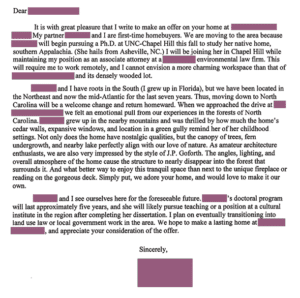
One way to get an edge over the competition is to write a personal letter and, if you’re comfortable, sharing a photo or recording a video letter to up the ante. Discussing your family, your love for the house and the neighborhood and your future plans for the space can help boost your offer in the eyes of the seller. Just note: some listing agents or sellers may not want to share letters and photos in case they are wary of potentially violating the Fair Housing Act!

by Kelly Nurge | May 31, 2016 | June 2016, Retreat, Stuff
Being a local of Raleigh is pretty rare these days. Residents are feeling the boom as housing inventory is low but interest is at an all-time high. With new businesses, restaurants, and breweries opening on a daily basis, we’re quickly filling in the 145 square miles our city encompasses. According to Wake County Government, an average of 63 people are migrating into the area every day, and an increasing number of people are buying their second, non-primary residence in Raleigh.
While some dream of a bungalow at the beach or a cabin in the mountains, more people are choosing the Raleigh area for their second home to be near family. Our newest neighbors are choosing to buy a home or townhome instead of sleeping on the old family pullout couch or staying in a pricey hotel for every visit.
Katie Joiner, a Gainesville, Florida resident, recently purchased a townhome in Wycombe Manor, off of Strickland Road, to be closer to family. Her family lives and works in North Raleigh so location was the most important factor in her buying decision.
“I wanted to live among my grandkids,” says Joiner, who shopped for nine months before finding the perfect part-time home. “I plan to spend about three weeks [in Raleigh] and ten days in Florida, depending on my son’s schedule.”
Frequent visitors may not feel the need to buy, but if it’s cost effective for you and your family to purchase a second home or an investment property in Raleigh, prices and interest rates are continuing to rise. It’s prime time to get in on the action.
Buying a second home?
Read this First!
1. BUDGET! After talking with your loan officer (and make sure to tell them if it’s an investment property), make sure to add up all of the monthly expenses for your new home. On top of your primary residence, factor in your second mortgage, taxes, insurance and utilities before buying another property that maxes out your monthly income.
2. LOCATION! What’s most important to you? Being as close to your family as possible or being in the hottest location for resale or rental value? A quick drive to the grandkids might seem ideal, but if it’s further away from your favorite parks and stores, you might want to consider focusing on your top priorities.
3. UPKEEP! If you’re not going to be visiting often or if you’ll be renting out the property through a vacation rental site, make sure someone local can check in and monitor regular maintenance. You don’t want to return to find the house in shambles and the lawn overgrown. Having a plan in place for upkeep will help reduce your stress upon arrival.