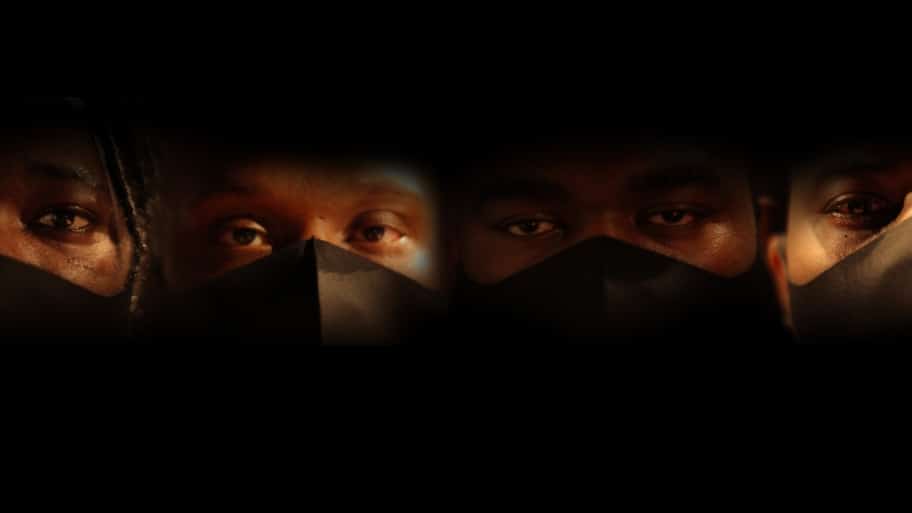
WEB EXCLUSIVE From August 10 through September 18, Raleigh Arts will showcase work from four Black artists—Clarence Heyward, JP Jermaine Powell, William Paul Thomas and Telvin Wallace—in a new exhibition titled Breathe: Life After Death in the Block Gallery located inside the Raleigh Municipal Building. The exhibition is an exploration of American life during and after the pandemic, the recent worldwide protests for justice and racial equality and how social distancing has affected each of the artists’ personal lives.
City of Raleigh curator Stacy Bloom-Rexrode says that after another artist cancelled a show at the Block Gallery, she reached out to Mike Williams of the Black on Black Project, who told her about the Breathe: Life After Death concept the four artists already had in the works. Bloom-Rexrode says that it was important for her to be able to offer the artists a place to showcase their work, as Black artists are often underrepresented in museums, galleries and other cultural institutions all over the country.
“I can’t claim to share their experiences but I can definitely help get their voices out there,” Bloom-Rexrode says. “Hopefully, the exhibition will start some much needed conversations.”
Artist Powell says that Breathe: Life After Death “exists as a source for creative, individualized problem solving during times of unrest and instability.” He says he hopes the collection will encourage authentic conversations, both during and after the COVID-19 crisis, and around the fight for social justice and racial equality. “The artworks featured in [the exhibition] serve as visual examples for the continued enrichment of the quality of relations of both Triangle individuals and local communities,” he adds.
“Same Old, Samo” by Clarence Heyward depicts a young Black girl holding artist Jean-Michel Basquiat’s painting “Defacement” which details the 1983 murder of Michael Stewart, a twenty-five-year-old art student who was killed by police.
JP Jermaine Powell’s portrait of Telvin Wallace
William Paul Thomas’ “Cyanosis” project is a metaphor for the disenfranchisement that people of color have experienced by way of white supremacist ideologies.
“Who Will Survive in America” by Telvin Wallace represents the struggles of a black man trying to have equal footing in an America that’s supposed to be equal for all.
Each of the four artists featured created three pieces for the show. Two of the works are personal reactions to, and interpretations of, the COVID-19 pandemic and the theme of racial inequality.
Wallace’s paintings are unfinished works in progress, tying back to the feelings of isolation he experienced while living alone during the pandemic and his creative struggles during such a tough time.
Meanwhile, Clarence’s work addresses the outcry over racial inequality following Geroge Floyd’s murder and how, even after so many decades, Black people and other people of color are still facing injustices such as police brutality.
Additionally, Heyward, Powell, Thomas and Wallace each painted a portrait of one of their fellow artists to reflect the ways they personally see one another and to speak to the topic of being seen, another important message of the exhibtion. “One of the themes that’s really prominent throughout this body of work is about Black men not being seen as a threat or vicious, but to be seen and recognized as fellow human beings,” Bloom-Rexrode says.
Bloom-Rexrode and the contributing artists say they hope that Breathe: Life After Death will encourage people to listen to the stories of injustice Black people are sharing and documenting, both within the exhibiton and across the globe, and spark conversations around change.
The Breathe: Life After Death exhibition will also be available to view online through Raleigh Arts’ website; keep an eye on the Instagram, Twitter and Facebook acounts for information about related virtual events.
The peaceful demonstrations for racial equity and justice and protests against police brutality over the past few weeks in Raleigh got us thinking about how we can build a better, more just, more equitable world. In times of crisis, it’s common to look to leaders, helpers, teachers and community builders who are best positioned to help guide the way. Three Raleighites share their thoughts about the work that lies ahead for us all.
Communicate and Educate
JoJo Polk
In this time, we need more educating. We need to allow ourselves to be vulnerable and be willing to share our own perspective. We need to communicate; I feel we are having a major breakdown in communication.
Under normal circumstances, I would ask how you’re doing, but I understand the response to that question has many layers considering everything happening in our country. I do hope that in this time, you are navigating through this crisis as best you can and are able to find moments of peace as you go throughout your days.
I think we are all forgetting one major thing: We control our own lives, our own thoughts. We decide how we view things, how we attack our days. We can’t let what is going on around us change the people we are. Is it easy? No. It is a test of character, a test of willpower and strength. Right now, the world is making us go back to basics. Find the passion and love we used to have in this world. When we were young, we took whatever came at us whether we knew better or not and we accepted challenges. Well, this is our biggest challenge. And we need to not only step up but be willing to accept we will not be able to do this alone. We have to work together on all of these issues, or we will fail.
We must understand that words are not enough. It takes people, resources and action to create the change we want to see, and, to help further efforts in bringing about lasting change, we need to find what it is we can do personally. Whether it’s volunteering virtually or in person; giving to a charity; talking with others. If you need to, start small: make changes within your immediate family. Reach out to your friends and family, to co-workers.
This is just one small step, but will give you something to strive for to bring people together.
We need your courage and resilience. You can use what you are good at to help in your community. I am the owner of a fitness studio. I work with people every day on their physical as well as mental health. When our business was shut down, we took everything virtual and continued to teach classes and tried to help our other local businesses with donation classes. I am also a Black man who has been a victim of police brutality. So I have stood up for justice and will continue to until we all understand that no man should lose his life for no reason. Ask yourself this: What will you do when no one else is around? When there is no coach. No boss. No audience. No set plan. That is when you find out who you truly are.
Mend Hearts, Change Minds
Nick Neptune
“There is a balm in Gilead To make the wounded whole; There is a balm in Gilead To heal the sin-sick soul. Sometimes I feel discouraged, And think my work’s in vain, But then the Holy Spirit Revives my soul again.” – African American Spiritual.
We’re all listening now. I must’ve started around age 5 – or whenever I began leaving the house; heading out for a friend’s, running off to a park or walking to school. My mother admonishing: “People will look at you a certain way … simply because of the color of your skin.”
I just wanted to go outside and play. She just wanted her first-born to come back alive.
George Floyd. Breonna Taylor. Ahmaud Arbery … I imagine their mothers wanted the same.
“Hey man. Just checking in. You doing OK?” This former pleasantry comes with unusual frequency now.
I’m grateful to be alive; to not have COVID-19; for the protesters.
I’m grateful for my family; my work.
I shared with friends recently, our politics, our systems, are a reflection of our society and our culture. Us. As we seek justice through better laws and policies, we must also seek to change and mend the hearts and minds of our nation’s people—if we are to achieve the truly equitable and enduring community we all seek.
This has been the nature of my work. Our work at Transfer Company.
Food brings us to the table—where it’s then our collective responsibility to transfer and exchange knowledge across our community. To inform, plan, organize … and mobilize.
With the constant pain and suffering in our world, we seek to heal the hearts of our people through the constant building and strengthening of our community and culture, through celebration around our music, art, food, drink and play.
If George, Breonna, Ahmaud, and the countless lives that have come before mattered … if my life matters … If Black lives matter … then may our work be not in vain and may we be revived again.
To march in protest. Dance in protest. Create in protest. Legislate in protest. Live in protest.
We all have a role to play. And we have a long way yet to go.
Step Back and Listen
Patrice C. Graham
This is a movement, not a moment.
For far too long, racism has been viewed as a segmented, nuanced and individual problem. In modern times (since the late 1960s) blatant and overt racism is no longer socially acceptable and now, no one wants to be labeled a racist.
Too often, racism is associated with overt/deliberate bias and this results in failing to examine implicit biases. Without the examination of our blind spots of implicit bias, we remain unaware of the ways we uphold white supremacy and remain complacent with systemic racism.
It is long overdue for us to collectively consider the systemic racism this country was built on and upholds daily. It’s not just a few bad apples in the police force, it’s a foundation and legacy of defining (and redefining) race and power in order to maintain the control and power of White folks to the detriment of Black, Indigenous, People of Color (BIPOC) and all other minority groups (women, LGBTQIA+, disabled, bigger-bodied, and others).
Every single system in this country was built on racism and continues to have racist policies. From redlining, to health disparities, to achievement gaps and discipline disparities in schools, to the new Jim Crow of mass incarceration of BIPOC, to a lack of diversity in leadership positions, the list goes on and on.
It’s time for us to take a step back and consider the ways in which racism affects every single part of this country.
No one is immune to the powerful system of white supremacy that built and sustains systemic racism. Much like at the beginning of the COVID-19 pandemic, in order to end systemic racism we must take steps to keep ourselves and others safe. We must all assume that we are racist and/or embody implicit bias, listen to experts and do our part to not spread racism; and we must be willing to adapt policies and social norms to prevent the spread and further harm.
So, what can we do?
We must be intentional and actively work to be anti-racist. We begin by examining our own implicit biases and where they come from.
We can educate ourselves and unlearn and relearn the foundation of this country and about the experiences of BIPOC.
Reeducation efforts may include attending an equity training, such as the Phase 1 training offered by Racial Equity Institute.
We can listen to the voices and stories of people of color.
We can take the time to notice what voices are being amplified and invited to engage. Who is represented (and who is not) in your community, at work, at events, in leadership, in government?
There is no quick fix. Just as it took hundreds of years and thousands of policies to create this racist system, it will take a great deal of work and dedication to undo this complicated and entangled racist web.
WEB EXCLUSIVE With the recent protests against racial inequality, injustice and police brutality across the country, it’s more important than ever to educate ourselves on the Black Lives Matter movement and to listen to black residents and people of color in our community who are speaking out.
“What to Do: Replying to Racism” Flyer
In an effort to project these voices, Raleigh native Marshall Sandman has launched “What to Do: Replying to Racism,” a week of informative interviews with activists, startup owners, athletes, actors and more on his Instagram page. Sandman’s interviewees share their perspectives on the Black Lives Matter movement, the recent protests and related donation and educational resources.
Sandman previously hosted “Spilling the Quarantea,” a series interviewing chefs, actors, influencers, comedians, startup founders and other prominent people in Raleigh and beyond on how they optimized their time in quarantine. Following the country-wide protests, Sandman paused the series and launched “What to Do: Replying to Racism” in its place in order to gain insight on how we arrived at this moment in history and what we can do to move forward.
“While there is a lot of valuable information out there about ways to contribute and educate, my goal is to provide a number of options, make them digestible and help everyone who wants to be actively anti-racist take steps towards doing so,” Sandman said. “Through ‘What to Do: Responding to Racism,’ I’m hoping to listen, learn and advance the racial justice conversation as much as possible.”
Sandman’s “What to Do: Responding to Racism” will also raise funds for the NAACP Legal Defense and Educational Fund, America’s premier legal organization fighting for racial justice. Find the link to donate here or on his Instagram profile.
“What to Do: Responding to Racism” will take place from June 5 to June 12 with the following schedule:
Friday, June 5: Dara Brown, a Cornell-educated lawyer, domestic violence activist and model
Monday, June 8: Jordan Johnson-Hinds, actor and star of Amazon’s “Upload” and USA Network’s “Suits”
Tuesday, June 9: Shelden Williams, former NBA and Duke basketball star and host of the podcast, “The Lease is Up”
Wednesday, June 10: Sherif Fouad, an Egyptian-born activist, CEO of Raleigh Raw and founder of Raw U, a community driven educational and spiritual program that challenges members to dig deep past cultural conditioning