Sky-high living doesn’t have to come with a sky-high price—at least not in Raleigh.
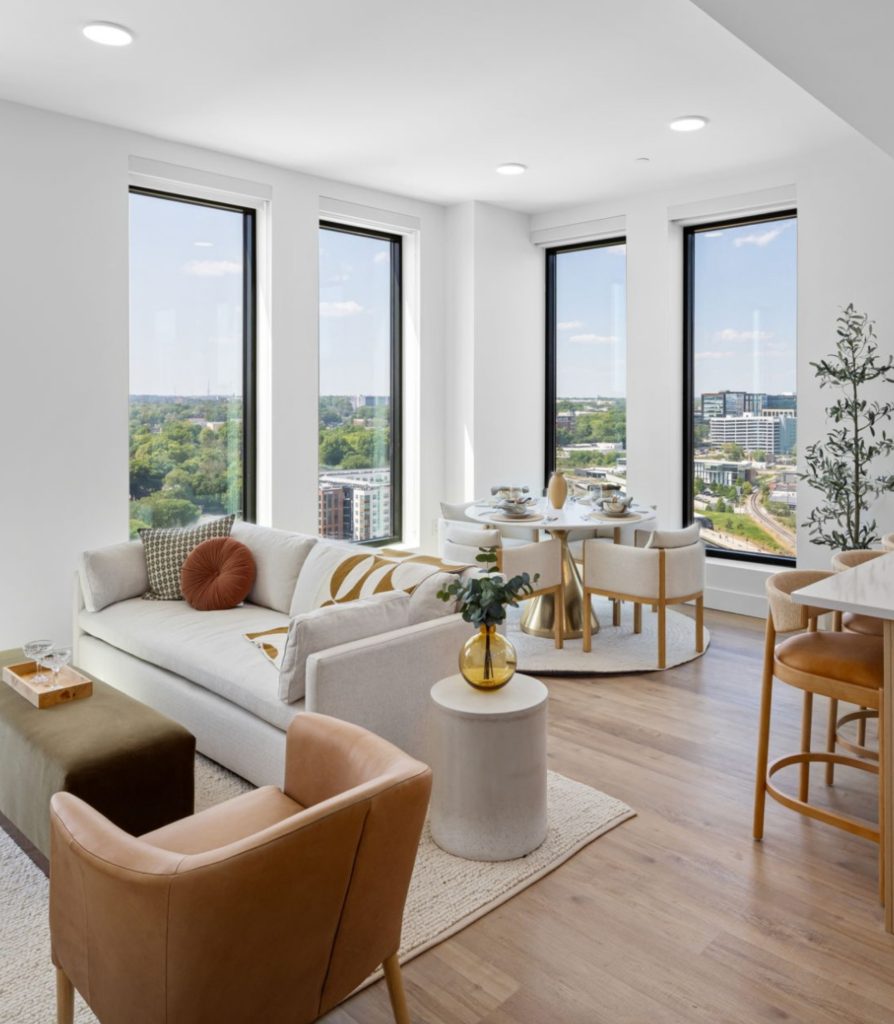
Floor-to-ceiling windows, superior skyline views, rooftop pools—in most major cities, that kind of high-rise lifestyle comes with a jaw-dropping price tag. But in Raleigh, that’s not the case. Living in the sky is less of a luxury reserved for a select few and more an attainable way of life for the average resident.
That’s a relatively new phenomenon. Until recently, vertical living barely existed here. Residential towers with views for days and luxe amenities running the gamut from boutique workout studios to spa rooms and outdoor amenity decks were a pipe dream that felt more like a big-city fantasy than a Raleigh reality.
But as the city’s modern growth spurt took hold and high-rise apartments started coming online, that began to change.
Maeve’s 2025 debut raised the bar on high-end, high-rise luxury living, delivering 297 mod units across 20 stories at the corner of Dawson and Lenoir streets—plus unbeatable views of Red Hat Amphitheater.
A quick rewind, vertical living first sprouted with Skyhouse in 2016, ushering in a new era of residential towers. Since then, Raleigh has added a growing roster of high-rise options, from North Hills’ The Eastern to Downtown’s Maeve, 400H and, the latest, The Weld—with more already in progress (see: Kane Realty Corporation’s The Strand, also in North Hills)—all affording panoramic vistas and elevated amenities sans an exorbitant price tag.
“The Eastern was the first of its kind in Raleigh, which naturally generated significant interest,” recalls Kane Realty Senior Residential Property Manager Michael Hester. “Local residents were curious about living in the city’s tallest residential tower, while out-of-state prospects from cities like New York, Chicago or LA immediately recognized the value. Compared to those markets, residents here can embrace a high-rise lifestyle with premium details and amenities at a more competitive price point.”
Now, prepped to take Raleigh to the next level—literally—is Highline Glenwood, set to become the city’s tallest residential tower at 37 stories when it bows in 2028. Part of developer Turnbridge Equities’ The Creamery redevelopment, the project will serve up a modern-meets-historic centerpiece sure to transform the city’s landscape.
“Highline will redefine the Downtown skyline for generations to come,” says Turnbridge Equities Managing Director Jason Davis. “From the upper floors, residents will enjoy sweeping, unobstructed views across the urban core, beyond North Hills and toward the rolling landscapes leading to Durham. For those who prioritize views and a true vertical living experience, the project offers an unmatched perspective.”
That influx of new supply—paired with Raleigh’s still relatively reasonable cost of living—has helped keep high-rise rents more accessible relative to many peer cities.
Reigniting a once-sleepy pocket of Downtown where West and Hillsborough streets intersect, 400H offers residences primo city views, plus a 10K-square-foot indoor/outdoor Skyhub.
“New supply that has come into the market has helped moderate rent spikes, keeping it relatively balanced,” affirms Josh Dix, principal at Trammell Crow Company’s MidAtlantic office—and a 20-plus-year vet of the large-scale development sector—which is behind such local projects as 400H. “Raleigh is still an incredibly affordable rent prospect.”
Stacked against other major metros, the difference is stark. In places like New York City or Chicago, high-end one-bedrooms can easily run you upward of $6,000+ a month. In Raleigh, many comparable one-beds are sub-$2K—even in newer amenity-rich builds, with some exceptions. And compared with peer cities like Nashville, Austin and Charlotte—where vertical one-bed rents exceed $3K/month—Raleigh often still comes in lower.
“We’re fortunate to have a lower land basis, more available development sites and less restrictive zoning in our key areas,” adds Dix. “That allows developers to deliver mid- to high-density products at a lower all-in cost, which ultimately translates to more accessible rents.”
Case in point, Dix says Raleigh’s high-rise rents generally remain below Charlotte’s on a per-square-foot basis, meaning residents here are often paying less for a comparable product—not settling for an inferior one. “You’re not getting a lesser product,” he stresses. “You’re getting a similar-quality product with a discount, which is what makes it more special.”
Raleigh’s ability to grow outward has also helped rein in some of the pricing pressure seen in more land-constrained cities, notes Dix. Unlike cities built around a single dense urban core, the Cap City has had room to sprawl—something reflected in the rise of mixed-use hubs, restaurants and residential growth beyond city limits. That flexibility, combined with a healthy wave of new supply and more measured job growth than some peer markets, has helped prevent rents from escalating as quickly here.
“Raleigh continues to attract a significant number of new residents, with more than half coming from markets like New York, Boston, DC and California—places where high-rise living is far more common, but comes at a much higher cost,” says Davis. “In many cases, comparable urban living can be two to three times more expensive than Raleigh’s top-tier apartments.”
That said, Dix warns the gap is narrowing. Construction costs are rising, prime development sites—especially Downtown—are limited, and more newcomers from high-cost cities are arriving with expectations for an urban, amenity-rich lifestyle, putting pressure on high-rise living. Even so, he says Raleigh remains far from the pricing and density of places like Atlanta or Austin, and “it would take a lot—and a long time—for us to get to the point where we’re comparing ourselves to them.”
For now, that leaves Raleigh in a rare sweet spot: amenity-rich, high-end, high-rise living with rents that still feel relatively accessible—and that undercut many larger and higher-priced peer cities. In a market where luxury increasingly comes at a premium, that’s no small thing.
The Condo Conversation
One Nash Square | Rendering by Morris Adjmi Architects / Bloomimages
While most major metros offer a mix of condos and rentals within the high-rise market, Raleigh’s condo inventory remains limited—made up of just a handful of buildings like The West and The Residences at Quorum Center. In 2025, New York-based developer Alchemy Properties South promised One Nash Square, DTR’s first new condo building in years—a pivot from originally planned apartments—though the project has still yet to break ground.
That’s due in part to NC’s condo laws. While they don’t outright prohibit condo development, the legal structure, financing requirements and liability exposure make condos a higher-risk, slower-return product than apartments—deterring developers from building them.
To put it plainly, Raleigh’s not yet accustomed to vertical ownership, stresses Dix. While condo culture is well established in bigger markets, local buyers still tend to favor single-family homes or townhouses.
“The only way for this to change is for developers to actually produce condos, and the only way for developers to produce condos is to have predictable sales and exit strategies,” says Dix—“and that doesn’t really exist as well in the condo market as it does within the rental market.”
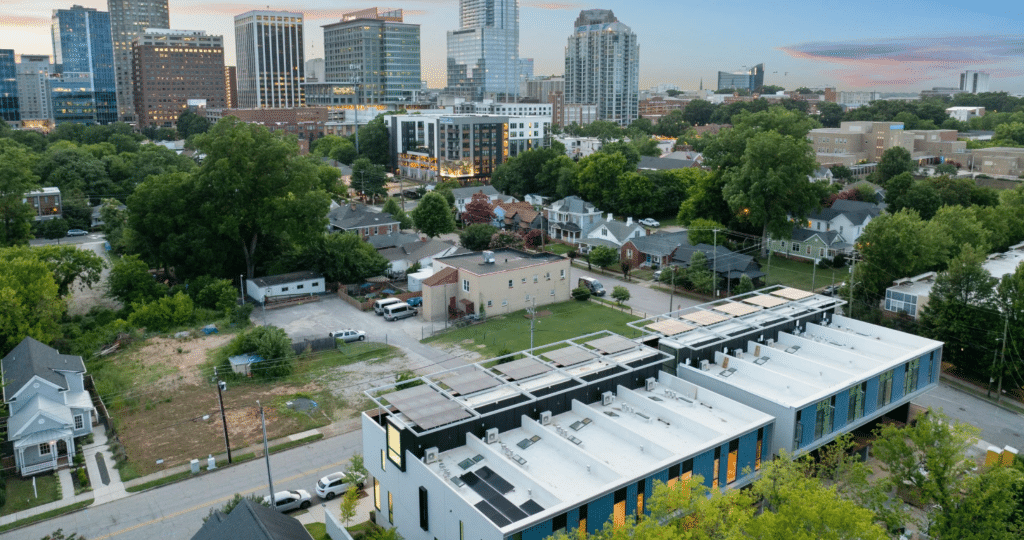
Shaking up Raleigh’s housing market in a green way is IDYLE, the city’s first net-zero energy-ready townhomes. Recently splashing on the scene on South Bloodworth Street just steps from Transfer Co. Food Hall, the collection of 10 mod three-story, three- to four-bedroom dwellings comes tricked out with eco-perks like solar panels, a Tesla Powerwall, EV-car hookups and a home-monitoring system to track energy performance.
“It’s a groundbreaking project for Raleigh,” says Johnny Chappell of real estate firm Chappell and developer DevPointe. “This was a chance for us to do something that felt like it fit well in the Downtown fabric, but also something that stood out and offered something different for people who are looking to live, work and play in DTR.”
The concept first sparked in 2021 with a mission to increase density, expand affordable housing options beyond larger single-family homes and build sustainably so as to “be good stewards of the planet we all live on,” adds Chappell. Bonus: The primo location means max solar exposure—and positions the Downtown core in the front yard.
Courtesy of Chappell
Fully passive-powered, the homes are capable of generating more energy than they use to earn a Home Energy Rating System (HERS) score of zero—aka max energy efficiency—when upgraded to a full package of 32 solar panels. Translation: Homeowners can all but erase their monthly utility expenses while cashing in on major tax incentives.
Still, green doesn’t mean giving up luxe. Think chef’s kitchens with custom cabinets by local pros, quartz countertops, high-end electric appliances, and walls of windows framing views of skyline vistas. Rooftop terraces pull double duty, pairing solar panels that both power the homes and shade the space for optimal lounging and entertaining.
The result plays right into IDYLE’s calling card: boundary-pushing sleek, smart, sustainable living that’s anything but cookie-cutter. “We’ve had a very positive response, not only from homebuyers, but from those interested in something truly original,” emphasizes Chappell. “Anytime we get to do something outside the box or that pushes our creativity, it’s good for our team—and for the Raleigh market.” Call it a blueprint proving that, in Raleigh, sustainability and style aren’t mutually exclusive—they’re the new standard.
How three locals navigate living and working car-free
If you thought you couldn’t get away with living in Raleigh car-free, think again. Even in the ’90s, a dedicated Quail Hollow professional faithfully took the CAT bus to and from his DTR Progress Energy post for a solid decade. But that dedication to a wheels-free low-footprint life is definitely rare for North Raleighites—especially in the 1900s—and easily the exception.
As a large central city, Raleigh takes the wheel as the most car-dependent major metro in the U.S. with 38 vehicle miles traveled (VMT) daily—and a walk score dipping as low as 18 in some burbs and averaging 31 in the city. The city is so reliant on cars that parking is at a premium and road construction is ongoing—or planned—for most major streets. While it may not yet be possible to change the tide citywide, it’s rolling differently Downtown.
Despite Raleigh’s carcentric sprawl, Downtown core’s respective walk, bike and transit scores of 82, 88 and 71 are perhaps a sign the city is evolving. And thanks to major strides in bikeability and Bus Rapid Transit—not to mention the influx of e-scooters and e-bikes—it’s keeping pace with cities like NYC and San Fran.
In fact, several residents have ditched their cars—saving time, money and a whole lot of stress in the process. We chatted with three locals living the “urban life” in Raleigh.
Intentional Living When local Ashton Mae Smith’s auto lease ended in 2019, it was a no-brainer not to renew. Having spent the last decade living within walking distance of her DTR office, she’s been in a one-car household with her husband and toddler ever since, spending the last six years walking, biking, scooting, bussing and ridesharing.
“I’m very intentional about choosing my doctors, exercise, son’s daycare and hobbies to be within walking distance,” says Smith, who adds she didn’t drive that much even before getting rid of her car. “That’s my preferred way to get around.”
After tracking her expenses over the years, she’s pocketed $5K a year just by skipping car ownership—savings that are reflected in her mental health as well. “Not having to think about a car is incredible,” she emphasizes. “There’s a lot of thinking about parking and is it gonna be safe and if you have something to drink do you leave it there overnight… all these things.”
Her toddler’s a fan too: “Half the adventure is riding the bus,” she says. It helps that kids ride free, tap-to-pay is seamless and their high-frequency line runs every 15 minutes.
Carless Confidence “It’s really not as hard as people think,” maintains Fayetteville Street resident Meg Crawford of her carless lifestyle. She ditched her car in San Francisco, and four-ish years after moving back to Raleigh, she’s still living that key-free life—thanks to remote work and easy access. “What’s great about Downtown,” she adds, “is it’s compact enough where you really have everything you need in a quick, easily walkable diameter. And public transportation obviously plays a role in that.”
Tapping into the tools at her fingertips, when walking won’t cut it, Crawford opts for her old triathlon bike, rideshare or even Turo—aka Airbnb for cars—which she’ll use for a jaunt to the beach or mountains. For her, the upside’s huge: She saves ~$1K a month while hitting up DTR events, cafes and restaurants on the regular—minus the hassle of traffic and parking headaches. To boot, she credits the walkable lifestyle with boosting her social life. “For me, it’s just pluses across the board,” she says. “I’m not sure I’ll ever fully own a vehicle again.”
Life Simplified For Raleigh Chamber VP of Leadership Development Shana Overdorf, the draw of DTR was about the strong community she expected to find. “But coming back Downtown meant sacrifice,” she admits—“and so when weighing my budget, the car was the first thing that could go.”
After making the move to Mira Raleigh in August 2024, she hung up her keys in January—a move she calls “freeing” and relatively easy, given her quick 471-step walk to work. While walking is her main mode, Overdorf taps into Raleigh’s full menu of options: scooters (her apartment has a few on hand), e-bikes, rideshares, carpools, the train—she’s even lined up for Raleigh’s E-Bike Rebate Program.
“I think the accessibility to different modes of transportation here—we’re really, very lucky,” emphasizes Overdorf. “It’s not that hard to figure out ways to have access to transit and transportation—but they’re also just easy to get to.” Doubling down on the community vibe, the Chamber VP reinvests her car-free savings by stacking up steps to faves like Sir Walter Coffee, The Bend, lucettegrace and A Place at the Table.
Walk Wins It’s all a sign of a city upping its urban appeal. While a current Village District dweller tells us she barely touches her keys more than once a week, another remembers feeling totally carbound just a decade ago.
Of course, it’s “not all rainbows and butterflies,” admits Crawford. Getting caught in the rain a mile walk from a destination is less than ideal, and it can take a lot of planning to get somewhere sans car. “There are definitely times where I’d really love to just jump in my car and do something that has arisen out of the blue very quickly,” she adds, “but there’s never so much of a hindrance that I can’t accomplish what I need to. The benefits definitely outweigh the negatives.”
New DTR apartment building to bow this year raises the bar on luxury living.
Over two years ago we spotlighted The Eastern’s primo penthouse, then priced at a whopping $14K/month, and asked if it was a sign that Raleigh had officially “made it” into the big leagues—or if we had simply lost our minds.
Well, an answer has emerged. Clearly, Raleigh is ready, evidenced by such additional properties as 400H and Mira. And, now, adding to the ever-growing roster is the mid-April delivery of Maeve, one of the first apartment buildings to bow in DTR this year, and Capital Square’s first residential development in the City of Oaks.
Leveling up local “luxury” once again, the upscale 20-story high-rise unfurls 297 modern-meets-natural units across studio; one-, two-, three-bedroom; and penthouse options, primely positioned at a busy thoroughfare on the corner of West Lenoir Street and U.S. 401.
Rendering by LCP Media
Rendering by Steelblue
Rendering by LCP Media
“Raleigh was and still is a market we have a lot of confidence in,” says Capital Square Executive Vice President and Co‑Head of Development Natalie Mason. “There’s such tremendous things going on in the region.”
Originally envisioned as a four- to five-story project, plans were shifted by the Richmond-based firm to meet market demand and “do [something] special in this building compared with what renters either moving to Raleigh or already in Raleigh can’t get anywhere else,” adds Mason.
To wit, the height increase made way for an array of possibilities when it comes to amenities, which are perhaps Maeve’s most prominent selling points. Take, for one, the rooftop lounge overlooking Red Hat Amphitheater that at once feels like a peaceful retreat and a refined escape—also boasting impeccable panoramic views of Downtown. Or step out onto the large outdoor pool deck and you’ll immediately be transported to what feels like a five-star resort, complete with grill stations, an outdoor dining lounge, a firepit and a 64-foot zero-edge pool that you can actually do laps in.
Rendering by Steelblue
For the fairway fanatics, there’s also a state-of-the-art golf simulator equivalent to what you might find at a full-fledged brick-and-mortar, a well-equipped 24-hour fitness club for the workout warriors—and for the pet parents, finally a space that meets you where you are via a pet spa for giving Sarah Jessica Barker the primo pampering she deserves.
The luxurious yet comforting ideals are echoed in Maeve’s sophisticated floor plans—outfitted to the nines with Architectural Digest-esquefeatures—from opulent quartz countertops and floor-to-ceiling windows to stellar DTR views and large balconies providing next-level alfresco living in the sky, plus the penthouses’ direct access to the rooftop lounge.
“We’re delivering something unique,” emphasizes Mason of Maeve’s never-before-seen-in-Raleigh level of grandeur. “We always feel like you need to have a variety of housing offerings for the spectrum of renters—and we definitely feel Raleigh is ready for a product like this.” maeveraleigh.com
A city dweller’s dream, meet highly anticipated Mira, the first luxury living space to bow near Dorothea Dix Park. Nodding to the Latin “mirabilis,“ the brand-new building boasts a new kind of “wonderful” that continues to level-up DTR living across its 288 units serving up unparalleled stellar views. At once sleek and charming, Mira features studio, one and two-bedroom apartments elegantly appointed with smart home elements and premium finishes. And not to be overlooked are the impressive amenities—think a cozy co-working space, lush courtyard pool, lavish sky lounge speakeasy complete with a bar (!), community kegerator and even a sports lounge with a multisport simulator. It’s peak living, indeed. miraraleigh.com