


River Runners

River Runners

WRAL’s Elizabeth Gardner’s dream of having a whitewater park in Raleigh may soon come true.

If WRAL meteorologist and avid whitewater kayaker Elizabeth Gardner has her way, Raleigh City Council will move forward on a transformative 80-acre park with whitewater features as early as this summer. Despite the 20-year quest, Gardner finally sees the light at the end of the tunnel—the project was included in the Raleigh Parks Bond approved last November and could paddle on the scene and be complete in as little as five years. 

Gardner first dreamt up the idea in 2001 when visiting Clear Creek Whitewater Park in Golden, Colorado (a suburb of Denver), with her husband. “We were like, ‘Wow, this is the coolest thing ever. We must have one here!’” As soon as she returned to Raleigh, she started asking questions about how to make a whitewater park a reality. … But it proved to be not such an easy feat (see the full timeline to the right).

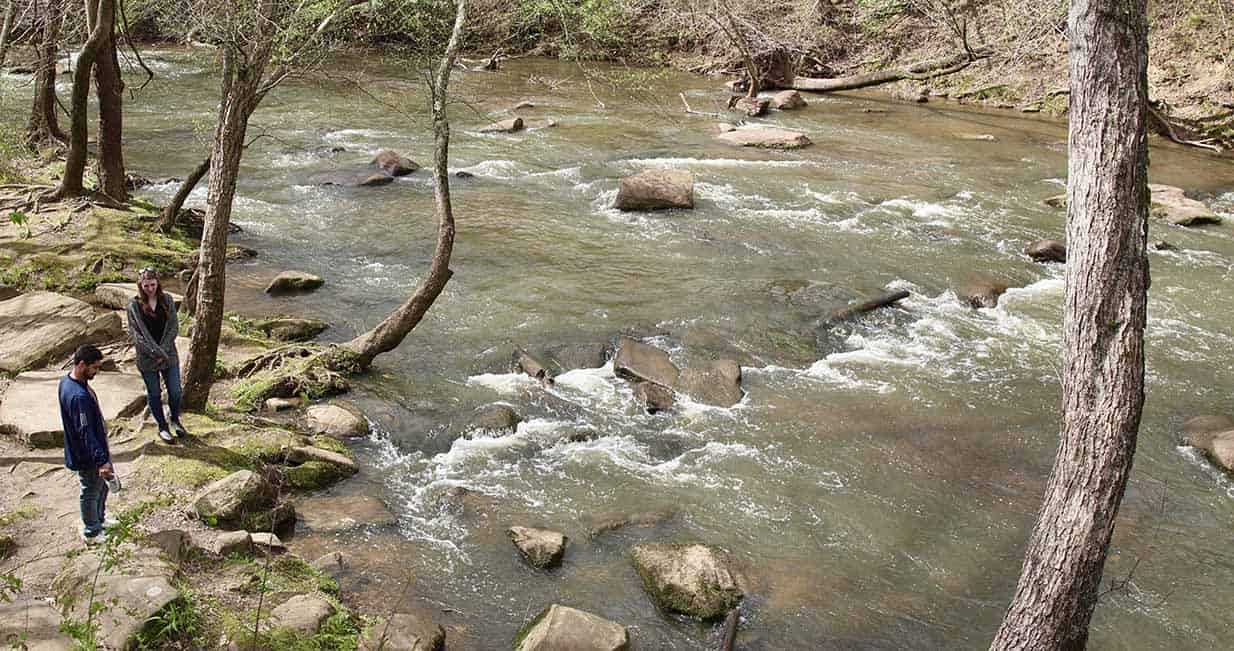
Naturally, the Neuse River—specifically the portion near Falls Lake Dam—proved to be the perfect place for the park, dubbed Neuse River Park. While kayakers, tubers and the like can utilize that part of the river as it is now, the problem is with access, Gardner maintains. Due to erosion from the different flows of water released from the dam, there’s currently a lack of access points to load into the river. 


A Deep Dive Into History: In 1978, the Army Corps of Engineers, who are responsible for building most of the dams in the country, and Wake County got together and drew up a plan for a whitewater park in Raleigh—which would’ve been only the second in the world. “Nobody’s around that knows why they didn’t build it,” says Gardner. “It was going to be paid for by the Army Corps.”
In 1998, if Raleigh had gotten the bid for the Pan American Games, the Neuse River would’ve been outfitted for the whitewater competition.

This project would change that, creating at least two access points for kayakers to get in and out of the water and surf through three different rapids. (Fun fact: According to Gardner, the City of Raleigh is also working on a blueway—think a greenway but for water—and in order to get the distinction there must be a certain number of accesses along the river.)

The main priority, Gardner emphasizes, is to get people into the river. With the Neuse being so far from Downtown, at times it doesn’t feel like Raleigh even has a river, but it does. And, soon, it’ll attract residents and visitors of all ages, interests and backgrounds. And not just kayakers.

Previously nicknamed Falls Whitewater Park, they ultimately went with Neuse River Park—as Gardner realized as she was visiting parks across the country —“yeah, there were some whitewater kayakers—but there were a lot more people who were tubing, boogie boarding, swimming and just hanging out on the rocks having a picnic,” she says. “So we decided we would take ‘whitewater’ out of the name because it’s really going to be more like an old-fashioned swimming hole.” 

In addition to the river features, the project will also encompass an 80-acre park. What will go there will depend on the master plan—and public input—but she foresees anything from ziplines and ropes courses to an amphitheater to a brewpub overlooking the water. Add to that the greenway trail that already flows alongside the river and connects to the Mountains-to-Sea Trail, nearby Forest Ridge Park and Wilkerson Nature Preserve, and you have an “incredible adventure destination,” as Gardner calls it.

Between the master plan, permitting and construction, it could still be about four years before Neuse River Park comes to fruition. “I think if we had it built in five years, I’d be ecstatic,” says Gardner. But it looks to be promising, and with all the park has to offer, it would be a big win for the city. Case in point: Clear Creek Whitewater Park claims $2 million a year in economic impact. 

“The point of this park is that everybody can use it,” Gardner emphasizes—from swimmers and fishermen to boogie boarders and tubers to picnickers to those simply walking or riding by on the greenway looking to cool down on a hot day. Think of it like a free outdoor playground for both kids and adults—a place where residents and visitors alike can realign with nature and escape from the city for a while. And that, we’d argue, is something definitely worth pursuing. 

20-Year Timeline For The Park

  • 2003: Gardner put together a committee and had a company provide a preliminary drawing and cost estimate for the park. The project received funding from the Parks Bond and interlocal fund. The city ultimately decided there wasn’t enough money to build the park.
  • 2012: $150K from the funds is used for a feasibility study. The project was approved by City Council, but not funded.
  • 2019: Raleigh started organizing another Parks Bond. The Parks Advisory Board loved the project and initially put it at the top of the list. 
  • 2020: The pandemic halted the project once again.
  • 2022: Another Parks Bond passes, and Neuse River Park ends up on the list of parks that would be funded by the bond, with $11 million dedicated to the project.
  • 2023: This summer, City Council will decide which projects will be built with the first round of funding.

Bonds on the Ballot

Bonds on the Ballot

Breaking down the three bonds: what they are, what they will do and what they will cost

This year, when you go to the polls, you’ll find three bonds on the ballot—the most ever Raleighites have been asked to vote on at one time. What’s at stake? The future of parks (Raleigh Parks Bond Referendum), the future of schools (Wake County Public School Bond) and the expansion of Wake Tech Community College (Wake Tech Workforce Forward Bond). Worth noting, Raleigh voters haven’t voted down a bond in over 20 years. 

Not all citizens realize that bonds aren’t about just shifting city money from pot A to pot B. Instead, there is a direct tax impact on taxpayers. To get us all up to speed—as a quick refresh or a sort of “bonds recap”—bonds are the cheapest way for a city or county to raise money and build infrastructure. For example, this year’s Parks Bond means $275 million for city parks—and  equates to about a 4-cent tax increase to Raleigh homeowners, explains City of Raleigh Parks, Recreation and Cultural Resources Department Director Stephen C. Bentley. Translation: Raleigh homeowners with a January 2021 median tax value of $256,578 would see an estimated tax impact of approximately $103 annually. 

So as inflation soars and with so much at stake in a city seeing seismic growth, we take a look at the three bonds on this year’s ballot and break down their potential impact against cost to Raleigh taxpayers. And as you cast your vote this Nov. 8—bonds or not—remember who you vote for determines how our tax dollars are spent.

Raleigh Parks Bond Referendum | $275 million

Elevator Pitch

The bond referendum is an investment in Raleigh’s overall quality of life and community health, including our environmental, social, physical and mental health, as the pandemic has clearly demonstrated the essential value of our parks and recreation opportunities. This bond also provides equitable investments in new park construction and renovations across Raleigh to meet the changing needs in our greater community.

Tax Value

4-cent tax increase to Raleigh homeowners—estimated tax impact on median tax value home ($256,578 in January 2021) is approximately $103 annually.

Projects Included

District A

  • Big Branch Greenway Connector
  • Green Road Park improvements
  • Mine Creek Greenway improvements
  • Sertoma Art Center improvements

District B

  • Kyle Drive master plan and implementation
  • Neuse River Park

District C

  • Biltmore Hills Tennis improvements
  • John Chavis Historic Park Phase 2 (Aquatic Center and Heritage Plaza)
  • South Park Heritage Walk and Top Greene Center improvements
  • Tarboro Community Center

District B&C

  • Marsh Creek Greenway feasibility and
  • preliminary design

District C&D

  • Walnut Creek Greenway improvements

District D

  • Devereux Meadows implementation
  • Dix Park: Play plaza, buildings and operations upfit + Phase 2 design
  • Lake Wheeler Road and multiuse path improvements
  • Method Community Center improvements

District E

  • Erinsbrook Park implementation
  • Lake Lynn Trail Loop improvements
  • Strickland and Leesville road park improvements

Wake County Public School System Bond | $530.7 Million

Elevator Pitch

The bond would go toward 2024–25 WCPSS capital needs, including funds for five new schools and renovations of seven existing schools.

Tax Value

To fund, the county would add 1 cent to property tax, or $10 for every $100,000 of assessed value. Per the County, beginning in the 2024 fiscal year, a Wake County homeowner with an average assessed home value of $337,000 would see an additional $33.70 on their annual property tax bill.

Schools Included 

New Schools

  • Pleasant Plains Elementary School (Apex)
  • Bowling Road Elementary School (Fuquay-Varina)
  • Wendell Elementary School (Wendell)
  • Parkside Middle School (Morrisville)
  • Unidentified high school (West Cary and Morrisville)

Replacement Schools

  • Lockhart Elementary School (Knightdale)
  • Brentwood Elementary School (Raleigh)
  • Briarcliff Elementary School (Cary)
  • Washington Elementary School (Raleigh)
  • North Garner Middle School (Garner)
  • Ligon Middle School (Raleigh)
  • Athen Drive High School (Raleigh)

Wake Tech Workforce Forward Bond | $353.2 million

Elevator Pitch

The Wake Tech Bond would allocate money to Wake Tech Community College new buildings and repairs. A national study by Georgetown University’s Center for Education and the Workplace ranks Wake Tech in the top 20% of all colleges and universities in the nation, and the top 10% in North Carolina for student ROI 10 years after graduation. Investments in Wake Tech help provide job opportunities; create the skilled workforce a growing economy requires; and deliver a proven return on investment for students and the whole community. Independent studies indicate that Wake Tech generates more than $1 billion annually for our local economy, with each dollar invested in Wake Tech generating more than $7 in added income and social savings.

Tax Value

As with the WCPSS bond, to fund, the county would add 1 cent to property tax, or $10 for every $100,000 of assessed value.

Projects InCluded

  • Perry Health Sciences Campus expansion
  • Permanent Western Wake Campus
  • New Cyber Science facility on RTP Campus 
  • Investments on infrastructure