Raleigh locals aren’t ready to see Logan’s Garden Shop go.
Before Logan’s was the beloved family-owned garden shop biz it is today, it served as the historic Bagwell Seaboard Railroad Station—nee 1942—a central location in Downtown Raleigh that allowed both Raleighites and visitors alike to gather and connect. Logan’s has occupied the building since 1991, becoming just as much a part of Raleigh’s vibrant history as the railroad station. Now, however, as many Raleigh residents are certainly aware, the Logan’s building is currently being redeveloped by New York-based real estate investment and development firm Turnbridge Equities (who also purchased The Creamery building on Glenwood South) into a multimillion-dollar mixed-use project featuring retail, apartments and a parking deck.
While plans have already been released for the Seaboard Station revamp, some locals aren’t ready to let go of the Logan’s building just yet—which Turnbridge Equities plans to replace with a parking garage to serve two 20-story towers (and in order to build the towers, Turnbridge must rezone the property). To that end, the Oakwood neighborhood sent a letter to Raleigh City Council in March urging them not to grant the rezoning unless it includes the preservation of the train station, as it’s a historic landmark that “informs us about our past and makes our city an interesting place for both residents and visitors.”
Matthew Brown—a historian, former commissioner at the Raleigh Historic Development Commission and past president of the Society for the Preservation of Historic Oakwood—sides with the Oakwood residents. “[The building] can be used in a variety of ways,” says Brown. “Lots of cities—their train stations are repurposed. [In Raleigh], it’s repurposed now as a retail business and a cafe.”
Michelle Bowers
Enter Old House Life’s Michelle Bowers. In an effort to save this important part of Seaboard Station—and Raleigh history in general—Brown recruited the Cary native, who now resides in Virginia and runs Old House Life’s Instagram/Facebook accounts, on which she posts photos and videos of old buildings, abandoned houses, etc. in the hopes that her 120K/701K followers, respectively, will purchase, preserve and/or restore them. “She reaches a lot of people, and she has a lot of energy,” says Brown.
Both Brown and Bowers picture the Logan’s building being preserved as a sort of common area, cafe, restaurant, bar or retail business(es)—even Seaboard Cafe could be maintained. To help save the building, Bowers plans to post about it on her social media accounts and ask her followers to email City Council members in the hopes “they can put a stop to it… or at least rezone where they have to keep the structure and utilize it in some way,” says Bowers. “It would give it a lot more character.”
Adds Brown, “It’s just a lack of imagination on [the developers’] part that they can just tear it all down and build these generic towers and a generic parking deck.” But, while Brown thinks the city will grant Turnbridge Equities the rezoning (which they’ll make a profit on, as the property is currently only zoned for seven stories), he’s unsure if City Council will grant it on the condition of preserving the train station, and it’s not yet on the council’s agenda—but hopefully it will be in May.
“It seems that that’s a very small return favor to insist that [City Council] preserve the train station,” says Brown, “which is an important part of our history and a beautiful piece of architecture—which we are sadly lacking in Raleigh.” And it would be a shame to see such a significant Raleigh landmark go away…
David Meeker is on a mission to preserve Raleigh’s character and culture—one project at a time.
The No. 1 fear you hear from locals? Raleigh losing its identity… morphing into a built-up blueprint of dotted skyscrapers with no forethought of connectivity or personality. Just a concrete and glass jungle where our humble but thriving tree-dotted small city built on Southern charm and a ton of history is but a memory.
Our warp-speed growth—and skyline, with new developments and tower rezoning requests announced on the daily—only serves to simultaneously accelerate our fair city’s cosmopolitan feel and people’s anxiety over losing our traditional culture. But one Raleigh investor is determined to preserve the places and spaces that make Raleigh, well, Raleigh.
Likewise fearing Raleigh is on the fast-track to becoming another Charlotte, Raleigh native and Carpenter Development managing partner David Meeker’s MO has been to keep the character of the City of Oaks with adaptive reuse projects, and he is now branching into new construction with a focus on sustainability via a handful of current projects.
A true investor in his home city, Meeker’s newest endeavors will take his mission of maintaining Raleigh’s personality even further. “We need the density because, without it, we couldn’t have the smaller spots,” he says.
Case in point, SoHi—a two-story, 25,000-square-foot, four-building development featuring retail, a restaurant and a yoga studio, with top-floor offices and coworking spaces to boot.
First announced in 2019 for an otherwise underdeveloped area just a mile south of Downtown on South Wilmington Street, SoHi (dubbed for its location south of I-40) will be one of the greenest developments in Raleigh. Think solar panels on every roof, water cisterns for every building—NTM more bike racks than parking spots (!).
“We are all personally into sustainability and stopping climate change, so it just made sense for us to do as green a development as we can afford to do,” says Meeker. “Hopefully we will have a lot of success with it and others will do the same.”
Projected for 2024 and anticipated to be one of the area’s first new spots, SoHi, Meeker hopes, will revitalize the area. “South Wilmington Street is the old southern entrance to Downtown Raleigh before South Saunders got the I-40 exit,” he says. “SoHi will hopefully bring back life to South Wilmington Street.”
Focusing his efforts elsewhere in Downtown, Meeker, who is also a partner in super-popular Trophy Brewing Co., is arguably positioned to define the future—while preserving the past—of Morgan Street.
In 2020, when now-former owner Arthur Gordon looked to sell Irregardless Cafe—one of Raleigh’s longest-running and most-popular Downtown restaurants—to someone who wouldn’t change it much, he sold it to Lee Robinson and Meeker, who grew up dining there.
Meeker recognizes the growing energy of Morgan Street and how it’s getting built up to become part of Downtown—thanks in large part, he says, to Bloc[83] and The Black Dollar Corp. CEO Johnny Hackett Jr.’s new creator’s space, The Factory. “Johnny’s coworking space (right behind Trophy Morgan) is a gamechanger for our neighborhood,” says Meeker. “The number of people he’s bringing here every day is just wonderful. … And I feel like we have a ton of energy now because of it.”
Now, down Morgan Street, Meeker’s other project —on “the bend” between Irregardless and Trophy Brewing + Pizza, where he bought three houses from a local business owner—will breathe new life into the otherwise arguably undeveloped strip that bridges Downtown to the Hillsborough Street Corridor and Village District. “I didn’t want them to get bought up by someone who was going to build a tower [there],” he says.
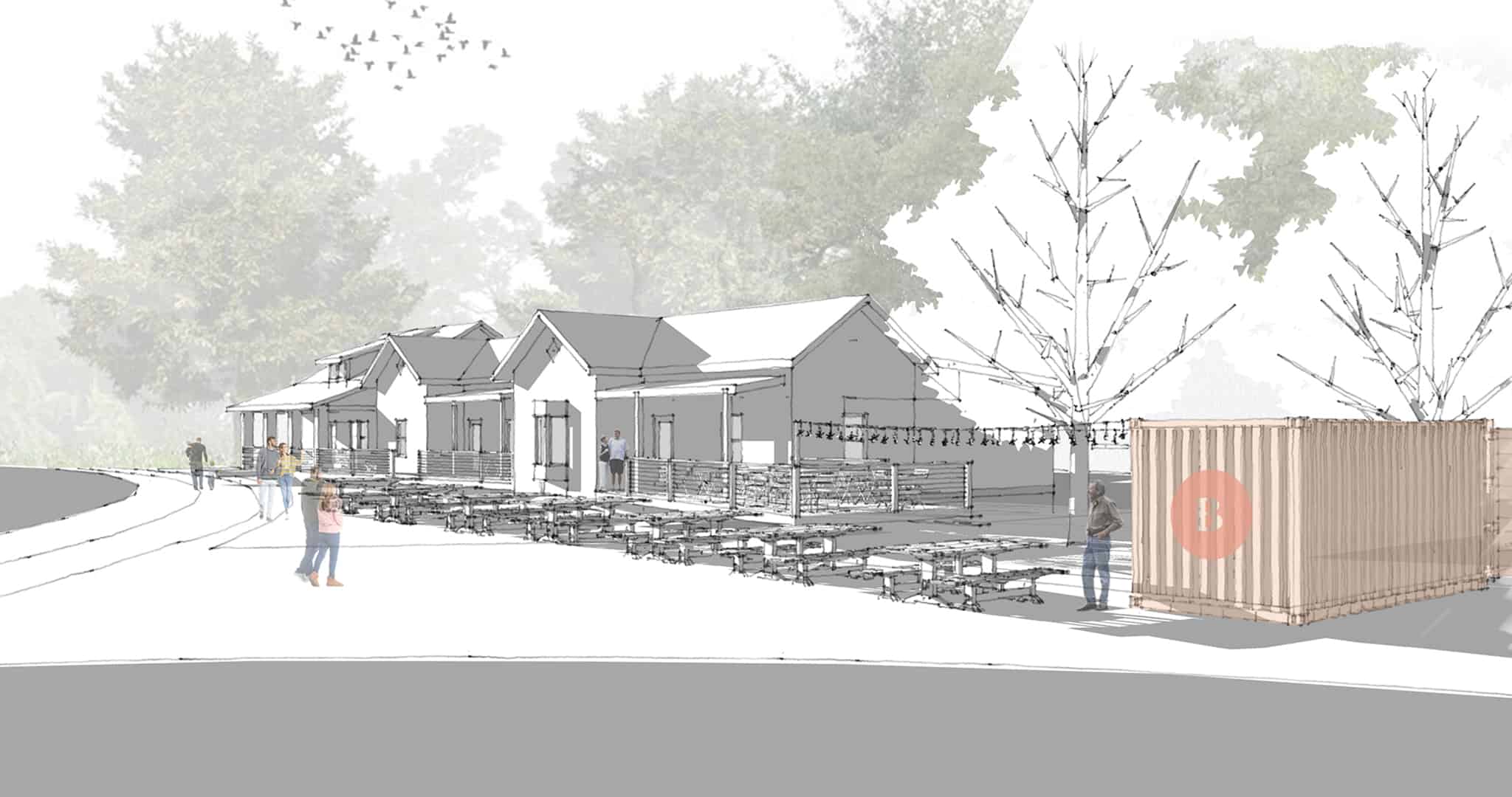
Dubbed The Bend, the trio of concepts—slated to bow in fall 2023—will be connected via an almost boardwalk-like shared front porch, so you can traipse back and forth between what Meeker envisions as a coffee shop, wine shop and neighborhood bar—each of which he hopes will be in partnership with established local concepts. The Bend will also include an outdoor area with tables, and a potential shipping container bar and semipermanent food truck.
Clearly, not all heroes wear capes—and this one is quietly quashing Raleighites fears of a concrete jungle while preserving our fave city’s authentic identity—one project at a time.