Find locally grown/made and affordable products through Food Lion’s Local Goodness program.
You may not think you’re supporting local when you shop at Food Lion, but we’re here to tell you that you’re—fortunately—wrong. Through the grocery store’s Local Goodness program, it sources quality, locally grown and affordable produce from area farmers and vendors in the Raleigh-Durham area to provide the wholesome food we put on our plates daily.
“Our Local Goodness program ties back to Food Lion’s overarching mission to provide customers with fresh and affordable food while giving back to the communities we serve,” says Kristin Wells, produce category manager for vegetables at Food Lion. “We realize how important it is for our customers to buy locally sourced products, and through our Local Goodness program, Food Lion customers can shop Local Goodness-tagged products and know exactly where their food is coming from.”
Food Lion partners with over 40 growers throughout the state, both large and small—from Oxford to Nashville to, of course, Raleigh—including Cottle Farms in Faison, NC, and locally sourced vendors FreshPoint Raleigh and FreshPik Produce in Kenly, NC, just down the road from the City of Oaks.
And not only do these partnerships bring shoppers fresh, affordable produce, they also support local growers who provide jobs in communities close to home, says Wells. Another perk? Since the local produce is grown closer to home, the travel time from farm to store is shorter—translation: the produce is extra fresh and full of flavor since it has a bit more time to ripen before it needs to ship (!).
Beyond produce grown and made in the state, the Local Goodness program also features products like chips, sauces and sausages. Raleigh-based vendors participating in the program include 1 in 6 Snacks and Bone Suckin’ Sauce. If you’re ISO Local Goodness products at your local Food Lion, simply look for the “Heart and Soul of Our Communities” tag in the meat/seafood, deli/bakery, and center store departments—and the “Local Goodness” tag on produce. Meal time never felt so good.
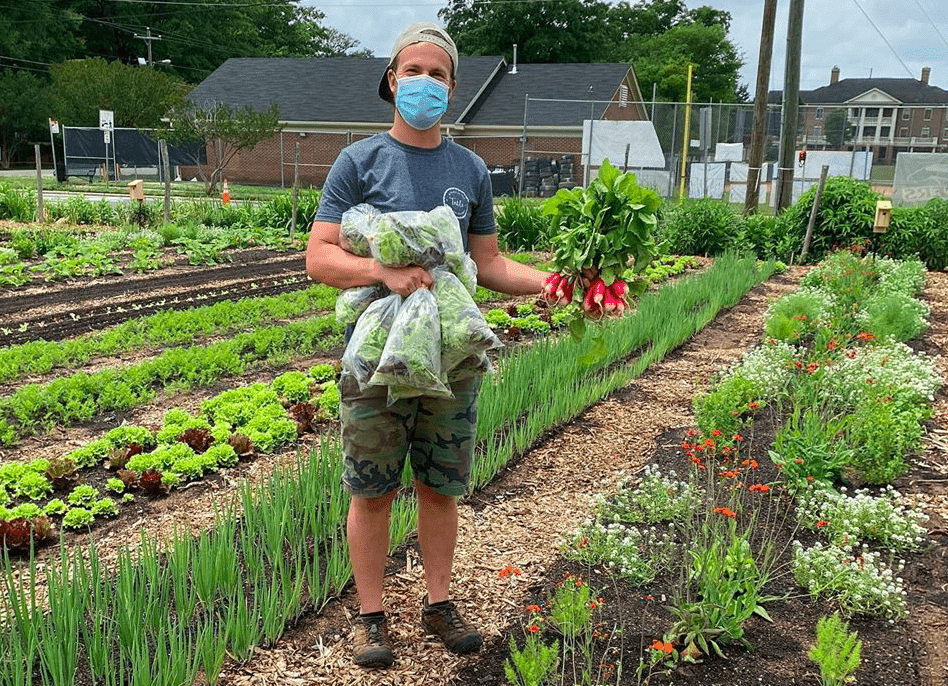
WEB EXCLUSIVE Every Wednesday at Raleigh City Farm, a colorful display of hyper-local produce awaits customers eager to get their hands on fresh vegetables. Lettuce, radishes, kale, green onions and carrots are just some of the rainbow of vegetables available each week at the Farmstand, all of which are grown sustainably and without any chemicals on an acre of land in the Person Street Neighborhood.
Raleigh City Farm’s Farmstand is part of its mission to connect the community to sustainable agriculture and ensure that consumers are getting their food from a reliable, local source. Purchasing vegetables from the Farmstand at Raleigh City Farm also supports the nonprofit’s efforts to share produce with other nonprofits who address food access and insecurity, including A Place at the Table and Inter-Faith Food Shuttle.
Flower bouquets, tote bags, hats, masks from Edge of Urge and locally-made birdhouses are also for sale at the Farmstand, along with Raleigh City Farm t-shirts adorned with the farm’s mascot Sir Walter Rabbit, drawn by artist Jenny Eggleston.
Join Raleigh City Farm’s Cultivator Club to further help the group share its produce with other nonprofit organizations by donating anywhere from $10 to $100 a month. You’ll receive one to three additional items free at the Farmstand each week.
The Farmstand at Raleigh City Farm takes place every Wednesday from 4 to 7 p.m. at 800 N. Blount Street. Wear a mask, socially distance from others and know that your produce haul is doing good for both yourself and your family, and for others in need.
Local farmers want the public to know, North Carolina’s farmers markets are open for business.
North Carolina’s Department of Health and Human Services has categorized the state’s farmers markets as being the same as grocery stores; they are allowed to remain open during the coronavirus shutdown. At the State Farmer’s Market, you’ll find local produce, meat, desserts and plants for your garden. Please support your local Farmers Market this spring!
Mike Jones, owner of Mae Farm in Franklin County, has been selling his pork, beef and dairy products at the State Farmers Market since 2004. As a vendor, he has seen an increase, albeit slight, in sales this spring, even as the shadow of the coronavirus lingers everywhere.
Last November, Jones renovated his location at the market, adding a counter where the only customers handling his products are those that have made a purchase. But he’s still stressed about what the future holds.
“It is a worrisome time,” Jones says. “I am concerned if the state were to close the market down. It may not have a huge impact on the community, but it would on me.”
Indeed, there is no rest for the independent local farmer.
Oftentimes, the work is seven days a week, sun-up to sun-down and, even then, there’s no guarantee that a crop won’t be ruined by weather or insects or the herd won’t get sick. Add to that the difficulty of competing with mega-farms run by global corporations that offer cut-rate prices and it’s a wonder farmers can sleep at night.
But with a global pandemic threatening to shut down the very venues where many local farmers earn their livelihoods, at the opening of the spring season no less, the uncertainty we’re all feeling likely translates to sleepless nights for our farmers. For many, the only fallback is a shaky plan to make home deliveries. The serious risks of bankruptcy or being forced to shutter farms loom large.
Fresh produce at the State Farmers Market | Photo by Jennifer Robertson
At 15,600 square feet, the Raleigh State Farmers Market is one of the largest in North Carolina and it’s where many farmers in the region earn their livings. The Farmers Market has already closed its main restaurant and the other two are only offering carryout. Sim McIver, a manager at the Farmers Market, has been in constant contact with officials at the North Carolina Department of Agriculture to discuss the very real possibility of closing the market.
“Vendors are worried,” McIver says. “They’re worried if the market is going to stay open. No one knows how long this is going to last. Things are happening so fast and there’s really no training for something like this.”
In the meantime, McIver’s staff is taking extra precaution with sanitation and cleanliness, encouraging vendors to keep customers from handling produce unless they’re purchasing it and to wipe it off if they do. Locally grown food is handled by fewer people than the produce at the larger stores and the state market is open air which significantly decreases the risk of exposure in comparison to the enclosed spaces of larger stores.
Couple these safety benefits with larger groceries being cleaned out by panicked shoppers and many produce vendors have yet to see a dip in sales. Some have even seen an increase in commerce, attracting both new and regular customers. If the state deems the market safe enough to stay open, there may be a silver lining. But if the coronavirus were a horse, no one is putting their cart in front of it anytime soon.
Jones of Mae Farms says he has recently made several bulk sales to customers making what he calls “precautionary purchases” and he has noticed an increase in new customers. He says his regular customers haven’t slowed because “they trust we’re going to be here.”
But so far, farmers have only seen the best-case scenario.
Jones’ fallback plan if the market were to close for an extended period of time would be to make home deliveries.
“I would have to apply for a permit to move around, try to deliver food for people,” he says. “But I’m just not set up for that kind of business.”
Jennifer Lusky is the operations manager for Rare Earth Farms which has been selling all of its meat at the State Farmers Market for 10 years.
Lusky says she has also seen a recent increase in sales which she believes is due to grocery stores running out of organic meat. Closing down the market would be devastating for her farm and the employees that work there.
“It is very scary business-wise, especially for a small farm with our sole income coming from the sales of our product at the State Market,” Lusky says.
Her fallback plan if the market closes or if quarantines keep customers at home is also to try to restructure her business to make home deliveries. It is unclear for Lusky or Jones how that would work as a business model in comparison with selling their food at one of the most popular markets in the area, they say, but hopefully, they won’t have to find out.
For Jennifer Britt, owner of Britt Farms, the selling season hasn’t started yet. For 10 years, her strawberries have gone to State Market in mid-April, the only place she has ever sold them. The short shelf-life of most produce, especially strawberries, makes farmers even more susceptible to steep declines in attendance or stoppages at the market.
“Once the produce is ready, it has to go somewhere,” Britt says.
Britt has taken to social media to encourage people to support the market.
“In my opinion,” she says, “eating local right now is more important than it has ever been.”
Bill Walker’s produce and bison meat from his Walker Farms has been a staple at the State Farmers Market for 12 years. Pushing 70, Walker doesn’t make it down to the market in person much these days. Instead, he delegates the work to employees.
When I asked him if he’s ever seen anything like this in his life, his answer is, “No, have you?”
He is concerned, he says, but knows that all things pass.
“I tell you one thing, we’re not going to run out of food, we just won’t have a place to sell it,” Walker says. “If they were to close the market, I guess the cows and the chickens and the buffalo can eat the produce. Then we won’t have to buy feed.”
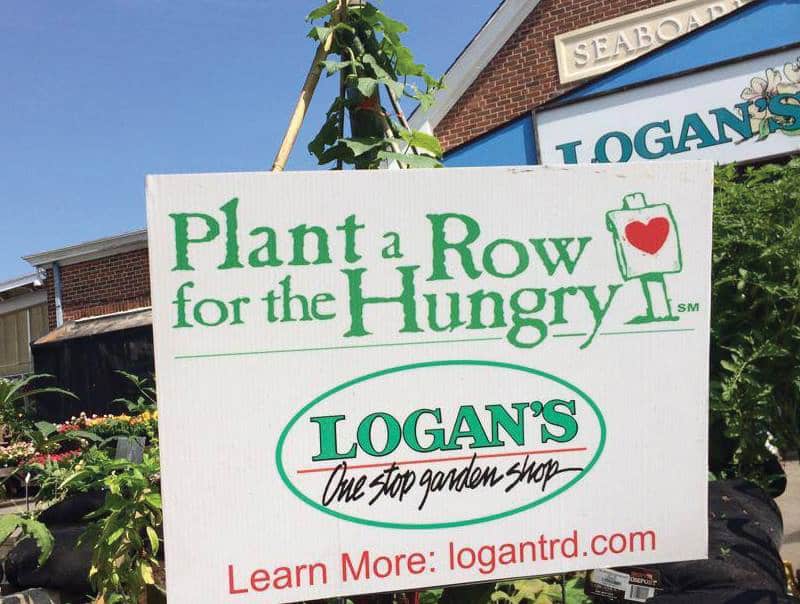
When you’re planting your garden this fall, consider adding a row to help feed families in need. Plant a Row for the Hungry is a national program that encourages gardeners and community groups to donate produce to those at risk of hunger.
Logan’s Garden Shop, a nursery in Seaboard Station, got involved with the program 12 years ago to inspire locals with green thumbs to help fight food insecurity through gardening.
“The Logan family saw a need in our community and had a strong desire to help feed families that were struggling to get fresh produce on their tables,” says Joy Sweeney, the store’s project manager.
Inter-Faith Food Shuttle, a nonprofit that distributes food to low-income families in seven North Carolina counties, is the local affiliate for Plant a Row. Logan’s partnered with the Food Shuttle to take donations and spread the word.
“Logan’s has been an incredible partner of ours,” says Katie Murray, the development relations manager at Inter-Faith. “They have provided an immense amount of support for our garden education programming.”
Logan’s collects donations from families, community groups and churches. Inter-Faith distributes the produce through several of its programs, including the Mobile Market, a temporary food bank that travels to people in need and allows them to shop for free.
One pound of produce can supplement four meals, so 25,000 pounds collected rounds out to 100,000 meals with fresh vegetables and fruit.
Logan’s encourages gardeners with any level of experience to stop by and impresses on parents the value in teaching their children the joys of gardening and the importance of helping others.
This year, individuals can pick up Logan’s starter kits of compost, soil, fertilizer samples and other supplies through an online sign-up and drive through pick-up. Go to logantrd.com/plant-a-row to let their team know what you would like to grow and whether you’ll be growing in containers, raised beds or in the ground. Then, when they’ve put your starter kit together, you’ll receive an email letting you know you can pick it up. Once harvest time comes, Logan’s hopes you’ll return some of your produce to the store’s drive-through area for the Inter Faith Food Shuttle to pick up and distribute.
“There’s never been a better time to consider your neighbors in need, and Logan’s is here to help us grow as a community in sharing love with one another,” says Leslie Logan, Logan’s general manager. “Join the movement and sow seeds of generosity this spring!”
Logan’s is located at 707 Semart Drive. Learn more at logantrd.com or follow them on social media.
This is an updated version of a story that ran in Raleigh Magazine’s April 2019 issue.
The Produce Project ensures that fresh, local produce goes to good use.
Several years ago, while browsing the local farmers’ market for dinner inspiration, Mike Shumake accidentally wandered into the wholesale building.
“I’m like a kid in a candy store. Sixty tomatoes were $10,” he says. “The problem is, when you get home with 60 tomatoes you realize you don’t need—nobody needs—60 tomatoes.”
Shumake began making regular runs to the farmers’ market, recruited some friends to split the costs and the bounty, and the casual collective grew into what is now The Produce Project.
The Produce Project is an all-volunteer nonprofit that aims to make fresh produce affordable for Raleigh residents. Customers can buy a single share for Wednesday or Thursday pickup as late as the afternoon before, or they can become subscribers to pick up a box each week. The price—$18—is constant, but the contents of the box, available in regular and keto-friendly, change by day and with the seasons.
This is how it works: Customers order online ahead of time or as part of an ongoing subscription. Then, Shumake picks up fruits and vegetables in bulk at the State Farmers’ Market and a small team of volunteers divides the haul into individual boxes for pickup. To collect their share, customers bring their own bags and boxes and enter at the side of the building at 1000 Brookside Drive (to the left of the tattoo shop) and walk up to the Dutch door, where they are handed a box loaded with produce. They take what they want and leave the rest, which becomes The Produce Project’s “profit.”
“When you buy a tomato, you’re paying for the tomato that you’re buying, plus the three or four tomatoes that are hiding in the back of the store…there is always waste,” Shumake says. As he buys only enough to fill the boxes that have been ordered, there is no waste in the traditional sense; however, the nonprofit donates produce that customers don’t have room to take home. Customers can also purchase a share for donation at a reduced price of $15, and subscribers can get a weekly share plus a donated share for a total of $30.
In the first three months of this year, the organization donated more than 9,000 pounds of produce to the Resource Exchange Commission, which helps wounded veterans; the Murphey School senior housing; and Love Wins Community Engagement Center, which serves those experiencing homelessness.
A recent box held a mini watermelon, two clementines, two onions, five cloves of garlic, three jalapenos, one poblano pepper, a green pepper, two avocados, two small mangoes, two peaches, three large carrots, a couple of yellow squash, a package of locally grown lettuce, a bundle of asparagus, a bunch of kale, a bouquet of cilantro and a 10-pound bag of potatoes.
“Going to the grocery store is like an errand, [but] I’ve heard from the parents that when they show up here on pickup day, it’s like an unboxing,” Shumake says. “They don’t know what they’re going to get. It’s like Christmas…I had someone say to me the other day that it’s like Iron Chef in their house. They get home with the kids and the ingredients are all there and they’re like, ‘What are we going to make next?’”
Shumake retired early after an award-winning career as a teacher and several lucrative years working as an education consultant. He is thrilled to see how the community has embraced The Produce Project, but he has even bigger plans for the nonprofit. Ultimately, he wants to apply the same model in local schools, building a business as an integrated program to teach entrepreneurship, math, logistics, nutrition science, teamwork, problem-solving, marketing and more, all while providing healthy food to those who may not otherwise have access to fresh produce.
“I believe that people measure success in this country with the wrong metric—we measure success by the amount of money that we pull in,” Shumake says. “There is a finite thing we can measure success by and that is the number of breaths we take. The question is, what do we do with them? For me, it’s helping others [and] helping the community.”
For more information or to purchase a subscription, visit produceproject.org.