As Ridgewood Shopping Center gets a fresh face-lift, one local creative is also decking it out with a brand-new work of art. Enter Charlotte-born, Raleigh-based Denise Hughes’ two towering oak tree silhouettes now “growing on the walls” beside Whole Foods and Drift—with a third set to sprout this fall.
An homage to the City of Oaks’ nickname and natural beauty, the brushstrokes also depict curious animals—think raccoons, birds, rabbits and dogs—as a “celebration of our shared roots, where nature and community intertwine,” says the artist, who worked alongside architects and in collaboration with studio mate artist Autumn Cobeland and photographer Simon Griffiths earlier this summer to breathe new life into the established spot.
“The shopping center has been a landmark in Raleigh for almost 75 years, long before the city’s major growth took place,” she adds, “so bringing the center ‘back to its roots’ was the sensible choice.”
And it’s not the first time Hughes has left her mark around town. Calling Raleigh her forever home for almost 30 years, the multidisciplinary artist specializes in murals, oil painting and even underwater swim painting—plus upcycled assemblages that put her passion of taking garbage to gallery at the forefront. “My love of art lies with sustainability,” she emphasizes.
After discovering a devastating video about microplastics in our oceans, the artist took it upon herself to draft a program, take it to schools and let the community in on her junk-to-genius effort. “In today’s throwaway culture, I feel it’s even more important to realize the effects on our planet and oceans,” asserts Hughes, “and to emphasize that all of us can do our part to keep it clean.”
One such green-minded piece, made entirely out of upcycled plastic, is a large-scale portrait of Dolly Parton—one of Hughes’ favorite musicians. Working, ahem, “9 to 5” during the pandemic, she fabricated the Dolly artwork from her kids’ old toys and a mountain of buttons. Although the music legend famously abstains from purchasing self-portraits, she made an exception for this one—Legos, Barbie limbs and all—which now hangs in the foyer of her Nashville mansion.
Proving that almost any item can be made into a vibrant work of art, Hughes continues to deliver her strokes of genius across Raleigh—and beyond. Color us impressed. denisehughes.com
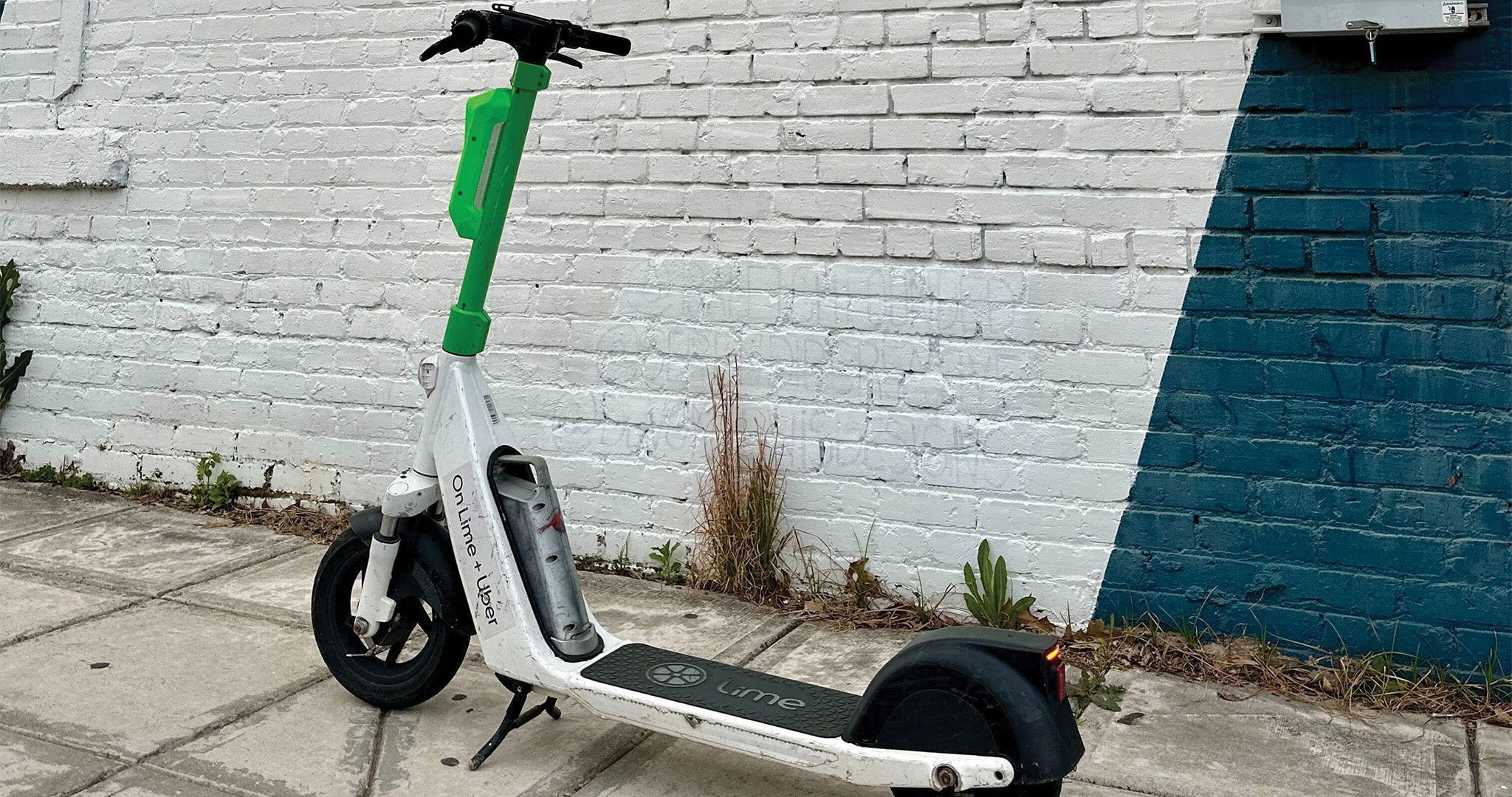
Landing like a viral trend, e-scooters rolled into Raleigh in 2018—with no warning to city officials—instantly becoming all the rage. The pitch was simple: then just a buck to unlock, pennies per minute (read: $0.15) and skipping the sidewalk trek sans surge pricing or waiting on a ride. It practically sold itself.
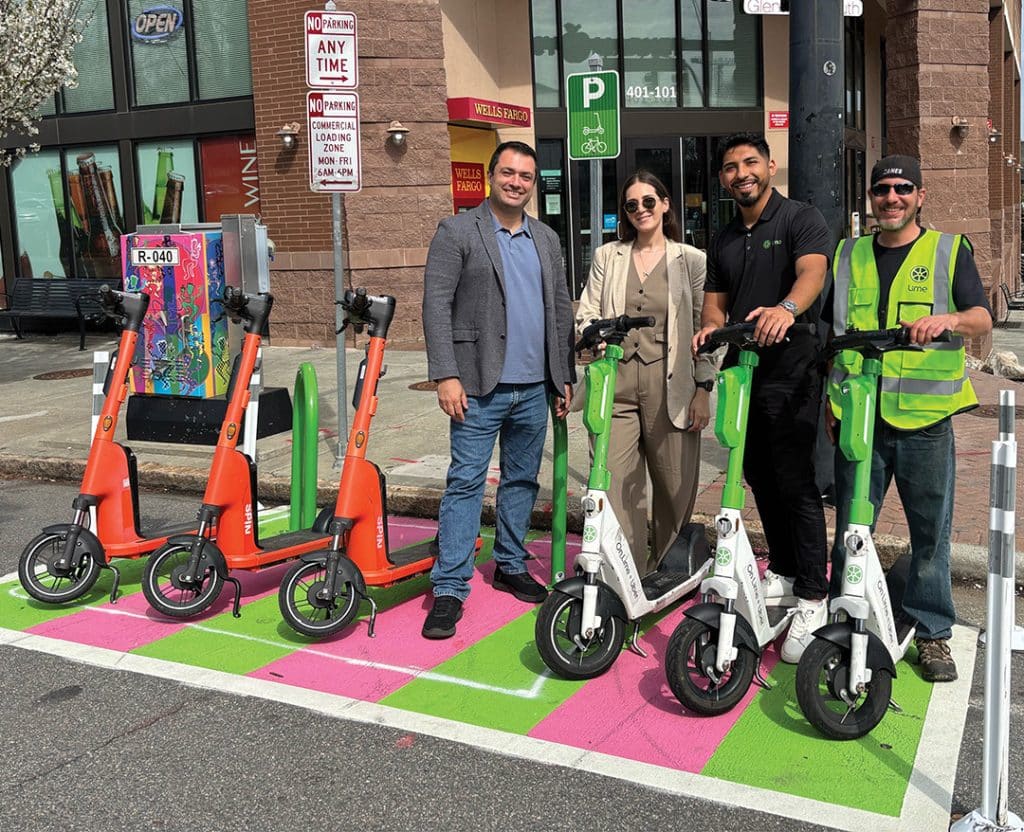
While scooters are still a go-to, that pennies-per-minute ride has since scooted out of reach—with both Lime and Spin now charging $0.41/minute. Lime’s Jacob Tugendrajch says their base rate hasn’t changed since officially inking a deal with the city—one that includes a $7,500 annual permit and a 15-cent per-ride fee that helps fund programming like those colorful DTR corrals. Spin’s Austin Spademan, on the other hand, points to rising operational costs, insurance, and tariffs driving up prices for parts and replacements.
Still, two Raleigh riders recently scooted from Publix to The Avenue on Glenwood South—one on Spin; the other, Lime—and Spin came out nearly half the cost for the same distance and time. That said, both companies now offer ride passes with upfront costs but better value—ideal for daily commuters (see “Pass Perks”)—with a bonus no $1 unlock fee for either.
“The most livable cities have a variety of modes of transportation for different types of trip needs,” says City of Raleigh Active Transportation Planner Hannah Dos Santos, who also leads the micromobility program. “And so the program works toward enhancing the livability of Raleigh by allowing people to be creative with how they can get around—all the while also supporting the city’s climate goals.”
Photo courtesy of Lime
Raleigh’s micromobility gains are no small feat. In the past year alone, riders took nearly 362,000 scoots—and since the program launched, it’s helped cut an est. 100 metric tons of CO2 emissions, per Dos Santos. As micromobility evolves, new ops like seated scooters—recently launched in Durham—could hit Raleigh next. “That’s something we’re working with the city to figure out how to introduce into the ecosystem,” says Lime Senior Manager of Government Relations Carol Antunez.
Spademan hopes scooter companies can eventually pass city fees directly onto users to lower ride costs across the board, emphasizing: “To solve sustainability goals, we also need to reward people for following those right behaviors.” So, as Raleigh’s streets continue to shift, micromobility stands as a key player—offering flexibility, sustainability and a glimpse at how the city can move smarter, faster and greener.
This Earth Month, invest in your community—and the environment.
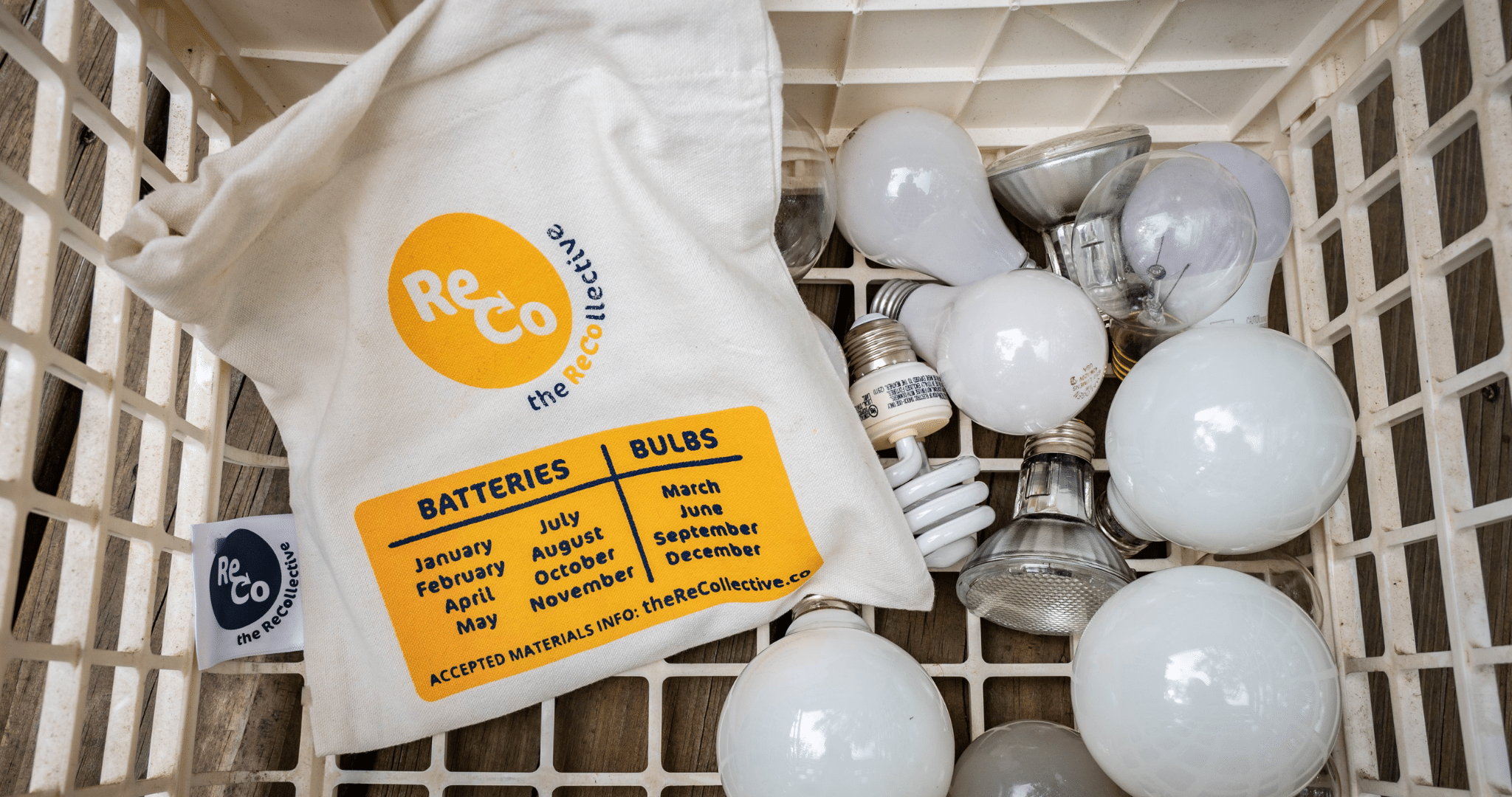
When it comes to recycling, there’s no question about whether items like paper, cardboard, plastic and the like are recyclable. But when it comes to things like plastic film, Styrofoam, paint, batteries and light bulbs, confusion abounds over how you should dispose of them. Enter The ReCollective, the Triangle’s first hard-to-recycle pickup service.
Launched in fall 2022 by Bryce Brooks and Kevin Younge, two eco-friendly Triangle residents with a passion of simplifying waste and reducing climate change, The ReCollective makes recycling easy, accessible and transparent while taking waste off your hands and creating something new out of it.
Filling the gaps left by traditional curbside programs, the concept has since expanded to serve 600 households/month across the Triangle—diverting the equivalent of 1 million plastic bags’ worth of plastic film from landfills and waterways (!). To boot, in 2023, The ReCollective expanded to offer organics collection—including food scraps and compostable waste—and introduced a partnership with Toward Zero Waste that makes composting more accessible and affordable.
“We are passionate about helping bring awareness to the community about the environmental challenges we face,” says Younge. Adds Brooks, “The Triangle is a special area that is so ready for circular community solutions that are affordable, accessible and have a positive impact for everyone here.”
The ReCollective’s pickup service is super-convenient—and you don’t even have to leave your house to use it. Collection bag kits containing four labeled canvas bags, a separate plastic bag for Styrofoam, and a waterproof bag are dropped off at your home before your scheduled pickup day. Simply leave the bags on your porch and a ReCollective crew member will swing by to collect them.
The sustainable service then takes materials and passes them on to local businesses and organizations that recycle or reuse them in a creative way—think art pieces or products like deck boards. Reduce, reuse, recycle in action!
The best part? Getting rid of those nonrecyclables costs about the same price as a Netflix subscription or getting a couple drinks at a local bar. So why not put your money toward something that’ll help better the environment—and the world?
As part of the ongoing implementation of sustainable efforts across the country, the grant gives local sustainable transportation a leg up, allowing Raleigh to plug in and push toward a future of clean energy.
The e-bike incentive program will provide accessible zero-emissions transportation for low-to-moderate income residents, while the charging station will help the city gain intel on implementing future public charging sites and development. So if you’ve been thinking about recharging your commute—electric (or pedal) style—consider this your sign.
“I think reducing car dependency and increasing efforts to make sure the cars still on the road are sustainable are two important, complementary goals,” says City Council Member Jonathan Melton following the announcement.
And Raleigh is keeping up with these sustainability efforts in stride. In 2022, North Carolina saw a 47% percent increase in registered electric vehicles in comparison to 2021, with last year’s data revealing electric vehicles registered in all 100 counties (s/o to the highest concentrations in the Triangle and Charlotte-metro areas!). To boot, Wake County reached a milestone of 208 registered EV vehicles per 10,000 registrations last fall. Way to plug, Raleighites!
Continuing to go green, Ral-E-Bike, another incentivized program announced last year, will begin accepting applications this spring, according to Melton. Looks like sustainable transportation innovations are here to stay—and Raleigh is riding the high.
A collection of high-end, net-zero-energy homes has hit the market near the Village District, marking a first for our area and a win for the environment.
A few decades ago, using the term “green” when describing a home would have conjured an image of some crunchy, solar-powered cabin tucked away in the woods. Fast-forward to today and low-impact living has become the epitome of modern luxury, as evidenced by Tower Raleigh, the stunning new collection of sustainable homes situated ITB near Village District and Jaycee Park.
Tower designer Will Alphin, also the founder of sustainably minded local firm REdesign.build, was perfectly suited to tackle this project given his 20+ years of experience designing and building for clients and working in existing neighborhoods.
“The combination of wanting to do something to push the envelope on sustainability, having a comfort level with understanding what folks want in a home, and also having a reputation as a good design-build team—it felt like those three things we could pull together and do a for-sale project,” he shares. “So that’s where it all started.”
The high-performance community—a partnership between REdesign.build, Chappell [Powered by Compass] and Southern Energy Management—is comprised of four net-zero-energy homes; that is, they can generate as much renewable energy as they consume, if not more. And it stands out as one of the first single-family residential developments of its kind in the Triangle.
“We knew we were going to be doing something like had never been done before, so we built one house first to completion and took an opportunity to learn how we could do things better,” explains Alphin, who loved the concept so much he decided to purchase the home.
Construction is now underway for the other three Tower residences, with expected completion in spring 2024. As of press time, one has already been claimed and two remain on the market, with a starting price tag of $1.95 million.
Each 4,100-square-foot, three-story home boasts eco-friendly materials, triple-pane windows, rooftop solar panels, and tech-savvy features that prioritize energy efficiency and functionality—think a Tesla Powerwall, Loxone home automation system and more. “We have the technology to be comfortable and energy-efficient, so let’s do that,” says Alphin.
But style is certainly not compromised. The modern, dark wood-accented dwellings are thoughtfully curated to be open and free-flowing, with a floating stairwell, swoonworthy chef’s kitchen and light-flooded spaces that truly bring the outdoors in.
Although Tower only recently hit the market, the cutting-edge community has already generated buzz after being awarded the coveted George Matsumoto Prize in 2020 by NCModernist—a recognition that Alphin says is “very validating.” He acknowledges that a development like Tower is a risk, but one that he’s willing to take.
“We’re saying we believe in this; we’re going to put this out there,” the designer shares. “We believe there’s enough like-minded people out there at this time who will buy these homes.”
When asked which design element he’s the most proud of, Alphin pauses to think. “The homes are high-performance, so they’re trying to accomplish more than just being nice homes. They are trying to do a lot: being hyper-energy-efficient and sustainable while also being amazing and wonderful homes to live in,” he muses. “And I think they do that very elegantly. It all has a simplicity to it. I’m proud of the overall design, and I think everything works really well in concert.”
He adds: “It’s like when you get in a really nice car. You know it has all this technology, but you just feel comfortable and safe and it’s really fun to drive. I just get a great feeling living in the house.”towerraleigh.com