Raleigh is getting its first hydroponic community garden.
A local restaurateur and his father are soon going to be able to increase food production in one area of Raleigh from 500 to 32,000 pounds (!)—and they don’t even have to use any dirt to do so. Enter Raleigh’s first indoor year-round vertical hydroponic community garden, which breaks ground today, Dec. 20.
A partnership between DTR-headquartered Green Blue Marketplace, founded by Oak City Fish and Chips owner Isaac B. Horton IV and his father, Dr. Isaac B. Horton III; and Passage Home, which works to break the cycle of poverty in Wake County, the Green Blue Community Garden will provide affordable, healthy, nutrient-rich food for all communities in Raleigh.
“This partnership will provide more than just an interesting new way to grow food,” says Raleigh Mayor Mary-Ann Baldwin, “it will bring opportunities that will have a far-reaching impact on people’s lives—starting in Southeast Raleigh.”
The garden comes after the Green Blue Marketplace—nee 2021—developed an ag and health tech platform to produce toxic-free, nutrient-fresh and secure food following six years of research in hydroponics, health and wellness.
Research done by the Hortons found that key nutrients in fruits and vegetables can leave the plant in only three days. By producing hydroponic food right here in Raleigh, the community garden will provide the community with the most nutrient-dense fresh produce before the nutrient index is compromised.
“This is a major advance in nutrition and food security for people in Raleigh,” says Dr. Philip Brown, past president of the North Carolina Medical Society. “I look forward to scaling across NC as we use the objective of fresh food as medicine to create new levels of health in our state.” And this is just the beginning of Raleigh becoming a Green (Blue) City.
Local maker cures the root of the city’s issue with repurposed material going to the landfill by turning local reclaimed trees into stunning wood furniture pieces.
The City of Oaks is no doubt logging plenty of, well, logs to make way for development. And while the harsh reality is that most of those are being thrown in a landfill or recycling center, some are being “recycled” in the coolest way.
Enter local Oak City Customs and its pop(u)lar custom-made tables and furniture already dotting homes, businesses, restaurants and bars across the community. The brainchild of Dylan Selinger (who helped open Crank Arm Brewing and Crank Arm Rickshaw), the “tree-to-table” concept was born of his realization that somebody needed to step in and do something about the city’s wasted natural resources.
Originally started in Selinger’s garage as a hobby, Oak City Customs’ operations have since moved to a 14,000-square-foot space in Zebulon, where all of the team’s projects are carried out—from planing and sanding to kiln-drying to CNC services (aka computer controlled-cutting services) to welding and fabrication. To boot, most of the equipment is secondhand, which “kind of jives with our theme,” says Selinger.
Around town, you’ve likely spotted some of the visionary log crew’s craftsmanship at Crank Arm, The Davie, The Darby, Poole’side Pies and SideBar, among others. NTM Selinger and his team also upfit all existing Dram & Draught locations (Raleigh, Durham, Greensboro and Wilmington).
Now, they’re working on Dram’s Fenton, Charlotte and Winston-Salem outposts as well. Translation: That bar top or table where you cop a squat will in essence be a reclaimed locally sourced tree. Cheers to that.
Beyond the bars, while the crew’s crown pieces (ahem—get it? Like crown of a tree?) are dining room, conference and coffee tables, Oak City Customs also crafts custom furniture (hence “Customs”). In producing the likes of shelves, stools and more, the team works closely with customers to ensure “you get exactly what you want—as opposed to something that you buy online and you have like three options for size and colors,” says Selinger. Sounds like a pretty sturdy sustainable business model to us. oakcitycustoms.com
Sole searching for sustainable socks—and feel-good “stocking” stuffers? Meet Teddy Locks.
Feel-good “stocking” stuffer found. Conscious soles are gonna swoon over Teddy Locks socks this season—and beyond. Traveling less than 250 miles from fiber to finish, this NC-born and -bred and 100% female-owned sustainable brand (!) sources its socks from recycled plastic bottles and upcycled textiles. Yup, plastic bottles—10,000 to date! Sewed from founder Samantha Tollworthy’s passion for the planet, Teddy Locks started when she surrendered her dream job as a wildlife TV producer to help fight climate change and the war on waste. Now, the sustainable sockster helps others feel good about their footprint by diverting materials from the landfill and stopping plastic from ending up in our waterways—earning the official Green America’s Green Business Certification. Made exclusively in the Old North State by local and family-run businesses, these snuggy feet sweaters aren’t just turning, er, feet—they’re legit luxuriously soft and come in an array of fashionable colors and sizes. And this’ll really knock your socks off: Teddy Locks socks are moisture-wicking, quick-drying, thermoregulating and feature arch support to prevent foot fatigue. Sounds like it’s time to pull up your socks and help save the planet. teddylocks.com
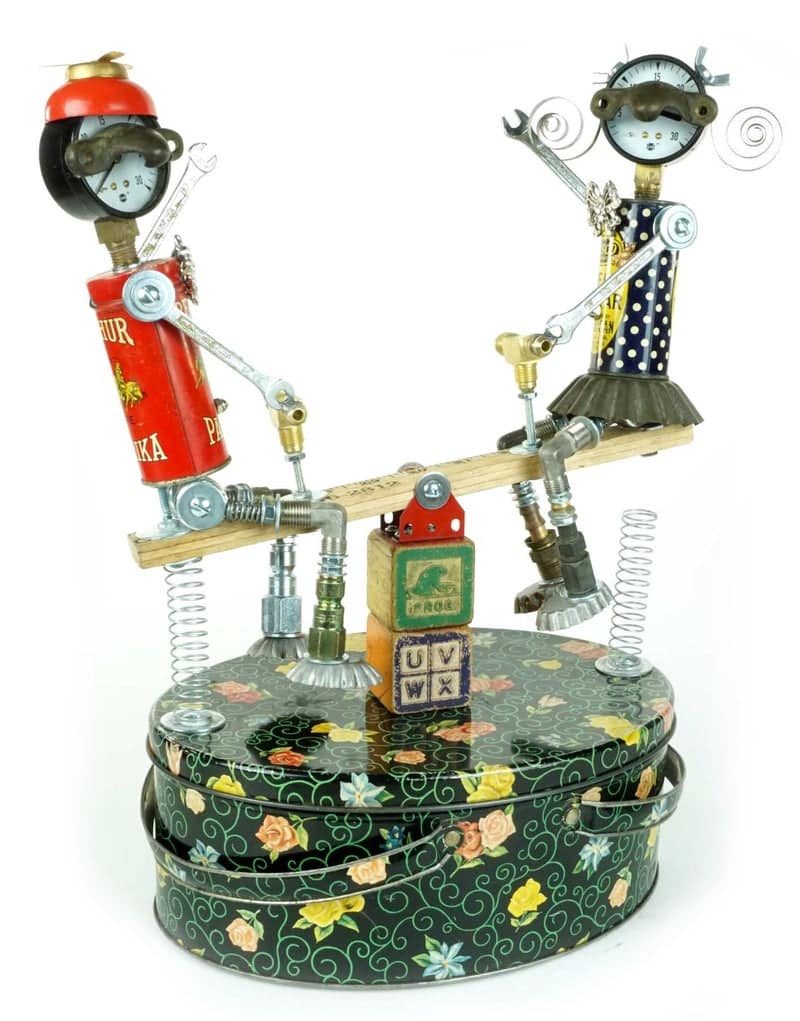
One man’s trash is another man’s treasure, as they say. Raleigh artist Amy Flynn takes that sentiment to a whole new level by turning waste materials from flea markets, junkyards, auctions and basements into one-of-a-kind “Fobot” sculptures—a combination of her passions for crafting, shopping and sustainability. Not too shabby, huh?
Each “Fobot” is made from unique pieces of scrap metal and junk that, while super-cool to look at, really make you think about how much waste humans produce (so much that artists can make literal sculptures out of it. Yikes.).
Flynn and her “Fobots” have been selected to be featured in the Smithsonian Craft Show’s Craft Optimism online marketplace, a collab between the Smithsonian Women’s Committee and Honoring the Future, an organization dedicated to educating, empowering and engaging the public on climate change.
Each piece in the craft show was nominated and recognized as a “beautifully made [and] handcrafted” piece that either addresses climate change through action (in Flynn’s case, waste reduction), or reflects the impact of climate change, according to the Smithsonian Craft Show’s website. Proceeds from the virtual event support grants to the Smithsonian.
You can check out Flynn’s “Fobots,” along with other climate-conscious art pieces, from now until May 1 on the Smithsonian Craft Show’s website. And if you’re liking what you see, peep more of her unique “Fobots” on her website.
WEB EXCLUSIVERedress Raleigh’s new exhibit, Tracking Textiles, explores how our habits impact the environment.
Fast fashion is a no-go, no matter how tempting those cheap, trendy pieces can be (we know, it’s hard to beat a sub-$20 outfit!). But hold off on hitting “add to cart” on websites like SHEIN or Forever 21, and first think about where your ’fits are coming from and who made them. You might be surprised at how big of an impact your $10 shirts are making on the world around you…
In honor of Earth Month, local nonprofit Redress Raleigh’s new interactive exhibit Tracking Textiles: The Modern Lifecycle of Fabric at the NC Museum of History explores those social and environmental impacts of fast fashion and helps you learn more about the way textiles are made; the ramifications of materials, production and individual textile waste; and how to make more sustainable choices when purchasing products.
“One of the biggest environmental issues within the fashion industry is textile waste,” says Redress Raleigh Executive Director Beth Stewart. “We created Tracking Textiles to offer an engaging, positive experience that encourages people to question overconsumption habits while celebrating the role fashion plays in our lives.” For instance, did you know that the most popular synthetic fiber used in clothing is polyester—which takes over 200 years to break down?! Insane.
After visiting the exhibit, you’re encouraged to ask yourself how you can make a difference in your clothing choices and take a pledge to reduce your fashion footprint by posting on Instagram with the hashtag #FashionFootprint and tagging @RedressRaleigh.
You can also try your shopping habit onry thrifting or checking out sustainable companies to reduce your environmental impact even further. There are so many ways to be green and still #slay your outfits. Redress Raleigh’s Tracking Textiles display is free and runs from now until May 2. Follow along on Insta (@RedressRaleigh) for even more tips and takeaways throughout the rest of April.