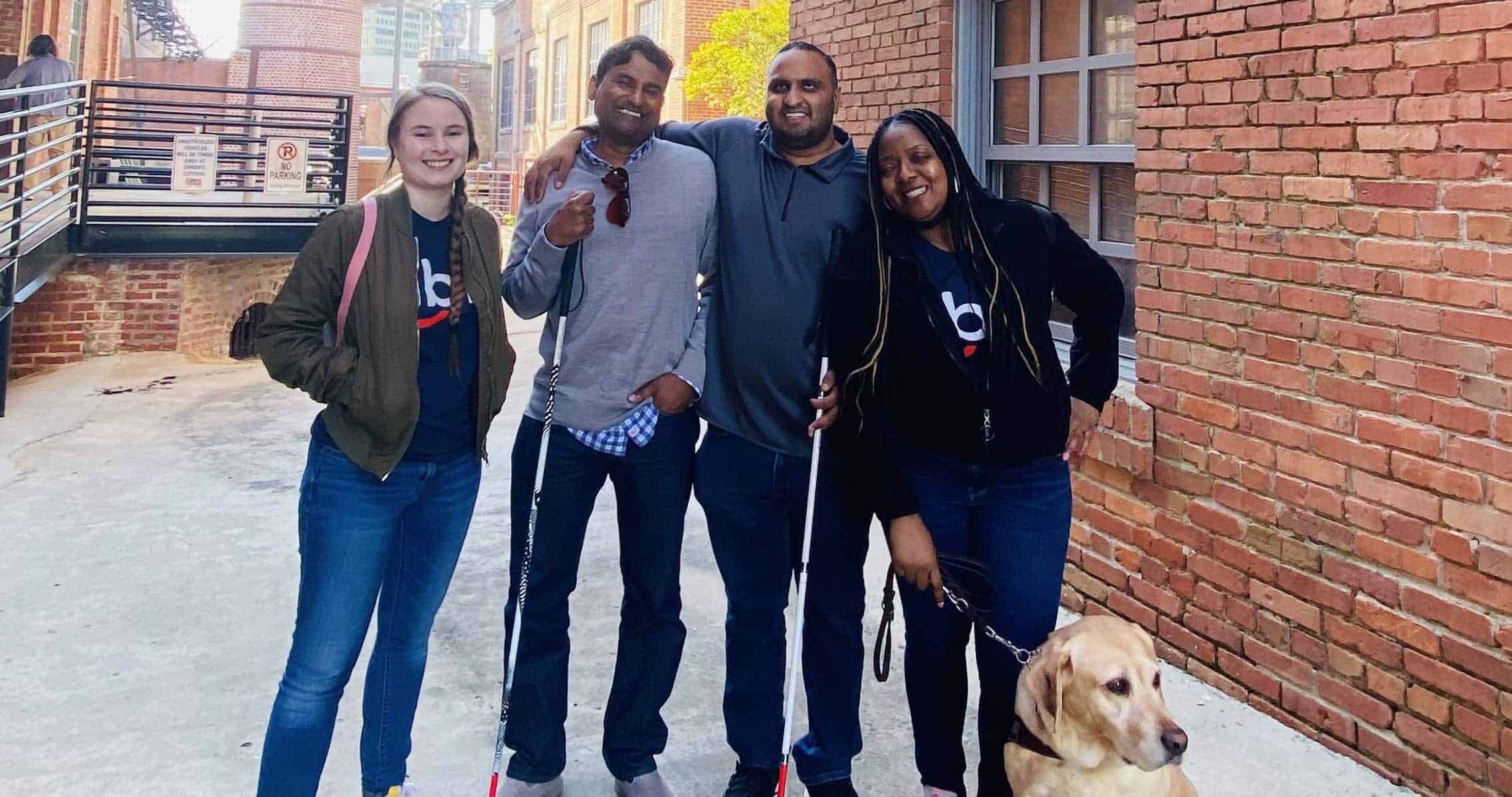
Ablr opens companies’ eyes to accessibility and inclusion.
While the U.S. is celebrating National Disability Employment Awareness Month this October with the theme Disability: Part of the Equity Equation, North Carolinians Mike Iannelli and John Samuel have taken the importance of equity a bit further by making it part of their life’s work.
Back in 2020, the duo launched Ablr (pronounced Ay-bler), a disability inclusion and digital accessibility company based in Durham that works to level the playing field and create opportunities for those with visual impairments and other disabilities. And to say they’ve been successful is an understatement.
“John and I had the opportunity to build Ablr in about 90 days,” says Iannelli. “We built a website; we built the name; we colored it; we did everything—and we launched a business with basically no real accounts, no clients… just a few team members and a mission.” Fast-forward to today, and the company has 65 clients, a strong team and a growing brand.
Iannelli and Samuel first crossed paths in 2019 at Bull City-based LCI, a manufacturing, distribution, wholesale and retail company—one of the largest employers of the blind in the U.S. It was a meeting Iannelli can only describe as “divine intervention.”
Iannelli, who then worked for Raleigh-based marketing agency Walk West, was asked by his boss to visit LCI. At the time, he was in a dark place in his life and could barely get out of bed.
Samuel had been working for LCI for just over two years and took Iannelli on a tour of the facility. He had moved from DC to his home state of NC, but prior to that, he thought his career was over, as he’d been diagnosed with a degenerative eye condition in college and the private equity crowdfunding business he had been working for had folded.
With Samuel looking to increase accessibility for the visually impaired and Iannelli yearning to do something that mattered, they soon realized that Ablr was their answer.
Today, Ablr focuses on three things: eliminating the digital divide, changing people’s mindsets on disabilities and creating pathways for employment.
To help close the divide, Ablr works with companies and organizations to ensure their websites and mobile applications can be used by those with disabilities. Right now, more than 90% of online content is inaccessible to those with visual, cognitive and auditory impairments, according to Iannelli.
As for changing mindsets, Ablr provides an online Disability Inclusion Training for employers, where they learn about things like etiquette and terminology—fundamentals Iannelli says are missing in society today.
And in terms of creating job opportunities, Ablr helps companies support their current employees with disabilities, as well as prepare to onboard new hires.
“I believe this is sort of a business transformation from the inside out,” says Iannelli. “We are saying, ‘Wait a minute. You’ve never considered an entire group of people, an entire community in your entire existence before, ever.’ Now, this opens the door for massive opportunity.”
Since its launch, Ablr has worked with businesses and organizations in the education, retail, finance, government and health care sectors, and will continue to try to add to its client base. Plus, Ablr recently received a contract with the State of North Carolina to provide a workforce development program for the Division of Services for the Blind in order to train people to become digital accessibility testers and enter the workforce.
“We really think the Ablr brand can really represent much more than just one segment,” he says. “This is just the beginning.” ablr360.com
How a local marketing executive prepared for a big talk on a tough subject.
It took approximately 80 hours for Sharon Delaney McCloud to prepare for her TEDx Talk at Cary’s SAS Institute in December. It’s the most time McCloud, the vice president of professional development at Raleigh-based marketing agency Walk West, ever spent getting ready to give a speech.
McCloud has been a public speaker and presentation coaching for years, so she’s no stranger to delivering speeches in front of large audiences. But, she says, giving a TEDx Talk was a completely different animal.
Sharon Delaney McCloud
“It was the toughest abstract I’ve ever had to write,” McCloud recalls. “I was very nervous that someone would look at it and laugh. I didn’t know what the reaction would be.”
McCloud is an active member of the Global Speakers Federation and the National Speakers Association and has dreamed of giving a TEDx Talk on how and why people should speak with bereaved parents—or vilomahs, as she refers to herself after losing her daughter to cancer in 2005. Last October, McCloud finally got the opportunity to share her story through TEDxCaryWomen. Two weeks before the deadline, she submitted her application and, after a rewrite on the day of her late daughter’s birthday, she was accepted.
Following her acceptance—and after signing several legal documents and consent release forms—McCloud was paired with speaker coach Stephanie Scotti, who coached at a Raleigh TEDx event in 2016 and regularly works with business leaders to prepare them for high stakes presentations.
Scotti and McCloud worked together for the two months leading up to the TEDx Talk, to develop McCloud’s idea into an 18 minute-long speech using a process Scotti developed called the “CODE Process,” an anagram for Clarify your idea, Organize your content, Develop your media and Express and engage.
Scotti says 80 percent of the time she spent with McCloud was dedicated to messaging and developing a strong throughline that got McCloud’s central idea across in one sentence, the hardest principle for TEDx speakers to achieve, according to Scotti.
Stephanie Scotti
“I can’t even quantify the time and effort she put into preparing me,” McCloud says of her coach. “She was so caring and she challenged me in ways that I so needed. She was just incredible.” McCloud says one of the toughest aspects of her talk, for her personally, was memorizing the speech as she wasn’t allowed to use note cards or have slides to guide her through her talking points. Nonetheless, McCloud says, she presented her speech comfortably and received good feedback from audience members who were vilomahs themselves or had known bereaved parents.
“She did a marvelous job,” Scotti says of her trainee. “She was dedicated to the process and generous in her time and in her delivery. She was present to everybody in her audience. She wasn’t performing, she was just talking.”
Watch McCloud’s TEDx Talk and learn more about vilomahs at vilomahvoice.com
A Wake Tech course prepares students to navigate the shifting landscape of social media marketing.
Social media isn’t just for teens posting selfies; it’s how we keep up with friends and family, get our news and, increasingly, seek out goods and services. That’s why, whether it’s on Instagram, Facebook, Twitter or Snapchat, it’s especially important for modern businesses to maintain a social media presence.
This summer, Raleigh-based digital marketing agency Walk West partnered with Wake Tech to offer a new, 16-week course in social media strategy and management. The goal of the course is to introduce students to social media management with lessons around analytics, paid media, influencer marketing, writing marketing strategies and more.
“Social media is going to be a part of the customer journey,” says Ann Marie Taepke, director of digital media at Walk West who helped teach the course. Taepke has personally led digital marketing campaigns for well-known brands including Velcro and AstraZeneca at Walk West, shaping social media strategies through video production, influencer outreach, paid medium and other initiatives. “You want it to be part of what’s pushing someone down the funnel to convert into a purchase or a sign-up. People don’t realize that there’s a lot of fundamental marketing you need to learn about, even when you’re just applying it to social media marketing.”
Ann Marie Taepke of Walk West
During the Wake Tech course, students worked with real-life clients—all startup companies—to find out what the businesses’ goals were and to create and present social media plans for them. Benjie Davis, founder of personal styling business Wirl, served as one of the students’ clients; Davis says he had his own goals in participating in the course and learning about how to get the word out about his company.
“They gave me a different perspective on how other people view us,” Davis says of the students’ proposal. “I’ve been more mindful of that and how [people] might view us if they came across us on social media.”
While courses like the one Wake Tech partnered with Walk West on are relatively new, businesses have been using social media in their marketing for nearly two decades now. But, of course, social media has evolved since Facebook launched in 2004, with Twitter following in 2006 and Instagram in 2010. Taepke, who previously worked at Cary-based Ignite Social Media—the first solely social media marketing agency in the nation—says social media used to consist largely of professional, picture-perfect feeds that felt very impersonal.
And while that strategy is still relevant in some markets, Taepke says she’s noticed that most businesses on social media are leaning towards more authentic, less curated presences, which helps brands connect to their customers on a personal level and feel more relatable rather than as if they’re just trying to sell something.
“The whole reason why social media was big when it came out and is still relevant is because it is a two-way conversation with the brand and with the consumer,” says Taepke. “We need to be talking with these people, not at them.”
Brand Cam—an open-air digital photo booth which aims to create unique, intriguing content for its customers—is a case study in how brands can co-create content and maintain an authenticity that attracts more potential consumers, explains Raleigh-based entrepreneur and founder Cam Lilly. Brand Cam records GIFs, boomerangs photos and videos of people at events, conferences or simply within a business’s normal operating hours that are instantly uploaded to a gallery and texted to users.
Cam Lilly, founder of Brand Cam
This allows both the brand and consumers to upload live content in the moment and share it with their followers. It’s an exciting, approachable way to promote a brand and a way to stand out among competitors on social media.
“If these are your customers and they’re posting something on your behalf, it’s authentic,” Lilly says. “When folks see that social content from a person they know, they say ‘that’s a cool place, I should go there.’ So it’s more of a friendly, native way of advertising. And it’s also kind of fun.”
In the future, Taepke says she sees social media as lending itself to more micro-niches and intimate, private groups within the larger social media platforms that we see now, with even more emphasis on those aspects of authenticity and connectivity.
“It’s going to be interesting to see how we penetrate into that as brands and engage with users in a meaningful way, and in a way that they don’t feel encroached upon,” Taepke says. Whatever the future of social media marketing for businesses holds, one thing’s for sure — you’re not going to be putting your phone down anytime soon.
Wake Tech will offer the course in Social Media Strategy and Management again in the fall semester. Find out more at waketech.edu.