Logan Mosteller looks a bit young to be the beverage director for South Blount Street’s speakeasy-style cocktail bar Watts & Ward. But talk with him for five minutes and you quickly realize that Mosteller exceeds his years in knowledge of, and passion for, his trade—a trade he says was never on his radar for most of his life.
Growing up in a household that’s members only imbibed with the occasional glass of wine, Mosteller “got hooked” into the curious world of bartending just days after his 21st birthday, securing his first role behind the stick at the bustling Cowfish in North Hills. Mosteller spent a year and a half learning cocktails and developing his style and when he left to try his hand in corporate America, a longing to return to the bar quickly overcame him.
“I couldn’t shake my love for the work,” Mosteller says of being away. “I would come home from work and read about cocktails, the art of bartending and cooking, and would doodle recipes to try.”
Certain of his calling, Mosteller knew it needed to be the right environment—one that would take him out of his comfort zone and engage him creatively. Lucky for him, when the opportunity came to work at the newly-opened Watts & Ward nearly three years ago, he was happy to jump back in. He secured an apprenticeship under then-bar director Daniel Barnes, who he credits for helping him take his bartending career to the next level.
Fast forward to now and the majority of Mosteller’s work goes on behind the scenes preparing his team to deliver consistent, quality drinks in a timely manner—no simple feat given the sheer volume of the subterranean space and the three working bars in cavernous rooms that fill to capacity on any given Friday or Saturday night. While still a “work in progress,” Mosteller says his current projects include expanding the large-batch program and building a selection that’s strong enough to encourage patrons to try at least two signature drinks, at least one of which that’s unfamiliar to them.
With an offering of more than 20 house-made products including tinctures, bitters and infusions, Mosteller says his favorite products are the regional Amari because of the time and extensive ingredient list required for producing them. Hosteler says his main inspirations for drinks come from travel, cooking and reading, but when he’s drinking close to home, he enjoys Santa Teresa Rum, Teeling Rum Cask Irish Whiskey, Ramazzotti and other Amari. Admittedly, Mosteller says, he prefers infusions over syrups and he pays careful mind to not turn every flavor into a sweetener. This explains why Mosteller seldom drinks an Old-Fashioned, he says, as they’re often “overly sweet and usually used to hide bad whiskey.”
Vincenzo’s Revenge, Cactus Garden and the So-to are some of the staff favorites from the Watts and Ward menu. A favorite new cocktail is the Foxfire:
Foxfire
1 ½ oz. Wild Turkey Rye 1 oz. Vino Pasubio ½ oz.Cocchi Vermouth di Torino 3 dh. Jerry Thomas’ Decanter Bitters Flamed Orange Zest
Stir ingredients over ice 25-35 seconds. Julep strain into Nick and Nora glass. Heat oils of orange with a lighter and express cocktail through the flame over the cocktail.
Jamien Tomlinson of Local Icon Hospitality brings a fresh face to Raleigh’s cocktail scene. Catch him at Little City Brewing, Architect, The Green Light and other Local Icon locations.
How did you find your way to bartending?
It was a pretty easy road. I always had this huge interest in bourbon, and my two best friends, Kyle, Levi, and I all worked at the same craft cocktail bar. I was a cocktail server at the time, and Levi was the bar manager. I begged him for months to give me a chance. Out of desperation, they threw me behind the stick. The rest has been history.
You’re from Kentucky. What made you come to Raleigh?
I really like Raleigh. I met [owner of Local Icon Hospitality] Jon Seelbinder and was doing a little consulting on a menu for him over at Virgil’s. I mentioned I was ready for something new and I’ve been the beverage director for all locations since.
What’s it like growing up in a place with historical distilling roots?
I’d be lying if I told you it wasn’t awesome. We’ve got a lot of rich history, a lot of bourbon money and a hell of a lot of talented folks. It’s the perfect storm. Heaven is a place in Kentucky.
What exactly is your role at Local Icon?
That depends on the day. I wear many hats. Right now, I’m the beverage director for Architect, The Green Light, Little City Brewing Company, Virgil’s and Level Up. My main jobs are to make sure our cost of goods look great, our bartenders are performing and I’m writing menus to bring fresh ideas to our group.
What inspires your cocktails?
This is a fun question. I used to pull a lot of it out of memories. My first cocktail I created because I wanted something to remind me of these awesome brown sugar cookies that my grandma used to make me as a child. Now, I just have fun with it and try to bring as many fun and exciting flavors as I can.
What are you like behind the bar?
Knowledgeable, borderline arrogant but really relaxed.
What do customers need to know?
When I ask you how you’re doing, “Old Fashioned” shouldn’t be a proper greeting.
Is here such thing as a “Bartender’s Handshake”? What is it?
Ah, the old shot of Fernet. Fernet is a bitter, evanescent, Italian amaro. It tastes a little like toothpaste, but once you get the hang of it, it’s like riding a bike. Order one in a bar, and I bet the bartender will ask you where you work.
What kinds of concepts/cocktails do you foresee becoming the next big thing?
Things will get just a bit simpler. Syrups will be a bit more complicated but we will see fewer ingredients.
What has bartending taught you?
In the great words of Doug Coughlin from the movie “Cocktail:” “Anything else is always something better.”
Bartenders can seem like a transient culture of people constantly searching for something more and living against the conventional grain. Do you agree?
I agree with this, but I feel like that’s anyone in this world. We as humans are always searching for the next big thing. Bartenders aren’t any different.
It’s a question Johnny Berry hears often at Whiskey Kitchen, usually in the middle of stirring Old Fashioneds for a table of four while intercepting a food order from a guest on his right and handing a check to the couple on his left.
With more than 400 whiskeys scaling the back bar of the 6,000 square-foot W. Martin Street space, questions like this are to be expected. But for Berry—a veteran bartender responsible for making sure each of the $1,000 worth of Old Fashioneds poured on any given Friday comes out tasting exactly like the last—“what’s a good whiskey?” just isn’t his favorite.
In an ideal world, Berry’s guests tell him exactly what they like upfront, so he can recommend a similar taste profile or introduce something entirely new.
That opens the door, Berry says, to a perfect guest experience where guests feel comfortable while trying new drinks. “People say, ‘I’ve never had that before,’ and I’ll think ‘Well, at some point you’ve never had ranch dressing.’ Someone has to hand you something and if I can open a guest’s eyes and expose them to a new taste, I’ve moved them forward to becoming more of a regular. And the next time you offer them something new, they’ll bite, because now, they trust you.”
For Berry and his staff, developing trust with customers is paramount. But unlike at some places, where bartender-customer engagement is drawn out over conversation, the window of time to connect at the high-volume Whiskey Kitchen is often condensed. That’s why Berry and his team spend hours researching and practicing what he calls “volume craft.”
“You can spend five minutes making an Old Fashioned or you can spend 45 seconds,” he says. “You don’t have to work at a speakeasy or cocktail parlor to maximize the quality of a drink. You can do craft at a large scale.”
Berry’s path was unconventional. In 2001, he snagged his first bartending gig at Bogart’s American Grille, which longtime locals remember as the grandfather of Glenwood South. The 28-seat circular martini bar had bartenders and a serving staff decked out like extras from a scene in “Casablanca” with black vests, shirt cuffs, fishnets and fedoras with red bandanas.
As Berry recalls, it was a typical night, dining room packed. He was serving on the floor when the manager shooed him behind the bar because someone had called out.
“I had no time to think about it and with a circular bar, there wasn’t anywhere I could go to hide my inexperience,” Berry says.
But it was this experience—and then six more years working from a cocktail list of dozens of martini combinations—that helped Berry master his craft.
Now, Berry’s bar lines run deep, including turns at Buku, Busy Bee, Raleigh Times, Hibernian and Tasty Beverage. But when Berry heard that the largest whiskey bar in town would open in 2016, he followed his knack for the volume-craft niche.
As Whiskey Kitchen’s “master of spirits,” Berry perfects cocktails according to mouthfeel, weight, finish, and, of course, efficiency. You’ll know him by his wide smile, focused gaze and calm, welcoming demeanor—and if you order a drink from him, you know it will be good.
It’s 3 p.m. on a Monday in the Warehouse District, and Samantha (Sam) Lott has just set up the A-frame chalkboard on the sidewalk, signaling to passersby that Circa 1888 is open for business. An original member of the bar’s starting lineup upon its opening in the spring of 2015, Lott tends bar at Circa on what those in the hospitality business refer to as “industry nights;” that’s Sunday, Monday or Tuesday evenings when your local bartender, chef or mixologist enjoys a day off. During these days, Lott finds herself serving the familiar faces of fellow service professionals who duck into the cool, dark comforts of Circa’s exposed brick archways to enjoy a game of pool or relax over a pour of whiskey from the rich mahogany back bar.
After discovering bartending in her early 20s, Lott worked on and off at restaurant bars outside of Detroit while also operating her own landscaping company on the side. When her husband’s career brought the two of them to Raleigh nearly eight years ago, it wasn’t long before Lott met Linda and Brendan O’Reilly, the owners of the popular Landmark Tavern on Hargett Street, and found herself opening the freshly renovated doors of Circa 1888, then their newest venture. “It felt like a real challenge,” Lott says of her bartending schedule. “I thought, ‘How am I going to build a following, especially at the beginning of the week?’ I had no previous bartending experience in Raleigh.”
Fast forward four years and Lott has found herself at home, catering to countless regulars who she knows by name and by drink preference, not to mention the loyal community of four-legged friends accustomed to her warm hello and generous treat-giving at the corner of the bar. “People refer to me as ‘mom,’” she says, “probably because I have a somewhat soothing personality and I always respond to my customers with kindness.”
When she’s not playing the role of “mom” behind the bar and making every guest feel special, Lott spends her time expressing herself as an artist. Her business, Nature Pottery by Sam, offers a collection of handmade porcelains for landscape art and décor—from detailed bird houses to vibrant flowers and critters for gardens. “Anything that’s clay in here, I made,” she says, pointing to a few of her pieces around the bar. And, like many who choose bartending as a way to pay for, or complement, their true passions, Lott finds herself lucky to be able to meet people from all walks of life—some of whom have become lifelong friends.
It’s now about the time Lott’s crew of local bartenders will start arriving for their regular afternoon game of pool. On the right, a gentleman stops in for a quick beer while waiting for his son to finish his martial arts class next door. In between pours for customers and cutting her citrus for the night, Lott explains what bartending means to her. “It’s a stage,” she says. “It’s about service and listening to people’s needs and responding with care. And you have to be willing to get on that stage, no matter what.”
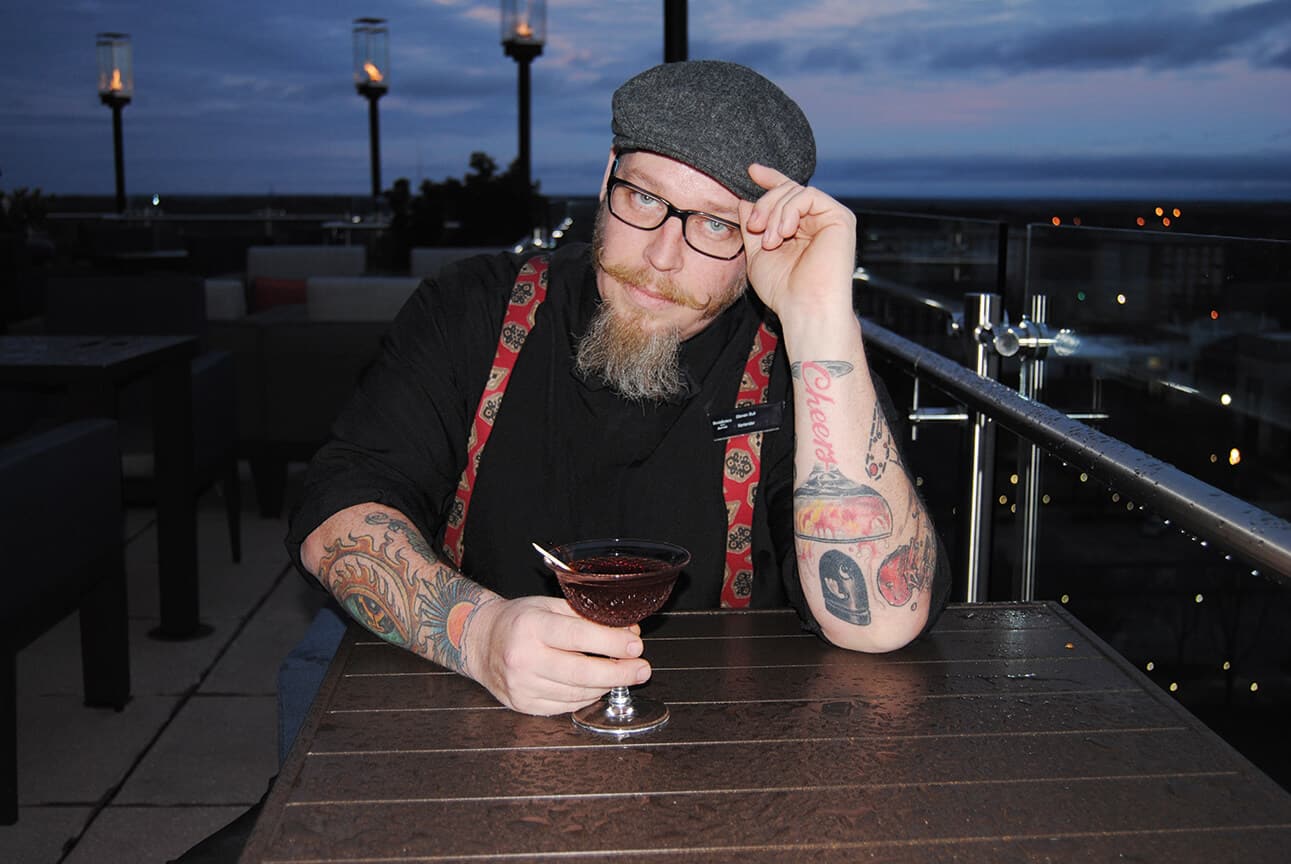
If it’s after5 o’clock, you’ll likely find Steve Bull chipping away at an ice sphere for one of his regulars, sleeves of his pressed shirt rolled up just above his elbows, exposed forearms showcasing a storybook of tattoos designed by his brother, an artist. The veteran bartender at downtown Raleigh’s 10th and Terrace—the rooftop bar located on the highest floor of the Residence Inn on South Salisbury Street—is left-handed, so it’s the left arm that he’s dedicated to his craft: There’s a sketch of a flaming Manhattan in a coupe glass with the word “cheers” in place of the stem; there’s a bullet to symbolize his favorite Bulleit Rye Whiskey and there’s a drawing of a single-prong ice pick, to name just a few.
Bull, who relocated to Raleigh from Maryland a little over a decade ago, has tended bar at 10th and Terrace, overlooking some of Raleigh’s best-known landmarks, since it opened in 2017. Before that, stints at places like O-Malley’s Pub, the old Ziggy’s Bar and Restaurant in Wake Forest, the Renaissance Hotel in North Hills—even a two-year go at co-owning his own spot—fill up his resumé. But, in contrast to the wayward college student who found a place at the bar before moving on to find a career, Bull knew more than 20 years ago that, for him, the bar was a career.
Following a job working as a lab tech at Johns Hopkins University in Baltimore, Bull, seeking a change, found himself newly married and unemployed. “It was a restaurant called Maggie’s,” Bull recalls of his first bartending gig in Westminster, Maryland in 1997. “I walked in and told the owner I had no bartending experience. But he let me in and agreed to train me.”
Now, with years of experience under his belt, Bull fine-tunes his signature cocktail ice behind a marble bar top at 10th and Terrace. It’s a transparent, rectangular block that’s frozen in a five-quart Igloo ice chest every other day. Bull tempers the ice perfectly before he cuts away at it with ice picks, creating personalized shapes for his guests. To Bull, the guest is everything; from the businessman who knows exactly what he wants to the wedding party full of bridesmaids looking for something new. Bull’s best guest, he says, is one who can “take some time to talk” and engage with him over creative cocktails.
Of course, over the years, Bull has landed in some challenging environments. But none have been extreme enough to have driven him out of the industry completely. “I believe you need to enjoy what you do as work,” Bull says. “If there comes a time when I start dreading going in to work, then I know it’s time to find another gig.”
At 10th and Terrace, a couple visiting for the weekend quizzes Bull on his favorite dishes. In the service well, a block of ice, fresh from the Igloo, reflects colors from an array of bottles on the back bar, including his favorite Bulleit Rye Whiskey. At home, Bull’s wife, Amy, watches over the couple’s six children. It’s Bull’s birthday, and he’s working, but none of this bothers him. “Everything I’ve done the past 21 years is bartending,” Bull says. “So many people come up to me and say, ‘Hey Steve, what are you gonna do after this?’ And I just say, ‘This is it.’”