by Christa Gala | Apr 10, 2017 | Eat, February 2017
Southern Living named Raleigh among the “Top 10 Tastiest Towns in the South,” and last year Zagat named us #19 in its “26 Hottest Food Cities.” Independent restaurants are flourishing, and national chains are knocking. The great news: national chains can be allies to local businesses, especially in affluent downtowns like Raleigh, Austin and Denver, says national restaurant industry expert Darren Tristano.
“The better the economic area, the better the chains and independents will work together,” says Tristano, president of Technomic, Inc., a research and consulting firm that specializes in data, trends and forecasting. “A good trade area is critical to success—entertainment venues, sporting arenas, movie theaters. The other part that’s key is having the right economic demographic—the middle upper income group, whether it’s retired boomers moving back to the city or being around the right corporate environment that gives you a large number of workers.”
High-end chains like Capital Grille and Seasons 52, both owned by Darden Restaurants, were eager to join Raleigh’s vibrant and much-talked-about food scene. Capital Grille is one of the top-ranked steak houses in the nation, and it opened last year in the new Bank of America Tower at North Hills. Surrounded by dozens of businesses, the restaurant serves both a corporate and local clientele.
Managing partner Joseph Butler says feedback has been fantastic. “Since arriving, our neighbors have welcomed us with open arms to an already sophisticated dining scene,” he says. “We look forward to welcoming many new faces in the coming months.”
At Crabtree Valley Mall, the newly opened Seasons 52 offers an usually diverse wine list—serving more than 100 bottles and 52 by the glass; the move created more than 100 jobs. While newly opened J. Alexander, located just behind the mall, is part of a collection of boutique restaurants based out of Nashville. The company chose Raleigh for its first North Carolina location and also hired approximately 100 full and part-time employees.
“The change with chains is that they’re looking at this business in a way where they’re adapting locally,” Tristano says. “It isn’t a one-size-fits-all. They’re going into a market; they’re using local architects. They’re building stores that don’t necessarily follow a cookie-cutter philosophy.”
Tristano has seen chains use local artwork and photography—or local materials—for interior elements. These days, chains also want to share more details when it comes to the bottom line. Also, national chains are often more local than consumers think.
“Chain restaurants are typically owned locally and run locally,” says Tristano. “The people who are there represent, in most cases, 25 to 30 percent of the restaurant sales through their labor and expenses. Often, you’re supporting local distributors, suppliers and farmers. I think many people forget that restaurants are about a 5 percent profit margin, and most of the money is spent locally.”
Still, it’s all about the experience. “It’s always going to come down to quality, value, execution, service; those things are always important,” he adds.
Of course, the relationship between larger corporations and local businesses can at times be rocky, and it can play out in the press and on social media. In September 2016, 1010 a burger chain owned by actors Mark and Donnie Wahlberg, announced it would open its first North Carolina location in January in The Hudson building, which formerly housed the Oxford. The area is ripe with potential diners, but the Oxford has been shuttered for more than a year, leaving those who live in the building with fewer options.
The Downtown Raleigh Alliance was excited, tweeting: “#MarkyMark is feeling those #goodvibrations in #downtownRaleigh! We showed Wahlburger’s the space where the Oxford used to be, and they’ll be opening next year!”
In an N&O article published shortly after, several independent restaurant owners weren’t as happy. “I think it sort of sucks the soul of out downtown,” said Van Alston in the article; Alston has owned Slim’s downtown since 1999.
Now, spring is here; Wahlburger’s is not. But Kelvin Dumas, the commercial broker with Colliers International who put together the deal, said Wahlburger’s will open this quarter. The delay is due to rollouts of other southeastern Wahlburger locations, not pushback from independents.
Still, the push-and-pull between national chains and independents is not new; it spans across all industries—and cities—when it comes to urban development.
“Generally, a healthy business mix will have both locally-owned businesses as well as chains to serve different types of users with varying preferences,” says Danny Vivenzio, communications manager with the Downtown Raleigh Alliance. “We do most of our work with the former and want to see downtown always maintain a strong local business core, even as we see more national chains potentially move into the area.

by Christa Gala | Feb 1, 2017 | Eat, February 2017
February is pretty much the month of hibernation in the South. We’re impatient to get on with warmer weather—especially since the delight of the holidays and the suspense of the Super Bowl is over. February is that month of doldrums; there are some days when only one thing will help: a change of scenery.
That, and comfort food. Anything buttery, creamy, cheesy or crispy that offers nostalgia and warms the belly. And if you can find a place that offers comfort food with beer, live music and games, even better. Some pubs even welcome dogs. Here, six pubs we love.
328 W. Morgan St.
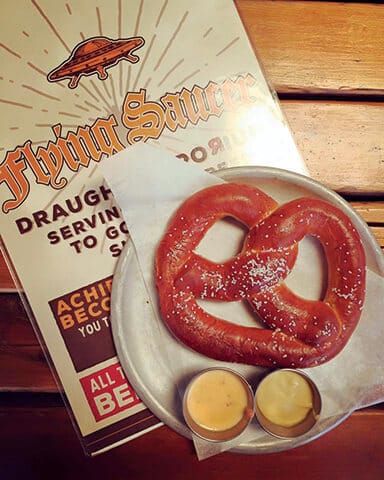
Check out the tap wall made of pennies or nurse your beer on one of the comfy couches, but definitely make sure to peruse all the plates on the wall of this pub. The “saucers” represent members of the UFO Club ($18 to join), all of whom have consumed at least 200 beers at the Flying Saucer.
And don’t even think about bar peanuts here. The soft pretzels are everybody’s favorite, says McKinzie Barnum, “beer goddess” at the Flying Saucer. “Our pretzels are a big thing; they’re fluffy and the sauce is good,” she says. “You can get cheese ribboned in, spicy mustard. We make our own cream cheese and you can get that too.” Other favorites include the Grilled Cheese served with Tomato Soup, Shepherd’s Pie and a German plate.
On Sundays, N.C. pints are $3; Mondays, nearly all drafts are $3, and Tuesday nights bring Bar Trivia.
311 Glenwood Ave.
A fire in 2012 devastated the original Hibernian, but the rebuild brought it back better than ever with a spacious rooftop patio. Inside, you’ll still find dark wood, cozy nooks and crimson red décor.
“Even though we’re bigger, we still try to maintain that small, country pub feel,” says General Manager Gerry McDermott. The menu features the traditional Irish staples guests love, including the Irish Breakfast and Shepherd’s Pie.
There’s something going on most days of the week here—Bingo Tuesday, Trivia Wednesday, live Celtic music on Sunday and $5 build-your-own burgers on Monday.
This Irish pub is well into its second decade in Raleigh, due in large part to its traditional “public house” feel, says McDermott. “You can either come in with a bunch of people and have a good time or you can sit at the bar by yourself and have a good time.”
6010 Falls of Neuse Road
A local family favorite, North Ridge Pub is often described as a “little gem,” where you’ll find weekly brunch, crab cakes and homemade pimento cheese—perfect on the pimento cheese bacon burger. Nachos and cheese fries are big favorites year round as are the mac and cheese, meatloaf or Philly cheese steak.
Although it’s not always on the menu, the baked ziti is a huge hit, says hostess Chloe Hegel: “It’s very good. When we make it, it goes quick.”
A new location is larger to accommodate more diners. And though the pub doesn’t host weekly events, the relaxed environment offers a comfortable space for conversation. It’s also a great takeout option.
10370 Moncreiffe Road—Brier Creek
3107 Grace Park Drive—Morrisville
Trali’s head chef, Eamonn Kelly, trained in Galway, Ireland, and takes pride in making traditional Irish dishes using locally-sourced food.
“We do a nice version of Shepherd’s Pie with grass-fed ground beef,” says co-owner Martin Mahon.
The seasonal menu changes every six to eight weeks and is more upscale than traditional pub fare. One recent menu included Chapel Hill Creamery Brie with crostinis and strawberry preserves as an appetizer. Another favorite: the $10 Rasher Stacker with Irish rashers, turkey, ham and cheddar on Sourdough.
On Mondays, all N.C. beers are $3, and Wednesdays offer half-price bottles of wine while Thursdays bring $5 Irish Whiskey. Catch Pub Trivia on Monday’s at 9 p.m. (with a $100 prize).
909 Spring Forest Road
You wouldn’t think to pair Mediterranean and Irish fare on the same menu, but it works! Try the traditional Fish & Chips or Bangers and Mash or go for the beef kebab, hummus, gyros and Tzatziki Dip. Bartender Courtney Scharinger says the eclectic menu offers dishes from other regions as well.
“The Bourbon Street Medley is my favorite,” she says. “It’s got a Cajun cream sauce, three-cheese tortellini, chicken, kielbasa sausage, mushrooms and onions.”
Daily specials include $3 pints; live music draws a crowd on Thursday, Friday and Saturday nights as does Tuesday’s Open Mic night. Get there early. The dog-friendly patio with fire pits is a great option any time of year. S&S just added a bottle shop, and it’s a big hit with patrons.
“We really get to know our regulars,” says Scharinger. “Most people want to keep drinking after they leave a bar; instead of having to stop at the store, you can check out the craft bottle shop before you head out.”
8304 Falls of Neuse Road
Owner and chef Dan Hurley says there’s one thing you won’t find on The Piper’s Tavern menu: Kale.
“We’re pretty much carnivores, and our menu is old-school,” says Hurley. “We roast all our meats in house, I grind all my own sausages, I corn my own beef, I smoke my own pastrami—a lot of things from scratch. Gluten runs free up and down my menu.”
Serving traditional food in traditional ways is a strategy that’s worked for 17 years. On Tuesday nights, Hurley makes international or regional cuisine. He’s a stickler for genuine dishes.
“Whether it’s German or low country or Chinese, it’s all authentic, and it’s all high end,” says Hurley. “By doing that, I teach myself, and I teach my cooks. We educate ourselves and hopefully get a little treat to the public.”
There’s always something going on at Piper’s, whether it’s live music, Sunday brunch or Sunday Trivia with “Big Slow Tom.”
“He packs the place,” says Hurley. “Between Sunday brunch buffet and this trivia, we’ve turned Sundays into a fantastic day.”

by Christa Gala | Dec 14, 2016 | December 2016 / January 2017, Polish, Stuff
Julie Majkowski is sick of “fast fashion,” the mass-produced clothing churned out every season by the big box stores.
“The fabric of late is of terrible quality,” says the owner and designer of Random 434 boutique in downtown Apex. “It doesn’t wash well; it certainly doesn’t wear well, and it can’t be worn for many years. It’s tossed away and filling up our landfills.”
Majkowski has a point. For the past five years, fast fashion retailers like Zara, H&M and Forever 21, among others, grew 9.7 percent each year, compared to 6.8 percent for traditional retailers, according to the financial holding company CIT. But often that top you paid less than $10 for is either out of style—or falling apart—in just a few months.
At Random 434, located upstairs over the popular Common Grounds coffee shop, Majkowski makes custom pieces out of gently-used quality clothing, refashioning them to fit trends—and different-sized bodies. She also makes custom handbags and scarves and teaches sewing. An accomplished seamstress, she initially started combining pieces for her own wear.
“I was refashioning clothing for myself as I was getting older and more full—I guess that’s the nice way to put it—and wanted to cover my derriere and still be dignified,” she says.
She mulled over the concept, thinking she’d hit on a need that wasn’t being met, and she could turn it into a business: “I just knew the clothing was going to take off because there are more women like myself who are my age and fuller and want to be dignified. I’m addressing it.”
Then one night as she had what she calls a “creative explosion” at 4:34 in the morning—hence the name for her business.
“As I was falling asleep, I was thinking, ‘How am I going to know what to buy in a clothing or consignment store? It would be whatever the world offers….random.’ What a great word. And then I jumped out of bed at 4:34 a.m., alive and on fire,” she says. “I took my pen and paper and wrote down exactly how I saw my new name and bought the domain name. I was on the computer all morning writing everything down.”
She spent the next two days shopping for inventory or, as she calls it, “thrifting.”
“I bought things that I saw could be combined right there. I made the clothing, all repurposed, all one-of-a-kind, and all the pieces sold in a month. The clothing I find is much better quality from before ‘fast fashion’ was a thing and better lines of clothing, which I’m familiar with, and I make them look like wearable art, one-of-a-kind pieces,” she adds.
Majkowski’s instinct was spot on, but she didn’t anticipate what happened next—customers started bringing her clothing from their own closets.
A dress they loved but didn’t wear anymore could extend a too-short top, creating a great tunic for leggings. Other pieces were reshaped and outfitted with buttons, a flared waist or a reworked collar. Quality fabrics like linen, lace, cotton, wool and silk were used to custom-create clothing, recycling what women already had—and liked. The average price per piece is about $50.
Word is spreading. The problem now is that Majkowski has more work than she can handle by herself; her part-time seamstress had to leave for a full-time job. But Majkowski’s looking for more help; in the meantime, she’s not worried. Apex has been good to her.
“It’s called persistence and believing in possibilities.”

by Christa Gala | Dec 7, 2016 | December 2016 / January 2017, Do
Attending a neighbor’s barbecue benefitting the Avon Walk to cure breast cancer (called Avon 39) was all the inspiration Debbie Cain needed to get involved. Cain, owner of Inspirations Home Décor and More on Glenwood Avenue, had her own breast cancer scare, and her marketing director lost her mother to the disease.
“Since many of us within the store have been affected by breast cancer, it was the perfect fit,” she says.
Cain and other sponsors, including Bella Monica, have partnered together to help raise money for breast cancer awareness and research through a fun evening of shopping.
The event, “Girl’s Night Out,” is a silent auction party that donates 100 percent of the proceeds to Avon 39 and awards $500 worth of design services to the winner of its scavenger hunt. All are welcome, although Cain asks guests to RSVP; donations at the door are appreciated. The night includes lots of extras and offers, exclusive girl time, as well as an opportunity to cross some names off your shopping list.
This will be Carrie Rosenquist’s third year attending; she’s had good luck winning items and enjoys bidding. Last year, she spent $20 on a tray, $10 on a pearl bracelet, and $25 for multiple pillows.
“On auction they have jewelry, clothing, furniture, home décor pieces, and gift certificates to restaurants,” says Rosenquist. “The auction items are generous. It’s usually packed and everyone is laughing and eating. I recommend getting there early to grab a parking spot.”
It’s no secret that increased fundraising for breast cancer around the globe has helped improve survival rates, which provides fuel for Cain to continue hosting more “Girl’s Night Out” events. The store holds three a year and so far has donated a total of $10,000.

by Christa Gala | Nov 14, 2016 | Do, November 2016
Could you win a violin just in time for the holidays?
Student Katelyn Martin tried twice before finally winning a custom-made violin from wood carver Mike Anderson. That’s two essays she had to write; the second one, written when she was 17, did the trick.
“It meant a lot to win the violin,” says Martin, a freshman now at Guilford Technical Community College. “I actually played the violin that I won at the State Fair last year, and it was the most sought after by all the violin players at the fair. It was also my last year of being able to try for the free violin.”
For the past 17 years, Mike Anderson of Louisburg has carved violins, violas, cellos and fiddles as FiddleMaker Mike. Four years ago, he decided to give away one violin every December to a North Carolinian between the ages of 10 and 17, awarding the prize based on a simple 300-word essay. For two of those four years, he’s given away two violins. Because sometimes the essays are so good, it’s hard to pick just one.
Anderson has been carving wood since he was a boy. He started with a bar of soap at the age of 5 or 6. He progressed to bowls and spoons but eventually wanted something more intricate.
“I’ve done a lot of different things in wood, and I wanted a challenge that would take me beyond my lifetime to figure out,” says Anderson.
Carving string instruments for nearly two decades, he works with a special mentor. Arthur Conner, 92, of Copper Hill, Virginia, is teaching Anderson what could very well be considered an art in danger of extinction. Before finding Conner, Anderson read books and attended university workshops.
“He [Conner] said, ‘I’ll teach you everything I know’ and for the past several years, I’ve gone to his home and spent weekends with him, and his wife has fed me meals, and I’ve stayed at his home,” says Anderson. “I’m still striving and learning.”
Each violin takes 200 hours to make and costs $1,200 retail. But Anderson does it largely for fun. He works full-time restoring and renovating homes but estimates he’s made 62 violins, five violas and two cellos in the past 16 years.
“I harvest all my own wood,” says Anderson. “It’s basically from the forest to the fiddle. I use local North Carolina Red Maple and Virginia Red Spruce.”
Anderson traces his interest in string instruments back to his Minnesota childhood.
“As a small child, my mother played classical music, and I heard so much violin music I think it may have had an impact on me,” says Anderson, whose great-grandfather also played the fiddle.
Enter to win a violin!
To win a free violin for Christmas, you must be between the ages of 10 and 17.
Submit ONE essay [up to 300 words] explaining why you or someone you know should receive a free violin to [email protected] between December 1st and December 15.
For more information, visit fiddlermakermike.com



