A new cocktail bar from V Pizza’s Anthony Rapillo mixes up the options in Brier Creek.
Flask sounds like the kind of bar that would be more at home Downtown, rather than tucked away in a Brier Creek shopping center behind a Planet Fitness, Panera Bread and Supercuts. In some ways, that’s the point.
Anthony Rapillo, the 33-year-old owner of the forthcoming cocktail bar, lives a few minutes away. As a single guy and big tequila fan, his options for a more intimate drink or post-work cocktail are limited here. This area, where Glenwood Avenue and Brier Creek Parkway intersect, is known for big-boxes like Walmart Supercenter and restaurant chains such as Olive Garden and Bob Evans.
“I live really, really close to there,” said Rapillo in an exclusive interview with Raleigh Magazine ahead of Flask’s opening. “There’s not really anywhere I could go and get a nice cocktail. We saw a need for it.”
Slated to open in early November, Flask will feature a range of classic cocktails, as well as an assortment of originals from Beverage Director Matthew Giles. The North Carolina native helped open the acclaimed Broken Shaker cocktail bar in Miami, suggesting Flask will be far from your run-of-the-mill watering hole.
“We’re going to do this together in the Triangle as long as people keep coming out and supporting us.” —Anthony Rapillo
Occupying its own space inside a newly constructed building on Skyland Ridge Parkway, Flask will abut another new business from Rapillo: V Pizza. The Florida-based Neapolitan pizza chain (with a Cary location that opened in late January 2020) will expand into the building as well. The 3,800-square-foot space will be split almost evenly between V Pizza, Flask and a shared back-of-house. The two spots will share a 1,400-square-foot patio outside as well, said Rapillo.
The pizzeria’s full menu—including its popular wings—will be available at Flask, but the bar will also boast a separate late-night menu after the more family-oriented V Pizza closes nightly. Think stuffed mushrooms and bruschetta, with the food menu designed to complement the drinks rather than the reverse.
In Cary, V Pizza offers an adjoining bar with dozens of beers on tap; Rapillo likened it to more of a sports bar vibe. With a Carolina Ale House location just a short walk from Flask, that’s less needed here. But Rapillo still wants to deliver the community vibe from his Cary outpost, starting by featuring the winning concoction from a cocktail competition held there. Diesha Banner of A Glass Above stole the show with her Lavender Berry Lighthouse, and her signature drink will star on Flask’s drink menu for six months.
Unlike the Cary location, where Rapillo took over an existing pizzeria’s space, he’s been involved in shaping this corner of Brier Creek from the ground up. Two of Flask’s four walls are glass—one of those being garage doors that open out to the patio—allowing in generous lighting during the day. It will still retain an intimate vibe, said Rapillo, adding: “This will feel a little more like us.”
As he struggled to stay open through the pandemic, Rapillo never thought he’d already be opening two new businesses. But a reliable staff and strong community support buoyed his confidence. He’s already envisioning half a dozen V Pizza locations across the Triangle, from Holly Springs to Durham, each with a distinct bar concept reflecting the given neighborhood’s needs.
“We’re going to do this together in the Triangle as long as people keep coming out and supporting us,” Rapillo said. See you there.
Exclusive: Bar and restaurant owner Jason Howard is opening two new spots in DTR that you will either love or hate—either way, it won’t bother him.
Photo by Food Seen by Felicia Perry Trujillo
Photos by Susan Holt Photography
Jason Howard isn’t particularly concerned with what people think.
“I find it better when you put your blinders on and do what you think you would like,” said the Raleigh bar owner and restaurateur in our exclusive sit-down interview. “Just open up something you like and see what happens.”
Howard, a service industry lifer who’s worked everywhere from Applebee’s to Pittsboro’s Fearrington House, is the man behind the Downtown members-only speakeasy Atlantic Lounge and hot dog dive bar The Cardinal. And, now, he’s unveiling several other projects around the same time in DTR, its exurbs and beyond.
One of these projects, which will be located up the street from The Cardinal, is a 23-seat “diner-esque country kitchen” called Rainbow Luncheonette. It’s the opposite of the many chef-driven places that are opening (or have recently opened) around the city, focusing instead on more modest classics.
“It’s basically a Waffle House on steroids—with liquor,” Howard laughed. As always, he’s having fun with it. In addition to diner staples, Rainbow Luncheonette will serve breakfast and lunch, and, on Thursday, Friday and Saturday nights, handcut steak, baked potatoes and salad will grace the menu.
“I’m either going to get laughed out of town, or just the opposite,” said Howard. “But either way, it doesn’t matter to me. There’s nothing else you can do these days with bars, so you just have to be as against the grain as possible.”
It’s that take-it-or-leave-it mentality that frees him up to be different, opening decidedly untrendy concepts like the forthcoming Pink Boot. The country music-blaring, domestic beer-slinging honky-tonk will be “the smallest, weirdest bar” in Raleigh, he said—the kind of place where Yoo-hoo, vanilla Stoli and Godiva come together in just one of the many “trailer trash” cocktails.
The only food offerings at Pink Boot will be pickled Brussels sprouts, peanuts and Lunch Lady Pizza (literally the same mass-produced square ’za shipped in from New Jersey and made famous in public school cafeterias nationwide—which also serves as a nod to his mom, who was Howard’s head lunch lady and school bus driver from elementary through high school).
“Everything’s getting a little too complicated for me,” Howard explained. “There’s just so much going on in Raleigh, you’re just missing some simple stuff.”
Instead of chasing trends, Howard hopes to open restaurants and bars that can last a generation. “The simpler they are, the more longevity you have,” he argued.
And, despite arguably being on the cutting edge of the Oak City’s food and beverage scene, Howard rejects the idea that anything he’s doing is innovative. “These kinds of places have been all across America your entire life,” he said. “You’ve just got to find them. They’re not front and center.”
He’s also expanding The Cardinal to Clayton and Wilson, and he’s working on a taco place called Lil Hombre that emphasizes smoked meats, tequila and frozen margaritas. But previously announced plans for a barbecue restaurant were tabled—at least for now.
Howard isn’t turning away from Raleigh; after all, he’s about to open two new businesses here, and others will likely follow some day, he said. But his sights are set beyond the Triangle, as he muses about reaching into places like Rocky Mount or Winston-Salem. He’s particularly excited about his plans for Wilson and Clayton.
“I’m banking on small-town America,” he said. “These small towns are ripe for the picking. Clayton is awesome. It reminds me of [Pittsboro], where I grew up. Wilson may be the most beautiful downtown in the state. Go see it before all the growth happens.”
At first blush, Howard’s concepts seem dissonant. A speakeasy where patrons need a key to enter, and then a honky-tonk? A taco place and a Waffle House on steroids? Expanding to Wilson, nearly an hour east of his Downtown empire?
But on closer inspection, there’s a through-line. These establishments are neighborhood-oriented and hyperlocal. They aren’t designed for the zeitgeist or the limelight, but play on a humble kind of nostalgia. They’re small—usually really small—and follow a clear philosophy. And the disparate styles reflect their creator, a man just as likely to be listening to Run The Jewels as Waylon Jennings. “If you like it, you like it; if you don’t, you don’t,” said Howard. “We want to make money while keeping our integrity.”
Howard’s approach to opening bars and restaurants is, in many ways, the reverse of his peers. “I don’t ever go looking for a space for a concept,” he said. Instead, when he finds a spot that interests him, Howard likes to stand in the space, feel it out and study the neighborhood to decipher what would make sense.
“Sometimes you need to let the building tell you what it wants to be,” Howard added.
That’s what happened with Atlantic Lounge. For The Cardinal, he passed the building so many times on the way to his friend’s business across the street that he eventually decided to think about what he could turn it into. Same for Rainbow Luncheonette. When he saw the tiny adjoining space, Howard mulled it over until the idea for Pink Boot was born.
It’s not that he isn’t interested in scaling his success—after all, he’s replicating The Cardinal beyond city limits, and describes Lil Hombre as a very similar format, only taco-based.
But he’s too creative, and maybe a little too impatient, to ever be satisfied with just one idea. “I get bored too quickly,” he said. “I like to do a lot of different things.”
Howard maintains that part of the key to launching so many different businesses, especially in an industry with high turnover, is to keep it small. (That—and he gets by with a little help from his friends: “I couldn’t have done any of this without my partners,” he said.)
“I don’t think I’ll ever do anything over 1,500 square feet,” he said. It isn’t manageable enough. You lose that strong relationship with employees. And the costs multiply. By denying his businesses any elbow room, it’s easier to iterate, and to care less if it fails, Howard added.
“I don’t have that much to lose with these small spaces, which lets you get a little weird,” he said. But weird perfectly fits Howard’s MO—and Raleigh sure seems to love it.
Raleigh’s Community Food Lab isn’t your average consulting firm.
Maybe this article should be about something else, Erin White suggested. As the founder and principal of Raleigh’s Community Food Lab, White’s more interested in talking about issues like food insecurity than talking about himself. He mentions in passing that he’s cooked at a couple restaurants, only revealing when asked that he spent time in kitchens like the seminal Crook’s Corner or cooking alongside Chapel Hill’s now-acclaimed chef Andrea Reusing. And he put in time as a cook and chef in Napa as well.
White’s modesty belies his experience, which ranges from working on a farm to a master’s degree in architecture from NC State. With the Wolfpack, he honed his thesis on how design thinking could help create more vibrant and resilient food systems, drawing on his experiences in restaurants, public health statistics, studying biology and more. It would later lead him to found Community Food Lab, a consulting firm connecting food systems and design thinking.
Right now it’s just White, but since its founding, the Boylan Heights-based Community Food Lab has sometimes included a team of two or three working on projects from the likes of the urban agriculture plan for North Hills and a statewide farmers market study to helping Raleigh’s UNC REX Healthcare create a food pantry. The idea is to make the local food system—from farm to fork—more sustainable, resilient and equitable.
White may be more reluctant to talk about himself, but he dives right into describing why this work matters: “If you look really honestly at our food system, it’s not doing very well. And, yet, most Americans take for granted that they can go to the grocery store and experience abundance, and there will always be everything they need there.”
Our food system is plagued by a host of issues, from childhood hunger to loss of farmland, but chief among them are “these existential problems of climate change and structural racism,” says White. To the Chapel Hill native, food is a lens through which to take on and find solutions for these overarching societal issues. That’s why Community Food Lab authored a Food Security Plan for Wake County several years ago, and it’s why, earlier this year, he urged Raleigh City Council to invest in a citywide food policy to look at issues like urban farming, composting, partnering with farmers and more. (He’s still waiting on council to make a decision on the idea.)
Ultimately, the goal of the Community Food Lab is to build a stronger local food system, and one way to do that is by bridging the gap between the urban Triangle and its surrounding rural farmland. It means a food system that can better withstand disruptions in the global supply chain (think of the recent chicken wing shortage). And it means tackling issues like the exploitation of agricultural workers and food service workers head-on.
It’s not that White pretends to have all the answers—quite the opposite. He sees his role as more of a convener, drawing people together and discussing new ways of thinking about “wicked problems” that can result in mutually beneficial solutions. It’s a tall order, and even eight years in, White is still figuring out exactly what that means and how he can best contribute.
“I think I see myself as trying to be valuable,” he says. Considering how unique a role White plays in Raleigh, it’s obvious he already is. communityfoodlab.org
Resto combo—one of Food Network’s Diners, Drive-Ins and Dives fame—lands in DTR.
“I want to trigger people’s curiosity,” says Trey Owens of his and Ari Augenbaum’s new Raleigh restaurant’s edgy name: JewFro. “The first thing everyone does is read something and decide how offended they should be. I want to spark people’s interest.”
For Owens, a Black Southerner, and Augenbaum, a Jewish chef, JewFro is a chance to explore the commonalities and corollaries between various Jewish and African cuisines and how two very different cultures can come together in an unexpectedly harmonious way. Together with business partner Nar Hovnanian, an entrepreneur with Armenian and Middle Eastern roots whose culture includes very similar food, Owens and Augenbaum designed the new restaurant concept to be not just palate-pleasing—but a conversation-starter.
“It’s about representation,” says Owens. “It’s about showing you that there’s so much more to a culture than what you hear about.”
The trio operates Soul Taco—a popular Richmond restaurant featured on Food Network’s Diners, Drive-Ins and Dives that’s known for its oxtail al pastor and buttermilk-battered fried chicken tacos, among other fusion recipes. During the pandemic, they experimented with various pop-ups, including JewFro, which melds common Jewish and African ingredients and cooking styles. It was a hit.
Now, they’re preparing to expand across state lines, opening a Soul Taco location—quickly followed by JewFro—inside the former Remedy Diner by Goodnights Comedy Club and Irregardless Café. The building is large enough to hold both restaurants, which drew the partners in.
“We’ve had our eyes on Raleigh for quite some time,” says Owens. “Raleigh’s poppin’, so it was really hard for us to get in at first. Baltimore or Nashville had been discussed. Fortunately, things in Raleigh went from looking almost like it wasn’t going to happen to coming together really well.”
Soul Taco will focus on replicating the success of its two Richmond locations. Slated for a late summer or early fall opening, this establishment, Owens insists, is not like other soul or taco restaurants. For starters, everyone—including dishwashers and servers—earns a living wage.
The team relies heavily on fresh, local ingredients and making everything from scratch—which includes braising some meats for 12 to 14 hours, Hovnanian says. But more than anything, it’s the blend of foodways that makes Soul Taco unique. “It’s like somebody’s abuela moved from Mexico down to Atlanta,” says Owens.
At JewFro, the menu is arguably more distinctive and original. While the millennial restaurateurs are still finalizing the menu, a draft includes items like a West African peanut soup with ground Moroccan lamb and kreplach, or Jewish dumplings. A brisket sandwich on marbled rye gets a makeover using an Eritrean dry brine technique, ras-al-hanout slaw, and a harissa and preserved lemon aioli.
Ashkenazi Jewish household favorites including pastrami, challah, latkes, potato kugel and chopped liver all make appearances, as does a South African piri piri chicken; a Doro Wat Ethiopian spiced roasted turkey; and a wide range of ingredients and preparations popular in Tunisia, Egypt and Cote d’ Ivoire. In line with their mission to start conversation and cross-cultural understanding, Owens says they’ll have a glossary of terms on the back of the menu so diners can learn more about a dish’s origins.
“The concept of JewFro is inclusion,” says Augenbaum. “At first, we worried it would be difficult to meld these cultures together. Once we started working on it, we started seeing how many similarities there are.”
For Owens, who can trace his family’s roots back generations to slave ships but not to the continent, it’s also been a journey of self-discovery. “This allows me to dive deep into all of Africa, and then also my own business partner and what he eats and partakes in,” Owens says. “That’s purposeful.”
Hovnanian agrees. “I think each concept has a very unique blend of all of us,” she says. “This is very much our food and very much tells our story. We are always giving each other a chance to talk about things because we have this relationship. We want people to just stop and try to understand each other.”soultacorva.com.
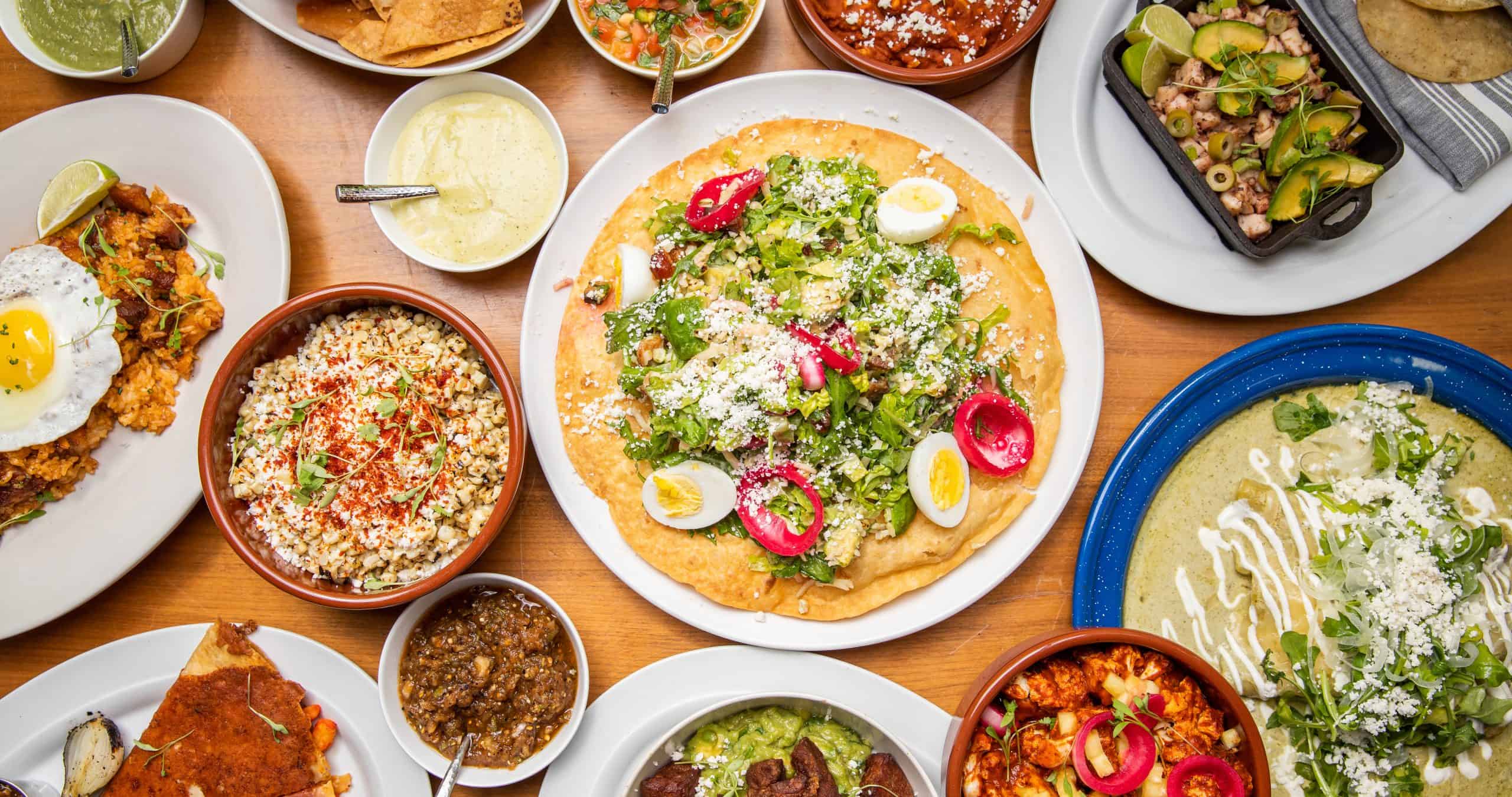
Approachability, affordability and accessibility—and flavorful homegrown dishes—are at the forefront of Katsuji Tanabe’s new restaurant, a’Verde Cocina & Tequila Library.
Katsuji Tanabe wants to transport you to his hometown. His forthcoming Cary restaurant a’Verde Cocina & Tequila Library, a partnership with LM Restaurants (Carolina Ale House, Taverna Agora, Vidrio and more), will introduce the Triangle to dishes that could be found at his childhood family table in Mexico City, as well as the kind of energized and creative cooking happening at the city’s best restaurants today.
“If you were to go to Mexico City right now and you were to go to a cool restaurant in the middle of the city, you’ll find something similar,” Tanabe told Raleigh Magazine in a sit-down interview. “It’s a restaurant you could open in LA, in Chicago, in New York—in Mexico City.”
Tanabe—a Chopped champ and one of the premier Mexican chefs in the U.S.—has been working as the culinary innovator for LM Restaurants since his debut Raleigh restaurant, High Horse, closed in July 2020. Now, he’s going back to his roots, tapping into the family recipes he grew up eating in Mexico’s capital (think an adobo fried rice with crispy pork belly, topped with a cracked egg like his dad used to make on Sundays) to curate the affordable menu at a’Verde, which is slated to open in Crossroads in the former Wild Wings location in late summer/early fall. The refried black bean recipe that his Japanese father used to impress the family of Tanabe’s Mexican mother also makes an appearance.
a’Verde diverges from most Mexican restaurants in the Triangle in several ways, including a dearth of rice, beans or cheese. Instead, Tanabe will rely on vegetables and seafood in particular—akin to what’s happening at the best restaurants in Mexico City, he said—with strong umami and acidic flavors. Japanese ingredients may not grace the menu itself, but fish sauce, soy sauce and miso will be workhorses behind the scenes in Tanabe’s kitchen, used to create layers of flavor.
Additionally, a’Verde will nixtamalize its own corn for tortillas, and dried chiles will be added to the masa to give it a reddish hue. The dishes will be infused with modern takes, including cubed and deep-fried steak for a delightfully satisfying build-your-own taco dish (pictured above).
“I remember the first time I heard of it in Mexico, I was like, ‘Don’t order it, it’s stupid; why would you deep-fry a ribeye steak?’” he said. “And then I ordered it in a taco and was like, ‘Oh, shit.’ I still feel a little dirty for deep-frying a steak, but there’s no flour or nothing; it’s just straight into the deep fryer. It doesn’t make sense until you eat it.”
The tender cochinita pibil—a Yucatán-style marinated pork dish—and the savory enchilada verde are among Tanabe’s personal favorites here, and rightly so. But the ribeye taco is just as mouthwatering as he makes it sound, and the bingeworthy corn esquites are a must-order. The same is true for the punchy and bright cauliflower al pastor. a’Verde aims to be upscale yet approachable, so it’s a good thing entrees like the massive shrimp quesadilla pull their weight.
We’re fortunate that LM Restaurants snapped Tanabe up before he could leave town because we’re going to need to get our hands on those tacos (and, well, everything else) ASAP.