Raleigh’s first cidery will open this spring. And Raleigh Magazine gets the exclusive look inside.
Raleigh is finally getting its first cidery. It’s about time, right?!
When East Bower Cider Co. (originally known as Shady Grove) opens inside the new East End Market near Atlantic Avenue and Capitol Boulevard late this spring, it will seize on a growing market for hard cider in the Oak City. Co-owner Oliver Koch saw that rising demand firsthand last year while managing State of Beer.
“When we put cider on draft, more people were willing to try it than I’d ever seen before,” he told Raleigh Mag in an exclusive interview.
Koch, who’s spent 15 years in the craft beer industry, quit his job at Terrapin Beer two years after Miller acquired it. Craft beer used to feel punk rock, he said, but it’s lost some of its edge. That’s partly why, when he quit, he planned to open a cidery. The pandemic froze that plan, and Trophy Brewing Co. offered him a soft landing until he could work out the details.
“They’ve been instrumental in every way with helping me launch this,” said Koch. “Trophy is the reason that East Bower Cider is going to exist.”
After another major setback—a potential legal battle that forced him to scuttle the planned “Shady Grove” name he’d been using for years—Koch is set to open East Bower Cider Co. in May or June.
But Raleigh may not be ready for a standalone cidery. That’s why East Bower will feature a full bar with beer, wine and liquor, in addition to making up to 60 barrels of cider at a time. Expect frozen cider drinks to cool off with in the summer, cider-based cocktails and some snack options as well.
As patrons enter the taproom, they’ll see the cidery’s production tanks through glass windows on the left, and the space will be practically littered in plants, a nod to “bower,” which means a shady area of a garden. Half of East Bower’s footprint is dedicated to its 3,000-square-foot patio, much of it covered, while the inside will feel relatively cozy, said Koch.
East Bower will fall somewhere between Bull City Cider’s more straightforward commercial operation and Botanist & Barrel’s experimental and wild-fermented approach. Koch wants to focus on “dry, easy-drinking ciders” derived from apples in western North Carolina and parts of nearby Virginia.
“When we talk about craft beer, a lot of the time the word that comes up is ‘local,’ but the ingredients are mostly coming from the West Coast or Europe,” said Koch. “With cider and us being in North Carolina, there are over 400 different varieties of cider apples. This will truly be a representation of our state and our agriculture.”
Like hard seltzer, cider is a growing segment of the beverage industry. There are only about a dozen cideries in the North Carolina Cider Association, but with clusters in Charlotte and Asheville, and more consumers realizing that cider can be much more than a Woodchuck sugar bomb, no doubt East Bower will soon have company. Koch certainly hopes so. “The more people drinking cider, the better for me,” he said.
The highly anticipated development redrafts the mixed-use blueprint by putting food & bev first.
At first, M Sushi owner Michael Lee turned down an invitation to expand to the Fenton mega-development in east Cary. In fact, Lee and his wife declined several overtures.
But Scott Crawford—whose Crawford Brothers Steakhouse was among the first restaurants announced for the 92-acre site—helped convince him.
“When Scott Crawford gave us more details about all the restaurants [planned for Fenton], he basically told us he approved it, and I thought there must be a good reason why,” says Lee.
That buy-in from local chefs like Lee—formerly chef-owner of Sono Sushi in Raleigh and now the owner of Durham’s highly acclaimed M Restaurants—and hometown favorite Crawford is the cornerstone of Fenton’s development plan.
“If someone was developing a retail project 20 or 30 years ago, you would’ve led with department stores,” explains Paul Zarian, managing director at global real estate firm Hines, codeveloper of the massive development. “Food definitely serves as an anchor tenant with Fenton. They were some of the first leases that we signed. They establish what the brand is for the project.”
Food excites people most, says Zarian, and it also creates demand for Fenton’s other uses—retail, office space, residential units and hotels. Less than half of the site alongside I-40 and WakeMed Soccer Park is currently under construction, with more phases planned over the next decade, but food and beverage tenants are heavily concentrated on the front end on purpose, says Zarian.
Most similar projects don’t revolve around food, at least not historically. After all, we’re not meeting up at the food court over Panda Express and Sbarro anymore. That’s part of the reason Lee didn’t see the benefits until visiting a similar Hines project in Alpharetta, which is essentially the Cary of the Atlanta metro.
“There was not much we could think of for why we shouldn’t other than that it was a mall-style development, but taking the trip changed our minds drastically,” says Lee.
The closest local comparison is arguably North Hills, where establishments like Rosewater Kitchen & Bar and Level7 Rooftop Bar make Midtown much more than a classic mall or even your average mixed-use project. Hines’ decision to focus on food first at Fenton—driven by the company’s success with similar investments elsewhere—suggests what could be the establishment of a new norm.
When Fenton opens in April, Lee’s M Sushi—recently named one of OpenTable’s 100 Best Restaurants in the nation—will be among its primary attractions. Lee will also run a small M Test Kitchen there, a space for staff to experiment where they’re “not confined by any type of specific concepts or cuisines,” says Lee (though it will also operate as a full-service restaurant and bar). That could easily make it a destination, even for his Durham faithful.
The two businesses will be in good company. Dram & Draught, a Raleigh MagBest Overall Bar winner for four years running, will open its fifth location in the development (with a sweet seven total slated to be open across NC by 2022’s end, including one in Wilmington). Co-owner Kevin Barrett says Dram & Draught Fenton will include a covered rooftop bar and a lunch-focused full food menu. It’s only a short drive from Dram’s original Downtown Raleigh digs, but “Cary is a different market than Raleigh,” says Barrett—and they’ll be in good company.
“When we heard our friends Scott Crawford and Mike Lee were planning to go there, we were sold,” he says. “We couldn’t pass up an opportunity to be neighbors with two world-class operators like them.”
Plus, Dram co-owner Drew Schenck lives in Cary, and Fenton is actually “a bit of a ‘coming home’ for me,” he says. He owned and opened Remington Grill in Cary in 1993, and opened RallyPoint Sport Grill in 2009 (both are still open under new ownership), so Dram & Draught Fenton will be his third Cary establishment.
“Cary has grown and continues to grow in positive and exciting ways,” adds Barrett. “And Fenton is a location that is capable of changing consumer habits and patterns.”
Indigo Road Hospitality Group—the folks behind Raleigh’s Oak Steakhouse and O-Ku Sushi—will be in the mix too, as the company expands its Italian restaurant Colletta to Fenton. And, of course, prolific Raleigh restaurateur Crawford will be representing the home team as well. These big draws will be buttressed by a range of regional offerings, including a Crú Food & Wine Bar, Honeysuckle Gelato, sports bar and social club Sports & Social, and celebrity chef Ford Fry’s acclaimed Tex-Mex restaurant Superica.
For Houston-raised and Atlanta-based chef and cookbook author Fry, bringing his Tex-Mex restaurant Superica to Fenton is a chance to plant a flag in the Triangle. He fell for the area while visiting for tennis tournaments with his son and hopes success at Fenton will snowball into more locations in Raleigh and Durham. So far, the available restaurant spaces he’s seen here were too small for Superica, which, of his dozen restaurant concepts, is one of only two to expand to additional locations (the other being famed The Optimist).
“The goal altogether was: Let’s do Superica throughout the Southeast,” says Fry. “I just felt that Tex-Mex was really lacking in the Southeast. And the Triangle is just cool.” He adds: “Or maybe it’s a square, with Cary.”
Working with the people behind Fenton on their Alpharetta development gave Fry a level of trust in the project, but it’s more about being surrounded by the right restaurant tenants, he says.
“The No. 1 piece is that it’s sort of all local operators and not many chains,” he says. “Scott [Crawford] excites me the most in all of this. It’s more about a general dining district that’s curated and that I can trust.”
Lee uses the word “curated” too. “Definitely the biggest seller for us was the fact that they came to us and said the plan was to do all local chefs and restaurateurs,” he says. Lee also likes how centrally located Fenton is in the Triangle, but proximity to Fry, Crawford and Charleston-based Indigo Road founder Steve Palmer is the real draw. It’s also the big names in hospitality who will pull customers in.
“We wouldn’t be where we are without Scott [Crawford],” says Zarian. “The same goes for all four of those chefs—Scott, Steve Palmer, Ford Fry, Mike Lee. But Scott was the local ambassador.”
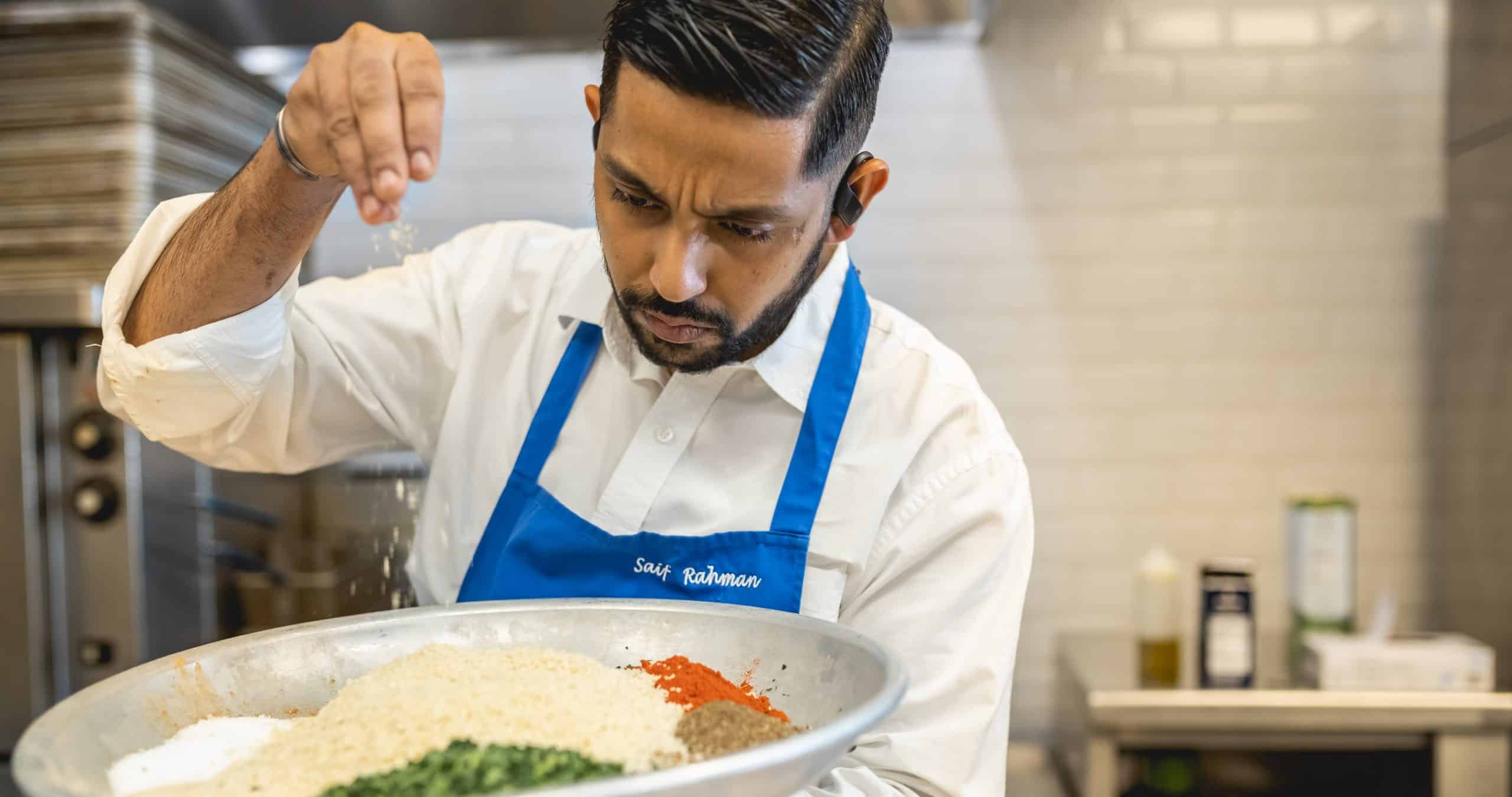
You may have no idea who chef Saif Rahman is, but soon everyone will
This might be the year Saif Rahman finally gets his due.
Despite being executive chef at Downtown Raleigh’s posh restaurant Vidrio and boasting an impressive culinary background, few people seem to know Rahman’s name. He admits that social media and self-promotion aren’t his strengths, and while he helped open Vidrio in 2017 as its chef de cuisine, he didn’t take command of the kitchen until shortly before the pandemic.
He’s not the biggest name at parent company LM Restaurants—that title belongs to celebrity chef Katsuji Tanabe. And as “a brown chef from an immigrant family” who is also Muslim and doesn’t drink, Rahman isn’t the archetype of a fine dining chef, leading more than a few people to overlook his talents.
“I’m definitely under the radar,” Rahman admits. To an extent, telling his story is out of Rahman’s comfort zone, but he’s ready to start trying.
Last year, Rahman entered the North Carolina Restaurant & Lodging Association’s annual cooking competition, in part to get his name out there. He walked away as the 2021 Chef of the Year, thanks to the strength of his tandoori chicken recipe that relied almost exclusively on ingredients grown in his and his mother’s Raleigh backyards.
“I didn’t go there to win,” says Rahman. “I just wanted to be who I am. For chefs like us, it’s very difficult to tell our story. It’s difficult to explain what’s in your head unless you’re speaking to another chef.”
However, Rahman’s victory and impressive reliance on homegrown ingredients didn’t garner him much attention or acclaim. And it was also overshadowed by the death of his father, who passed away the same day Rahman won. His father, a former New York City cab driver, had been sick for a while and frequently asked Rahman to cook for him and bring dishes to the hospital. He had also raved to anyone within earshot that his son was “the most amazing chef.”
“That, my friend, is absolutely amazing,” says Rahman. “That is absolutely stunning when your father tells people that.”
Cooking has been a way for the chef to work through his grief. It’s also a way for him to connect to his roots. Originally inspired by his grandmother’s cooking on family trips to visit her in Bangladesh, Rahman has learned the joy of watching someone’s facial expression change when they bite into something he’s prepared. From Vidrio’s open kitchen, he can see the restaurant’s entire dining room, and he’ll watch people’s focus shift from their conversation to the bite of food in their mouths. His grandmother derived similar satisfaction making dishes like sticky rice and crispy tiger fish for her grandchildren, observing as they enjoyed her meals.
“She’d never eat with us,” he recalls. “The satisfaction that she was getting was making someone so happy, touching someone’s heart with your cooking. Now I know what that means almost 40 years later. It’s the greatest feeling in the world.”
After getting his start at his uncle’s restaurant in New Jersey, Rahman traveled and went to culinary school at the Paul Bocuse Institute in Lyon, France. He hustled up odd jobs like cutting grass so he could afford to eat in “badass restaurants,” and eventually staged at the legendary (and now closed) three-Michelin-starred Grace restaurant in Chicago. After his family left New York and relocated to North Carolina, Rahman followed suit, doing stints at World Central Kitchen and 21c Museum Hotels. Last year, his cooking took him global again, as he traveled to Qatar as a culinary ambassador for the North Carolina Department of Agriculture.
There, Rahman and fellow chef William Dissen represented “American Thanksgiving” at the famed Qatar Food Festival (think Aspen Food & Wine, but even glitzier), cooking expertly executed classics like pumpkin pie, Carolina Gold Rice grits and fried chicken. Attendees decked out in Gucci and clutching Fendi bags couldn’t get enough of the cheddar cheese grits, says Rahman, because of the high-quality ingredients and craftsmanship.
That describes Rahman’s approach to the menu at Vidrio too. When he took over as executive chef, Rahman focused the menu, paring down the options and prioritizing local ingredients cooked to deliver layers of flavor. That’s partly out of necessity—as the cost of ingredients rises, it makes sense that Rahman would look to use previously discarded lemon rinds from the restaurant’s bar to make lemon preserve to give depth to his New York strip. But it’s also because Rahman is obsessed with “doing epic shit” rather than finding the easy way out.
“As a chef, you adapt and you overcome,” he says. “You keep pushing to build these amazing things. We create luxury quality food from the most basic ingredients. That’s hard to do.”
Rahman’s strength is also his ability to pull off the unexpected. At Vidrio, some menu items like the roasted chicken sound deceptively straightforward or almost predictable—but, on closer inspection, offer ingredients like rose petals and rose water that add a fragrancy and romanticism to the dish, says Rahman. It’s also a reflection of his personal style, adding that he’s been given complete freedom to express himself through the menu.
“I run it like I own it,” he says. “I do everything I want, everything I can, and nobody tells me, ‘You cannot do this.’ I have that freedom.”
That’s allowed him to hit his stride. Now, the driven chef with an infectious enthusiasm and a dogged work ethic appears to be bursting at the seams, ready to break out to the next level. Given his lengthy credentials and deft execution at Vidrio, there’s no good reason that hasn’t happened yet. But smart money says Rahman won’t remain a best-kept secret for long. vidrioraleigh.com
Preeti Waas is expanding her popular Cheeni concept into a whimsical Indian food emporium.
There’s nothing like Cheeni Indian Food Emporium in Raleigh. Or maybe anywhere.
The new concept from Preeti Waas—scheduled to open in February in northeast Raleigh—is a coalescence of a range of ideas that have been kicking around in the restaurateur and former Wake Take culinary professor’s head for more than two decades. As the name suggests, the emporium’s offerings will be expansive, ranging from a demonstration kitchen to a cafe to a retail space with spices and cookbooks from Indian authors.
“The word emporium is evocative of a store or space that’s filled to the brim with things,” Waas told Raleigh Magazine in an exclusive interview. “You never know what you might find. That’s really what I’m going for.”
This is not your stereotypical Indian lunch buffet where a photo of the Taj Mahal looms over portions of chicken tikka masala and butter chicken. Instead, Cheeni Indian Food Emporium will rotate its menu weekly to highlight the seemingly endless range of regional Indian culinary traditions.
“Indian food has been put into a box, which is so unfortunate because it’s a large subcontinent,” said Waas. “Every 15 miles, you have a new cuisine almost.”
Waas is North Indian but was born and raised in South India. She often runs into preconceived notions about both what Indian food entails and what types of Indian food she excels at cooking. The emporium is a way to avoid being pigeonholed, and to offer an exciting and ever-changing mix of dishes, events and opportunities that she was unable to do at her first cafe, Cheeni Chai + Coffee +Tiffin.
Opened in Downtown Raleigh in late 2019, Cheeni drew enough praise and interest that Waas was quickly able to expand to a second location at the Alexander Family YMCA on Hillsborough Street near NC State. The original spot closed indefinitely at the end of 2021 due to the pandemic, but Waas is open to reviving it in the future.
Cheeni Indian Food Emporium—which will be located near the Falls of Neuse exit on 540—is much larger than Cheeni (just over 2,700 square feet), combining two storefronts that used to house a coffee shop and the Hop Yard (which relocated within the same shopping center). It will build on the success of the existing Cheeni locations, with its snacks, masala chai and Indian filtered coffee. But the emporium will also feature an Indian deli concept, more premade takeout meals and a full dine-in menu as well. And the emporium also boasts a larger commercial kitchen, adding capacity that can support the Hillsborough location too, added Waas.
“Indian regional cuisine is not being touched—at least in our area—at all,” explained Waas.
There will be staples like keema pav, which she likened to “Indian sloppy Joes,” and Cheeni’s popular veg puffs, but Waas hopes people will come ready to try something new. The emporium will also offer cooking demos and events with cookbook authors, kitchen staples from brands like Brooklyn Delhi, and pop-up dinners with chefs like Cheetie Kumar.
Waas is intentionally expanding beyond the center city, opening closer to where her family lives.
“To me, North Raleigh is a food desert, especially when it comes to cuisines that are not mainstream in America,” she said. That’s especially true for her attempts to find quality Indian food nearby. “I would like Americans to know about the various regions of India through its food. I make what I would make at home with my family. I’d like to make their experience personal.” And at the emporium, that dream becomes a reality. cheeniraleigh.com
There’s a reason your next favorite bar or restaurant might be in Clayton.
Just a few years ago, Max Trujillo mocked the idea of opening a cocktail bar in Cary. He wasn’t alone—when SideBar opened there in 2018, Bond Brothers Beer Company had already planted a flag in the affluent suburb, but plenty of people scoffed at the idea. The last three years changed everything. … “Now we use Cary as the example for what could happen in other towns,” says Trujillo.
That’s why Trujillo—a service-industry pro and Raleigh resident who co-hosts the NC Food & Beverage Podcast—is opening food halls in Oak City exurbs like Knightdale and Clayton. He and partner Kip Downer plan to open the first Craften* concept in Knightdale just before the end of the year.
“When I tell people that we’re doing it, nobody really bats an eye the way I think people would’ve two or three years ago,” says Trujillo. “People now think it makes sense; people want to keep it local, keep it small. I think you’re going to see more of that.”
It’s true; other Raleigh restaurateurs are looking beyond city limits for their next bars and restaurants. So many are reaching into Cary that it’s almost not worth mentioning—but we will—from Ashley Christensen’s new BB’s Crispy Chicken* to Katsuji Tanabe’s Mexico City-style restaurant A’Verde*. There’s also Boxyard RTP in Research Triangle Park.
But the outward growth goes deeper into the exurbs, especially Clayton. Besides Craften, restaurateur Scott Crawford is opening Crawford Cookshop* imminently there. Jason Howard just expanded The Cardinal*—one of his several Raleigh bars—to Clayton, and he’s introducing a new smoked meats and tequila-drenched business called Lil Hombre too. Like Trujillo, Howard is looking to neighboring towns, with construction on The Cardinal location in Wilson already underway. He’s also about to ink a deal in Wake Forest.
“Raleigh’s really saturated,” says Howard. “You kind of have to be willing to go into a strip mall or something more cookie-cutter. I think this COVID thing really opened up my mind to going outside of Downtown Raleigh.”
Crawford agreed. “I’ve had my challenges with the city of Raleigh, but we were able to work through those, and I’m not opposed to doing more things in the city,” he says. “It’s a little bit more difficult to find a building or space that speaks to me. I have other ideas—and a space kind of has to excite me.”
The pandemic also influenced Crawford’s perspective. The more casual approach of the Cookshop emerged when Jolie and Crawford and Son were forced to switch to a takeout model. Their traditional menu didn’t translate, forcing Crawford to switch gears. A strong reception prompted him to consider it for a standalone business.
Trujillo mentioned COVID as well, pointing out that more people are working from home or looking for options closer to where they live. “In today’s market you don’t want to pay 30 bucks for an Uber to get out there and 30 bucks to get back home,” he says. “I think everyone realizes that the greater Raleigh area is far bigger than it once was.”
Crawford admits he hadn’t really considered the exurbs initially, saying he didn’t know much about Clayton other than its cocktail bar Revival 1869. But when a friend suggested that he might like some of the older buildings in the fast-growing community, Crawford was intrigued.
“I didn’t want to go out of Raleigh into the strip- mall burbs or something that lacked character,” he says. “The selling point for me [in Clayton] was the building and the charm of Main Street.”
And while there isn’t necessarily a huge restaurant and bar exodus from Raleigh on the horizon, the more people move to outlying communities, the more likely it is that food and drink will follow.
“I’m seeing a pattern,” says Crawford. “I’m doing a steakhouse in Cary. Cary’s grown a lot. People never really used to go out to eat much in Cary when I first moved here, and now they have a lot more options. Apex, Clayton—they’re all growing communities, and growth creates opportunity.”
Howard, Crawford and Trujillo all say the small-town feel is part of what drew them in. It’s cheaper, they admit, but that’s not the only driving factor. They want something that feels distinct, full of character, and where the neighborhood and community really embrace them. “It’s not like Clayton is inexpensive right now,” says Trujillo. “There are tertiary markets that are cheaper.”
It’s all about where they’ll bring something distinct to the table. Trujillo and his partner turned down some surrounding towns that already have a tight food culture or similar food hall—they want to be unique and get in on the ground floor.
Howard and Crawford also brought up challenging permitting and approval processes in Raleigh. “With every step of the process, it can go smoothly or not, depending on the individual,” says Crawford. “It would be nice if we felt like in more cities and more communities, the people in charge wanted to help us. It doesn’t feel that way often.”
Crawford says he still has more concepts in mind that Raleigh would embrace, but for now he doesn’t have anything planned beyond Crawford Brothers’ Steakhouse in Cary and Crawford Cookshop in Clayton. Howard, meanwhile, is busy building a small exurb empire for The Cardinal, with Lil Hombre potentially following suit.
“Things are getting really hard to do in Raleigh,” says Howard. “[Clayton] is more conducive to small business. You’re really appreciated in these small towns. It’s just amazing to me.”
Not that Howard won’t open more businesses in the capital—he just launched the Rainbow Luncheonette* and Pink Boot* on North West Street. But being a bigger fish in a smaller pond can have its benefits.
“People appreciate the concept more when there’s not 35 other similar choices,” he says. “There’s more attention on you. You make a lot more people happy, and that’s really what we’re here to do—while keeping our integrity.” @craftenfood; @crawfordcookshop; @thecardinalbar.
*Editor’s Note: Visit raleighmag.com for exclusive full coverage on each of these concepts.