It’s been a hell of a year, Raleigh. Fires, floods and pestilence across the globe had it looking like the end of times, not to mention peaceful racial justice protests and subsequent rioting, and a #MeToo reckoning, that took place right here at home. Meanwhile, our government at all levels was plagued with corruption and scandal. We hope this is the last year we’ll ever have to see grown men brandishing military grade weapons in our local Subway sandwich shops and we hope in 2021, we’ll see the back of COVID-19. Until then, wear a mask, wash your hands and help us bid adieu to 2020—from a socially distanced six feet away, of course. When the acorn drops, the auld acquaintance will be forgot, and so will this miserable year.
Restaurant Reckoning
Bida Manda and Brewery Bhavana had everything: Good food and beer; a moving origin story and a charismatic owner; a beautifully curated, socially conscious Instagram feed and cachet with Raleigh’s political, business and media glitterati. The restaurants were the city’s crown jewels, places we pointed to proudly to show that Raleigh was growing into a sophisticated, cosmopolitan, vibrant metropolis, a far cry from our farm town days of yore. Then, one former Brewery Bhavana employee took to social media to air her grievances; others followed her lead, and the restaurant’s carefully cultivated, tastefully minimalist facade came crashing down. Harassment and abuse ran rampant, it was alleged. The businesses harbored sex offenders and sex pests, maligned women and nonwhite workers and had no avenues for accountability. Employees were drawn in by a seemingly cult-like vibe and stayed because the money was good, and, when issues were raised, they were swept under the rug by management, handled poorly or outright ignored. It was a sad situation all around, for the survivors especially, and for a community that was already reeling from the effects of the COVID pandemic. It also opened the floodgates to more stories of harassment and abuse in Raleigh’s restaurant scene, including at Neomonde, Poole’s Diner and other bars and clubs all over town. Bhavana and Bida Manda, which stayed closed for much of the year due to the pandemic, recently reopened under new management. All of the company’s original owners have stepped away and the brands are working to chart a new course. Meanwhile, on social media, Raleigh’s overdue #MeToo movement rages on; whether there will be lasting change in the service industry locally remains to be seen.
MealTeamSix
The threat was non-existent, the streets, empty. With no enemy in sight or otherwise identified, a dozen armed demonstrators decided to descend upon Raleigh to defend us from…well, it’s not clear what, exactly, but the governor’s stay at home order is our best guess. There they were, frightening the neighborhood kids at the gates of Oakwood Cemetery. There they were again, congregated outside a downtown Subway shop, wavering between turkey and tuna, rocket launchers bobbing merrily in the sun. Were they Proud Boys? Boogaloos? Q Anons? What the hell is the difference between the three? We, like they, may never know what they stood for, or what points they were trying to make, but at least they looked absurd. And, let’s not forget, two of the crew were later arrested by federal agents for offering themselves up as assets to the Islamic militant group Hamas—which, all told, seems about right.
Politically Incorrect
Lies, sex, money. Federal, state and local. Vice, scandal and corruption weren’t bugs of North Carolina government in 2020, they were features. Here’s who’s on the NC politics naughty list.
Historically Dumb His sexting game was as mild as his suits were finely pressed, as his campaign platform was purposely vague and pleasingly uncontroversial. All Cal Cunningham had to do was ride that wave of goodwill, engendered by his corporal blandness and his opponent’s unprecedented unpopularity, to the U.S. Senate and relieve the constituency of one of its dreaded Thoms. The national balance of power was in his hands, and he was ahead in the polls—but his phone was in his hands, too, and he just may have blown it with his tasteful indiscretions. Truthfully, no one can say that if Cunningham hadn’t sent those sexts, he’d be on his way to Washington. As we all know, voter preferences in North Carolina are historically wacky. But the fact of the matter is he was senseless enough to try to pull a John Edwards when he was supposed to be pulling the Democrats’ Senate majority. A rookie mistake, bless his heart—but now, North Carolina’s stuck with Thom Tillis for what’s sure to feel like another century. Thanks for nothing, Cal.
Insider Dumping Richard Burr didn’t support Wall Street reform or increasing the federal minimum wage. He’s not on board with tax increases, ever, and has no use for consumer protection. But he does seem to support Senatorial protection, especially when a global pandemic threatens hundreds of thousands of dollars in his personal stock holdings. Back in February, North Carolina’s senior senator sold between $628,000 and $1.72 million in stocks, shortly after he would have learned, as chair of the Senate Intelligence Committee and a member of the Senate Health Committee, that the coronavirus pandemic was set to wreak havoc on international populations and markets. Burr said he dumped the stocks based on publicly available information at the time—presumably not President Trump’s very public assurances that the virus was “under control”—rather than on what he would have learned in confidential briefings. But the FBI found Burr’s timing suspicious enough to seize his cellphone and launch an investigation and he stepped down as Intelligence chairman. In any case, Burr will retire from the Senate in 2022, we’re guessing to return to Winston-Salem to spend more time with his money.
Red Flags Saige Martin had never voted in a city election in Raleigh before he ran for, and won, a seat on its city council in 2019, becoming its youngest and one of its first openly gay members. He showed up on the civic scene quite out of nowhere, flush with cash from somewhere, claiming to have worked in various roles at the United Nations, on President Obama’s 2012 campaign and as a communications consultant for Hillary Clinton’s. Overstating a resume is one thing but causing real harm in your community is another; while Martin was supposed to be finishing up a master’s thesis in art at NC State’s College of Design, and working as a graduate teaching assistant, and running for council, Martin was also alleged to have been harassing and assaulting fellow students, according to four men who spoke to the News and Observer about what they described as incidents of Martin’s “predatory” behavior. He resigned immediately after the news broke this summer and skipped town, leaving the newish council with an empty seat to fill not even halfway through its term.
Dishonorable Mentions
State lawmakers, while not Raleigh residents per se but who spend enough time to here to at least partially qualify, were busy getting their hands dirty in 2020, too. Here’s what they got up to.
Sen. Phil Berger The government watchdog group Democracy North Carolina filed a complaint this summer about the Senate President Pro Tem’s double dipping as related to his housing expenses while he spends time in Raleigh away from his district. (That’s after he was outed last year for using campaign cash to pay the mortgage on a Raleigh townhouse he owns). Berger collected $50,000 from the General Assembly from 2016 to 2020 to pay for housing, and received $72,000 from his campaign committee to pay for the same housing over the same period. No word so far on whether he plans to pay the state its $50K back.
Rep. David Lewis A high-ranking, long-serving state lawmaker and one of the architects of the state’s voter ID and redistricting laws, Lewis resigned abruptly in August after being charged with federal financial crimes. The Harnett County Republican allegedly used $65,000 in campaign donations to help his struggling farm; he will take a plea deal to avoid a lengthy prison sentence.
Sen. Rick Gunn The Burlington Republican was sued by the husband of his legislative assistant after it was revealed the two were having affair, a scandal so textbook it’s barely worth mentioning. Gunn did not run for reelection
Gary Pendleton While he no longer holds elected office, the former state representative from Wake, and former county commissioner, decided to serve the state in another capacity this year—as a Republican poll observer. But on the second day of early voting, Pendleton was cited and charged with misdemeanor assault and trespassing after allegedly pushing an election worker at a Wake Forest early voting site. In his defense, Pendleton compared the charge to “hunting without a hunting license.”
City of Raleigh Hits and Misses
From virtual meetings to emergency mandates, this year has felt like all COVID, all the time. But, for better or worse, Raleigh’s city council did get some things done, unrelated to the pandemic. Take a look back at city government’s 2020 hits and misses.
-4 Council abruptly abolished CACs without notifying the public +3 Council established a police advisory board -2 But it doesn’t have subpoena power +1 Council loosened restrictions on Airbnb +2 Council voted to install custom designed, bright red bus shelters at stops around town -3 But they will cost $5.7 million +1 Council chose a consultant to study ways to engage local communities after abolishing CACs +3 Council established a Commission on Hispanic and Immigrant Affairs -3 Mayor Baldwin took a job with Barnhill Contracting Company after it received a $6 million city contract -5 RPD used tear gas on protestors during demonstrations downtown +2 Council passed a budget for the 2021 fiscal year with no tax increase +2 Council voted to allow building of ADUs (or backyard cottages) and cottage courts and eliminated minimum parking requirements in the city code +2 Council allowed streets to close to traffic for bikers and pedestrians, as well as for bars and restaurants to expand their seating downtown -3 City manager Ruffin Hall announced he’s retiring +3 Council authorized an $80 million affordable housing bond referendum -3 But critics say the bond proposal doesn’t do enough for very low income people +1 Council allowed new contracts with micromobility (electric scooter) companies +2 Council voted to install the Downtown North-South Greenway Connector +2 Council approved plans for its members to participate in racial equity training +1 Council approved a rezoning for a 40-story mixed use tower, the tallest in Raleigh, adjacent to Capital Boulevard +1 Council approved the first design phase for a new Civic Campus +3 Council endorsed the Southern Corridor Bus Rapid Transit Route along South Wilmington Street and authorized funds to help build commuter rail +3 The affordable housing bond passed with 75 percent support +2 Council voted to include renters in receiving mailed notices sent out by the city and will work on ways to get their input +2 The city announced assistant city manager Marchell Adams-David will replace Ruffin Hall as city manager in 2021
Total: +13 points for one year of bad luck; here’s hoping for a better 2021
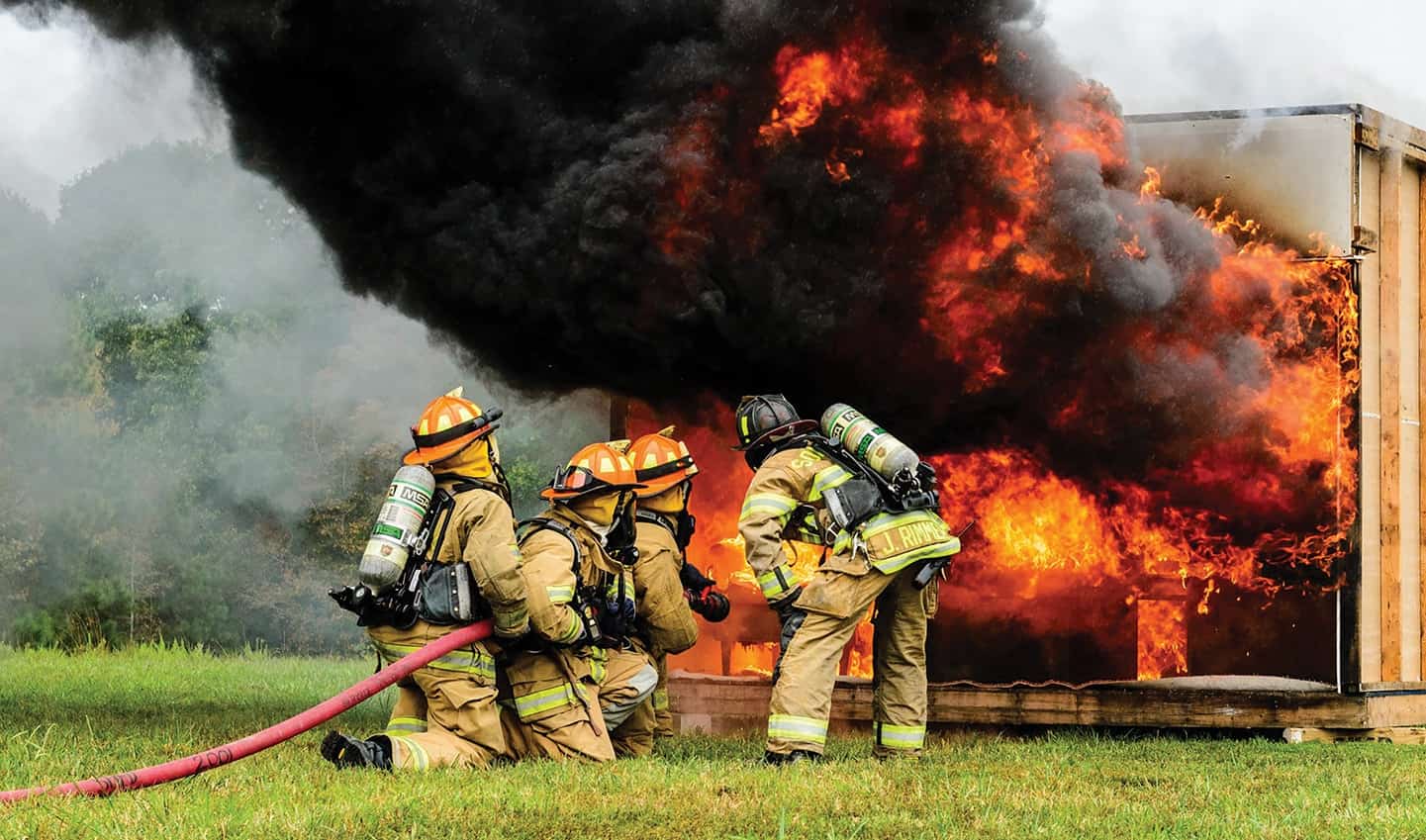
NC fire departments, including Wake County Fire Services, need more volunteer firefighters.
For three generations, over the span of 97 years, the Stephenson family has seen its members serve as volunteer firefighters in Wake County. Inspired by his father before him, Bill Stephenson—who works an 8-to-5 job when he’s not volunteering—has served with the Northern Wake Fire Department for three decades. Bill’s son, Thomas Stephenson, is a professional firefighter with the Town of Apex and volunteers at Northern Wake as well.
“I’m kind of an old guy in this business,” Bill says of volunteering. “I’m around a lot of younger people and I tell all of them, this is the greatest job in the world.”
According to research from the Federal Emergency Management Agency (FEMA), 72 percent of firefighters in North Carolina are volunteer firefighters. Unfortunately, the number of volunteer firefighters in the state is declining by 11 to 12 percent year over year, including in Wake County, which is one of 12 counties in the state targeted by the North Carolina Association of Fire Chiefs (NCAFC) for a two-year-long volunteer firefighter recruitment campaign.
“Local volunteers provide the bedrock of North Carolina’s firefighter workforce,” said chief Tracy Mosley, a program manager at NCAFC. “We understand that the safety of our communities relies on fully staffed and trained departments, and based on the success of past campaigns, we’re eager [to transform] our state’s volunteer fire service landscape.”
The COVID pandemic has dealt another blow to fire departments. This summer, local officials declined to fund 20 new Raleigh firefighter positions at a cost of $2.4 million. And fire departments across the county, including Wake Forest’s, have seen their ranks depleted as firefighters have had to isolate after contracting the coronavirus. This, coupled with the training and time commitment it takes to become certified as a volunteer firefighter, has made it a less attractive option for potential volunteers over time.
“The dynamic has changed from 20 or 30 years ago,” Thomas Stephenson acknowledges.
But, the Stephensons say, there are plenty of perks to volunteering beyond a small stipend and equipment fees that the county pays for. Volunteer firefighters are trained to the same standards as professionals and many find the experience to be rewarding, a way to make a direct, tangible difference in their communities and a meaningful impact on the lives of their neighbors.
“Starting with the camaraderie at the fire station— you have other individuals that form a team, a crew,” says Bill. “You eat together, train together, wash vehicles together, do station maintenance, cleaning, all the non-glorious things. The actual fire call is a very small part of this. We’ve answered calls about everything possible, from vehicle accidents to incidents on the lake, to actual fires in residential homes in Wake, snake bites—all types of emergency scenarios.”
North Carolina’s two-year recruitment and retention campaign is part of the state’s Volunteer Workforce Solutions program and is designed to help the state’s fire departments achieve a viable, sustainable volunteer workforce. With funding provided by FEMA, the campaign is targeting 15 at-risk fire department groups across 12 counties in North Carolina’s east, west and Piedmont regions.
“Volunteerism, still, is quite simply dollars and cents,” says Bill. “A volunteer firefighter is a taxpayer’s best friend. Whenever you answer a 911 call, your goal is to make a perfect stranger’s day better. That’s why it is still a thrill for me to do this job.”
To learn more about volunteer firefighting in North Carolina, visit VolunteerFireNC.org.
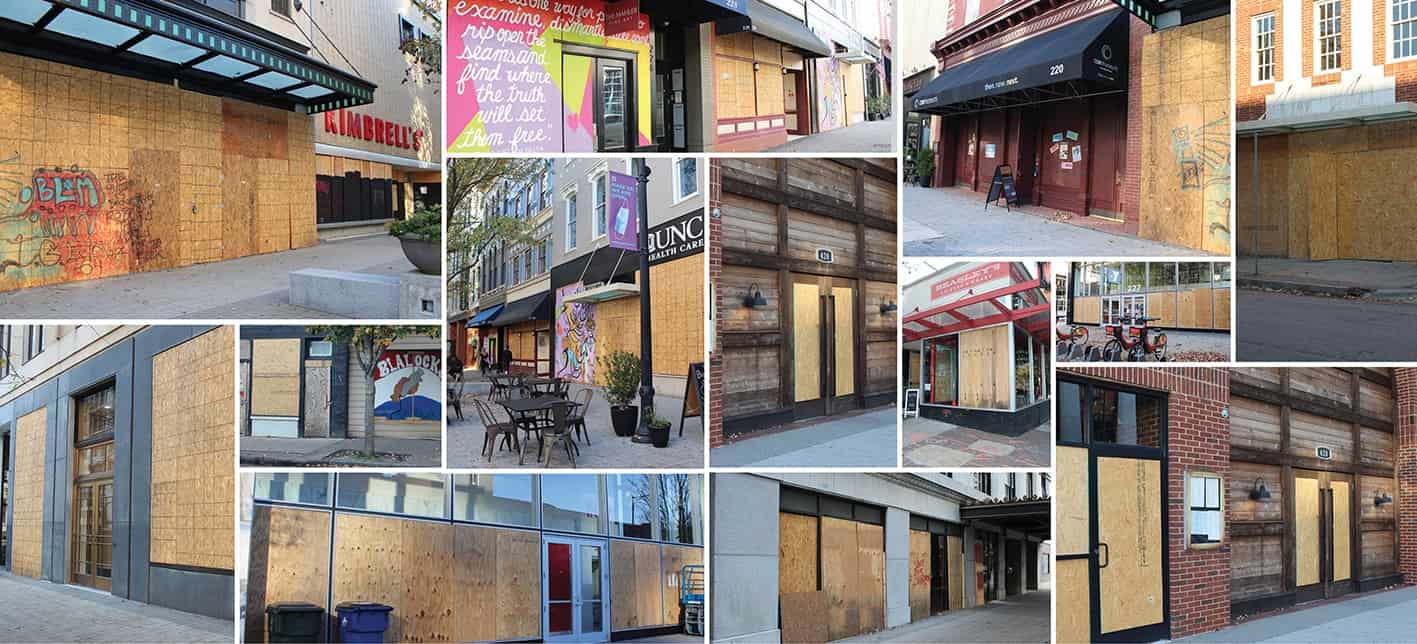
It’s been more than six months since protests on a Saturday night in May in downtown Raleigh led business owners to board up their storefronts in order to avoid more damage. Already reeling from statewide shutdowns due to COVID-19, preserving their property was a top priority for business owners.
And while the threat of more destruction loomed throughout the summer, nothing like the damage on that first night of protests came to pass again—and yet, 180 days later, business fronts all over downtown are still boarded up. If we want our local businesses, the fabric of city and of our downtown to rebound, we have to get rid of the plywood. Businesses that are open should feel reassured that it’s safe to take the boards down, while those that have permanently shuttered, such as Kimbrell’s on Fayetteville Street and Royale on Blount Street, should see their landlords advertising prime real estate space without wooden planks obscuring the windows. The Downtown Raleigh Alliance, in partnership with Duke Energy, is offering storefront revitalization grants to business owners who need to make repairs due to damage related to the protests—but that’s not enough. City leaders, our elected officials, need to be meeting with business owners and landlords and encouraging them—convincing them— to take down the plywood boards. They must reassure them that, in the event of more protests, their businesses will be safe. As the holidays descend and folks head downtown to (safely) shop, eat and visit with friends, downtown Raleigh should feel welcoming once again, not eerie and abandoned. Downtown’s recovery is long overdue. The boards have got to go.
In the wake of property damage and a pandemic slowdown, businesses say they need more help from city leaders.
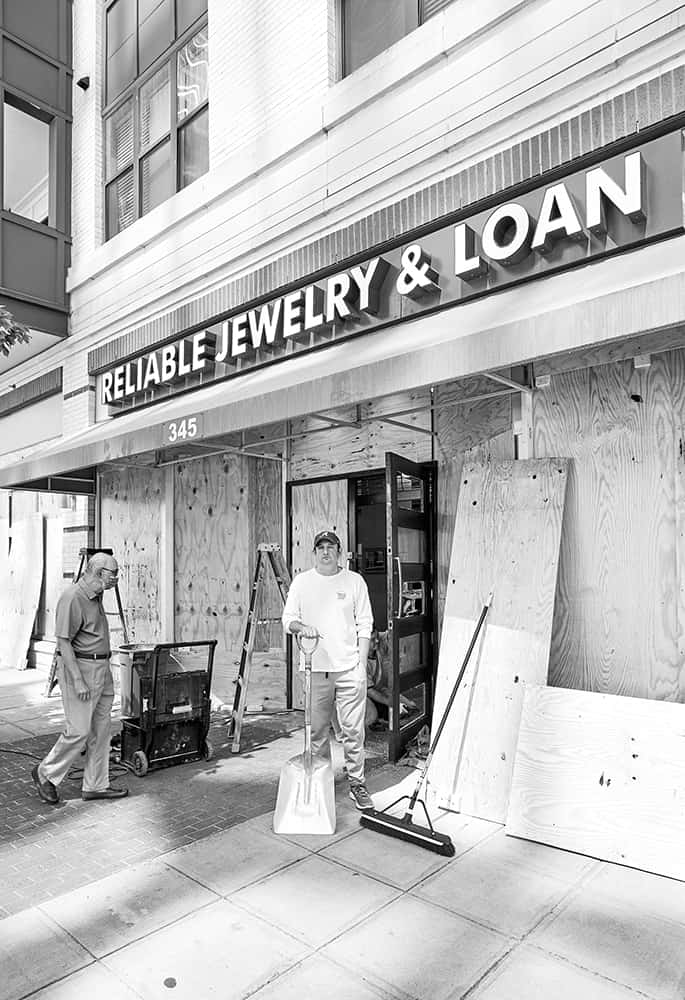
Despite sustaining $100,000 worth of damage to his storefront following racial justice demonstrations this spring, Reliable Jewelry and Loan owner Alan Horwitz says the South Wilmington Street business is “doing great.”
“We have a very loyal clientele, we’re fortunate with everything going on,” says Horwitz, whose family has operated the business downtown since the 1930s. Because it issues loans, the store never had to close during the pandemic shutdown. “We were lucky in that regard.”
Horwitz was not one of 71 percent of business owners who said they didn’t think, or didn’t know if, their business would survive the COVID-19 pandemic in a recent survey of some 200 locally owned businesses from advocacy group Shop Local Raleigh. But he was one of the nearly 75 percent of business owners who responded that he doesn’t think local leadership—the mayor and city council—has “the best interests of Raleigh’s small business community in mind.”
“Government officials set downtown back years with those few nights [of protests],” Horwitz says. “All the progress we’ve made came to a stop. It was a 100 percent unforgivable response.”
Though the COVID closures ordered by state leaders were beyond the scope of the city council’s and mayor’s control, business owners say they aren’t happy about some of the council’s recent decisions and actions around both the protests and the pandemic and say city leaders aren’t doing enough to advocate on their behalf.
Along with criticizing the mayor’s and police chief’s handling of the protests, survey respondents say they need better communication from the council on its plans to help small businesses and to revive downtown in particular. Some say they have reached out to elected officials with questions and requests for assistance and have received no response. Others say the mayor and council members have simply “disappeared.”
“We need more frequent updates on what the city’s plan is on reopening the downtown area,” wrote one survey respondent. “We are all struggling. The city is not even attempting to lure guests or commerce back into our businesses.”
“As far as saving small business is concerned,” wrote another respondent, “we personally feel Raleigh treats small businesses as expendable. We’ve received no real support at startup or to help us grow. Small grants are not impactful to businesses.”
The city has allowed restaurants to apply for permits to temporarily expand outdoor seating. It approved $1 million to support small businesses and raised an additional $600,000 with the Raleigh Chamber of Commerce to support nearly 200 businesses. It waived permit fees related to repairing damage and reinstated its storefront facade grant program and Mayor Mary-Ann Baldwin says the council is discussing how to close Fayetteville Street to cars on weekends, creating safe spaces for pop-ups and other activities.
The council has largely outsourced downtown’s revival strategy to the Downtown Raleigh Alliance, allocating $300,000 to the nonprofit this summer for marketing efforts, installing more lighting and art and to hire more ambassadors to make downtown feel safer and more inviting. The DRA is also offering storefront revitalization grants of up to $5,000 to businesses to repair damage from vandalism or to assist with implementing COVID-19 protocols.
“With the assistance of DRA, I’ve held more than a half dozen meetings with local business owners to better understand their needs,” Baldwin wrote in an email to Raleigh Magazine. “We are also looking at an alert system that business owners have suggested, which would allow our team to alert them of issues and improve communication…. We are also looking at city-owned property downtown that could be used to support arts and other nonprofit organizations, as well as minority-owned businesses.”
District C Council member and mayor pro-tem Corey Branch says he has personally been speaking to business owners to “get a better understanding of their concerns and challenges.”
“Could we have done better during those nights of disturbance and destruction? In hindsight, everyone is going to say yes, but I don’t think anyone expected it,” Branch says. “That was the first time we’ve had riots like that in my lifetime.”
The DRA’s efforts seem to be paying off some. The nonprofit reported an 87 percent increase of sales of food and drinks downtown from May to June, coinciding with restaurant dining rooms reopening across the state, and a 34 percent increase in foot traffic downtown from July to August. In a recent poll, the DRA found that 80 percent of downtown residents said they felt safe living downtown and residential occupancy rates remain above 90 percent.
Shop Local Raleigh, too, is planning a recovery strategy for small businesses, hosting seminars on topics like financial restructuring, and planning for holiday shopping.
“We hope to work with the city to put a message in the water bill to remind people to shift to buying here in Raleigh instead of online,” says Shop Local Raleigh’s executive director Jennifer Martin.
But with more than half of local businesses reporting that they face closure by the end of the year, Martin acknowledges there’s a difficult road ahead.
“The business community is looking for someone to be that point they can go to for information, someone advocating for them and reassuring them that we’re fighting for them,” Martin says.
Elected officials say they’re trying to help, but, right now, business owners don’t perceive that advocacy and fighting for them as coming from the city.
It started with a flurry of accounts of sexual harassment and abuse on social media against employees, managers and the owner at downtown’s Bida Manda and Brewery Bhavana.
Over the summer, it grew into an avalanche, encompassing restaurants like Neomonde and Ashley Christensen’s Poole’s Diner, tattoo and piercing shop Blue Flame, Red Hat’s HR department and bartenders, musicians, tattoo artists, body piercers and other men—almost exclusively men—about town.
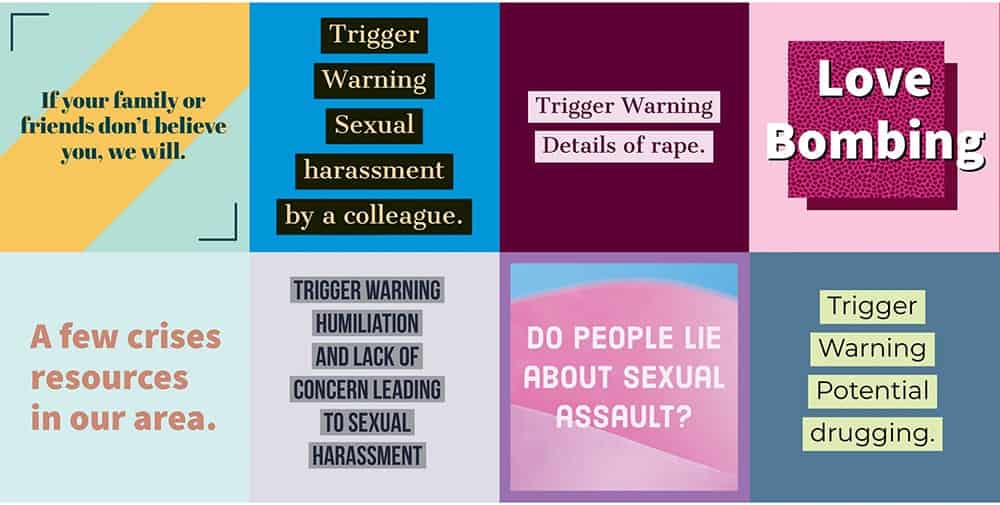
Raleigh is having a #MeToo moment, with survivors recounting stories of their abuse anonymously, naming the perpetrators, and a new third party platform, the Raleigh Protection Alliance, emerging on Instagram (@raleigh_ncpa) to give them a space to share their experiences, connect and document it all.
With new posts from survivors popping up on the group’s page daily, the #MeToo avalanche is growing, not slowing. “The purpose of our organization is to shed light on issues of abuse and assault,” the volunteer-run group says in its mission statement. The group, which has similar affiliates in at least five other North Carolina towns and cities, says it is working on forming as a nonprofit while continuing its mission. “[NC Protection Alliance] considers itself a space for survivors to come forward, share their stories, receive resources and, most importantly, create dialogue that fosters support. It is our hope that by amplifying voices, accountability and change will happen.” (The group wrote it is “flooded with new tasks currently” due to a surge in new followers and is “putting a hold on media interactions” until it adjusts in messages to Raleigh Magazine in response to an interview request).
Survivors and their advocates say the NCPA and similar platforms are helpful for those who have experienced abuse, providing a safe and cathartic way for them to speak out.
“When we first started seeing survivor stories on social media almost a decade ago, there was far more easily targeted victim blaming against survivors,” says Monika Johnson-Hostler, the executive director of the North Carolina Coalition Against Sexual Assault (NC CASA), a nonprofit that works statewide to end sexual violence through education, advocacy and legislation. “Now, allies are shutting down victim blaming in a way I don’t think existed before. The victim blaming was a part of why survivors didn’t come forward and because it wasn’t public, there wasn’t a space for other people to see how nasty it was. I’m watching people step into the space, advocating and calling out horrific, vitriolic victim blaming and seeing more people step in as allies to survivors.”
As to the second part of the group’s mission statement—the hope for change and accountability to happen—there has been change, to be sure.
Last month, Vanvisa Nolintha and Patrick Woodson, the owners of Bida Manda and Brewery Bhavana, announced they were stepping away from the company following outcry online and in-person protests when the restaurants tried to reopen with curbside pickup service. They issued an apology on Bhavana’s Instagram page and announced the hiring of a new CEO. (The company’s original owner and manager, Van Nolintha, left and divested his ownership following allegations of abuse and mismanagement, in June). Christensen released a lengthy letter apologizing for abuse alleged to have taken place at Poole’s (though received swift backlash online for naming the survivor and not contacting her before re-sharing her story). Blue Flame Tattoo scrubbed its social media presence and has reportedly closed its doors following the departures of several employees. And a new local service, Harassment Free NC, is working with businesses to help them assess their policies, evaluate their workspaces and company cultures and train business owners and employees on how to create safer, harassment-free work environments.
“We fully support survivors speaking out,” says Amy Circosta, who co-founded Harassment Free NC this summer. “Their stories are crucial to raising awareness and accountability and having businesses inspired to make substantive changes to prevent harassment is where we see ourselves being useful.”
Johnson-Hostler says she supports NCPA’s approach but acknowledges that how much real accountability there will be as a result of online callouts, and businesses responding to them, is still an open question.
“It is yet to be seen if this is going to make the community safer,” says Johnson-Hostler. “I certainly believe in systemic work. I absolutely believe we should be saying, ‘here are some policies and practices to put in place to create a workspace that is preventative to sexual violence and the culture around harassment,’ and then, ‘here are ways to support survivors as they come forward.’”
Then, there’s the question of the potential for collateral damage. It’s one the NCPA has already had to grapple with following accounts of rape and other instances of sexual abuse the group shared on its page that were made against a local tattoo artist, who formerly worked at Blue Flame and now owns Raleigh Tattoo Company, as well as allegations made against a piercing artist who recently worked at Blue Flame.
“Just to clarify—we never encouraged any business to close up shop, nor did we demand any particular response from them,” a post on the NCPA’s Instagram page reads in response to reports of the artists leaving Blue Flame and the business reportedly closing. “We’re not privy to the process of the decision for these individual artists to quit …We can only trust that these steps were the ones that the artists and owner felt were right, even if they were heartbroken.”
Johnson-Hostler says she shares the view that the outcomes of survivors publicly sharing their accounts on a third party social media platform shouldn’t be a consideration in whether they decide to speak out.
“There is always going to be collateral damage but that is not a reason to silence survivors,” she says. “As a survivors’ advocate, I cannot raise my hand to silence survivors in any way, shape or form. I am not going to say [speaking out] couldn’t shut down a business or cause major damage to a business that could be ‘undeserving,’ but the damage to survivors is centuries old.”
Johnson-Hostler says she is interested to see what the NCPA and its role in shaping Raleigh’s #MeToo movement will look like going forward.
“We don’t really know what the evolution of this group of survivors will be,” she says. “My hope is major change in our communities. And for those survivors, healing.”