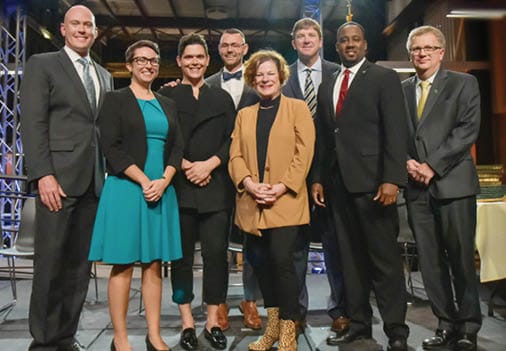
Mayor Mary Ann Baldwin requested city staff bring planning proposals for ADUs (backyard cottages) and cottage courts before the council on June 2.
The council voted 7-1 to hire consultant Mickey Fearn, a professor at NC State’s College of Natural Resources, to study ways to engage local communities in place of CACs at a cost of $72,000 from council’s contingency funds.
The council received a report on the city’s COVID-19 response. City staff is working to ensure PPE is available for city workers and implementing wellness checks at downtown facilities and for some employees.
At its evening meeting, the council voted unanimously to allocate $1.8 million in federal CARES Act funds to provide rent, utility and mortgage assistance, and $1 million in federal emergency solutions grants to assist with homelessness and eviction prevention, to low income households.
May 19 Meeting:
Under its Shared Streets for Social Distancing Accommodations initiative, the council voted unanimously to authorize city staff to start identifying streets across town that could close to car traffic to make more space for bicyclists and pedestrians to use. Council also voted to allow staff to look at ways for restaurants and bars to expand seating options for diners as they begin to reopen at limited capacity.
Council voted 7-1 to accept new terms governing a partnership between the City and the Dorothea Dix Park Conservancy, the nonprofit tasked with raising private funds for creating the park. The new Memorandum of Agreement governs appointments to the Conservancy board and term lengths, among other considerations.
The council received a report on the city’s COVID-19 response. The city has aligned its reopening efforts with the state’s three reopening phases and is taking measures to ensure safety of city workers.
The city manager introduced a $1.01 billion proposed budget for the 2021 fiscal year. The city will hold a public hearing on the budget, and will consider adding an $80 million affordable housing bond to the November ballot, on June 2. The council appointed 15 members to its newly established Commission on Hispanic and Immigrant Affairs.
WEB EXCLUSIVEUpdated: The state House voted 65-53 to pass the bill Thursday afternoon.
In a press conference, Gov. Cooper says he is not ready to reopen bars, citing “some of the highest numbers” of hospitalizations and deaths in North Carolina so far due to COVID-19.
“I know it is a tough time for business, and I believe that there will be a time when we can open bars, but that time is not now and I hope that the House will look at this carefully and senators will reconsider their choice about this,” Cooper said.
Today, you might be one step closer to enjoying your favorite drink at your favorite local bar—but you’ll have to be outdoors to do it.
A bill passed in the state Senate this morning in a 42-5 vote would allow bars to open and serve drinks to guests outside, on a patio or under a tent or awning, with social distancing and at a limited capacity. Previously, bars had been prohibited from opening under Gov. Roy Cooper’s phase two executive order, along with gyms and a handful of other businesses.
The vote came as a newly established lobbying group, the North Carolina Bar and Tavern Association, threatened to file a lawsuit against the Cooper administration if bars were forced to remain closed in phase two while restaurants and breweries have been allowed to reopen.
Zack Medford, co-owner of Isaac Hunter’s Hospitality and the founder and board president of the NC Bar and Tavern Association, says his group spent much of the last week working with lawmakers to get them to support the bill. And though the bill allows for limited reopening (at 50 percent of the bar’s current indoor capacity, or 100 customers, whichever is fewer) and paves the way for local governments to open streets and sidewalks for restaurant owners to space out their tables, Medford says the bill doesn’t go far enough.
“Being able to open our outdoor seating is definitely a step in the right direction but bars and restaurants are not to designed to operate at 50 percent capacity and there is really no way to be profitable at 50 percent capacity,” Medford says. “There is even less opportunity to be profitable with just your outdoor open. So we see this as the first step on a very long journey to getting our bars open, and doing it safely, but doing what is necessary.”
Mike Tadych, an attorney at the Raleigh-based firm Stevens Martin Vaughn & Tadych, will file the suit on behalf of more than 50 bar owners in the state tomorrow, Medford says. The complaint seeks a preliminary injunction that will allow bars to open immediately and asks that bars be considered under the same guidelines from NC DHHS currently governing the reopening of restaurants, breweries, wineries and distilleries.
Medford says he launched the Bar and Tavern Association because bars “haven’t really had a seat at the table up until now.” The lawsuit, he says, is a response to “misconceptions about what a bar is.” Though North Carolina law states that, if an establishment generates less than 30 percent of its revenue from food sales, it’s considered a bar, not a restaurant, the reality for many is less straightforward.
“That leaves out places like The Cardinal [which serves hot dogs] or Clockwork that function as restaurants but also have a bar component,” Medford says. “Maybe they don’t meet that 30 percent threshold but it is drawing these lines between who is to say what a bar is and is not. How do you define a bar? Is Tin Roof a restaurant? They have live music and people dancing all night long. Is it a bar? Ultimately, there are plenty of restaurants that function more like bars and plenty of bars that function more like restaurants. The only thing we can do is provide fair treatment across the board.”
Medford says he is optimistic about the outdoor seating bill’s chances of passing in the state House and that he hopes that Gov. Cooper will sign the bill into law. He says he hopes his lawsuit will speed along the reopening process for bars and allow bars and taverns to receive equal treatment going forward.
“I hope this is something the governor is paying attention to and see that we have got to find ways to help out the rest of us in our community that are suffering under this [executive order],” Medford says. “I hope he sees the writing on the wall here and understands what’s at stake.”
With Count on Me NC, businesses, as well as the public, pledge to take measures to keep everyone healthy and safe in the wake of the pandemic.
UPDATED 5/26North Carolina business owners knew when they reopened their doors to the public last month, health and safety would be top of mind for many of their guests. Luckily, there’s a plan in place to help folks feel more comfortable venturing out into the world again.
In May, the North Carolina Restaurant and Lodging Association (NCRLA) and state tourism office Visit NC partnered with NC DHHS and NC State University to launch Count on Me NC, a program designed to reassure guests that participating restaurants and customer-facing, hospitality-related businesses are operating at the highest levels of sanitation and safety.
Count On US from Carolina Ale House
“[Our research] from a few weeks ago found that the one most popular word people associated with travel right now is “unsafe,’” says Wit Tuttell, the executive director of Visit NC. “There is a perception issue there and people are afraid that traveling is unsafe. So we have to do everything we can to make them feel comfortable in order to get them traveling again.”
In fact, Tuttell says, the research showed that, when asked how they will approach getting back into traveling again, most respondents were very cautious. While 11.2 percent of respondents said they would jump right back in as if nothing had changed, 47 percent said they would approach travel carefully and 41 percent said they would hold off for a while and let others test out the waters.
“Places are going to open up and we will see how people behave,” Tuttell says. “If we can get people to behave well, we will continue to grow for the summer. But if we have too much of a good thing, we could see issues that could hurt us.”
In order to help alleviate the public’s fears, Count on Me NC participating restaurants ensure that they continue safe food handling practices, observe social distancing in table placement, offer hand washing and sanitizing stations and sanitize menus, utensils, place settings and condiments after every use if they are not single use. For all other businesses—tourist attractions, hotels and restaurants included—staff must pass a health check prior to each shift, social distancing will be observed on the job and all common areas and surfaces will be cleaned and sanitized regularly and thoroughly with specified disinfecting products.
Dr. Ben Chapman, an expert in consumer, retail and food safety culture in NC State’s School of Agricultural and Human Sciences, developed five training modules for hospitality industry employees designed to teach them the best operation protocols with regard to reopening following the coronavirus outbreak. The first modules, for restaurant owners and operators and front and back of house staff rolled out mid May, while modules on cleaning and disinfecting surfaces for all businesses, as well as guidelines unique to hospitality businesses, quickly followed.
Completed certificate at Cantina 18.
The training courses are all online, free, voluntary and take about half an hour for employees to complete. When a business owner and their workers complete the online courses, they print out a certificate of completion to hang in their restaurant or business and receive door and window clings with the Count on Me NC logo to display. They can use the logo on their websites and social media, on items such as menus and brochures and in their marketing and advertising materials. A website, countonmenc.org, is available for consumers to learn more about the program and the measures businesses are taking to keep them safe.
“Guests can learn what the guarantee means to them, so they will know all about the training and what we anticipate and expect to be able to provide to ensure their safety when they come in our establishments,” says Lynn Minges, the president and CEO of NCRLA.
“This is is exactly what people are asking for,” Tuttell says. “They say they want to go to places that have done these type of things.”
Tuttell says that, while these enhanced cleaning and sanitizing measures, combined with social distancing and the use of PPE, including masks and gloves, will be crucial to luring folks back into businesses again, North Carolina can expect to see a slower summer for tourism, but he thinks things will pick up again towards the fall.
Part of the success of Count on Me NC will depend on how members of the public behave once businesses are open.
“It is going to be like an experiment,” Tuttell says. “We want people to come back and explore the businesses and have a good time but we don’t want a stampede to some of the favorite places in the state, with people who aren’t willing to do the proper social distancing. We want to give people that comfort level to feel like they can get back and travel in a safe way.”
The same goes for restaurants.
“We ask patrons to make the promises to each other, simply that if they are exposed to COVID-19 or have symptoms, that they enjoy our food through contactless delivery and takeout options,” Minges says. “If they have underlying health conditions or are part of a high risk population, that they consider using delivery or takeout rather than coming into our facilities. And we ask our patrons to be patient and kind to our staff and other guests as we all try to adjust to this new normal.”
WEB EXCLUSIVE The June issue of Raleigh Magazine will be on stands around town and delivered to your doors in just a few days! If you can’t wait until then, here’s a quick look at some of the stories we have in store.
400H on the corners of Hillsborough and West streets
Reshaping Raleigh Other local industries have seen business slow in the wake of the coronavirus shutdown, but one market seems, so far, to be relatively unaffected: commercial real estate in Raleigh is still booming. From newly emerging hotels to mixed use towers, the city’s skyline is on track to look rather different, rather soon. Even Dix Park, which won’t see an infusion of tax money from a parks bond this year, will forge ahead with early designs. We bring you the scoop on some exciting local projects.
Face Masks 101 Like it or not, they’re likely going to be an important part of our lives as we venture back out into the world again. We’re talking, of course, about the face mask. We spoke to local public health experts to help us break down the science and etiquette behind the mask: how you should wear one and when, where and what kind. As Gov. Cooper says, wearing a face covering shows you care about other people’s health; to us, that sounds like a pretty good reason to mask up.
Jalapeño Popper Showstopper at The Cowfish Sushi Burger Bar
Bring on the Burgers Fire up the grill, folks! We asked local burger restaurants to share the recipes for some of their most popular burgers and they’ve more than delivered. If you’re hankering for the heat of Cowfish’s Jalapeño Popper Showstopper or a novel take on the Wendy’s Baconator—the Baconmaster—from the fine folk at Cary’s Gov’t Cheeseburger, we’ve got you covered. Spread some homemade CowBar Raged Bull hot sauce, Mandolin onion marmalade or MoJoe’s salsa verde on a couple of buns and you’re ready to roll into summer.
Reopening Raleigh North Carolina is in the second phase of reopening its economy following the shutdown and it looks a lot different out there for businesses, offices, gathering places and schools. Workers are wearing face masks, intense cleaning practices are in place, social distancing is being enforced; we take a comprehensive look at how industries are changing their operations, from lecture halls to restaurant dining rooms, churches to concert venues, museums to salons, bars to boutiques in an effort to help you navigate the “new normal.”
WEB EXCLUSIVE North Carolina will move into a modest phase two reopening on Friday at 5 p.m., Gov. Cooper announced this week.
Under the new executive order, people may leave their homes for whatever reason, but public officials are still strongly advising North Carolinians to “stay safe at home.” People should continue to work remotely if they can, Cooper said during a press conference on Wednesday, and if they do go out, they’re advised to follow “the three Ws:”
Wear a face covering to protect others
Wait six feet apart in public
Wash your hands often
Allowed to open under the order are restaurants, tattoo parlors and personal care businesses (salons, spas, barber shops, nail salons) at 50 percent capacity, with social distancing and mask wearing for workers and rigorous cleaning methods in place. Day care centers may reopen to all children, swimming pools may open at 50 percent capacity and overnight and day camps may reopen, too.
Bars and night clubs, gyms and fitness centers (including dance studios, basketball courts, rock climbing facilities, etc.), movie theaters, public playgrounds, bowling alleys, skating rinks, museums, concert venues and other indoor entertainment venues must remain closed, likely for five more weeks.
Under the order, indoor gatherings will be allowed but limited to no more than 10 people, including at event venues and conference centers. No more than 25 people are allowed to gather together outdoors at beaches, public parks, sports arenas and stadiums and outdoor amphitheaters. Weddings and funerals can be held without the mass gathering caps but receptions following the ceremonies are not allowed.
“We think this phase two is a good boost to the economy but at the same time, it’s working to keep people safe,” Cooper said.
The phase two, which officials say will last for four to six weeks, is stricter than many business owners had anticipated. Originally, public officials had planned to lift the stay at home order and encourage only vulnerable populations to continue staying at home. Bars and many other businesses would have been allowed to reopen following phase one, but the increasing number of laboratory confirmed COVID-19 cases in the state has warranted a more cautious approach, officials said.
NC DHHS Secretary Dr. Mandy Cohen said the phase two order is based on a steady or declining percentage of positive COVID cases. While the number of laboratory confirmed cases is increasing, so too are the numbers of tests being administered, between 8,000-12,000 daily. Along with increased testing, front line workers are receiving more PPE, the trajectory of hospitalizations is slowing and the Carolina Community Tracing Collaborative has added 150 staffers for ramped up contact tracing.
“The state’s trends are stable but we still need to be cautious,” Cohen said.
Under phase two, worship services are allowed to take place indoors without having to adhere to the 10-person maximum but Cooper urged worship leaders to plan carefully and use social distancing.
“I hope pastors and church leaders throughout North Carolina will think twice about what they’re doing and look at recommendations and follow them for the health and safety of their members,” Cooper said. “I believe most will.”