Moonshine University

Moonshine University

All trades have certifications and nowadays, bartending is considered a trade more than “what I did between college and my first real job.” (It only took us 100 years to get back to that— thanks, Prohibition.)

Some bartending-related accreditations have been around for years. Most are familiar with sommeliers, or “wine stewards,” masters of the wine list. A newer one is beer cicerone, or “beer guide,” one who can drop beer knowledge from a guest’s first pint to their fifth. We now also have the “Lucky in Kentucky” expert, the Executive Bourbon Steward, which loosely translates to “Bourbon God.” Loosely.

Currently, four North Carolina establishments (listed below) are certified under the country’s first bourbon certification program, the Stave and Thief Society. The “Thief” part refers to the whiskey thief used to taste whiskey while it’s in the barrel; master distillers are only legally allowed to taste a small portion of their whiskey over the years. The “Stave” part, of course, comes from the staves of charred white oak used to make the barrels that lend our national spirit 70 to 80 percent of its flavor, and all of its seductive color.

To become Stave and Thief official, would-be Bourbon Stewards are required to travel to Moonshine University in Louisville, Kentucky for their certification course.
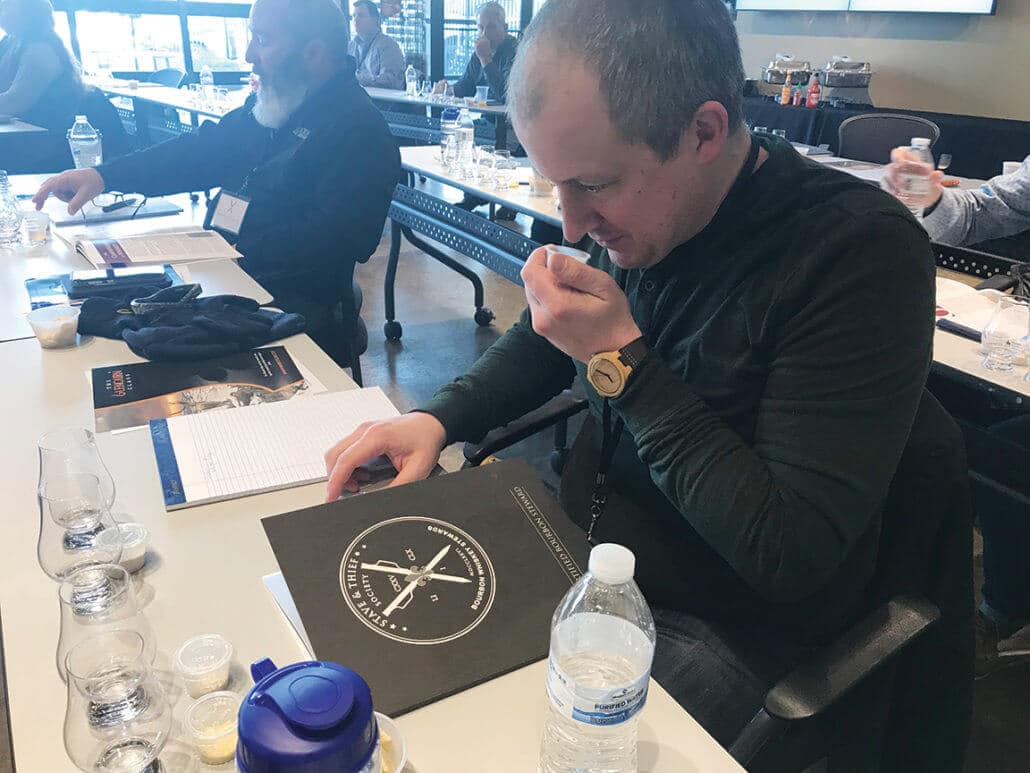
The course involves some traditional classwork and an in-depth exam, as well as participation in the distilling process at an on-site distillery. Participants mill their own grain and taste the heads, hearts and tails of a small batch distillation. This is important: the heads, or first part of the distillation, contain lots of off-tastes and some potentially dangerous alcohols; the hearts, the middle part, is the good stuff and distillers want as much of that as they can get; the tails, or the end part of the distillation, can add some character to the batch but can also negatively impact the flavor, if the distiller doesn’t “cut the tails” soon enough.

Master distillers achieve part of their unique taste profiles by deciding when to cut the heads and tails, the only part of the distillation process they can control. Once the whiskey enters the barrel, where it gets most of its flavor, the storage space and temperature over the next few years determine how it matures.

Would-be Bourbon Stewards also study nuances of flavor and scent at a flavor lab next door, called Flavorman—no lie, but I guess Bourbon Stewards are kind of like superheroes—as bourbon picks up distinct flavors during its time in the barrel. In the first four years, it gains most of its appealing amber color and signature vanilla and caramel flavors. In years five through 10, the bourbon pulls out more of the wood sugars and develops some dark, fruity and nutty flavors. After the 10-year mark, oxidation is a concern. Some of the developed flavors will begin to degrade, while the bourbon is still picking up new notes; not every whiskey can make it 20 years in the barrel.

The nuances of the aging process help potential stewards guide their guests to whiskies that fit their personal preferences. They also help in a blind taste test which, lo and behold, features in the final exam for Executive Bourbon Stewards. Kentucky’s wizened bourbon mavens will attest to the difficulty of a blind taste test, but it’s an exercise that sharpens the palate and guides the mind through the distinctive scents and flavors of the most complex bourbons. (Just ask Flavorman). Students taste a few bourbons, name them, and present them in a hypothetical flight.

Though a PhD is (thankfully) not necessary to tend bar, those who are serious about their trade will, like any professional, seek out knowledge about the products they shake, stir, pour and serve. You, drinker, are the lucky beneficiary; who wouldn’t want an expert advising you on your drink of choice, whether it’s beer, wine or, best of all, bourbon?

Kevin Barrett co-owns Dram & Draught and is a certified Bourbon God Executive Bourbon Steward.

(more…)

In Totality: BevCon 2017

In Totality: BevCon 2017

There was more than one reason to travel to Charleston, S.C. on August 21st. There was, of course, the chance to be in the path of totality for the Great American Eclipse, but keep in mind, “totality” can mean a few different things—especially when Ashley Christensen, a local James Beard Award winning chef, Sean Lilly Wilson, a Durham beer legend, and Gary Crunkleton, the master of spirits and cocktails from Chapel Hill are there, too.

These folks, along with an intrepid food and beverage app developer, some not-so-surly bartenders, and one would-be writer went for BevCon 2017.

BevCon, an industry-only gathering in its second year, featured classes and seminars led by legendary drink slingers, beverage historians, and masters of wine. Topics ranged from new and innovative cocktail techniques to bookkeeping for bartenders. There was even a class on how to get published, taught by James Beard award-winning author Brad Thomas Parsons.

Some of our local food and beverage heroes shared their knowledge, too. Crunkleton of The Crunkleton in Chapel Hill, Wilson of Fullsteam Brewery in Durham, and hometown favorite Christensen all spoke about their respective areas of expertise. To listen to them, you might say, was to be in the path of totality.

Before and after their events, each instructor from the Triangle sat in other seminars and classes, soaking up even just a bit of knowledge from their peers. David Wondrick, the pre-eminent cocktail nerd—and I mean that in the greatest way possible— taught my class in the morning and then sat behind me in the afternoon. Maybe that puts totality in a different perspective.

Some, like one would-be writer who moonlights as a bar owner, might wonder why some of these folks are teaching these classes, much less sitting in on others on a beautiful summer day in Charleston. Is there really much more out there when you own an enormously successful business, have been written about nationally, and have won countless awards in the region and beyond?

It comes back to totality, I guess. Totality, in a non-eclipse sense, means the whole of something or the quality or state of being total. Most who participated in BevCon were chasing totality whether they arrived in time to see the eclipse or not.

The awards don’t start piling up by sitting back and relaxing. Some people chase a little more and a little bit more until it adds up to—well, I’m not going to say it anymore.

BevCon, which will be returning to Charleston next summer, had an impressive cadre of participants and attendees. Our beloved Triangle had a more than respectable showing in both categories. If you would like to attend next year, keep in mind, it’s for industry only. If you are in the beverage industry, even on the periphery, I recommend you pay your price of admission, and spend a few fun and informative days in one of the South’s best cities.

There may not be an eclipse next year, but we can all still chase totality. Oops. I said it again.

Island Time

Island Time

Somewhere in the middle of the Atlantic Ocean on a pink sand beach on a three-and-a-half-mile-long island, someone is drinking a Goombay Smash while they stare off into crystal clear water. I can’t bring you to Harbour Island in the Bahamas, but I can bring a Goombay Smash to your backyard this spring.
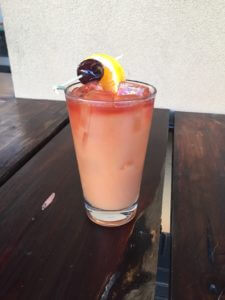
The Goombay Smash is a common drink in the string of islands known as the Commonwealth of the Bahamas, but if you’ve never been there you’ve probably not heard of this tiki style drink.

By now, you probably have two questions:

1. Who, where or what is a Goombay?

2. What exactly is a tiki style drink?

When I first heard of the Goombay Smash, I thought maybe there was some old time Bahamians named the Goombays. You know, maybe it was mayor Goombay or governor Goombay, but I couldn’t find that bloodline in the intriguing history of the islands. Then I thought there might be a place called Goom Bay, but I couldn’t find that place anywhere on Google Earth.

It turns out a Goombay is actually a goatskin drum often used in a style of Caribbean music by the same name.

Now, for the sake of brevity, I’m going to offer my own definition of a tiki style drink. A tiki drink is a vehicle for delivering large amounts of rum to your liver usually accompanied by tropical juices.

It’s also the name of the first man on Earth according to Polynesian mythology, but let’s stay focused on the drinks and the livers.

In the Bahamas there are as many recipes for this drink as there are places that serve it. And I researched as many as humanly possible. I did it for you. I did it for this article. I didn’t do it for my liver, but we’re in the middle of a permanent feud anyway.

While visiting this little peace of paradise, I was also fortunate enough to work with a resort staff training them on cocktails and hospitality. This gave me a test lab to work out what I think is the best recipe for a Goombay Smash that stays true to its island roots.

This is a strong and surprisingly easy-to-drink cocktail. Be careful. The Myers’s Rum float adds a little extra kick. Do not operate any M. Night Shyamalan movies while drinking it. It will just make you confused and angry.

However, if you ever take a trip to Harbour Island in the Bahamas, make sure to stop by the bar at Valentine’s Resort and Marina and ask for the best Goombay Smash in all the islands. Tell them I sent you. In the meantime, bring some of the Bahamas to your backyard this spring.

Goombay Smash

¾ oz Bacardi Light

¾ oz Bacardi Gold

¾ oz Malibu Rum or Coconut Rum

¾ oz Nassau Royale or Orange Curacao

1 oz Orange Juice

1 oz Pineapple Juice

½ oz Myers’s Rum

Mix all ingredients except Myers’s Rum in a shaker with ice.  Shake vigorously for 7-10 seconds. Strain into a pint glass with ice. Float Myers’s Rum gently on top of drink. Garnish with an orange slice and brandied cherry.

Kevin D Barrett is the owner of Dram & Draught.