Here’s a roundup of local podcasts you should check out to stay plugged in.
The Fly Angle RDU Airport has an official airport podcast, and we think it’s pretty fly (had to). #AvGeeks and occasional flyers alike can—and should—get an insider glimpse of the busy international airport via this bird’s-eye view by RDU’s Communications, Government and Community Affairs staff. rdu.com
Bop or Flop Music: Good or bad? That is the question. Tune in to Bop or Flop every Tuesday as Raleighite BFF comedians Spencer Bland and Jordan Scott Huggins welcome guests (think comedian and YouTuber Jake Weddle) to bop through the ages and assign a yay or nay in hilarious fashion. @boporfloppod
This Is Raleigh After globe-trotting over 50 countries (plus living in five!) and founding award-winning travel blog ytravelblog.com, Aussie couple Caroline and Craig Makepeace—who could live anywhere in the world—landed in Raleigh for their permanent home and launched passion project This Is Raleigh… now with a namesake podcast to boot! Tune in for a deep-dive into why the City of Oaks’ spirit spoke to them via stories, interviews, stay and play (and getaway) ideas, and more. thisisraleigh.com
Podcast Raleigh With guests ranging from the voice of the Canes to the chief of police to music critics and more, Raleigh-natives Raleigh Over Easy creator Ashton Mae Smith and 99.9 FM The Fan’s SportsChannel8: The Radio Show’s Hayes Permar co-host this society and culture podcast all about, well, Raleigh, natch. podcastraleigh.buzzsprout.com
RDU is the first airport in the world to launch travel requirement tool, further increasing passenger confidence.
By mid-March, 1.35 million people were taking to the skies again—a drastic (uplifting) contrast from rock bottom last April (a mere 87K daily), and RDU was on track to have its busiest month since the health crisis began. Now, further lifting passenger confidence, RDU has launched the first-in-the-world real-time interactive safety travel tool on its website.
Remember going places? … Besides from the bed to the dining table to the kitchen (wash, rinse, repeat). Well, cases are down; vaccinations are up—and as vaccine rollout continues to flourish, passenger confidence is quickly on the rise and air travel is skyrocketing.
With Memorial Day on the horizon, air traffic is expected to continue to take flight through summer, with domestic travel being the big draw. At RDU in particular, travelers continue to report confidence in its strict health and safety measures.
Raising the bar a step higher, in March, RDU became the first airport in the world to help passengers travel even smarter by launching a know-before-you-go interactive travel tool on its website that includes all nonstop destinations. So, you simply select your potential destination and get up-to-date real-time info on that locale’s specific travel/entry prerequisites (testing, quarantine, etc.); required travel documentation; arrival instructions; local advisories and regulations; and what’s open—from restaurants to businesses to attractions (rdu.com/travel-info/travel-requirements).
And RDU is poised to soar, having just been named by Delta as one of only two U.S. “focus cities” (the other is Austin) as it looks into the future of travel post-pandemic—think less hub and more resource center. Former focus cities included San Jose ( Silicon Valley), Nashville and Cincy. And doubling down on our market’s potential, Sun Country Airlines will start flying direct to Minneapolis-St. Paul out of RDU in May. Clearly, when it comes to air travel, all eyes are on the Triangle. Here’s what you need to know to resprout your wings and go wheels up at RDU.
We know. COVID fatigue is real. Pandemic PTSD is a thing. And we’re all tired of living it, mourning it, fearing it, seeing it, hearing about it—much less reading about it.
The last year no doubt created its own special brand of hell. But with it came a level of community (and solitude), reflection, innovation and growth like none of us have seen or experienced in our lifetimes.
And at the one-year anniversary, with more sleeves being rolled up each day and numbers finally dropping, we can actually see the light at the end of the tunnel. Social distancing will come to an end. We will sit on bar stools again and dine indoors without inhibition. We will sway to live music. We will complain about all the people at fests and the NC State Fair. We will tailgate (pack those coolers!). We will fill the stands at Carter Finley and PNC. And we will hug and high-five again. (Is anyone else in their feels?)
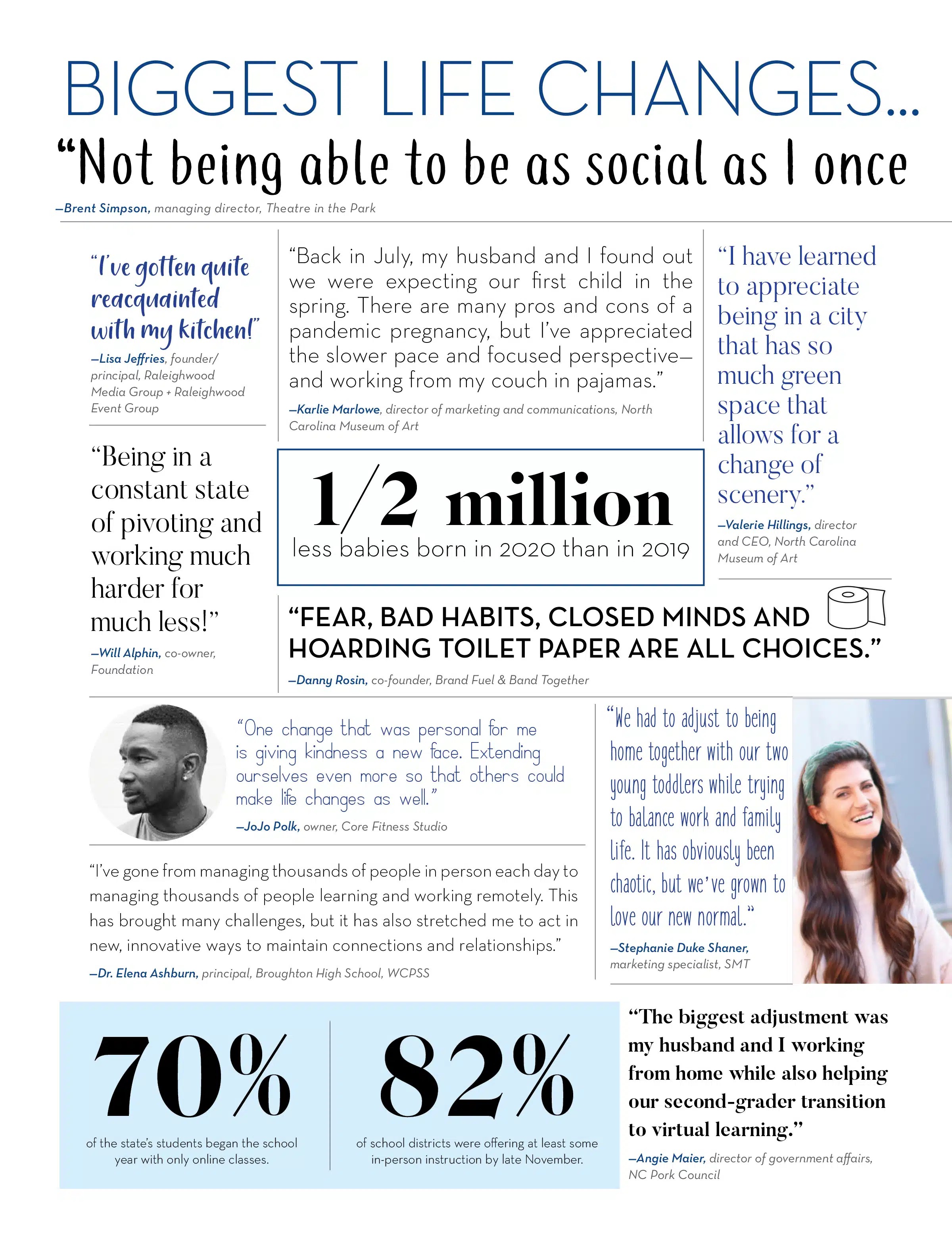
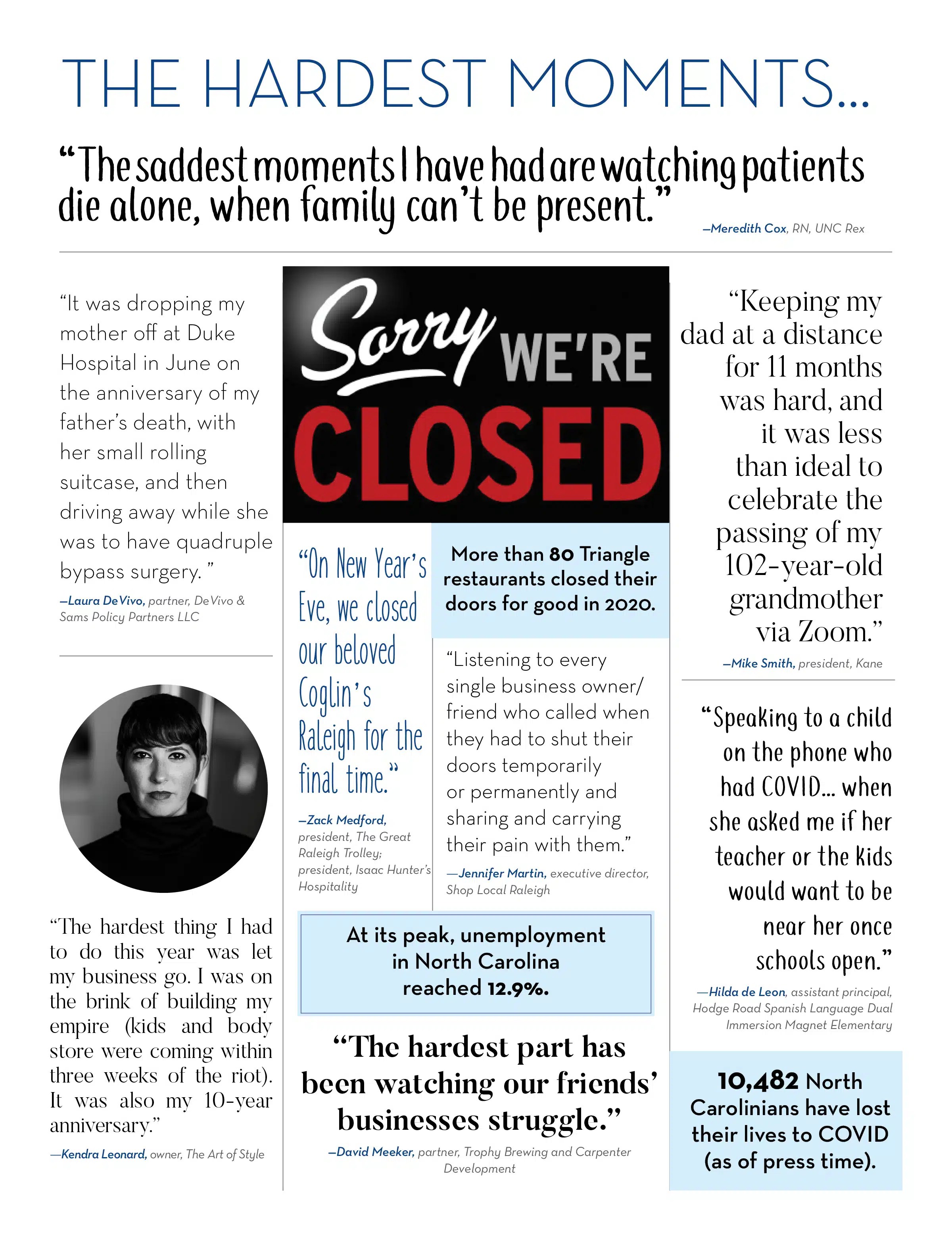
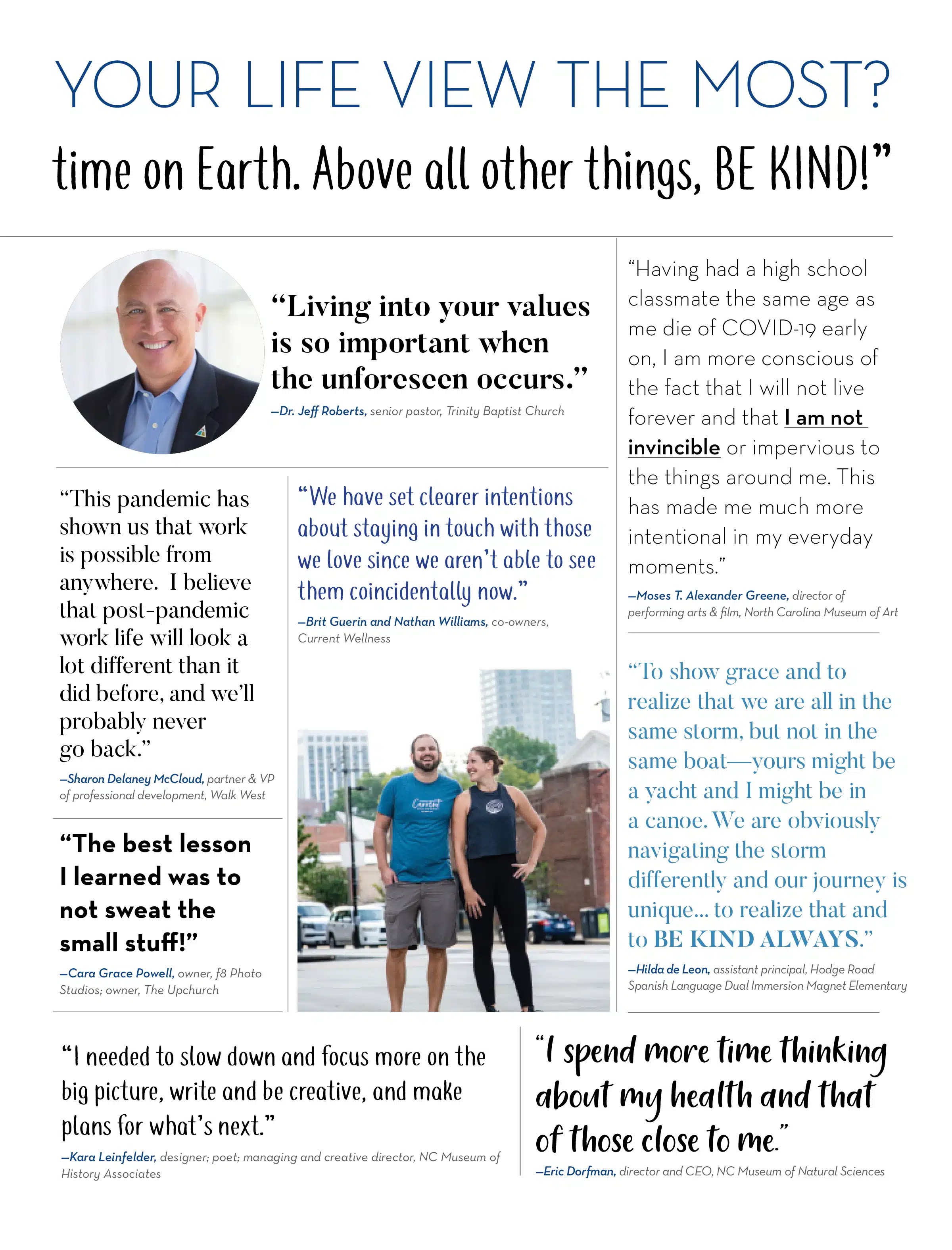
And, as you have told us, most importantly, we will live with a level of gratitude and abandon we could have never discovered if not for this pandemic. So, at this one-year anniversary (which somehow seems momentary and lifelong at once), we asked people from all walks of life—of all ages, stations and from all over the city—to tell us their biggest life changes, saddest moments, what they learned, how their life view changed—and what they are most looking forward to.
So, grab the tissues and dive in—and feel solidarity and hope. We thank you; we see you; we feel you—and we cannot wait to hang out with you again.
Move over Gibson and Fender—there’s a new guitar guru in town.
Vibe this: “Perfection is a fool’s game; it’s for suckers.” So is the MO of self-proclaimed “imperfectionist” and musician Jerry Bodrie. But the guitarist and drummer isn’t your everyday musician—those guitars? He makes them—one at a time, with a pencil and eraser, by hand, with a Craftsman bandsaw and a router table (which he also made himself), and then paints them outside in the elements.
Being crafty is arguably in Bodrie’s genes. The managing director/partner at advertising, design and media strategy company Baldwin& by day, Bodrie strummed up his guitar-making biz in 2012 while doing a motorcycle restoration—after which he shifted gears and Redeemed Guitars was born. Initially a restoration concept, production evolved into unique handbuilt designs in 2018.
Instead of creating perfect axes, Bodrie focuses “on playability in the form of feel and tone.” His process, which typically takes two to three months, has yielded a dozen masterpieces to date across three model types (The DeVille, The Fleetwood and The Eldorado). He has two more in the works right now. Here, we chat up the music-maker on his inspo, his craft and more.
The first time you remember touching an instrument? My older brother forbid me from touching his drum kit, so, in elementary school, I immediately started playing it. At 15, I joined a band, and we played at bars and clubs in and around Detroit. At 19, I went away to Michigan State, leaving the drums behind, and bought a guitar, and I’ve basically played either drums or guitar in bands ever since—I’m now 53.
You’re in a band now? Yes, my band is called Medium Heat, and I play guitar. So your brother is “instrumental” in your passion for playing music? I learned a lot about drums from my brother—no lessons or school band or anything like that. I wanted to be in a band… and in a band you play a lot, work with others and learn to perform, so that was really my training ground.
When did banging the drums evolve into your love for strumming guitars? My first memory is probably watching The Monkees on TV after school. Those guys were so cool. I loved the music, and right away I started paying attention to their gear too. They all played Gretsch gear, which is one of my favorite brands. Gretsch is a go-to—any other brands or specific models? That’s a moving target. If you mean guitars I own—and I own a bunch—it’s probably my 1967 Gibson Firebird or my 1959 Gretsch Chet Atkins. But, lately, I’ve been playing my guitar (ones that I’ve built) more and more, especially The Fleetwood Thinline.
From a craftsman standpoint, who’s your guitar muse? My guitar inspiration is Paul A. Bigsby. He’s famous for the Bigsby vibrato, which is found on many guitars, but most people don’t know that he is acknowledged as the father of the solid body electric guitar. He was well ahead of Fender and Gibson. His design, his craftsmanship and his commitment to making things by hand are all very inspiring to me. How did you go from motos to axes (aka guitars)?
I was chatting with my friend Bob Ranew about bikes, and we hatched the plan to find an old beater from the 1970s and then customize it and bring it back to life as something new, something cool. So, we cleared out some space in my basement and did that over the next few months. It was an awesome experience and a cool creative outlet. Bob kept the motorcycle angle alive with Redeemed Cycles (his stuff is killer), and I took that approach into guitars with Redeemed Guitars—initially just salvaging, hot-rodding or restoring ill-fated guitars, until eventually designing my own models and building them from scratch.
Who does your first model belong to? The first one went to my friend Jim Vincent, who should be famous, as he’s not only a super-cool guy, but he has been a guitar tech to some of the biggest bands in the world (think Nirvana, Pearl Jam, Sonic Youth, etc.). How did you whittle your craft to the three styles of guitars you build? I didn’t want to copy the guitars I own or long to own, but I wanted to pay respect to them and put my spin on them. The way I view it, the guitars I build are like the best friend you haven’t met yet. So, The DeVille was first, inspired by my love of offset guitars like the Gibson Firebird and the Fender Jazzmaster. The Eldorado came next, an homage to the guitars of Paul Bigsby (of which there are so few). And, last, The Fleetwood, which is my Telecaster-adjacent model.
Give us the beat on your “imperfectionist” MO. My guitars are not perfect, I’m not even trying for perfection—because I don’t think that is really important. Perfection is just an unattainable goal that will make you unhappy. I work for feel, for sound, for stability, for cool details or something different. I want people to love to play these guitars, to take them out and use them often—and any imperfections on day one or day 1,000 are just part of the story.
Gather may no longer be a bad word? As cases go down and vaccinations go up, our sweet little city is starting to feel alive—and host live events!—again. Besides its social and mental health significance—aka a reason to finally break out of the house—it’s also a monumental sign that Raleigh’s economy is en route to recovery after suffering a $21 million decrease in tourism tax collections in 2020 due to the pandemic. So, as events large and small start to get planned (or even occur), the light at the end of the tunnel feels finally in view—as does a thriving local tourism and hospitality sector. Here, our spread of HOPE. Stay strong, Raleigh. We’re pushing through together.
ARTS, THEATER, MUSIC
North Carolina Symphony
Duke Energy Performing Arts Try to conduct yourself… the North Carolina Symphony is back with its first in-person event since the pandemic, presenting Tchaikovsky Symphony No. 4 March 5–6 (and streaming March 11).
North Carolina Museum of Art The NCMA “unwraps” its first large-scale post-pandemic exhibit opening with the Golden Mummies of Egypt, bowing March 6 and featuring a collection from the Manchester Museum in England. The museum has also reopened its coffee shop, Sip, for the first time since last March—just in time for patrons to grab a latte while strolling through the exhibit.
Red Hat, Etc. Last year, all we could do is tragically reckon “I guess that’s why they call it the blues.” But get ready to fiddle up some fun as the IBMA Bluegrass Live—the largest free urban bluegrass fest in the world—is slated to take stage in DTR this fall with a mixture of in-person and virtual concerts.
Fayetteville Street Perhaps its moniker has never been more fitting… Artsplosure will no doubt bring an explosion of creative energy in 2021 as the nationally lauded juried Art Market and fest (named top 50 fine art and design shows) pushes its famed two-day spring event to fall for a LIVE return to the streets of DTR this October.
FESTIVALS
Midtown Remember food trucks? And live music? And vendors? It’s no longer a memory. March’s monthly installment of MAKRS @ North Hills pop-up market (March 14) sees that full lawn of vendors and raises them a food truck, coffee truck and music. Rock. On.
Greater Raleigh Convention and Visitors Bureau “Sports do not build character, they reveal it.” Amen. And, thankfully, youth sports have returned to the Raleigh Convention Center. Volleyball tournaments started in February, and basketball will be resuming in April. Nothing but net!
CHARITY EVENTS
North Ridge Country Club It’s time to par-tee. NRCC is back with its famed and benevolent two-day Wheels Up party and golf tournament May 2–3, restrictions allowing, to benefit the children. 2019’s event raised more than $175,000 for Children’s Flight of Hope. Let’s tee it high and let it fly for the kids—and show them all the good 2021 can bring.


 The Fly Angle
 Bop or Flop
 This Is Raleigh
 Podcast Raleigh