by Alexandra Drosu | Apr 4, 2017 | April 2017, Do
 #1 The Mason Jar
Holly Springs
Mint juleps and pork sliders may not be the first combination that comes to mind, but both are specialties at this tavern that prides itself on southern hospitality with a modern twist. All beverages are served in (you guessed it!) mason jars. Don’t miss the corn fritters and s’mores in a jar at this family friendly spot.
#2 Full Frame Festival
Durham
The prestigious international documentary festival celebrates its 20th anniversary this year. The four-day event sponsored by Duke University offers attendees an opportunity to buy a pass for all events or to attend specific films—more than 100 will be screened. In the past, guest speakers have included documentarian Michael Moore and director Martin Scorcese, and special panels have discussed subjects such as diversity and gender bias.
Full Frame: A world-class documentary film festival just down the road
If you have never made the short drive to Durham to check out the Full Frame Documentary Film Festival, give it a try this year. Documentary filmmakers and film fans will descend on the Bull City to experience this truly world class but equally approachable festival.
One of the unique things about Full Frame is that you’re guaranteed to see the documentary films that everyone will be talking about for the next year since many will be picked up for distribution just prior to or during the festival.
Full Frame has another great quality to it: it is a friendly, comfortable festival. If you’ve ever hesitated to go because you felt it might be a clique of big city filmmakers wheeling and dealing, think again. You will be having coffee, standing in line, ordering popcorn, and eating meals alongside all kinds of folks, including plenty of locals who get to indulge in a documentary feeding frenzy over the course of the long weekend. It’s fun to meet people from all over who have a passion for telling or watching stories about the world we all live in.
If you are going for the first time, you can either buy a pass or individual tickets. The Opening Night screening is always a crowd pleaser and tickets for that event will sell out, so grab those as soon as you can. On Sunday, there is an awards ceremony and the winning films are screened again throughout the course of the day, which is a great chance to see the cream of the crop. If you want to attend the festival for just one day, Sunday is a good one since it tends to be less crowded, and you get to see the best of the best.
You really can’t go wrong at the festival, since the selection committee rigorously evaluates all of the many submissions. Sometimes it’s fun to pick a film blindly, but you can always read the descriptions online to pick films about the subjects you care about. It’s one of my favorite events of the year, and those of us who live here are fortunate to have it in our backyard. —Dr. Marsha Gordon, NC State University, Associate Professor of Film Studies.
#3 Aviator Brewing Company
Fuquay-Varina
What’s missing from so many of the area’s breweries? Food! Many rely on food trucks to meet demand but not at Aviator. Served alongside its award-winning brews, you’ll find a robust menu from its Smokehouse, including slow- smoked meats, burgers, sandwiches and even salads. They also offer kid-friendly dining options. The taproom housed in the historic train depot pours standards plus limited-edition beers, and several times a week live bands perform everything from blues to rock to 80s pop.
#4 Ackland Art Museum
Chapel Hill
If you haven’t visited this free museum, it’s time to go. This year, Carolina alumnus Sheldon Peck and his wife Leena donated 34 primarily 17th-century European masterworks (valued at $17 million), including seven works by Rembrandt van Rijn. But the new endowment is only a small part of the permanent collection comprised of more than 17,000 works and artifacts. Highlights include works by cubist artist Max Weber, 19th-century painters Eugène Delacroix and Fujiwara Nobuyoshi and Andy Warhol. Check ahead of time for special events and weekly programs such as Drawing in the Galleries (Apr. 8) or Music in the Galleries (Apr. 2).
 #5 Oaklee Distilling
Wendell
Located in Wendell’s historic district, this local distillery crafts vodka made from sweet potatoes and corn. A traditional dry-style gin will debut in late May or early June. Raleigh native and distiller Lee Browne wanted to capture a down-home feeling at the venue, which is also open for special events: The century-old building has lots of character with a cozy upstairs area. Oaklee will start offering structured tours this spring so check the website for more details. Larger groups can schedule a tour at their convenience.

by Alexandra Drosu | Mar 1, 2017 | Buzz, March 2017
After a decade, a community service mural finally gets a new home

For more than a decade, a small community mural project languished unfinished. It was housed in the old Osceola Recording Studios before the studio relocated to its current Capital Boulevard location. The new owner, Riley-Lewis General Contractors, was in the process of renovating the building when they stumbled across the incomplete mural, an eclectic collage of various musical performers across different musical genres. Instead of demolishing the wall, Sean Riley and Dave Lewis salvaged it and put the mural into storage.
“We always had the intention of having an artist come in and add more depth,” says Riley. After construction on the new building was complete, it was left to Project Manager Amy Adams to figure out how to accomplish Lewis and Riley’s goal. First, though, she wanted to know the history of the piece and after a little sleuthing she tracked down those responsible for it.
 In 2006, professional writer Judith Guest was leading a free summer youth enrichment program called the Jambalaya Project through her work as the Executive Director of the Latta House Foundation. The focus of the project was to enhance reading and writing skills through a journalism program; many of the kids came from underserved communities, group homes or shelters, she says. As part of that effort the kids, ranging in age from 12 through 17, would have an unbelievable opportunity—to interview then 16-year-old R&B star Chris Brown.
Dick Hodgin, the owner of Osceola, often let Guest and the students use the recording facilities, and so she fashioned a team-building project with the kids to say thank you to the music producer. She enlisted the help of local artist Gregory Paige, and they set about working with the kids to create a mural that showcased the diversity of music. Paige met with the teens to choose artists who would represent the spectrum of musical genres—from Johnny Cash to Michael Jackson.
“They would come in and paint and participate, but it had to be carefully orchestrated. We put 30 to 35 hours into the painting,” says Paige. “I like to expose kids to art because it expands their mind and lets them know what they are capable of.”
Though the group spent a significant amount of time on the mural—and in fact Chris Brown attended the ribbon cutting for it—the project was never fully finished. However, more than 10 years later, Riley-Lewis would commission artist Dan Nelson, known for his live event painting, to finally complete the work.
“We were really honored and taken aback to learn that [they] were interested in preserving our mural and its backstory,” says Guest. “It was refreshing to learn that they share in our passion for music and the diversity that it brings.”
Nelson, for his part, was intrigued by the purity of the project and the fact that it was both visually and historically stimulating. “It was sincere and authentic,” he says, adding that he was also impressed that Riley-Lewis salvaged the work. “It was an extremely fine gesture.”
Left with the task to complete the montage of musical icons, Nelson did his best to track down the images Paige and the teens used for the renderings, and in most cases he was successful. But there were instances where he had to resort to using a different pose; however, he succeeded in retaining the original intention of the work.
In mid-February, Riley-Lewis invited the various individuals involved in the mural to see the finished result. The gathering was a casual tribute to how artwork can bring together communities while also preserving the story of these young, aspiring journalists.

by Cameron Walker | Dec 7, 2016 | Buzz, December 2016 / January 2017
Name: Noelle Ocon
Title: Conservator of Paintings
Company: North Carolina Museum of Art
Noelle Ocon does invisible work. As Conservator of Paintings at the North Carolina Museum of Art, she is tasked behind the scenes with caring for the collection’s paintings—an art defender, protecting priceless works from age, pests and the occasional handsy tourist.
The New Orleans native initially didn’t want to go to college, but she made a deal with her mom that she would try UNC-Chapel Hill for just one year. She ended up graduating from the university and chose to major in art history.
“At the end of my sophomore year, I went to a meeting for careers for art history majors,” says Ocon. “As I like to joke, it was a very short meeting, but I met a woman there who was a conservator. I had a ‘eureka’ moment; it was like a calling. From that point on, I had this path.”
After graduation, she worked for a private conservator in Maryland, and in 1996, earned her master’s degree from the State University College of Buffalo. The following year, when Ocon was hunting for a job, the only open position in her field was at the North Carolina Museum of Art, a happy coincidence. She’ll be celebrating 20 years at the museum this coming March.
Can you describe your job for us?
When we get a piece of art, I first want to make sure that it’s preserved, meaning controlling the temperature, the humidity, the light. We want to prevent or slow the agents of deterioration. Then we want to document it, determining the condition, the construction, the materials and the technique, which is a relatively new concept in all of art history. It’s really only the last 40 years or so that conservation has become more of a science instead of a craft. The sexy part is actually working on the painting, which is the preservation where we clean paintings and try to restore them as close to the original as possible. It would be great if that was all I did every day, but there are a lot of other things that go into taking care of the museum.
Like what?
Checking light levels, heat, temperature, humidity, periodic dusting, checking what insects are inside and if they could harm the art. We get called if someone has touched a painting and we need to check on it. My colleagues go outside and clean the outdoor sculptures a few times a year because they have to be washed and waxed. Then there are other things such as traveling with artwork when we loan [it]. And when we have a show come here, we examine everything that comes in the door and then we check it when it leaves to make sure that it’s in the same condition it was when it arrived.
That sounds intense.
It is intense especially when you’re responsible for a $60 million Rembrandt or a $30 million Vermeer! People often ask if I’m nervous around artwork and I will say no, because when the artwork is in here, it’s my job. I make this analogy that when a surgeon is cutting into a person he’s not like, “Oh my God! I’m cutting into a person!” It loses its aura—it becomes just an object on the easel. Then, when it goes back on the wall, it regains its preciousness.
Will you walk us through a typical day?
I try to do my retouching in the morning. Retouching is where you touch in where all the paint has fallen off. Then I might give a tour to a group of interns here at the museum. We just bought a painting last week and I x-rayed it a few days ago; it took all morning to x-ray it, develop the films and put them together to examine what was in the x-ray.
What drew you to art history?
I signed up for this class focusing on Dutch and Flemish art, Jan Van Eyck to Bruegel and up to Rubens, 15th-, 16th-, 17th-century. That first day of art history class, the professor said, “Don’t take notes, just look.” And he showed us all these amazing paintings. I had been to art museums as a kid, but he started showing us Rogier van der Weyden and Hieronymus Bosch and Pieter Bruegel, and I thought, ‘This is it.’ And to this day, it’s my favorite kind of art. [The same professor] wrote me a letter of recommendation to go to graduate school. The “e” was broken on his typewriter, so he had to handwrite all the “e”s into the recommendation letter.
What are some of your favorite works that you have helped to conserve?
One of my favorites is “The Last Judgement” by Crispijn van den Broeck, a 16th-century painting. When we bought the painting, it was shipped down here and the way it was framed, the wood couldn’t move… so when I unframed it, the wood finally said, ‘Ahh!’ and cracked in half. That was a bad day. But I restored the front, and when I think about my favorite painting in the last 19 years, I would think of that one.
What are some challenges in the art world?
It’s all changing. I would rather just go look at a painting. I don’t need an iPad, I don’t need a soundtrack, I don’t need entertainment. All I need is a painting, but I’m a dinosaur now. It’s all about audience engagement and selfies and hashtags. I’m not that old, but that is sort of the newer generation and how they want to interact with art.
What are the best parts of your job?
I’ve been able to travel to Japan—none of this has been on the taxpayer’s dime—Russia, Germany, Holland, Italy, England, and see beautiful art. Also working here in this institution with my colleagues and making sure this art is here for future generations. It’s something that is difficult to think of because of the immediacy of our society. Like the Crispijn van den Broeck painting, that artist painted it with the intent to last forever. It’s still here 500 years later.
Does it ever strike you, when you are holding something that’s 500 years old, just how incredible that is?
Yes! So a painting that I was working on, the tree that it was painted on was cut down 50 years before the Jamestown Colony was established here. Christopher Columbus had just died when the tree was cut down. That’s how old the painting is and also how young our country is. You go to Munich, and you’re in a 13th century church or a restaurant that has been there for 700 years.
Do you make any art in your free time?
Not really. I dabble in calligraphy and watercolor, but once you look at a really good painting, it’s hard to go back and paint a picture of your cat.
Are there any misconceptions people have about your field?
Well, it’s not like Sigourney Weaver in Ghostbusters 2. Also, I want to make sure that people know that you get what you pay for. There is a sad truth to my field and the sad truth is that I am not certified. I have credentials, I have my undergrad degree, I have my graduate degree, I have my internship, my portfolio, I have the word of my colleagues, I have my publications…however, anyone today can say they are a conservator and there is nothing I can do to stop them.
Have you seen any examples of something going horribly wrong?
We have a painting here that someone put masking tape on, duct tape, people have nailed paintings to boards…there is a lot of bad restoration going on.
Like that woman who “restored” the mural of Jesus and it resembled a monkey?
Yes, exactly. Poor “Ecce Homo.” But you know? That city, Borja, in Spain made so much money from people coming to visit that painting that they are opening a visitor center. So, it’s been a boon to their economy.

by Mandy Howard | Nov 14, 2016 | Do, November 2016
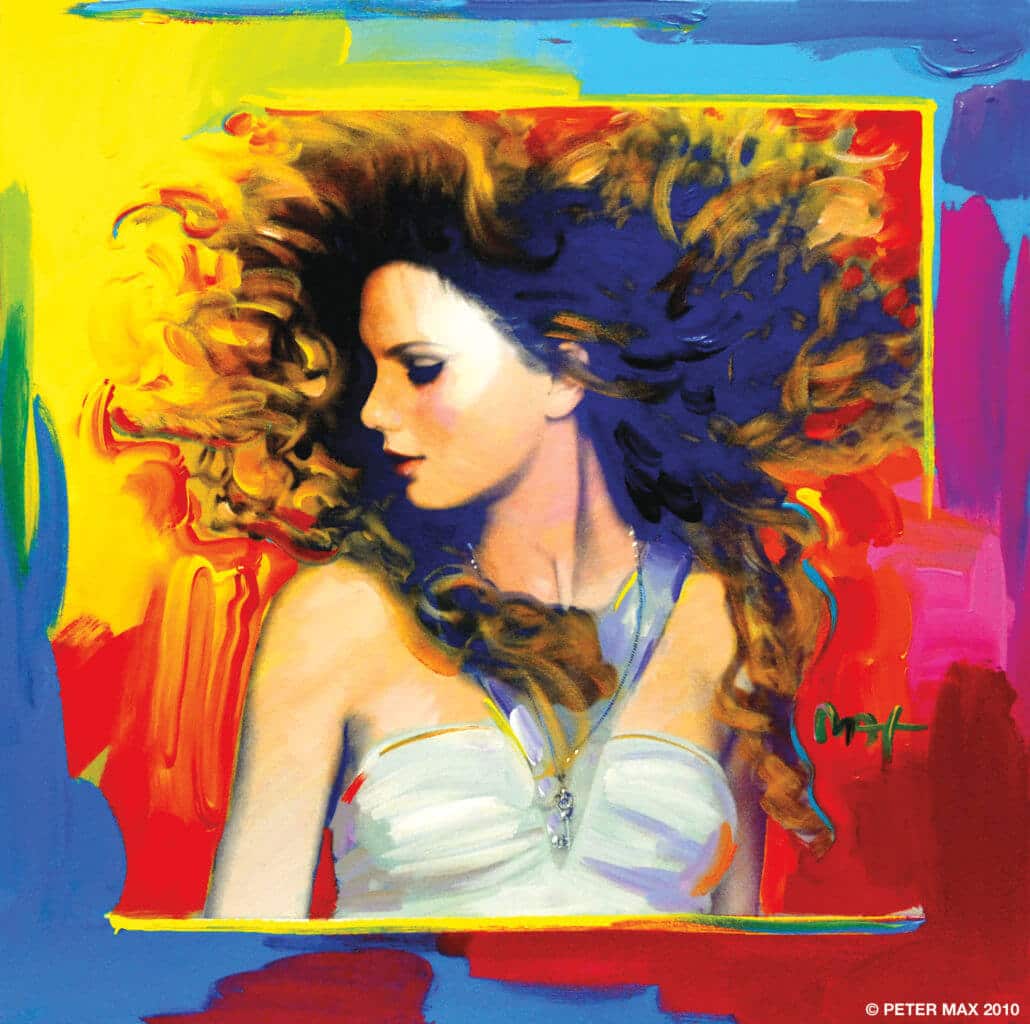
Pop artist Peter Max brings color to Raleigh

He has painted the last seven presidents, Marilyn Monroe and Lady Liberty, and his work has been featured everywhere from government stamps to Boeing jets, but what makes Peter Max truly stand out is his undying love of color and his optimistic portrayal of the world around him. Born to parents who were forced to flee a Nazi Europe, Max traveled all over the world and often credits his time in Paris for fostering his love of art. His family eventually settled in Brooklyn, and Max quickly became a household name. Colorful palettes and psychedelic pop imagery allowed him to interact with some of the most influential artists of all time. His travels and career now bring him to the Mahler Fine Art Gallery this November, and Raleigh Magazine had an opportunity to learn a little more about this colorful icon.
You have been an art icon for over 50 years but your work remains fresh and relevant, how do you keep your art so current?
Well, it is because I paint everyday of my life really. Technically, I spend five days a week at my studio and when I’m not at my studio, I paint and draw. I stay present and aware of everything that is relative and current.
You seem to associate closely with music, from painting Ringo’s piano to recently painting the judges of “The Voice.” How does music influence your art?
Simply put , I’ve fallen in love with music so it inspires me. Especially when I got well known, I got to meet all of these amazing people. I got to meet The Beatles and so many amazing artists personally. They’ve all been to my studio. You cannot imagine how wonderful that has been for me.
Your artwork always feels optimistic and you talk about love often. Is it your goal to promote love and optimism in your work?
It’s just in me. It’s just natural. I am focused inside by my art, on my colors, on the music. I’m focused where it is all lovely.
And you are bringing that art and spirit to the Mahler Fine Art Gallery. How do you choose pieces for a show?
I always select pieces with my assistants. It is a natural procedure we have developed. We always create a nice broad variety.
Do the pieces vary depending on the location? Would the pieces you select for Raleigh be different than, say, Los Angeles?
It could be. It’s always a little bit different. Each piece for each show is always individually picked.
What advice do you have for artists trying to find success today?
I say just draw, paint, do what you like [doing] and follow your feelings; that will always work. I think if you’re a good artist and people enjoy your work then you’re giving a lot to the people and they appreciate it. It becomes a very beautiful circle.
It has been said that your work is the building block for popular apps like Instagram and Photoshop, in which you take an image and bring more to it. How does it feel to help foster art for so many?
 It’s wonderful. There’s so much available now to us in our lifetime. The colors are there, the reproductions are there, the mediums are there, it’s endless.
Your work is momentous, spanning everything from painting the hull of a ship to being the official painter for the Olympics and World Cup; is there any experience that stands out above the others as a favorite?
I think every single day, something new happens. I’m so appreciative that I can do it. That’s what stands out as important, I just appreciate the millions of favorites all the time.
You have also painted the last seven sitting presidents. I know you talk about being spontaneous, but in an election year, are you looking ahead and brainstorming about future portraits?
Sometimes I think about it ahead, but sometimes not. Mostly it is spontaneous and whatever happens new and now.
Do you have any other words for your fans in Raleigh?
I can’t wait to meet them and to be there, for me that’s the big thrill. That’s what I enjoy.
Meet the artist at Mahler Fine Art Gallery
Fri., Nov. 18, 7 p.m.-9 p.m.
Sat., Nov. 19, 2 p.m.-5 p.m.
Sun., Nov. 20, 1 p.m.-4 pm.
RSVP: 919.896.7503 or [email protected]