If you think colored pencils are just for kids, think again. Raleigh-based artist Jaimon Caceres uses them to create magical landscapes and lifelike portraits that look similar to oil paintings.
Raised on a small farm in Burnsville, NC, Caceres grew up without television and internet, encouraging him to take in the natural beauty of the world around him. During the warmer months, Caceres adventured through fields, forests and creeks surrounding his home and in the wintertime, he’d draw what he encountered.
Though he drew constantly as a child, Caceres studied interior design at the Art Institute, thinking it would be a more financially stable career path. Then, two years ago, he decided he didn’t want to go another day without following his dream of becoming an artist, so he started a business creating colored pencil art.
“I was having visions of myself as an older man, totally miserable in a job I hated, wishing I had pursued my art and I needed to do something about it,” Caceres says.
While colored pencil is one of the hardest mediums to use, Caceres says he chose it because he loves a challenge. “I need the pressure of a challenge to perform really well. There is a very small margin for error with colored pencil, so I have to be hyper focused while I am working.”
Caceres says that while making colored pencil art is demanding, his process is fairly traditional. He starts by looking at a reference photo and sketches the image onto heavy cotton paper with graphite drawing pencils. Then, he layers on the colors, starting with black and finishing with white. It’s the white, he says, that helps blend the colors and achieve that smooth, oil-painting look.
“I love the finished result of colored pencil art,” Caceres says. “It makes me so proud when people tell me they can’t believe a piece was done in pencil.”
Since transitioning to working as a professional artist, Caceres has completed two series of drawings, one of Paris cityscapes and the other, a study of ballet dancers. As a former ballet dancer himself, he sees similarities between colored pencil art and classical ballet; both require a specific skill set that demands hard work and patience, as well as practice and constant attention to improving technique.
“Also, both are definitely going to give you blisters and calluses; not my favorite part of either discipline,” Caceres jokes.
As for future series, Caceres constantly seeks inspiration and new things to try. One of the most important aspects of his art, he says, is capturing beauty.
“In all the work that I create, I am interested in recreating moments in life that are so beautiful and intriguing, they force me to stop and take them in.”
After a decade, a community service mural finally gets a new home
For more than a decade, a small community mural project languished unfinished. It was housed in the old Osceola Recording Studios before the studio relocated to its current Capital Boulevard location. The new owner, Riley-Lewis General Contractors, was in the process of renovating the building when they stumbled across the incomplete mural, an eclectic collage of various musical performers across different musical genres. Instead of demolishing the wall, Sean Riley and Dave Lewis salvaged it and put the mural into storage.
“We always had the intention of having an artist come in and add more depth,” says Riley. After construction on the new building was complete, it was left to Project Manager Amy Adams to figure out how to accomplish Lewis and Riley’s goal. First, though, she wanted to know the history of the piece and after a little sleuthing she tracked down those responsible for it.
In 2006, professional writer Judith Guest was leading a free summer youth enrichment program called the Jambalaya Project through her work as the Executive Director of the Latta House Foundation. The focus of the project was to enhance reading and writing skills through a journalism program; many of the kids came from underserved communities, group homes or shelters, she says. As part of that effort the kids, ranging in age from 12 through 17, would have an unbelievable opportunity—to interview then 16-year-old R&B star Chris Brown.
Dick Hodgin, the owner of Osceola, often let Guest and the students use the recording facilities, and so she fashioned a team-building project with the kids to say thank you to the music producer. She enlisted the help of local artist Gregory Paige, and they set about working with the kids to create a mural that showcased the diversity of music. Paige met with the teens to choose artists who would represent the spectrum of musical genres—from Johnny Cash to Michael Jackson.
“They would come in and paint and participate, but it had to be carefully orchestrated. We put 30 to 35 hours into the painting,” says Paige. “I like to expose kids to art because it expands their mind and lets them know what they are capable of.”
Though the group spent a significant amount of time on the mural—and in fact Chris Brown attended the ribbon cutting for it—the project was never fully finished. However, more than 10 years later, Riley-Lewis would commission artist Dan Nelson, known for his live event painting, to finally complete the work.
“We were really honored and taken aback to learn that [they] were interested in preserving our mural and its backstory,” says Guest. “It was refreshing to learn that they share in our passion for music and the diversity that it brings.”
Nelson, for his part, was intrigued by the purity of the project and the fact that it was both visually and historically stimulating. “It was sincere and authentic,” he says, adding that he was also impressed that Riley-Lewis salvaged the work. “It was an extremely fine gesture.”
Left with the task to complete the montage of musical icons, Nelson did his best to track down the images Paige and the teens used for the renderings, and in most cases he was successful. But there were instances where he had to resort to using a different pose; however, he succeeded in retaining the original intention of the work.
In mid-February, Riley-Lewis invited the various individuals involved in the mural to see the finished result. The gathering was a casual tribute to how artwork can bring together communities while also preserving the story of these young, aspiring journalists.
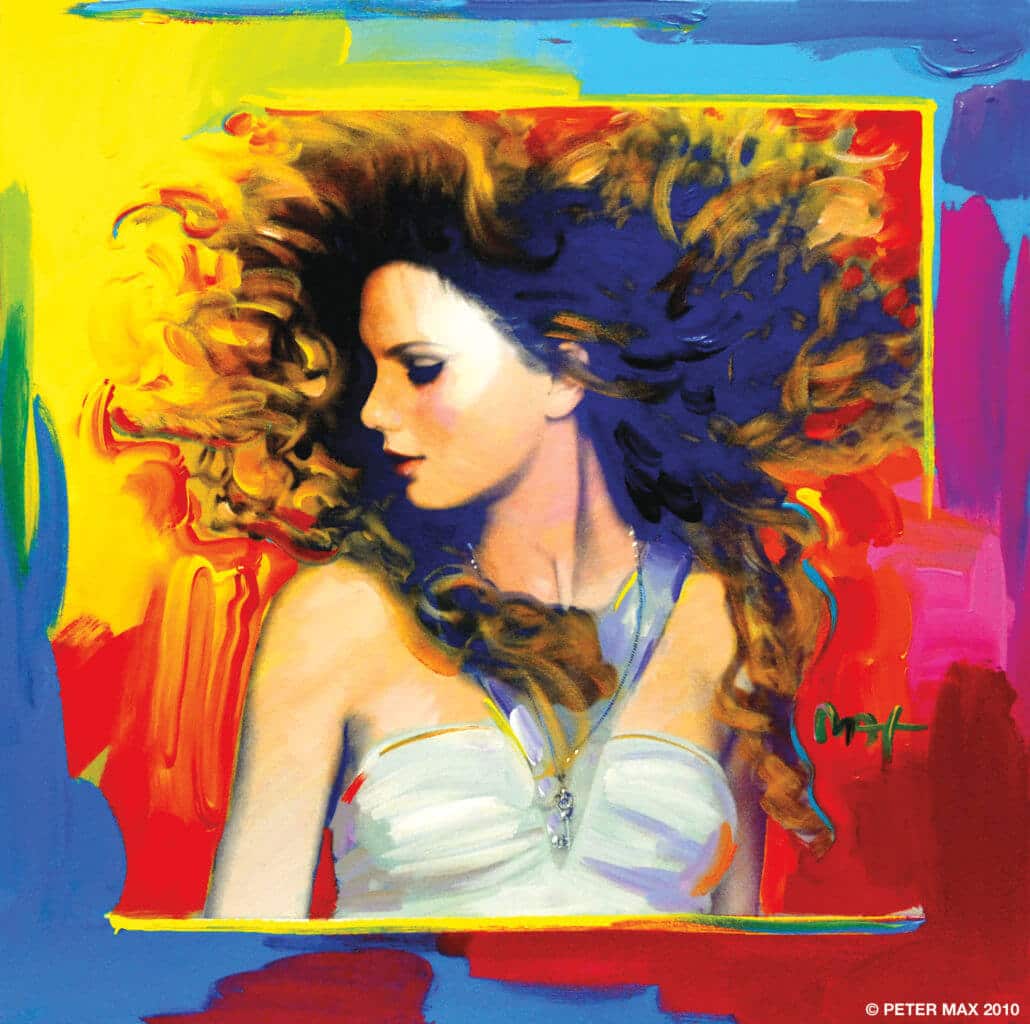
He has painted the last seven presidents, Marilyn Monroe and Lady Liberty, and his work has been featured everywhere from government stamps to Boeing jets, but what makes Peter Max truly stand out is his undying love of color and his optimistic portrayal of the world around him. Born to parents who were forced to flee a Nazi Europe, Max traveled all over the world and often credits his time in Paris for fostering his love of art. His family eventually settled in Brooklyn, and Max quickly became a household name. Colorful palettes and psychedelic pop imagery allowed him to interact with some of the most influential artists of all time. His travels and career now bring him to the Mahler Fine Art Gallery this November, and Raleigh Magazine had an opportunity to learn a little more about this colorful icon.
You have been an art icon for over 50 years but your work remains fresh and relevant, how do you keep your art so current?
Well, it is because I paint everyday of my life really. Technically, I spend five days a week at my studio and when I’m not at my studio, I paint and draw. I stay present and aware of everything that is relative and current.
You seem to associate closely with music, from painting Ringo’s piano to recently painting the judges of “The Voice.” How does music influence your art?
Simply put, I’ve fallen in love with music so it inspires me. Especially when I got well known, I got to meet all of these amazing people. I got to meet The Beatles and so many amazing artists personally. They’ve all been to my studio. You cannot imagine how wonderful that has been for me.
Your artwork always feels optimistic and you talk about love often. Is it your goal to promote love and optimism in your work?
It’s just in me. It’s just natural. I am focused inside by my art, on my colors, on the music. I’m focused where it is all lovely.
And you are bringing that art and spirit to the Mahler Fine Art Gallery. How do you choose pieces for a show?
I always select pieces with my assistants. It is a natural procedure we have developed. We always create a nice broad variety.
Do the pieces vary depending on the location? Would the pieces you select for Raleigh be different than, say, Los Angeles?
It could be. It’s always a little bit different. Each piece for each show is always individually picked.
What advice do you have for artists trying to find success today?
I say just draw, paint, do what you like [doing] and follow your feelings; that will always work. I think if you’re a good artist and people enjoy your work then you’re giving a lot to the people and they appreciate it. It becomes a very beautiful circle.
It has been said that your work is the building block for popular apps like Instagram and Photoshop, in which you take an image and bring more to it. How does it feel to help foster art for so many?
It’s wonderful. There’s so much available now to us in our lifetime. The colors are there, the reproductions are there, the mediums are there, it’s endless.
Your work is momentous, spanning everything from painting the hull of a ship to being the official painter for the Olympics and World Cup; is there any experience that stands out above the others as a favorite?
I think every single day, something new happens. I’m so appreciative that I can do it. That’s what stands out as important, I just appreciate the millions of favorites all the time.
You have also painted the last seven sitting presidents. I know you talk about being spontaneous, but in an election year, are you looking ahead and brainstorming about future portraits?
Sometimes I think about it ahead, but sometimes not. Mostly it is spontaneous and whatever happens new and now.
Do you have any other words for your fans in Raleigh?
I can’t wait to meet them and to be there, for me that’s the big thrill. That’s what I enjoy.


 In 2006, professional writer Judith Guest was leading a free summer youth enrichment program called the Jambalaya Project through her work as the Executive Director of the Latta House Foundation. The focus of the project was to enhance reading and writing skills through a journalism program; many of the kids came from underserved communities, group homes or shelters, she says. As part of that effort the kids, ranging in age from 12 through 17, would have an unbelievable opportunity—to interview then 16-year-old R&B star Chris Brown.