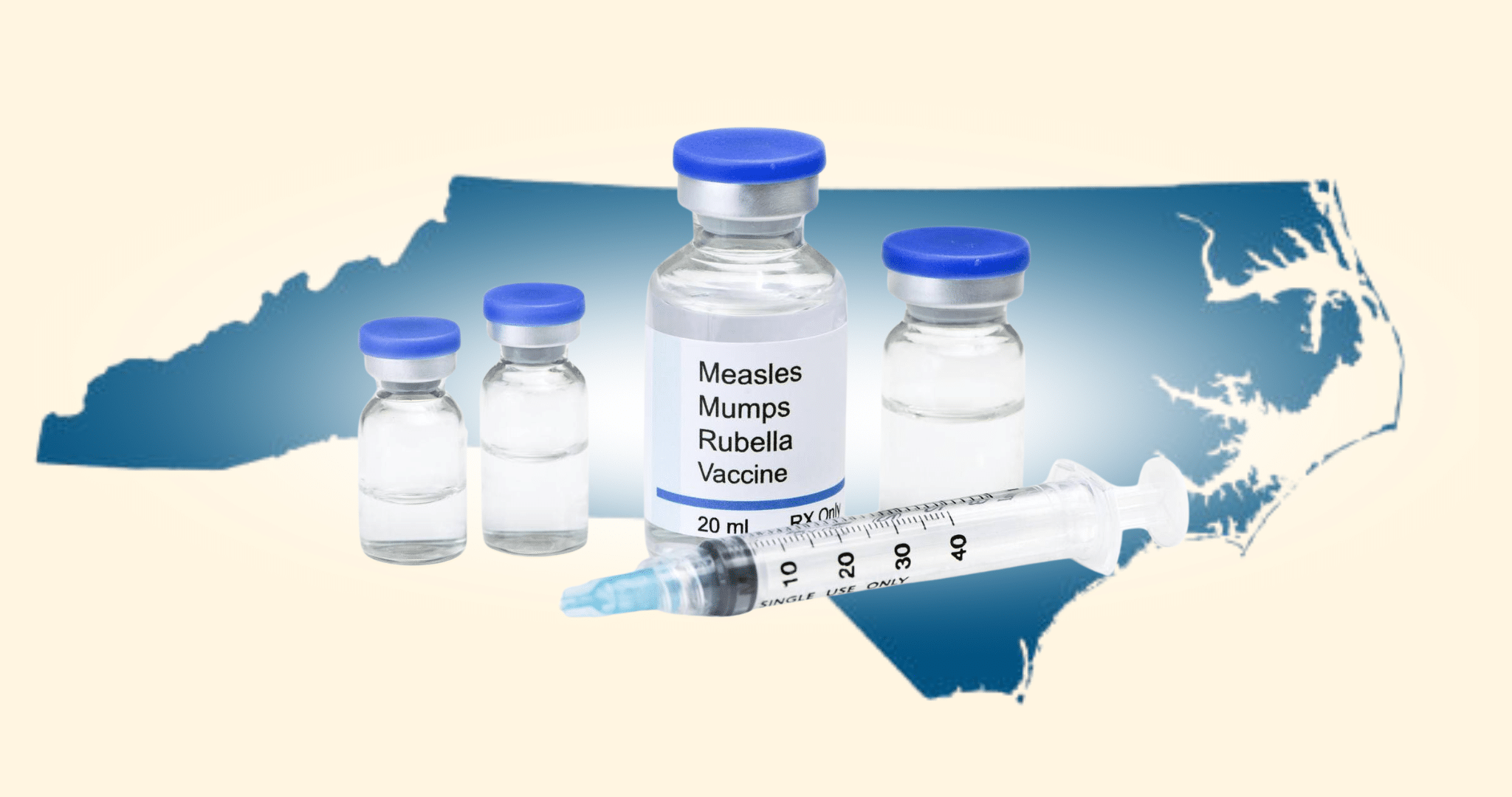
Just when bird flu fears have died down, a newly prevalent illness stepped in—and has made its way to the Tarheel State. Read: NC’s first case of measles has been confirmed.
The Department of Health and Human Services identified the state’s first case of the year in Kernersville June 24 in a child visiting Forsyth and Guilford counties from another country where an outbreak had recently been reported. Given how contagious the illness is, the department recommends anyone who may have crossed paths with the child review immunization records or contact a health care provider—better to be safe than sorry.
While Forsyth and Guilford counties ran short of luck, Wake County hasn’t seen any measles cases since 2016 (cue sigh of relief). But, we aren’t out of the woods quite yet. As of June 24, the CDC is reporting 1,227 confirmed cases across 37 states—a huge spike from 2024’s total cases of 285, and the year is barely half over. Texas’s infamous outbreak lays claims to sparking the first signs of nationwide fears, but clearly isn’t the only state dealing with more cases of the disease than usual.
Thankfully, there are ways for NCers to stay healthy amid the outbreak. The first step is knowing who’s at risk. Kids are at a higher risk for measles, and the numbers back this up. 68% of cases in 2025 are affecting kids under age 19.
But, as Wake County’s Public Health Director Rebecca Kaufman warns, “Measles can be dangerous for people of all ages, especially babies, older adults and those with weakened immune systems.” Symptoms usually show a week or two after infection and start with things like cough, runny nose or a high fever. A few days later, you’ll see the tale-tell rash—and often paired with a dangerous fever spike.
And in not-so-good news, it spreads fast. If someone with measles coughs or sneezes nearby, and you’re not immune, you’ve got a 90% chance of catching it. To reduce your risk, Wake County is recommending people stay on top of their vaccination game. The MMR vaccine is what brought measles under control in the U.S. in the late ’60s—NTM 96% of people contracting measles present day are either unvaccinated or unsure of their vaccination status.
Local health officials say kids should receive both doses—one between the ages of 12-15 months and the other between ages 4-6. Two doses are 97% effective at preventing measles, while one is 93% effective. And for any adult born after 1957 (aka the last year of presumed natural immunity) who never got vaccinated: The time is now.
As for summer vacation, if your crew is vaccinated, you’re in good shape—just remember to keep an eye out for symptoms up to three weeks after returning to help keep yourself—and your community—measles-free.
As a measles outbreak flares across the nation, Wake County Public Health gives recs to stay healthy this summer.
As fears of a bird flu pandemic are dying down, concern over a newly prevalent illness is on the rise: Measles is taking center stage. While Wake County hasn’t seen any measles cases since 2016 (cue sigh of relief), the rest of the country—including many of our neighboring states—haven’t been so lucky.
Texas’ outbreak lays claim to sparking the first signs of nationwide fears, but it isn’t the only state dealing with more cases of the disease than usual. As of May 1, the CDC is reporting 935* confirmed cases across the U.S.—a huge spike from 2024’s total cases of 285, and the year is yet to be half over.
In good news, out of 50 states, 20*—including North Carolina—are currently measles-free. But with summer travel right around the corner, how can NCers continue to stay safe? The first step is knowing who’s at risk. Kids have a higher threat for measles, and the numbers back this up: 68% of cases in 2025 are affecting kids under age 19.
But, as Wake County’s Public Health Director Rebecca Kaufman warns, “Measles can be dangerous for people of all ages, especially babies, older adults and those with weakened immune systems.” Symptoms usually show a week or two after infection and start with things like a cough, runny nose or high fever. A few days later, you’ll see the tale-tell rash—often paired with a dangerous fever spike.
And in not-so-good news, it spreads fast. If someone with measles coughs or sneezes nearby, and you’re not immune, you’ve got a 90% chance of catching it. To reduce your risk, Wake County is recommending people stay on top of their vaccination game. The MMR vaccine is what brought measles under control in the U.S. in the late ’60s—NTM 96% of people contracting measles present day are either unvaccinated or unsure of their vaccination status.
Local health officials say kids should receive both doses—one between the ages of 12–15 months and the other between ages 4–6. Two doses are 97% effective at preventing measles, while one is 93% effective. And for any adult born after 1957 (aka the last year of presumed natural immunity) who never got vaccinated: The time is now.
As for summer vacation, if your crew is vaccinated, you’re in good shape—just remember to keep an eye out for symptoms up to three weeks after returning to help keep yourself and Wake County measles-free.
Sky-high egg prices are scrambling breakfast and hatching a DIY boom.
Egg prices are cracking records—period. Thanks to widespread bird flu, the January U.S. average dozen price of $4.95 appeared to have just been the appetizer, as the price jumped yet again in February, setting a new record of $5.90/dozen. And the U.S. Department of Agriculture expects prices to soar another 41% this year.
The outbreak is affecting local businesses as well, with restaurants forced to up the cost of breakfast, brunch and other egg-heavy items. Spots like Watkins Grill and Ex-Voto in the Durham Food Hall have already made the change.
“Despite the insane cost of eggs, we’ve done our best to hold off and not change the price of our breakfast burrito,” Ex-Voto shared in early March. “We’ve operated at a loss for seven weeks, but we’ve gotta do this price bump.” After some debate, the go-to grab-and-go Mexican hot spot decided against shrinking its popular brekky wrap because “we’re not McDonalds” and messing with product consistency is just not an option. Now up from $12 to $15, the “Crunchwrap Factory” promises prices will go down as soon as the yolk economy settles.
In addition to high-rolling huevos and the like, the spike has hatched a home movement: backyard chickens. Rental services (yes, they’re a thing) like Rent The Chicken are booming, while such local hatcheries as The Urban Chicken are selling out a month or two before chicks even crack their shells. But is setting up a flock in your backyard all it’s cracked up to be? Here, the lay of the land.
Chicks don’t lay eggs: Full-grown hens? You could see eggs in a week. But if you’re starting with chicks, get comfy—your first bounty is six months away.
$teep startup: Chicks run only $5–$20ish each—but their real price tag? A coop can set you back anywhere from a few hundred to thousands of dollars.
Hens gotta eat too: With five fowl on egg duty, Wake Forest’s Renee Miller shells out $50 for chicken feed every ~six weeks.
HOA crackdown: Raleigh’s cool with chickens, but better check your covenants before you ruffle any feathers.
It’s a job: “[Chickens] are relatively low maintenance,” says Miller, “but they’re still animals. I have to care for [them] and consider them our pets.”
Savings scrambled: Miller’s hens crank out ~30 eggs a week—aka ~10 dozen a month, matching a $50 bill at the grocer. But when you factor in feed, startup costs and time? The savings fly the coop.
FARM-FRESH ALTERNATIVES Skip the grocery store for these fresh egg ops around town.*
Rebus Works, Warehouse District: $7/dozen sourced from MyrtleBee Farms; available direct delivery twice a month for $8/dozen within allotted delivery area
MAE Farm, available at State Farmers Market every day: $6/dozen for extra-large brown eggs; ostrich, goose and quail eggs also on offer