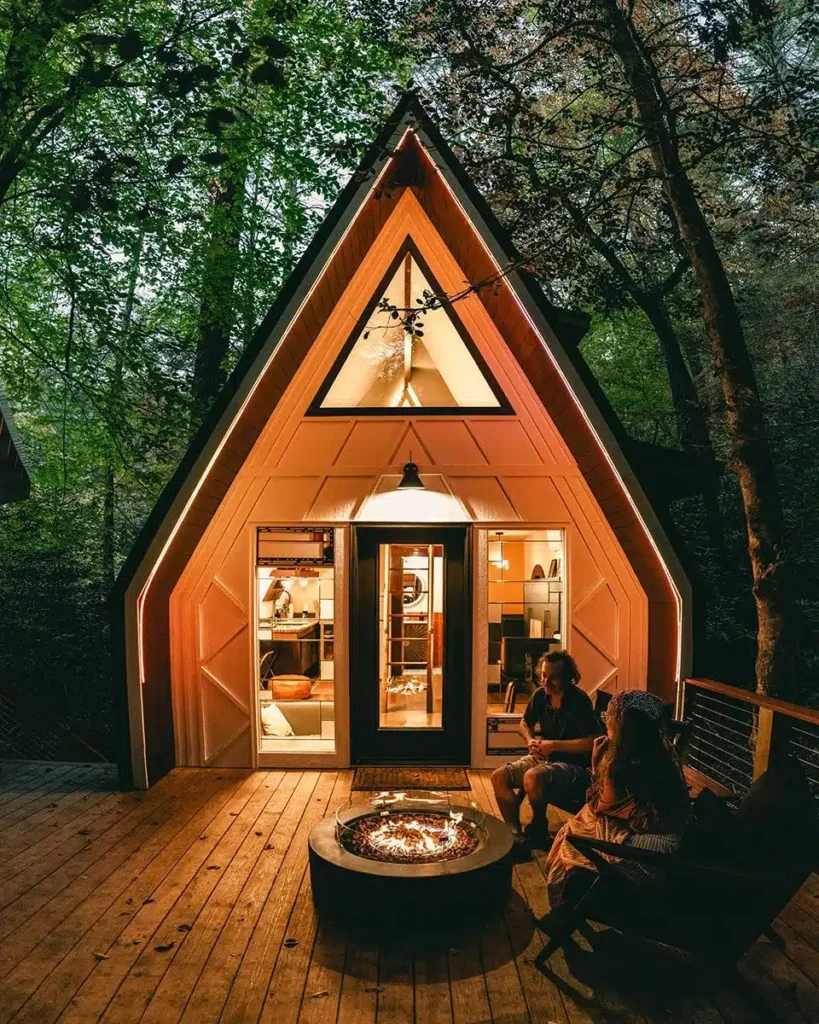
Let’s be real: More often than not, a vacation isn’t actually a vacation. It’s a jam-packed itinerary of late nights out followed by early morning activities, leaving you returning home far more exhausted than when you left.
But change can be found quietly tucked away in the mountains of Western North Carolina. Enter Wunderland Resort, a high-end campground off a gravel road in Old Fort, ideal for indulging in a calmcation (read: a calming vacation where restoration actually happens). The secluded grounds are backdropped by rolling peaks and a complete lack of cell service—the upper corner of my phone read “SOS” my entire stay—making it refreshingly easy to prioritize genuine rest over a sightseeing checklist.
The resort serves up space for tents, RVs and campers, plus upscale tiny home-like cabins for anyone craving the perks of the outdoors sans the setup, bugs or weather drama. But whether your refuge has running water or not, a peek inside the musically inclined bathhouse is a must (pro tip: Each bathroom has a different theme—and song!).
I spent the night in the newly unveiled creator villa, which feels purpose-built for unplugging and creative flow. Inside, a midcentury-modernesque conversation pit houses a pullout keyboard and musician biographies lining the walls. Outside, a porch stocked with a table, chairs, fire pit and a hammock built right into the deck served as a primo spot for sunning and stargazing.
As I quickly learned, a stay at Wunderland is very much a build-your-own adventure. If disappearing is the move, bring a bottle of wine and a book to settle into your porch or one of the many tucked-away nooks on the grounds. For a more literal cleanse, pack a swimsuit to work up the nerve for a cold plunge (I did not, thanks to freezing temps) followed by a bask in the sauna.
While doing “nothing” is absolutely allowed, outdoor adventures are still on deck to get your nature or movement on as its own recharge. On- and off-site ops beckon from foraging tours for a walk on the wild side to fly-fishing, hiking and mountain biking in the surrounding Pisgah National Forest. And because you can’t really call it a trip to WNC without chasing a waterfall—Catawba Falls is an ideal short drive + easy hike combo, and the ephemeral Glassmine Falls can be spotted just off the Parkway.
When you crave a reentry to civilization, Old Fort delivers charming small-town energy with just a single grocery store (don’t sleep on the Piggly Wiggly) and a handful of shops and restaurants. And Black Mountain and Asheville lay in wait just down the road for some bigger city ventures once you feel refreshed and renewed for a robust hit of culture, food or people.
All to say: If your idea of an ideal getaway involves fewer plans and better sleep, it’s high time for a holiday of true relaxation. wunderlandresort.com
A look at the devastation—and resilience—of WNC, one year after Helene’s impact.
Kate and Patrick Chamberlain awoke to their children’s screams as water rushed into their Pisgah Forest home early one Friday in late September 2024.
The blaring flash flood warnings on their phones had failed to wake them, and now, they stood thigh-deep in brackish water, frantically passing their children through an open window of their f irst-floor duplex. Clambering to the top of their driveway with three kids and pets in tow, the two hospitality workers could only watch as the murky water lapped at their windowsills—inside, swallowing a lifetime of possessions despite their futile attempts to lift what they could while fleeing.
In Swannanoa, Rick Canup headed inside to dress and grab his car keys. Initially unfazed by the storm, he decided to move his car after noticing water inching over his tires—only to return and find it already swept away by the raging current. Soon after, water surged inside, submerging the first floor and climbing to the second-floor ceiling. When rescuers reached him by boat, his house sat under 25 feet of water.
Several miles down the road, Thea and Gerald Emery’s Fletcher home sat on high ground, but still faced destruction from a mudslide. Like “an ocean coming off the mountain,” water barreled down the slopes, carrying dirt and debris that poured into their house, destroying everything inside.
Meanwhile, farther downstream, vehicles, propane tanks, pieces of houses and tree branches surged past as Swannanoa and Asheville residents looked on in shock from the top floors and roofs of their now-submerged homes, some clutching go-bags in case they had to swim for their lives. And as the water slammed vehicles and trees against their homes, they braced against the fear of being pulled under.
Joshua R. Craig
As the rain slowed and the winds started to subside, glassy-eyed residents staggered through the devastation with what belongings they could salvage, caked in mud to their hips, still haunted by the sight of their homes being washed away. Locals handed around lists of missing loved ones Sharpied onto legal pads, desperate for any word of those last seen wading through the rushing waters.
By nightfall on Saturday, the waters had receded enough for looters to ransack what was left of homes and businesses. Cell service was gone, power was out—and though water was still everywhere, not a clean drop to drink could be found.
With no way to reach the outside world, Swannanoa-based Warren Wilson College student Emily Arden remained isolated for several days. When a friend finally found a working station on her tiny portable radio, the static crackled with calls for help and reports of locations of bodies.
Days after the storm, fear surged again when someone sprinted through the dorm halls, shrieking that a nearby dam was failing—echoing New Orleans’ levee breach during Katrina. “I thought I was going to drown with my friends and classmates,” said Arden. Students huddled on high ground for hours before the breach was declared a hoax. With little cell service or Wi-Fi, rumors spread as fast as the floodwaters that had overtaken them.
South of the college, the Emerys’ Fletcher home had sat under the heavy stench of sewage and rot for three days. The couple and their grandchildren waded through knee-deep water until help finally arrived. With no family nearby, they took refuge in an ag center.
Across Western NC, families remained in deteriorating homes, slept on neighbors’ couches with only the clothes on their backs, and wondered whether loved ones were just unreachable, missing or worse. They didn’t know when—or if—help would come, or where they would go next. Their homes, routines and lifetimes of memories had been swept up by the angry arms of Helene—and their lives would never be the same.
The Aftermath
Joshua R. Craig
By far the deadliest storm to ever hit the state, it’s also the most fatal contiguous U.S. hurricane since Katrina in 2005. Reportedly, Helene claimed at least 250 lives, including over 100 in NC—though the true toll is likely far higher, as mudslides hindered body recovery, some residents remain missing, and casualties in remote rural communities may have never been reported. As one former Henderson County funeral director noted, many rural residents lived off the grid—paying for funerals in cash, without Social Security numbers or family—leaving them vulnerable to going uncounted in death.
Beyond the lives and livelihoods lost, Helene was NC’s most expensive disaster, causing ~$60 billion in damage. And the cleanup required for full recovery has only just begun. Nevertheless, in the storm’s wake, the region’s resilience shines through.
“There are so many individuals still trying to find places to go… but from the people I’ve talked to, they want to stay and are trying their best to work it out,” Brian Hall, executive director of Asheville-based nonprofit Elben Charities, told Raleigh Magazine. But, he sighs, “this is not an easy fix.”
Immediately following the storm, questions arose statewide about whether residents were fleeing WNC. But the region itself knew better: Roots run deep in Appalachia. Eli Cotellese, a resident of the hardhit Lake Lure and co-founder of local co. Moonwater, shot down any notion of a mass exodus. “Most people don’t realize just how many generations of families are in Lake Lure,” he told RM. “And many of the businesses in Chimney Rock have been there for 50 or 60 years.” Not even the destruction left in Helene’s wake could coax locals away from multigenerational homes and land. Despite the devastation, WNCers fought—and continue to fight—to reclaim their home.
Road to Recovery
One year later, the impact of Hurricane Helene in WNC is still palpable— and the consequences, very real. But so is the reality that the region is rebuilding. “Last year, we actually had our highest retention of freshmen historically,” says Arden of her small school’s post-storm student body. Already, even some of the hardest-hit neighborhoods are beginning to unshutter and welcome back visitors. All is not lost—although certain neighborhoods seem to have returned to business as usual, the region as a whole still desperately needs our support.
Joshua R. Craig
Arden emphasizes the importance of remembering and repeating accounts of the once-in-a-thousand-year catastrophe late September last year—the stories of lives and homes lost, and of resilience and community goodwill. “Don’t forget about Western North Carolina,” says Arden. “We need the support. You can pay it forward and donate, or support us by visiting.”
It’s not for nothing—and it’s not a lost cause. As we hit the one-year anniversary of Helene, Katrina reached its 20th—in a city that has risen from sheer devastation to utter revival, hosting this year’s Super Bowl and recently recognized for the best food in the world. Read that again: the world’s biggest sports stage and world-class cuisine. The city isn’t just surviving—it’s thriving, having bounced back stronger, bolder and better than ever.
So, just one year later, the mountains are calling—for the best cause: for the love of our state, its people and the South; for those still without permanent homes; and for those who will forever associate the changing leaves with watching their loved ones wash away. For all of them, go.
*Some names have been changed for protection of privacy.
There’s something about driving up Black Mountain with its steep hairpin turns and beautiful mountain range that makes your breath catch every time.
At the top, you’re rewarded with majestic views and a quaint small town filled with shops, eateries and beer gardens.
Just a short drive from Asheville, this town of just 7,000 people is totally different from its sister city down the mountain. The small-town feel is palpable and yet the variety of eateries (German, Thai, Italian, French and Argentinian, to name a few) is impressive.
The Cherokees first settled Black Mountain more than 10,000 years ago, and the lure of adventure and rugged beauty attracted early settlers.
Drive up for the day while visiting Chimney Rock or Biltmore, or book at a night at a local bed and breakfast and explore Lake Tomahawk and Black Mountain’s extensive greenway system.
On the bike, hitch an easy ride down Point Lookout Trail—from Ridgecrest to Old Fort—a 3.6-mile coast that lets you take in the beauty of the Swannanoa Valley. Or pack your clubs and play a round of golf at Black Mountain Golf Course, the front 9 designed by the legendary Donald Ross. And the back 9? Look for hole 17, a par 6 that was at one time the longest hole in the world.
You’ll be ready for a watering hole after that.
Day Trip
Downtown Black Mountain is a quaint village with 40 or so shops and a dozen restaurants. Here are a few of our favorite pit stops:
The Town Pump
135 Cherry Street
Opens daily at 3 p.m.
The Town Pump is a classic dive bar full of antiques, memorabilia and, yes, animal trophies on the wall.
Don’t be deceived by its appearance; this will be the most memorable bar you visit in 2016. They serve it all – $2 beers, whiskey and even a $5 mimosa on Sundays. Insider Tip: No plastic, cash-only bar. Check out the 45-star flag hanging on the wall and be ready to name the last five states to join the union – you will impress your friends.
Fresh Wood Fired
Pizza & Pasta
100 South Ridgeway Avenue
11 a.m. – 9 p.m. daily
freshwoodfiredpizza.com
Enjoy wood-fired, 13-inch single-serve pies like you’d find in Naples, Italy.
Fresh is truly fresh, using local produce, local beers and even a local coffee roaster.
They offer gluten-free crust, pasta, salad dressings and desserts.
Insider Tip: Try our favorite pie: the MADONNA, a white pizza with a blend of Mozzarella, Fontina, Ricotta, Parmesan, garlic and herbs.
Dripolator Coffeehouse
221 West State Street
6:45 a.m. – 9:30 p.m. daily
If you love coffee, don’t skip the Dripolator Coffeehouse. Fun, colorful and delicious, the owners buy the finest coffee beans available and roast them off-site at a Diedrich roaster for an amazing cup of Joe.
Bramblewood Unique Gifts
111 Cherry Street
10 a.m. – 5 p.m. daily
Bramblewood is a quaint, family-owned shop downtown, featuring unique gifts and local art.
Insider Tip: They have a great
selection of Christmas ornaments year-round.