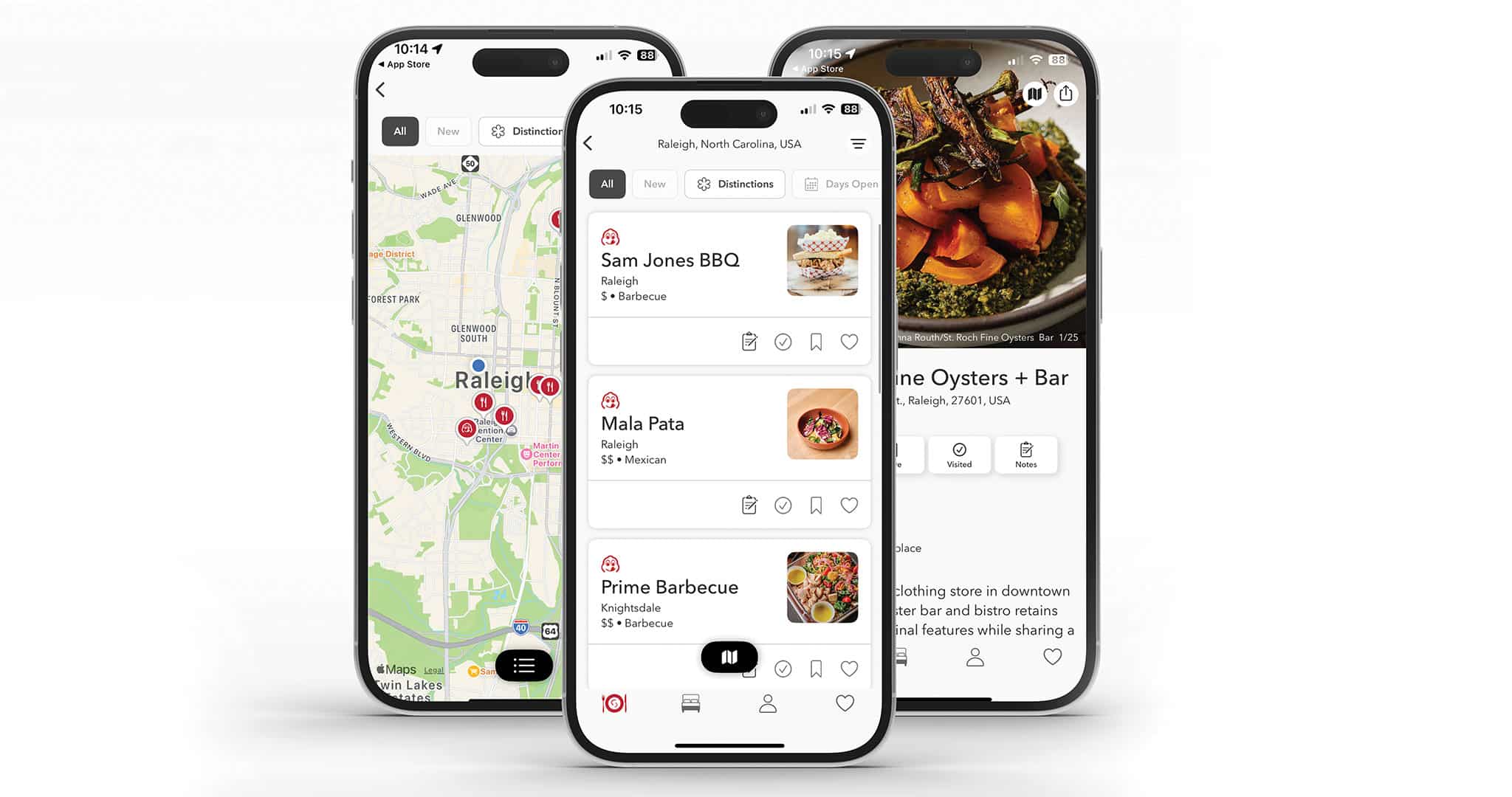
Michelin recs mean big numbers for local restaurants.
For 13 Raleigh restaurants, the relentless pursuit of plated perfection paid off in full with a nod from Michelin in the premiere Michelin Guide American South, and, in the culinary world, no accolade shines brighter. But beyond prestige—and the potential for stardom come next year—what does a Michelin recommendation actually mean for business?
At Mala Pata, co-owner Marshall Davis says reservations skyrocketed within a week of their Michelin name drop, and, within just 72 hours, the recently bowed eatery was 80% booked through the end of 2025.
“We’ve served nearly 1,000 first-time guests since the Michelin news,” remarks Davis. Sales are up 10–15%, and the restaurant is working to accommodate walk-ins as diners travel from across the state—from Charlotte to the coast. “November was the biggest month we’ve ever had because the news broke,” the restaurateur tells RM.
Over in North Hills, Tamasha co-owner Mike Kathrani says the Michelin status has driven a sharp rise in reservations, translating directly into a substantial increase in guest count and overall revenue—along with a significant visibility boost. “A growing percentage of our guests, particularly out-of-state travelers visiting for business or leisure, are discovering Tamasha through Google searches and the Michelin Guide website,” notes Kathrani.
Despite only receiving a rec for its DTR location, Brewery Bhavana is seeing similar increases in reservations, guests and sales at its Fenton outpost. Co-owner Patrick Woodson says just how long the uptick will last is the “golden question,” but he’s optimistic.
“Being on the Michelin app makes a huge difference,” he says. “There are so many people who travel through here, particularly because Raleigh has so much going on in terms of tech and universities. Yelp and OpenTable are helpful, but Michelin definitely seems to have an impact—and I think it’ll be sustainable.”
While the prestige of a Michelin nod is clear—only time will tell whether the business boom proves just as enduring.
This article is being updated as additional information is released.
UPDATE Nov. 28: Pro-immigrant group Siembra NC reported ICE is deploying 50 agents to Raleigh and the surrounding areas Dec. 1 for a monthlong operation.
***
“They went into the building where people were working, being productive members of society, pulled them out, put them in handcuffs and drove away,” says Cary resident Pamela Hoile. “It’s not giving anyone due process.”
Her account captures the fear that swept across Wake County Nov. 18 when Customs and Border Protection moved in with little warning—disrupting school days, shuttering businesses and grinding daily routines to a halt. The terror extended far beyond undocumented residents. With uncertain immigration policies and tactics perceived by many as racially targeted, entire communities shut their doors and stayed inside.
While the exact number of detainees from initial raids is unavailable,* locals witnessed agents making arrests. Hoile witnessed four men taken from a construction site. After spotting an all-black SUV with tinted windows and Texas plates, she followed it as a second vehicle joined, and both pulled into the site, where she says the men were detained. “I call them ‘kidnappings,’” she tells RM.
Across the county, sightings mounted—from Southeast Raleigh to a Cary Home Depot—and pro-immigrant group Siembra NC confirmed at least 20 sightings within the first 24 hours. While unofficial reports claimed the Raleigh raids wrapped up after a day, agent sightings continued, and the sudden appearance of an ICE HQ in Cary* further fueled anxiety as the city slowed across all major sectors.
“As immigrants, our reality is now masked vigilantes with no respect for human rights or the law,” Mala Pata owner Angela Salamanca tells RM. “What do you do with that? That is terrorism.”
Mala Pata quickly announced limited capacity for the week, with Salamanca saying they won’t fully reopen until their staff feel safe coming to work. The restaurateur stressed the importance of talking with impacted communities—not taking away their agency by assuming what they need.
The fear even touched workers with legal status. “I think it’s messed up that people come here, work and try to give their families a better life, and are then being taken,” says a local construction worker, noting many colleagues stayed home for days despite having documentation or DACA status. “I understand it for those with violent criminal backgrounds, but it’s messed up so many have to worry about even walking outside of their house.”
Nowhere was the disruption more visible than in Wake County Schools. A staggering 19,471 students—or 1 in 9—were marked absent the day after CBP operations began. At one local elementary school, an ESL teacher tells RM more than half of her students were out. Officials expect lower attendance to persist as long as CBP does.
Legally, public schools must remain accessible to all children regardless of immigration status under Plyler v. Doe, and Wake County Public School System says it doesn’t track student immigration status and will seek legal counsel before granting any law enforcement access to campuses.
“One thing we want to do is express to our parents that students have a right to be at school,” said Superintendent Robert Taylor in a statement.
The fear gripping the city—and the county—stands in stark contrast to statements from DHS, which maintained their focus is on removing “criminal aliens.” Gov. Josh Stein called on the agency to focus precisely on that: “Stop targeting people simply going about their lives because of the color of their skin,” he admonished. Meanwhile, Mayor Janet Cowell strongly urged Raleighites to remain peaceful amid the pandemonium.
Raleigh heeded her call—and showed up. Peaceful protests formed almost immediately, with a clear message: “We aren’t going anywhere,” as one activist says.
“We didn’t ask for this presence,” says Cowell. With DHS refusing to discuss future operations, uncertainty lingers—regardless of whether ICE returns to Raleigh. For now, fear remains the constant, and communities across the state—and nation—are bracing for what comes next.
Is a Michelin-star restaurant also a tourism cash cow?
Fun fact: North Carolina will pay more than $1 mill over three years—about $345,000 annually—to be included in the Michelin Guide American South. The prestigious price tag covers Michelin critics crisscrossing the state, largely funded by Visit NC, with the Raleigh, Durham, Charlotte and Asheville tourism bureaus footing the rest.
So what makes a Michelin star—nay, the chance of a star—worth such a wad of cash? In the culinary world, no accolades shine brighter. As the pinnacle of culinary prestige, a Michelin nod puts a city on the map. After all, a star-studded city calls to foodie tourists far louder than one without.
Research shows Michelin-acclaimed eateries tend to attract international tourism rather than local diners—aka visitors spend far beyond the dinner bill. And the impact doesn’t stop there: A Chicago study found that “an increase of one Michelin Guide restaurant leads to a 0.5% increase (or roughly $1,141) in the home value of the median home in a neighborhood.”
Bottom line? NC’s bet on Michelin is more than a bid for bragging rights—it’s an investment in the state’s culinary and cultural credibility.
“For many chefs in North Carolina, this is their dream. And, more importantly, it’s a dream they didn’t think would become a reality. … They are going to have a chance to shine.” —SCOTT PEACOCK, VISIT NC DIRECTOR OF MARKETING & COMMUNICATIONS
By the Numbers
2005 First Michelin Guide lands in the U.S.—in NYC only 57% say they’d extend a trip for a Michelin-starred experience 66% would choose a Michelin destination over a comparable option 71% are willing to up their spending for a Michelin-starred adventure
A local biz disguises mini art galleries as vending machines at businesses throughout Raleigh, offering a treasure trove of creative oddities.
Forget the soda and snacks—Loot Drop Art Club is serving up a new kind of vending machine. Recently dropped at five locales throughout Raleigh, these transformed treasure troves are art nouveau’d into mini art galleries with limited-run goodies from local artists and makers— everything from stickers and pins to tarot fortunes and handmade toys and games.
“It’s like a side hustle that makes everybody else’s side hustle go a little further,” emphasizes co-owner and writer Ben Loomis. “We’re spending thousands of dollars every year on the local art economy to beef it up and give people more places to sell their stuff.”
Taking inspo from Portland, Oregon’s La Venderia—“the godmother of creative vending in the U.S.,” as Loomis describes it—he and business partner Bunny Eaton realized the East Coast potential. What began as coin-operated machines in Boone has since grown into 24 full-size vending stations across Asheville, Charlotte, Hickory and now Raleigh.
To bring these machines to life, the duo sources used ones online and transforms them into “works of art themselves” at their Foothills Community Workshop in Granite Falls, muses Loomis. Up until the Raleigh drops, in-house lead artist Eaton handpainted all the machines—with new local additions at Wake-N-Bakery featuring a whimsical design by local artist Damalis, Le Dive’s jungle-esque exterior by Vonne Brown, and Transfer Co. Food Hall’s silly striped character by Toasty Tuna.
The facade “amplifies the vibe of the venue without just blending into the background,” says Loomis, who also notes the machines are no cost to the hosting spots. “We try to make it look like it’s been part of the environment there for a while—but still catches the eye. … They basically get a free mural, and then some extra traffic and fun for people while they’re there.”
Inside each of the Loot Drops, treasures run the gamut of goods artists commonly craft like patches, jewelry, zines, souvenirs and other novelties, explains Loomis, to off-the-beaten- path selects “giving artists a chance to flex their creative muscles and work within the parameters of vending machine products. We really love when somebody has a creative idea that’s different, that we haven’t seen before.”
Think disguised chip bags stuffed with a variety of insults ranging from mild to spicy. “We’re able to go kind of weird with it sometimes,” laughs Loomis, nodding to mystery bags of prints donning foot pics—the result of a silly dare. Functional items like nailcare products, soaps and even Wake-N-Bakery’s clay pipes are also at the ready.
Courtesy of Loot Drop Art ClubCourtesy of Loot Drop Art ClubCourtesy of Loot Drop Art Club
Curated and restocked with the help of DTR’s Munjo Munjo, the Loot Drops get a weekly glow-up via new goodies— and there’s an always-open invite for artists to submit. “New people are finding them every day,” says Loomis, who also teases in-the-works community workshops and events coming this summer. “We try to make just a little something fun in everyone’s day—something extra to discover in your built environment.”
It’s a win for the business owners too. “We absolutely love having the Loot Drop machine at Tap Yard,” says owner Zack Medford. “We are a very eclectic bar with an incredible community that supports all things wacky and weird. Loot Drop is perfect for that vibe—it’s mysterious, quirky and fun. Most importantly, it’s a brilliant way to support local artists and creative thinkers.” And who doesn’t love a local trinket? lootdropart.club