
by Heidi Reid | Oct 15, 2025 | Buzz, October 2025
NC Republicans plan to redraw congressional maps.
Heeding President Trump’s call to secure more Republican seats across the nation, NC Republican legislative leaders announced plans Monday to introduce and vote on a redrawn congressional map next week, with the intention of shifting a U.S. House district seat from the Democrats to the Republicans.
“President Trump earned a clear mandate from the voters of North Carolina and the rest of the country, and we intend to defend it by drawing an additional Republican congressional seat,” says House Speaker Destin Hall (R) of Caldwell.
The current congressional map—drawn and passed in 2023—gave Republicans a significant majority in 10 out of 14 districts (with a chance at an 11th) and is facing gerrymandering allegations. Beforehand, the NC congressional delegation sat perfectly even, with seven Democrats and seven Republicans.
Only the first congressional district—currently held by Rep. Don Davis (D), who won by less than two points in 2024—is a true swing district. New maps are expected to target this district.
Providing more insight into the party’s motives, Republican state reps. Brenden Jones and Hugh Blackwell stated updated maps are necessary to thwart “California and the radical left” from “handpicking” who runs Congress. Senate Leader Phil Berger concurred, saying NC Republicans are “doing everything we can to protect President Trump’s agenda, which means safeguarding Republican control of Congress.”
This reach for control stems nationwide. Initially ignited with Texas redrawing to add five Republican seats earlier this year, The White House also pushed Missouri to shift its map and are working a similar effort in Indiana and Kansas.
NC Dems responded immediately. House Minority Leader Robert Reives of Chatham said Republicans are dodging accountability. “The party’s politicians are more focused on consolidating power than on lowering costs or funding the state’s Medicaid program,” he wrote in a statement.
Gov. Josh Stein wasn’t on board either: “The General Assembly works for North Carolina, not Donald Trump,” he wrote in a statement—but under the NC Constitution, governors don’t have veto power over congressional maps. (Fun fact: The Governor didn’t have veto power at all until 1996.) Furthermore, the U.S. Supreme Court ruled federal judges cannot overturn electoral maps on the basis of partisan gerrymandering.
Stay tuned for updates as NC lawmakers introduce the new map.
by Heidi Reid | Oct 26, 2023 | Buzz, October 2023
We delve into the NC Legislature’s newly passed district map.
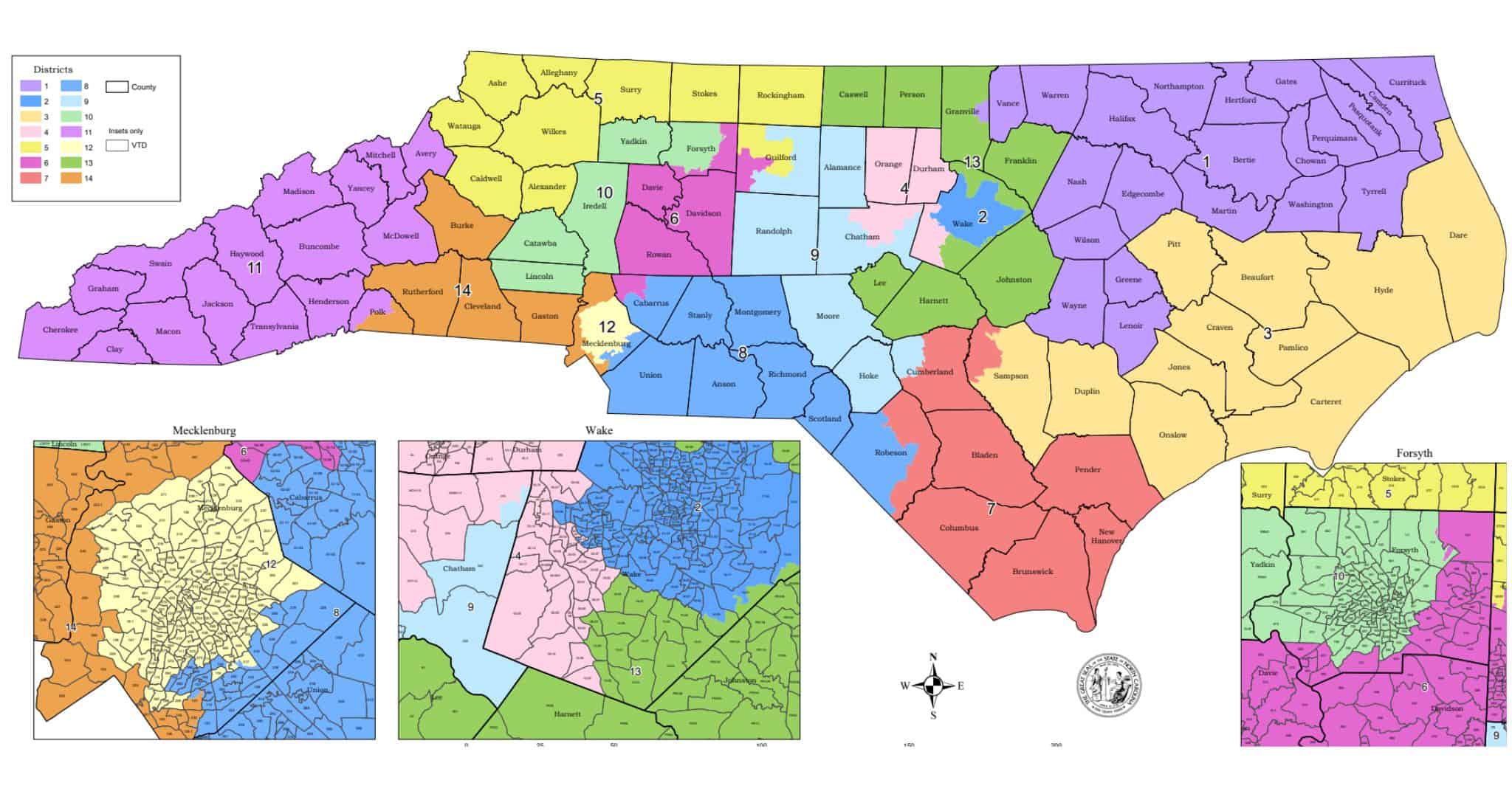
A new map outlining NC political districts is now set for the 2024 election, and it could shift power to one party. Up until now, the NC congressional delegation has sat perfectly even, with seven Democrats and seven Republicans.
Now, the two senate bills proposed Oct. 18, passed the General Assembly and became law Oct. 25 putting three incumbent House Democrats in districts that make for a very difficult victory. (State law gives Gov. Cooper no part in redistricting, so the map will go into effect immediately.) Essentially, the Republicans who drew up the new map could get as many as four more seats—a move that could ultimately determine which party holds control of the U.S. Congress.
Here’s how the new law shakes out party power:
°In the Charlotte area: Jeff Jackson was drawn out of his county, which also gives current state House Speaker Tim Moore the ability to run for Congress if he chooses.
°In the Greensboro area: Kathy Manning was drawn out of her district.
°In Raleigh: Wiley Nickel was drawn out of her district
°In the Northeast District (stretching from the Virginia border and extending southward into several counties of the Inner Banks and the Research Triangle): A fourth Democrat could be knocked off the docket, as the new map turns Rep. Don Davis’s first congressional district into an evenly split battleground. Rep. Tricia Cotham, who was elected as a Democrat in 2022 and flipped parties, had a new Republican-leaning district drawn for her.
Ultimately, with Democrats drawn out of these districts, Republicans are likely to have a significant majority in 10 of the 14 districts, with a chance at an 11th.
This only serves to up tension on the heels of the recently adopted budget, which removed public access to redistricting records, as mentioned in a statement by Gov. Roy Cooper Oct. 18, along with a racial gerrymandering accusation.
“Enabled by the State Supreme Court’s partisan reversal of constitutional law, Republican legislators have rolled out their latest illegal maps that show gerrymandering on steroids,” said Cooper. “Drawn in the back room and armed with their new law that keeps their plotting secret, they have used race and political party to create districts that are historically discriminatory and unfair.”
Added House Redistricting Chair Destin Hall on Wednesday: “There’s no doubt the congressional map that’s before you today has a lean toward Republicans running in these congressional districts. However, just as I said on the House map, it doesn’t preordain any sort of outcome.”
What Is Gerrymandering?
If you haven’t thought about gerrymandering since high school history class, here’s the CliffsNotes to catch you back up to speed.
Gerrymandering—aka when a partisan group manipulates the boundaries of an electoral constituency to favor one party—can deprive many voters of a voice in congress by drawing the map along racial or party lines. Gerrymandering accusations are nothing new for NC, with three cases reaching the federal courts—and even more proposed maps being rejected in the state courts.
In 1991, the U.S. Department of Justice rejected a congressional district proposal on the basis of the 12th district, which snaked over 150 miles across the state in order to confine as many Black voters to a single district as possible. Both the first and 12th districts were challenged in court, resulting in the landmark court case Shaw v. Reno (NC’s claim to gerrymandering fame and the basis of many federal redistricting decisions to come) that found racial gerrymanders unconstitutional.
In 2016, the first and 12th districts were once again ruled illegal gerrymanders by the U.S. District Court for the Middle District of NC, a decision upheld by the Supreme Court in Cooper v. Harris. The Supreme Court later took their foot out of the door with the 2019 case Rucho v. Common Cause, ruling partisan gerrymandering represents a political question beyond the reach of federal courts.



