In a big-time win for, well, everyone, hoops star and March Madness standout DJ Horne has teamed up with local VIANI Watch Company in an ode to Raleigh that serves to strengthen and celebrate our diverse local community—and is, hands down, the most baller move for a baller who’s always had his eyes on the clock.
Set to 9:19 in the photo campaign to rep the 919 area code, the duo of completely solar-powered unisex red VIANI watches dropped this July in limited quantities. And, as a natural Wolfpack nod, the Raleigh Red is of course “a tribute to our hometown and honors DJ and I’s shared pride as Wolfpack alumni,” says VIANI CEO Sunny Bhathela. “DJ is an avid watch lover… and we’re both born and raised in Raleigh, and love to represent our city.”
Famously sporting the number zero as the nation rooted for the underdog Pack through the madness to an ACC Championship and NCAA Final Four, Horne’s “0” jersey serendipitously aligns with VIANI’s ethos as the only solar watch company to proudly represent Hindi numerals on the dial—credited as the first to develop the zero, explains Bhathela.
Broadening its diverse reach, the campaign also marks the first time a South Asian-owned product is representing NC’s capital, he adds, nodding to the community as one of the fastest-growing minority groups. “There’s never been anything like [this partnership]—and we are proud to spotlight this vibrant and growing minority community alongside a hometown hero,” muses Bhathela.”
The result is a timeless recall of Horne’s part in carrying the NCSU Men’s Basketball team to nine straight all-or-nothing wins against all odds that unified Raleigh—NTM rallied the nation around NC State—and instilled a deep sense of pride in our city. Muses Bhathela: “This feeling of representation and uniting of our hometown was what I intended to capture with the release of the VIANI Solar in Raleigh Red.” Time to unify/Right on time, indeed.
Shaw University preps for a new district—and with it, a new era for Downtown Raleigh.
is a type of symbiotic relationship where all species involved benefit from their interactions. The term also perfectly encapsulates the vision Shaw University President and CEO Dr. Paulette R. Dillard has for the forthcoming The ShawU District after the school’s rezoning was approved by the Raleigh City Council in June.
Dr. Paulette R. Dillard (Jennifer Robertson Photorpahy)
“It’s a district within Downtown Raleigh that gives the opportunity for separate entities to interact, support [and] make each other better,” she says of the project. “It gives the city the opportunity to experience African-American culture at its finest, while our students get an opportunity to participate in a diverse community that is a top city.” … Translation: It’s a win-win.
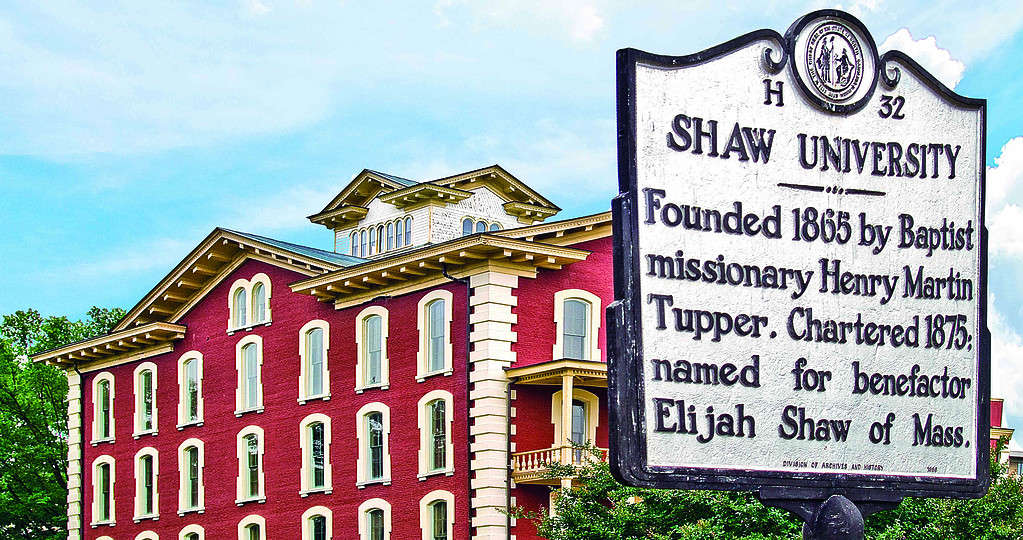
For Shaw, founded in 1865 and boasting the distinction of being the first historically Black institution of higher education in the South, location is everything. Its main campus occupies 26 acres on the southern border of Raleigh’s Downtown boundary—and the acquisition of this property is undeniably the school’s greatest endowment.
A desire among university leaders to leverage their real estate for long-term sustainability—one of the priorities agreed upon in their 2025 strategic plan—spurred talks of rezoning. And, so, the school engaged the Urban Land Institute in a land-use study in 2019 to begin exploring options for driving revenue and growth.
Shaw University
The university got the report back in February 2020, and a month later, the world shut down. But sheltering in place had its silver linings. “[It] gave me a little bit of time to actually think about what this really means when you think about the university, its value proposition and what is the ‘why’ for Shaw,” reveals Dillard, who, as the school’s 18th president, constantly walks a tightrope between progress and preservation. And she kept coming back to the same solution: location, location, location—“where you can walk to internships, you can walk to museums, you can eat anywhere,” she says. “You’ve got everything.”
That vision for student-community engagement echoes one we’ve seen play out with Campbell Law School’s move to open a DTR campus. Shaw students would likewise benefit from bridging that gap between campus and community. Proximity to the developing world-class Dix Park alone would benefit a wide swath of studies for such Shaw programs as computer science, accounting, recreation management, political science, marketing, communications and others, says Dillard.
So too would “spending time in internships or shadowing individuals in companies such as Red Hat, Cisco Banking, Raleigh Magazine, News & Observer and state government agencies,” she adds. “I refer to these arrangements as affording us expanded classrooms focused on practical applications,” she says, adding the intention to have young Shaw scholars pay it forward as well. “We also want students to work with public and private K-12 schools to tutor and mentor, and to engage in volunteerism to advance community engagement.”
Since the Urban Land Institute report recommended increasing density on campus via taller buildings to boost property value, Dillard and her team looked to other historically black colleges or universities (HBCUs) for inspiration, namely Howard University in DC, as they began to navigate the changes. Shaw’s real estate advisory firm, Hayat Brown, had also worked with Howard on 10 mixed-use commercial development projects on previously underutilized land, resulting in more than $1.4 billion in development and $200+ million to improve the university’s student housing portfolio.
If Dillard were to dream up a wish list of the kinds of mixed-use spaces Shaw might include: “I love The Dillon, and I would love to have a residential and retail complex—coffee shop, bookstore and sandwich shop.”
“Is it risky? Yes,” Dillard admits. “But the fact that Shaw is here was a risk.” Case in point: When the university broke barriers in 1882 by becoming the home of the first medical school in the U.S. to offer a four-year curriculum. And Dillard is confident Shaw can do it again. “Here is another whole new opportunity for Shaw as we rethink the higher education landscape,” she says. “We’ve got to do things differently.”
A lot of the angst around the rezoning, she says, “was many of our alumni and the community thought the vision was to make Shaw indistinguishable from the city and just have everybody over here and it’s no longer Shaw—but that is counter to the vision. If we don’t do what students need who actually use it, we’ll end up just being a placard on the pavement.”
Moving beyond the classroom doesn’t mean completely erasing the boundaries between college and city. Rather, Dillard hopes The ShawU District will reposition the two as neighbors who get along, collaborate and help each other thrive.
Shaw’s next step is to prepare the campus master plan, a guide that will “define the physical features of The ShawU District to support the university’s vision for a reimagined core campus with a physical, social and professional connection to Downtown Raleigh, but with its own distinct and recognizable The ShawU District identity,” explains Jay Brown, chairman and managing director of Hayat Brown.
To address that master plan, Dillard imagines what can go within that footprint and how it addresses lifelong learning and workforce development, in addition to how it meets the needs of the 21st century student who still wants to have a college experience. “How do you take the amazing resources that are already here—the performing arts center, the museum—and create this unique experience that can only be achieved at a small, private, flexible institution?”
Looking ahead, Dillard sees The ShawU District as an unparalleled destination for cultural enrichment and social acceptance. “I think about it especially around the polarizing issue of race and diversity,” she says. “I think having an HBCU is an opportunity to interact in this environment where it’s not political. I’m not doing DEI training; I’m just being your neighbor. … It’s an opportunity to experience it not in a combative way, and our students at the same time get to experience a diverse city.”
Dillard hopes Raleighites can begin to view The ShawU District as the first step toward reaching that mutualistic sweet spot. She paints a picture of an area where parents push their babies in strollers while music played by the Platinum Sound marching band drifts through the air. “We want to be an environment that shows that kind of thing can happen naturally,” she says. “You come, you feel comfortable; we go, we feel comfortable—because we’ve gotten to know each other. Because Raleigh has The ShawU District.”theshawudistrict.com
Howard University Bond Bread redevelopment, courtesy of Studios Architecture
RPD kicks off Women’s History Month with new pledge
Despite the fact that our fair city’s police chief is a female, the Raleigh Police Department is currently made up of only 12% women—a sobering statistic. To counter that stat, RPD is taking action to increase the number of women behind the badge. In celebration of Women’s History Month, the department announced it has taken the 30×30 Pledge to improve the representation and experiences of women in law enforcement and advance women in policing.
The Pledge serves as the foundation of the 3×30 Initiative, a coalition of police leaders, researchers and professional organizations whose goal is to reach 30% of women in police recruit classes by 2030. These principles apply to all demographic diversity in policing, not just gender.
By taking the 30×30 Pledge, RPD will assess the current state of its gender equity, identify factors that may be driving any disparities, and develop and implement strategies and solutions to eliminate barriers—think addressing recruitment, assessment, hiring, retention, promotion and agency culture.
Not only will bringing more women onto the force increase diversity, but research suggests female officers also use less excessive force; are named in fewer complaints and lawsuits; are perceived by communities as more honest and compassionate; and see better outcomes for crime victims, especially in sexual assault cases.
“Women bring unique skills, communication styles, and a level of maternal care and compassion that is needed for public safety,” Chief Estella Patterson tells Raleigh Magazine. “It takes a diversity of individuals to provide the best service to our community. Increasing women in law enforcement will bring us closer to reflecting the community we serve. And that is why the Raleigh Police Department is committing to the 30×30 Pledge.” For that, we salute you.
Words can hurt. Learn to lead with inclusive language
Ever used terms or expressions that are unintentionally loaded or offensive (think: master bedroom, you guys, that’s lame). Turns out no matter how many times you said “sticks and stones may break my bones, but words can never hurt me” as a child—what you say can and does hurt people.
And because the language we use directly impacts our social connections, it’s essential to equip ourselves with inclusive language—and avoid age-old terms and phrases that, while their use may be part of mainstream discourse, are discriminatory.
Not just a vague “how-to” guide, The Inclusive Language Handbook helps readers recognize and consciously avoid words that alienate and offend by unintentionally reinforcing cultural notions (think gender, race, sexual orientation, age, ability)—and choose intentional welcoming and respectful word choices. This is not about being politically correct. It’s about being inclusive—and demonstrating you value unique cultures, communities and identities.
“Sustainable business and strong relationships both rely on one thing—good communication,” says Ferguson. “In speaking with thousands of people on this topic, I’ve found that many of us are not always sure what to say in every situation in our increasingly diverse society.” In the workplace specifically, she adds, “repeating harmful language over time creates a toxic company culture, high employee turnover and a damaged reputation.”
Thus, inclusive language should be at the cornerstone of our word choice, and learning how to do that—from the boardroom to the bar—well, we definitely want to take a page out of that book.
Nicholaus M. Neptune is an artist, educator, entrepreneur and community advocate currently serving as the managing director of Transfer Company Food Hall, Ballroom and Work Hall, a former partner and co-founder of Raleigh’s shared creative studio The Assembly and owner behind the music, entertainment and consulting firm Good Times Assurance Company.
For more than 15 years, Neptune’s work has been defined by the constant celebration, building and strengthening of community and culture through music, art, food and play. In 2020, Raleigh Magazine recognized his longtime community work by including him in our “30 in their 30s” feature as one who’s working “hard for positive change … to make life better for everyone in the city.”
Neptune currently serves as an appointed commissioner with the City of Raleigh’s Bicycle and Pedestrian Advisory Commission and is a board member with the Wake Tech Community College Foundation.
This September, he begins coursework in an executive program in social innovation and design, a joint program organized by the University of Pennsylvania’s Weitzman School of Design and its School of Social Policy and Practice.
Photo by Joshua Steadman
Where’s your hometown: Winston-Salem. Home to the University of North Carolina School of the Arts (where my youngest sister is currently pursuing a degree in filmmaking and animation), Winston-Salem State University, Wake Forest University and Forsyth Tech Community College. Winston-Salem has enjoyed a renaissance in its downtown food, beverage, music and arts scene over the last 15 years; there’s always something new to see when I return home to visit with family.
What neighborhood do you live in today: As of this writing, I’m in the middle of moving ever closer to downtown – truth be told, I’m grateful to have never lived more than 10 minutes from downtown over the last 10 years, including in Five Points, near NC State and more recently in Longview Gardens and Olde East Raleigh.
What do you love most about Raleigh: Our people, our talent, our drive – there’s this undercurrent of recognition that we’re living through a once-in-a-lifetime opportunity to shape the growth and trajectory of our city. It’s truly remarkable and a privilege to be a part of this community at this time.
What book are you currently reading: Currently, I’m working through “The Geography of Opportunity,” a collection of policy papers on housing choice, affordability, racial equity and metropolitan growth and development, featuring contributions from economists, urban planners, civil rights attorneys, and, more broadly, individuals committed to expanding opportunity for populations historically denied it and improving outcomes in education, employment, safety and health for the same populations for generations to come. I’m also revisiting Christina Greene’s “Our Separate Ways” (an in-depth study of African American women and their role in sustaining the Black Freedom Movement from the 1940s through 1970s in Durham).
What are you currently listening to: Given our current times, a lot of live albums including James Brown’s “Say It Live and Loud: Live in Dallas 08.26.68,” Aretha Franklin’s “Aretha Live at Fillmore West,” The Rolling Stones’ “Get Yer Ya-Ya’s Out! The Rolling Stones in Concert” (also featuring B.B. King and Ike & Tina Turner live at Madison Square Garden), and, more recently, Sylvan Esso’s “WITH” live album. In terms of podcasts, The Daily and Still Processing from The New York Times, Podcast Raleigh with Ashton Mae Smith and Hayes Permar and WNYC’s On the Media. All are favorites and regular listens.
What’s your style mantra: Define who you want to be – despite society’s expectations – then dress accordingly.
Who are your style influencers: Architect Jordan Ryland, clothier Victor Lytvinenko and the designers Gino Reyes, Steven Smith and Judah Oechsle—all local gentlemen and friends whom I have a great deal of respect and appreciation for as it relates to their values, personal aesthetics and style. The floral designers Nikelle Orellana-Reyes, Hannah Ross Clarke, Deana Nguyen, and the recording artists Kate Rhudy and Zen Stewart are local women for whom I would say the same—impeccable tastes and values to match.
Favorite clothing labels: In an alternate universe, one where I had access to limitless resources, I’d likely wear Raf Simons, Calvin Klein, Raleigh Denim, Adidas, Champion, Patagonia and Marine Layer every day.
Boxers vs briefs: The truth is that “boxer briefs” are perfect for capturing the best of both worlds.
Local go-to shop: Though I don’t actually go shopping very much—because, again, I don’t live in an alternate universe with limitless resources—whenever I do, I deeply appreciate the selection found at Unlikely Professionals, Edge of Urge, Father & Son, Raleigh Denim and Vert & Vogue in Durham.
Where was your last great lunch: Well, it should go without saying that I’ve enjoyed countless great lunches at Transfer Company Food Hall, but when I get off campus for lunch, I can typically be found picking up (or dining outside) A Place at the Table, State of Beer, Beasley’s Chicken & Honey, lucettegrace, Capital Club 16 and Tazza Kitchen at Cameron Village.
What’s your go-to, sure thing piece in your closet: Currently, a faded green utility jacket by the San Francisco-based Marine Layer. I should mention, beyond the clean, coastal aesthetics of their clothing, I’m particularly appreciative of their commitment to sustainability.
Favorite piece of jewelry: A gold necklace my father wore throughout his 20 years of service in the U.S. Army. He gave it to me before I left for college (for good luck, as it was given to him before joining the Army) and I’ve worn it ever since.
Where are you dreaming about traveling: At the moment, given how long it’s been, I’d love to visit my family in Winston-Salem. Otherwise, I’d love to travel through South America and Africa.
How do you stay fit: I’m generally able to walk or bike wherever I need to go downtown day to day, so that’s incredibly helpful. That said, once I’ve restored some balance to my work/life schedule, I’d like to re-introduce more running, volleyball, 4-square and ultimate frisbee.
Favorite cocktail/drink: Coffee to start the day. A Greyhound or Paloma at brunch (preferably captain’s strength); whiskey in the evening (or an Admiral’s Nightcap at Transfer Co., which is generally whatever Courtney Fugate or Zach Neuman’s interpretation happens to be on any given weekend evening).