The Future of Raleigh Parks
Raleigh parks project from bond to beyond
If there’s one thing the pandemic taught us, it’s how much Raleigh loves being outside. In an era of social isolation and shuttered spaces, parks, trails and greenways became more than amenities—they became lifelines: respites for calm, connection and movement during a time of uncertainty and seclusion. So it was little surprise that Raleigh voters approved a hefty $275 million Parks Bond referendum in 2022, funding 23 projects across the city.
“Post-pandemic, people had a renaissance—they discovered [or rediscovered] Raleigh’s parks and greenway systems,” reflects Stephen Bentley, director of the City of Raleigh Parks, Recreation and Cultural Resources Department, adding that regardless of the pandemic these projects are a priority for the community. “Parks were our front yard and backyard. … We’re pretty fortunate Raleigh put [the bond] on the ballot after the pandemic.”
With touching grass now part of our daily routines, Raleigh’s investment in parks reflects a broader commitment to access, equity and the outdoors. Now, those Bond plans are beginning to take shape, with $65 million already spent in the largest investment in public parks in NC history, and a host of groundbreakings and ribbon cuttings anticipated in the next couple of years.
“As we grow larger as a city, one of our goals is to bring neighbors and strangers together to build community, and these projects will certainly do that,” adds Bentley—as well as support Raleigh residents’ mental and physical health.
From reimagined neighborhood parks to expanded greenway connections and renovated community centers, these projects reflect a city investing not just in recreation, but in how people gather, move and live—meeting Raleighites where they are: outside. The result is a Raleigh that doesn’t just love the outdoors—it’s actively building a future around it.

John Chavis Memorial Park | 2029
For years, the pool at John Chavis Memorial Park was more than a place to cool off—it was a rare refuge in a then-segregated city, the only park in Raleigh where African Americans were allowed to swim. Now, years after its closure, water is finally returning to the historic site.
As part of Phase 2 of the Chavis Park Master Plan, the city is building a new all-ages aquatic center featuring children’s, competition and indoor therapy pools, alongside an outdoor lazy river and two-story waterslide. But for many residents, the project represents something bigger than amenities.
“The community has been hoping and fighting to get an aquatics facility back at this park,” says EVOKE associate principal and project architect Steven Haardt, “so this facility has a meaningful impact for them in terms of aquatics.”

The design itself draws inspiration from the park’s iconic Carousel House, delivering an airy crown-like structure wrapping the aquatic center. Glass walls visually connect the co-located indoor and outdoor pools, creating an open, communal atmosphere, says project manager Vershaé Hite.
“[The design] is very much meant to create something that’s celebratory and that becomes a destination for not just the city of Raleigh, but for people throughout the region,” says Edwin Harris, EVOKE cofounder + principal design lead.
More than a new aquatic center, though, the project restores a gathering place generations of Raleigh families have long fought to reclaim—reviving a space that has carried deep cultural significance for decades.

Tarboro Road Park | 2029
With Raleigh’s only dedicated teen center, Tarboro isn’t just a neighborhood park—it’s a community gathering place generations of East Raleigh residents have grown up in. Now, a sweeping redesign aims to modernize the aging campus while preserving the energy and programs that have long made it a staple.
“This place is filled with good memories—the programs just need a better building to facilitate and expand the fun,” says HH Architecture partner/CEO Kristen Hess, whose Raleigh-based firm is leading the project.
Building off of the historic site’s roots while upping its standards of play is a new community center, outdoor amenities and recreational features—plus upgrades to the St. Monica Teen Center, which occupies a circa-1930s Catholic school.
“The teen center and community center work in tandem, and there are a lot of programs that reflect the energy the teens bring,” says project manager Kelly Walstrum. “That’s something we’re hoping to celebrate with the new building.”
With its prominent presence in the community and a BRT station planned for the southwest corner, the area surrounding Tarboro Road Park is poised to grow—positioning the park to evolve in tandem with the surrounding corridor.
Big Branch Greenway Connector | 2028
Celebrating 50 years this year, Raleigh’s greenway is one of its greatest highlights and most-loved amenities—a ~115-mile network that sees hundreds of thousands of visitors annually.
As part of the bond, “there was a high focus on neighborhood connectivity to our greenways,” says Bentley—as well as looking at future greenway opportunities. “I always hear from people that they want a more walkable and accessible parks system.”
Now adding another three miles to the already-expansive trail system, the Big Branch Greenway Connector will stretch from the Crabtree Creek Trail to Cedar Hills Park, closing a critical gap while linking neighborhoods to parks, schools, shops and future transit. Expected to benefit over 10,000 residents, the project also restores parts of Big Branch Creek and includes the highly anticipated Midtown Multimodal Bridge over the I-440 Beltline near North Hills.

Sertoma Arts Center | 2027
Tucked into the woods surrounding Shelley Lake Park, Sertoma Arts Center has long functioned as more than an arts facility—it’s a creative refuge for generations of Raleigh artists, hobbyists and makers. And for many of the people who take classes here, it feels a little like a second home.
That sense of deep attachment is exactly why the city opted not to tear the building down. Instead, the longtime arts hub will be preserved, renovated and expanded—allowing the center to grow while maintaining the character locals love.
Known for programs spanning painting and drawing to metalworking, printmaking, sewing and its most popular, ceramics, the center has struggled to keep pace with demand in recent years.
To better accommodate demand while preserving its ’70s vibe, HH Architecture is knitting together the old and new portions of the building through an expansive lobby and angular roofline—creating a more welcoming new entrance designed to improve flow throughout.
A new addition on the main level will specifically support Sertoma’s booming ceramics program, while jewelry and fibers studios will be relocated to create more flexibility.
“We didn’t want to lose the character,” emphasizes Walstrum. Instead, the redesign aims to modernize the cherished arts hub while preserving the creative spirit that has made Sertoma a cornerstone of Raleigh’s arts scene.

South Park Heritage Trail | 2029
Connecting landmarks like Chavis Park, Black Main Street, Pope House and the historic Fourth Ward, the South Park Heritage Trail is designed to do more than link prominent community spaces—it aims to tell the story of Raleigh’s African American history.
First envisioned around 2007 by the South Park and East Raleigh Neighborhood Association in collaboration with the NC State College of Design and its linguistic program, the heritage walk was created to honor more than a century of African American history, culture and contributions.
“It’s a long time coming,” says Design Workshop principal Emily McCoy, whose firm was selected for the project. “There’s a lot of excitement around it now that the money’s there.”
Snaking 3.5 miles through East Raleigh and DTR, the trail will upgrade existing sidewalks while integrating interpretive signage, wayfinding and public art—think plaques, decals, works by J. Stacy Utley and viewfinders which allow guests to visualize spaces that no longer exist.
McCoy says placekeeping remains central to the project: preserving the stories tied to these communities while helping future generations better understand the legacy they inherited.

“Top” Greene African American Cultural Center | 2028
East Raleigh’s South Park neighborhood remains one of the city’s most significant links to the past. Home to one of the state’s largest historic urban Black communities, the area is anchored by the John P. “Top” Greene African American Cultural Center—which preserves and celebrates the history of South Park and East Raleigh’s African American heritage.
Now, a major renovation and expansion aims to ensure those stories remain visible for generations to come. Plans call for a complete interior refresh, alongside expanded exhibits highlighting Raleigh’s Black history and culture. The addition of a collections room and state-of-the-art sound studio for recording oral histories and podcasts is also on deck. “That’s a really great feature for the city that we don’t currently have,” says Hess.
A new detached rear building connected by a covered walkway will add a community room, restrooms and catering/warming space while creating a welcoming front porch gathering space for visitors. Outside, works by local artist Dare Coulter will be integrated into a new central plaza.
Serving as the trailhead for the new South Park Heritage Trail, the cultural center further connects residents and visitors to the stories that shaped the neighborhood.

Method Community Park | 2028
Long considered the beating heart of Raleigh’s Method community, the park is also one of the city’s oldest. Both the Berry O’Kelly/Harveleigh White Community Center and Pioneers Building are designated Raleigh Historic Landmarks and listed on the National Register of Historic Places.
The two remaining buildings from the former Berry O’Kelly trade school for African Americans carry deep historical significance: the nearly 100-year-old Pioneers Building once hosted shop classes, while the community center served as the school’s cafeteria and gymnasium.
In an effort to meet programming needs and better serve today’s residents, both buildings will see extensive interior renovations and upgrades. The Pioneers Building’s history room—like a museum exploring the school’s history and student body—will get completely new content from the City, including a new exhibit from artist Kulsum Tasnif. Meanwhile, the community center will receive upgraded athletic facilities, new multipurpose rooms, renovated bathrooms and a state-of-the-art weight-lifting room.
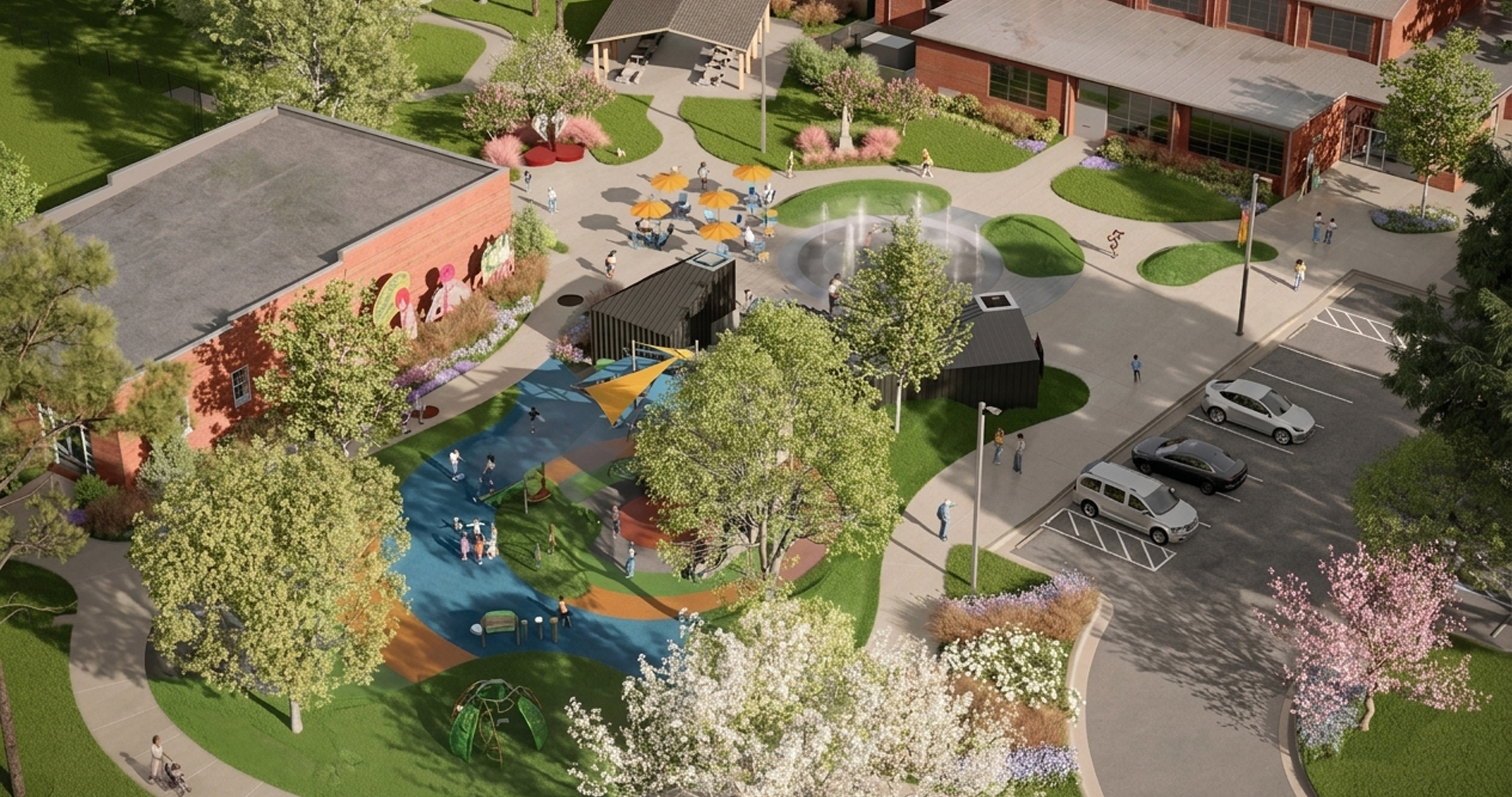
The broader site will also be reimagined, says Clark Nexsen principal/senior architect Jennifer Heintz, with a new central plaza anchoring the space alongside a splashpad and playground.
These improvements will help Method continue serving today’s community while creating a place that feels safe, welcoming and accessible for everyone.

BEYOND THE BOND: The Exchange Park
Building on Dewitt Carolinas’ massive plans for The Exchange Raleigh—including a 4-acre greenspace with natural trails, water features, boutique retail and a year-round entertainment pavilion—an interim park is bringing new life to the site.
Set to launch around mid-June, the temporary outdoor activation—notably not part of the Parks Bond—will feature pickleball courts, a dog park, beer truck and garden, ice cream pop-up, movies, live tunes, and large stone seating installations designed to encourage gathering and lingering.
“We want the park to be a welcoming amenity for tenants, neighbors and visitors,” says Dewitt Property Development Manager Connor Saieed. “As we bring an exciting mix of events and new F&B vendors online in the next few months, we invite the community to come see what’s happening at The Exchange.”
Even before its official debut, the space has already hosted community events ranging from the 11th annual Touch-A-Truck—which drew ~3,000 attendees—to intimate yoga classes and pop-ups, serving an early glimpse at the development’s broader community-centered vision.