by Alexandra Drosu | Mar 20, 2017 | Eat, March 2017
Dear Restaurant Guru,
Last Wednesday my boyfriend and I went out to dinner. We asked the hostess to sit at a table in the bar; the area was empty. She seated us at a two-top; five minutes later she seated two people to our right and another five minutes later two people on our left. We were crammed together yet there were several empty tables around us. It was a $100+ dinner, and the seating affected our experience. What can we do to make sure it doesn’t happen again?
Dear Two-Topper,
This is quite the conundrum. You’re in a situation where you feel cramped, invaded upon and uncomfortable, telling other guests that you’d prefer more privacy. What was the hostess thinking? Was this a well thought-out plan constructed by the evil restaurant manager?
First, my opinion; then my solution: Sometimes we give more credit to those doing their jobs than we should. How many times have you seen a co-worker do something baffling? Why is Chad-from-accounting reheating his tuna sandwich in the microwave? Doesn’t he know the bread will get soggy?
The short answer is the hostess wasn’t thinking. She was simply filling up tables without regard to how a guest may feel about becoming temporary roommates with the neighboring table. Her boss may have told her to seat tables near the window to give the impression that the restaurant is busy. Or perhaps, they were expecting a larger group? Either way, the problem starts there. So what do you do?
In a situation where you’re the first group to be seated, you have no control as to where the next group sits. Perhaps, the onus is on the next couple being seated, to communicate they aren’t comfortable sitting shoulder to shoulder with a complete stranger? (I put a small amount of blame on them.) The third couple doesn’t perceive it’s unusual at the moment and only realizes their discomfort after the menus are being handed to them, which is too late.
As a diner, you have a very small amount of control in your ‘seating’ destiny. If the place is empty, I typically scope out the floor, find the table that best fits my mood and ask to be seated there. If I’m on a date, I encourage the host to seat us somewhere comfortable and quiet, and I make sure to communicate the importance of our privacy. I may also put notes in my reservation. If I’m making a reservation online, OpenTable, Resy and Yelp offer that option. Communication is key, and most restaurants are happy to know a little back-story from their guests.
But let’s say it’s a spontaneous meet-up with a friend, and you still want a table-buffer. It’s ok to ask the host if the restaurant plans on being busy. They, most likely, will offer up information that will give you insight as to how the dinner service will be that evening. That’s where you might want to speak up and guard your territory.
Let’s be honest, the real problem was with the host, training and management.
Max Trujillo
Host of the NC F&B Podcast.
ncfbpodcast.com

by Paige Luck | Mar 6, 2017 | Eat, March 2017
Duck has always been a popular menu item, but you were more likely to find it featured on a table with linen rather than paper napkins. Recently more casual dining restaurants have been offering duck on their menus with regularity. Most home cooks aren’t willing to tackle this tricky, expensive meat. The lack of familiarity and expense of duck has made it less popular on casual dining menus in the past. In the Raleigh area, the trend is changing with duck making more appearances on moderately priced menus.
Finding sources of duck also has gotten easier for chefs. Mike Badger, the Director of the American Pastured Poultry Producers Association (APPPA) has said: “What I see is anything duck increasing in demand.” The trend has proven true in the Triangle area, including local farms like Joyce Farms. Most local farms offer specific breeds of duck, such as Peking, the most commonly consumed duck in the United States.
“The popularity of duck on restaurant menus correlates with the rise of the caliber of talent working in this region,” says Royale chef Jeff Seizer, who often features a duck confit special on his lunch menu. You’ll find duck tacos on the menu of Cantina 18, a casual Mexican fusion restaurant in Cameron Village by Chef Jason Smith of 18 Restaurant Group. Both chefs spent time honing their culinary skills in New York at Danny Meyer’s Union Square Café, among other notable restaurants.
Sporting a more intense poultry flavor than chicken, the deeply red meat of duck is rich with fat. Because ducks are waterfowl, they have a thick insulating layer of fat. This fat becomes a flavorful source of juiciness when duck is roasted or confitted.
Duck confit is most often used in casual dining. This preparation slowly simmers duck legs and thighs in duck fat for hours producing a highly flavorful, tender, rich meat. Duck is showcased with waffles or as spicy duck enchiladas at Brier Creek Beer Garden and as a pulled duck sandwich at the Oak and Dagger. These dishes allow the flavor of duck to soar in the form of shredded or chopped meat.

by Cameron Walker | Mar 6, 2017 | Eat, March 2017
Surf meets turf and east meets west at Cowfish, proving opposites really do attract
Every evening, right around 6:30 p.m., the heady aroma of grilling burgers wafts across Six Forks Road. Drivers roll down their windows to inhale the scent, and The Cowfish Sushi Burger Bar braces for a busy night. Business is smoking, both figuratively and literally; co-founder Marcus Hall says due to the smoke generated by heavy dinner volume, the kitchen staff has been surprised more than once by firefighters showing up to put out nonexistent fires.
The key to The Cowfish’s success is the concept—a restaurant that caters to both sushi devotees and burger fans. “It’s a little bit of something for everybody,” says Hall. “I can’t tell you the number of times I hear, ‘But my significant other won’t go out to eat with me!’ We’ve solved the sushi ‘veto vote.’”
Enter “burgushi,” a portmanteau that Hall says describes the marriage of meat and sushi in three different forms: sushi rolls created from burger components like the All-American Bacon Double Cheeseburgooshi; pickup-style sandwiches made from sushi ingredients like the What’s Shakin’ Tuna Bacon Sandwich; and bento boxes, “combo meals” with a mini burger, sushi roll and house-favorite side items.
It’s easy to gauge the chain’s current success by its Saturday night wait times, but Hall says the concept didn’t always seem like a sure thing.
“We were stressed out beyond belief (before opening), because we thought we might have just stepped in the biggest pile ever,” he says. “We just had to put blinders on and trust in our ability to produce…if you’re putting a great product out there and you’re creating great value, then how can you fail?”
Luckily, early guests loved the burgushi concept—as well as the vibrant, fun atmosphere and zany decor. The Raleigh Cowfish, located on the ground floor of the Captrust Tower, is painted an enthusiastic red and hung with original artwork by Scott Partridge that cheekily mimics Lichtenstein, Japanese woodblock prints, Broadway posters and anime. Every location also houses a large saltwater aquarium with colorful fish but only a single cowfish per restaurant.
“It has horns and is quirky and is an underdog…it’s our perfect mascot,” says Hall. “But we’ve learned that you cannot have more than one! They’re very territorial and they emit a toxin if they get stressed out. This tank was built by Animal Planet for a show called “Tanked,” and they put 16 cowfish in there. It was a civil war—it was horrible. We realized what was happening and got them all out, but for the first two weeks we were open, this tank had no fish in it.”
He sees a parallel between the territorial little fish and the restaurant chain; their uniqueness is their edge, so they don’t want to saturate the market in a given area. As the chain grows, it plans to spread out to new locations that will embrace its hybrid concept.
Hall, 41, followed in his father’s footsteps to attend N.C. State, studying business management as he worked various restaurant jobs. Before his senior year, he spent a year in Europe, learning Scottish hospitality working in an American eatery in Edinburgh.
“I learned this international language—a smile is so important, as is just treating people the way you want to be treated,” he says. “I didn’t know it at the time, but those are the building blocks of hospitality.”
After graduation, he dabbled in a few different jobs, then started working for business partner Alan Springate at his string of CiCi’s Pizza franchises. The pair opened eeZ Fusion and Sushi in Charlotte in 2005 and launched The Cowfish in 2010. The North Hills location, which opened in 2013 at the invitation of developer John Kane, is their sophomore effort; they’ve gone on to open incarnations in Atlanta and at Universal Studios and are slated to open a fifth location in Birmingham, Alabama this summer.
“We encourage our staff to live by this idea that we’re very serious about our product, but we’re not serious about ourselves,” he says. “We have a mission statement that basically breaks down to ‘Don’t suck.’ It’s a very guest-centric list of principles—do whatever it takes to please the guest. You should feel that as a guest coming in, if we’re doing things right.”

by Alexandra Drosu | Mar 1, 2017 | Eat, March 2017
Not all oil is created equal; many brands don’t offer the health benefits promised
The health benefits of olive oil, such as protecting against heart disease, have been well documented; however, many olive oil users aren’t getting any of them and being duped in the process. The University of California-Davis tested olive oils bought from grocery stores to determine whether they met the strict standards to be classified as “Extra Virgin”—a whopping 69 percent did not.
“Creditable producers are under scrutiny and trying to make a profit and a honest living while the cheaters continue to find ways to extend the harvest yield through adulteration of other oils or using inferior oil from a previous harvest to reduce cost and increase profits,” says Whitney Brown, Owner of local olive oil company, The Olive Wagon (theolivewagon.com).
The report has sparked increased scrutiny of industry standards, but you still need to be informed in order to choose olive oils that are rich in polyphenols, which have been shown to help fight cancer, reduce inflammation and protect the cardiovascular system.
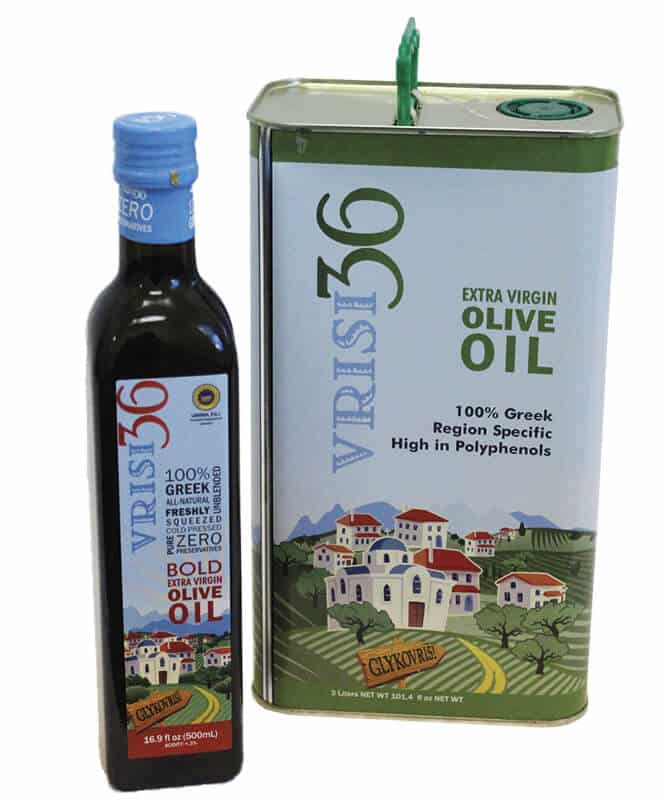
One way, according to Pam Skea, Managing Director of Flying Olive Farms, is to identify a single-sourced olive oil whose origins are traceable. All the olives that get pressed into their signature extra virgin olive oils under the brand Vrisi 36 (vrisi36.com) can be traced to a small farming community in Greece called Glykovrisi. “We’re very transparent,” says Skea. “We test for levels of polyphenols in our oils.”
It’s this transparency that’s often lacking in mass-market brands. But small shops like Brown’s work with distributors that provide chemical test results from independent labs that are approved by the California Olive Oil Council. “This assures the store owner that we are purchasing a pure product and can therefore confidently represent the products with integrity intact,” adds Brown.
How to choose a good olive oil: Brown and Skea offer tips on ways to choose olive oil brands that you can trust.
“Choose a label that comes from a smaller distributor, has dates of harvest and country origin listed,” says Brown.
Price of the olive oil is not an indicator of quality and neither is color, so don’t base your purchase on either.
“A good quality olive oil should have a pleasing aroma- fresh, grassy and herbal with no lingering mustiness,” says Brown. Of course, you can’t always smell or taste oil in all supermarkets, but you can learn from your purchase for next time.
Taste it! The oil should not be greasy or have a vinegary aspect. Take a small sip into your mouth, then inhale air through your closed teeth. If you feel a burning sensation in the back of your throat, it’s often a sign of quality olive oil.
Make your olive oil last longer
Olive oil is meant to be enjoyed not saved, so once you unseal the cap, the clock starts ticking. “Time is its enemy,” says Brown. “The oil will eventually go flat, then rancid.”
Store your olive oil at room temperature, and keep it away from direct sun, preferably in a dark bottle. Also, avoid keeping it near the stove.
Once opened, try to allow as little oxygen to enter the bottle as possible, says Skea. Don’t leave it open on your countertop for hours on end. Lastly, if the bottle has been sitting in your cupboard for more than six months, toss it.
Keep in mind you don’t necessarily cook with the same olive oil that you drizzle on your salad or dip your bread into. Save your more expensive, quality oil for dishes where you’ll really taste the robust flavor.

by Alexandra Drosu | Feb 2, 2017 | Eat, February 2017
We have all been there, out of town in a great city ready for dinner or a drink but struggling to pick the best spot. Wishing you could ask local chefs or bartenders for their top pick. Now you can, thanks to Raleigh entrepreneur Steve Mangano.
Mangano’s new app, CurEat, is designed to help you find the best restaurants and bars in 60 cities. He won’t call it this, but it’s an anti-Yelp restaurant app. It only includes positive comments about local independent restaurants and bars – no chains or franchises. Restaurant and bar owners control all the information and photos you see on CurEat.
A unique feature of CurEat are the CurEaters—chefs, bartenders, tastemakers and artisan craft-makers—who are influential in each city and who share their favorites spots to eat and drink.
Some of the CurEaters in Raleigh include: Scott Crawford, owner of Crawford & Son; Kevin Barrett of Dram & Draught; Ashley Christensen, owner of AC Restaurants; and Marjorie Hodges of the North Carolina Museum of Art. So CurEat will tell you where Scott Crawford likes to have a drink in Charleston or where Wyatt Dickston of PICNIC in Durham likes to eat in Atlanta.
Presently the app shares more information about the Triangle area since it was developed and beta tested here. Expansion plans will soon roll out CurEaters’ picks for Charlotte, Asheville, Charleston, Richmond, Atlanta, Miami and Birmingham.