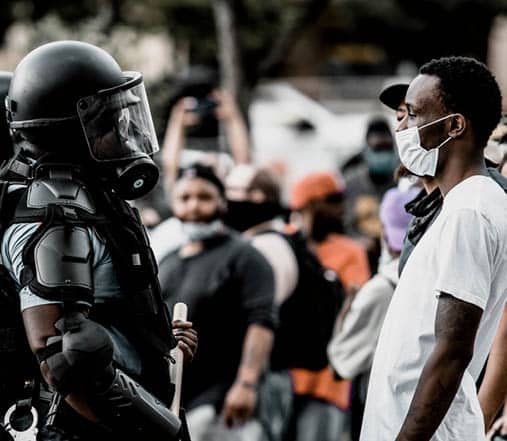
WEB EXCLUSIVE Following the police brutality—including the use of tear gas—that ensued after peaceful protests in downtown Raleigh in May after the death of George Floyd, the Raleigh Police Department underwent an independent review of their practices, policies and procedures on the use of force and their response to protests and mass gatherings by 21CP Solutions, a group that “helps law enforcement agencies and communities effectively tackle the challenges of policing in the 21st century.” Last week, 21CP Solutions released their report, which also included several after-action recommendations for the RPD.
21CP says they used information and data provided by RPD, RPD personnel in focus groups and community members to conduct the final report, which they also note was not an independent after-action report, nor were they charged with conducting an independent investigation on what did and did not occur during the protests. 21CP then formulated recommendations for future issues based on RPD’s existing policies and national practices.
The report outlines a total of 38 recommendations across eight categories. Below, we summarize key points in each of these eight categories. (According to 21CP Solutions, recommendations are not ranked in any specific order.)
Operational Planning
RPD training records obtained by 21CP showed that RPD provides crowd management and incident command training to officers within the National Incident Management System (“NIMS”) framework RPD uses to manage large and complex events. However, 21CP recommends that the police department train additional commanders that are more capable of handling large police actions during critical incidents, and have all officers undergo Mobile Field Force (MFF) and Crowd Management training. 21CP also recommends that whenever RPD gets word of an organized protest, they develop an Incident Action Plan, which would help them effectively manage any civil disorder and subsequent action like arrests. Additionally, this category sheds light on the City of Raleigh’s picket or protest permitting ordinance that requires an application to be approved by the Chief of Police, which 21CP recommends both the city and RPD start enforcing.
Use of Force and De-escalation During Protests
RPD’s policy on the use of force and weapons as of March 26, 2020 stated that “force should be used only when all other means of resolving a situation have been exhausted or are clearly inapplicable” and should only be used when “reasonably necessary to control a situation.” Through interviews with Raleigh community voices, RPD’s After Action Report and video footage, 21CP found that RPD deployed several munitions, including tear gas, foam batons and rubber bullets, on the nights of May 30 and 31.
In their report, 21CP recommends that RPD develop a more clear and specific guidelines on when the use of force is okay in crowd contexts and re-train commanders on when and how to deploy special munitions, including in what circumstances RPD should deploy tear gas. 21CP suggests that RPD find a way to document the use of tear gas, foam batons and/or projectiles for accountability purposes.
Equipment and Resources
Through interviews with RPD, 21CP found that many of the police department’s gas canisters were expired. 21CP recommends that the police department keep an inventory of their equipment to ensure their effectiveness and, should they continue to use chemical munitions, their supply be “vetted for quality and usability.” Additionally, 21CP suggests RPD look into using “soft” protective equipment for Mobile Field Force personnel, which offers similar protection provided by the gear currently worn by RPD’s MFF squads without the intimidating “militarized” look. It may also be helpful, according to 21CP, for RPD to look into CCTV cameras, aerial support and intelligence, small utility vehicles like Gators and sound amplification devices in department-issued gas masks.
Communications
21CP Solutions noted that communicating with staff is extremely important when planning for a large-scale event or a critical incident response. They recommended that RPD develop a strategy to communicate clearly and effectively what they expect from MFF during a protest that could potentially turn violent. 21CP said that, through interviews with RPD stakeholders, they discerned that there was no communication strategy in place before the protests on May 30 and 31. 21CP also suggested that there be a debriefing after protest, crowd management and critical incident management shifts.
Mutual Aid
During the nights of May 30 and May 31, RPD obtained mutual aid from ten different jurisdictions. 21CP recommends RPD review their existing Mutual Aid Agreements and reach out to local and county law enforcement agencies that may be able to offer further protection or resources to them; all agreements should be reviewed annually.
Body Worn Cameras
Nationally, the use of body worn cameras by police officers has increased greatly in recent years. According to an RPD camera policy provided to 21CP, “the use of body worn cameras is prohibited during many protest situations.” 21CP recommends that RPD review this policy to ensure that its requirements are clear within the contexts of protests and crowd management. 21CP also suggests that RPD establish a committee that would convene to manage training, implementation and maintenance of body cameras.
After Action Reports
21CP defines an After Action Report (AAR) as a “process in which ‘following a project or event,’ an organization and its ‘members gather to share insights and identify mistakes and successes.” They recommend that both stakeholders inside and outside of the Raleigh Police Department are involved in the After Action Review process and that all After Action Reports filed detail actions, responsibilities and timeframes, as well as recommendations for future events. The police chief should ensure these actions are being implemented within a regular report.
Community Engagement
21CP recommends that after large protests and other incidents, the community should be able to debrief with the department to express any personal experiences or concerns. A third party can further help with communication between police and the community in order to deter violence or conflict. Additionally, RPD should utilize their social media accounts for communicating with protesters and other community members during critical events.
View 21CP Solutions full report of the Raleigh Police Department following the protests in May here.
WEB EXCLUSIVE The fight for voting rights for African Americans and people of color, as well as for racial equality, has been going on since even before the 1960s, when mass civil rights protests broke out over the right for equal rights for Black people as well as for their right to vote. Though the 15th Amendment prevents the federal government from denying any citizens the right to vote, ingrained racism and voter suppression targeting people of color has become even more apparent in the electoral system as of late.
Renowned artist Shepard Fairey believes voting rights are human rights, and that everyone should have equal voting access regardless of race or economic circumstance. In an effort to share this message on a larger scale, he collaborated with photographer Steve Schapiro, who documented many important civil rights protests in the 1960s, on a new 18-foot high mural for the exterior of the Cortez restaurant on Glenwood Avenue. The work, titled “Voting Rights are Human Rights,” was also created in response to George Floyd’s murder.
Photo by Joshua Steadman
Wyatt Closs of Big Bowl of Ideas, a creative production company that collaborates on projects surrounding themes of social justice, selected Fairey’s art for a national project called “Walls for Black Lives.” The project will support a national day of strike for Black lives on July 20. As part of the project, eight cities around the country—including Raleigh—now feature artworks supporting the Black Lives Matter movement.
Closs says he chose Raleigh as one of the participating cities because of its notoriety. “[Raleigh] is a flashpoint for voting rights and the minimum wage is too low, both of which disproportionately impact Black people, a metaphorical set of ‘knees to the neck’ for African Americans generally,” Closs says.
“Voting Rights are Human Rights” is Fairey’s first large-scale installation in Raleigh. Closs says the mural should last at least a month, but he hopes it can last until Election Day on November 3—because of the medium of the artwork, it’s hard to predict how long it will last. Raleigh Murals Project secured the location and local artists Taylor White and Sarahlaine Calva installed the mural at Cortez.
Closs says he hopes Fairey’s mural will make Raleighites pause and contemplate what’s going on in the world right now. “It’s really a message to folks that, not just that Black lives matter, but it’s important to channel the energy from [the strike] into civic engagement and voter participation and be a voice for change,” Closs says.
Fairey also created the Barack Obama “Hope” poster for Obama’s 2008 presidential campaign. In Wisconsin, Fairey will paint the same “Voting Rights are Human Rights” mural on the south side of the 12-story Railway Exchange building in downtown Milwaukee, which served as the city’s headquarter’s for President Obama’s 2012 reelection campaign. The piece is expected to be completed in time for the Democratic National Convention in mid-August.
WEB EXCLUSIVE In the wake of protests against police brutality, white supremacy and racist policies, Americans have taken to the streets to demonstrate peacefully and call for change. But there is a lot more many of us can do to inform ourselves about these issues and what needs to be different. We’ve curated a list of ways folks can educate themselves about the history of racism and white supremacy in America as well as ways they can support the Black Lives Matter movement. Additionally, here are some local resources and ways to be supportive.
Educate yourself on the history of racism in America and the Black Lives Matter movement.
WATCH: 13th American Son Clemency Dear White People Explained: The Racial Wealth Gap LA 92 Time: The Kalief Browder Story When They See Us Who Killed Malcom X?
Sign these petitions to demand justice for Black victims of police brutality.
Text FLOYD to 55-156 Text JUSTICE to 66-8336 Test ENOUGH to 55-165
How to Take Action
Register to vote. Check in on your black family members, friends, colleagues and partners. Educate yourself about what it means to be anti-racist. Share resources with those around you. Be an ally.
Know of some other resources or ways to be helpful? Email us.
WEB EXCLUSIVEGeorge Floyd’s brutal murder by a white police officer in Minneapolis one week ago—on top of countless other incidents of racist violence against Black people in America—triggered protests in cities across the nation.
This weekend, those protests came to Raleigh.
What began as peaceful demonstrations downtown on both Saturday and Sunday evenings devolved into chaos after sundown. Police officers fired tear gas and rubber bullets at demonstrators. Looters destroyed storefronts, businesses and city property on Fayetteville, Wilmington and Salisbury streets. Raleighites were left to pick up the pieces, prepare for more unrest and, in the long run, seek out ways to heal deep racial divisions and to try to figure out how to build a more equitable city.
Here, we try to piece together what happened this weekend from the differing perspectives of demonstrators, police, activists, media outlets, business owners and other observers.
Saturday Evening
Several activist groups call for peaceful demonstrations to demand justice for George Floyd, Breonna Taylor, Ahmed Arbery and those killed by police officers in Raleigh. Protesters are asked to wear face masks and bring posters and water.
Local activist groups including Raleigh PACT, Young Americans Protest and Carolina Peace Center release a list of demands, including a police review board with subpoena power, restoration of CACs, closing police stations in black communities and policies requiring police officers to intervene when they witness police abuse. They call for the removal of Police Chief Cassandra Deck-Brown if their demands are not met.
By 6 p.m., following a march into downtown via Capital Boulevard, up to 3,000 demonstrators gather in front of the Wake County Courthouse. They listen to speakers, hold signs, chant and rally peaceably in honor of George Floyd’s memory.
Thread of the Raleigh protest. Starts off strong, lots of people here. Chants of NO JUSTICE NO PEACE. SAY HIS NAME. GEORGE FLYOD. pic.twitter.com/upWN01Urq1
We’re in downtown Raleigh covering the nationwide protest against the killing of #GeorgeFloyd. Families, adults and young people alike are present. Hundreds of peaceful protesters gathered on Fayetteville St. in front of the Wake Co. Courthouse. pic.twitter.com/uaC4e8w4DF
— The News & Observer (@newsobserver) May 30, 2020
Raleigh protest was very peaceful until cops instigated and started throwing tear gas like candy. 99% of those tear gassed were peaceful. police responded to water bottles being thrown with gas bombs
Police didn’t hassle the main group even when we took over the highway, but there’s a smaller group that got some tear gas and rubber bullets because they didn’t outnumber cops 100 to 1 pic.twitter.com/8VvtifbhUc
— Yes, You’re Racist (@YesYoureRacist) May 31, 2020
This is what happened according to Chief Deck-Brown.
Today, May 31, Raleigh Police utilized tear gas to move protestors out of the path of an EMS vehicle on its way to an emergency medical call after they refused to move. The use of tear gas yesterday, May 30, is explained in this video. #RaleighDemandsJustice#raleighriot#Raleighpic.twitter.com/8EqW7Dv6Fx
Many of the demonstrators begin to leave as the sun sets. The situation worsens.
Police in downtown Raleigh deploy tear gas, pepper spray and smoke bombs against a crowd of protesters near South McDowell and West Davie Streets intersection #Raleigh#George Floyd pic.twitter.com/Y8vD8Qe8pg
This is one of the tear gas canisters fired at protesters in Raleigh last night. Manufactured by Combined Tactical Systems, many may know that this is the same company that supplies tear gas to Israel. pic.twitter.com/ldM0aJ2iVf
Looters begin breaking glass windows of downtown storefronts with bricks. The CVS pharmacy at the corner of Hargett and Fayetteville streets is broken into and set ablaze.
Went back to my office to get some water. I work at a progressive newspaper. Someone threw a brick through the window while I was inside. I stepped outside and immediately inhaled tear gas. #Raleigh. pic.twitter.com/gLrE55h5Cg
There are reports of white supremacist groups infiltrating the protest and rioting. White supremacist symbols are found spray painted onto downtown buildings.
Last night a symbol of hate was painted over one showing love. We deplore this symbol, for it is the opposite of what our world needs & what we believe. We stand with peaceful protestors & businesses hurt in our community during last night’s events. pic.twitter.com/O8kiJS37Q3
The sun is up and it shines light on the damage left behind from Sunday’s protests. This is the YMCA on Fayetteville Street in Downtown Raleigh. @WNCNpic.twitter.com/mOCbxfrW0O
Cleanup @BeasleysChicken the morning after Raleigh, NC. One of many protests that turned violent after police released tear gas & pepper spray into the peaceful demonstration of more than 1000. The stencil on the window says, ‘Don’t Forget Kindness’ #IamGeorgeFloyd#protests2020pic.twitter.com/g55A9RZk42
My restaurant, The London Bridge Pub, was vandalized and looted tonight in Raleigh, NC by what I can only assume was a fringe sect of the peaceful protestors. Just came to say I still support the protest. The root cause of all this upset, is too awful to not continue protests.
Activists organize another peaceful demonstration downtown. Demonstrators gather near the State Capitol and the Governor’s Mansion.
A small group of protesters assembled at the State Capital in Raleigh on Sunday. It’s the day after a night of chaos in the Capital city after Saturday protest escalated causing major destruction downtown.@SpecNewsRDUpic.twitter.com/BIv17jZ2gz
— Ted Corcoran (Red T Raccoon) (@RedTRaccoon) May 31, 2020
This is RPD’s explanation for using tear gas.
We utilized tear gas to move protestors out of the path of an EMS vehicle on its way to an emergency medical call after they refused to move. https://t.co/g3h7Bmej7v
— Ted Corcoran (Red T Raccoon) (@RedTRaccoon) June 1, 2020
And more reports of looting and destruction, including at North Hills and Triangle Town Center.
Late Sunday evening, law enforcement officers are shown on video shooting at a downtown business owner.
Monday Morning
With protests showing no sign of abating, Baldwin institutes a citywide curfew beginning at 8 p.m. RPD says the National Guard has been deployed to restore order.
The National Guard is now deployed to provide support as we work to restore order & ensure the safety of residents; protect necessary & critical infrastructure; and help ensure that those who wish to lawfully and peacefully exercise their 1st Amendment right to protest can do so.
Baldwin is criticized for “official incompetence” in an N&Oeditorial for not implementing a curfew sooner.
Chief Deck-Brown is criticized for, among other perceived missteps, not instructing officers to protect property and businesses.
So…Raleigh PD chief basically saying police will not stand in the way of rioters and looters and NcGOV tells small biz owners the protest message is more important than the businesses they worked so hard to build. Really bad look for NC leadership right now. Terrible. #ncpol
RPD is criticized for, among other perceived missteps, reacting overly aggressively towards demonstrators, especially compared to how officers treated demonstrators carrying firearms around downtown last month.
I’ve no issue with rules, but it’s quite clear— in the eyes of @raleighpolice only white supremacists groups that wish to protest WITH ARMS in Raleigh are allowed to do so. #gotithttps://t.co/zuELkw2yf3