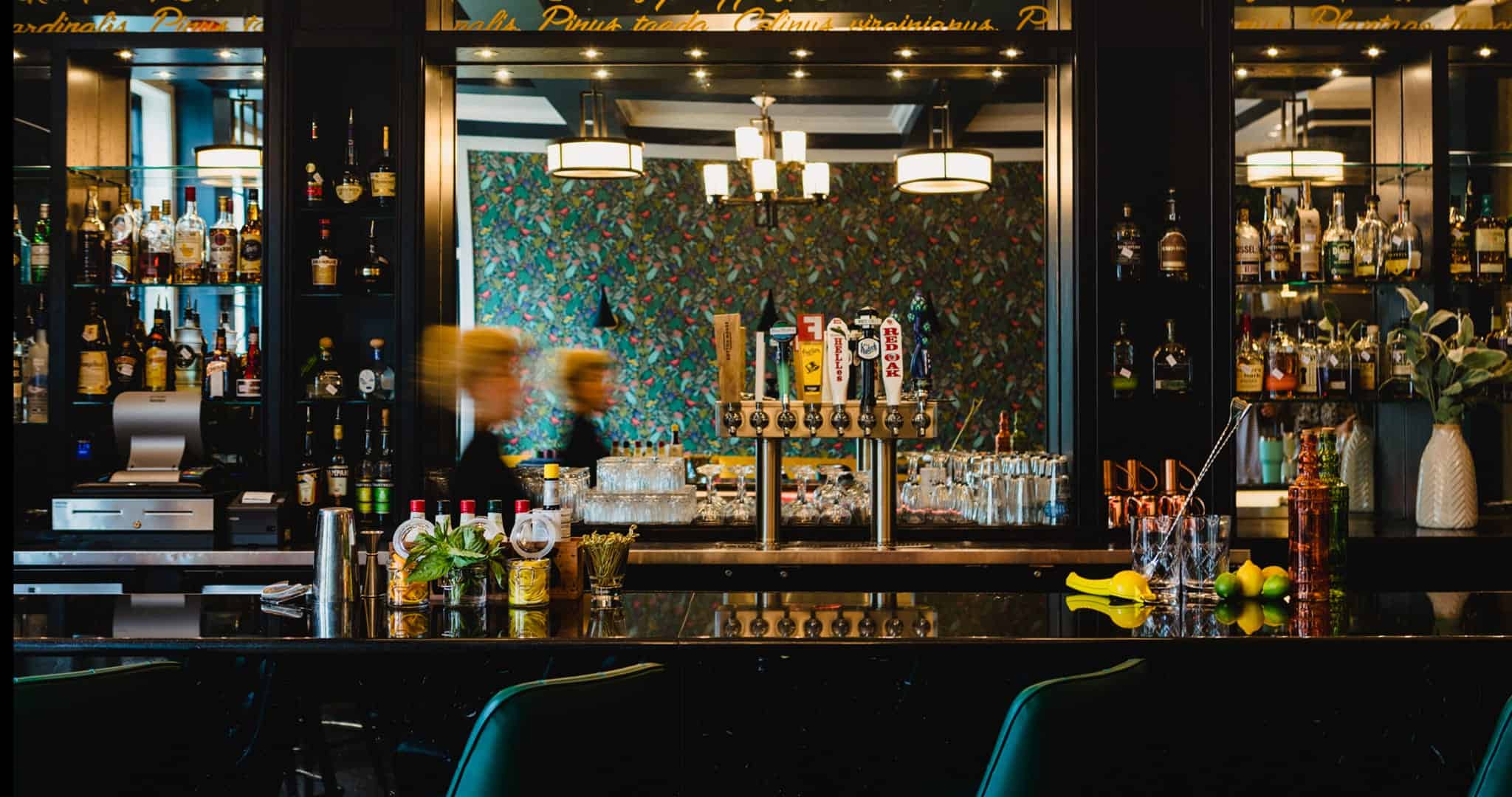
The standard Old-Fashioned gets a tasty—and boozy—upgrade at The Mayton’s Peck & Plume.
Photo by Baxter Miller
Peck & Plume bartender Seneca McAllister is giving your basic Old-Fashioned a run for its money—and makes your money worthwhile with some extra added booze. In addition to the drink’s standard simple syrup, he adds Disaronno amaretto and black walnut bitters to his Seneca Old Fashion for a flavorful and balanced fall sipper that you’ll most definitely want multiple rounds of.
McAllister originally created the drink at a Pinehurst retirement home he worked at, where the seniors “did not care for water of any sorts going into their drinks,” he laughs. “Anytime I’d put simple syrup in there, they’d wig out, so I had to come up with a way for them to see me reach up on the liquor shelf to bring down another bottle of booze.” Honestly, we like their style.
Today, the Seneca Old Fashion is a hit at Peck & Plume, where McAllister has worked for the last five or so years. “It’s one of my top three favorite drinks of all time,” says McAllister. And those who frequent the bar at The Mayton—which was recently rebranded and extensively renovated—seem to love it too.
So, belly up to McAllister’s bar at Peck & Plume to have him whip up his signature Old-Fashioned for you—or recreate the delicious drink at home. peckandplume.com.
Virginia Distillery Company brings its unique award-winning whiskies to NC.
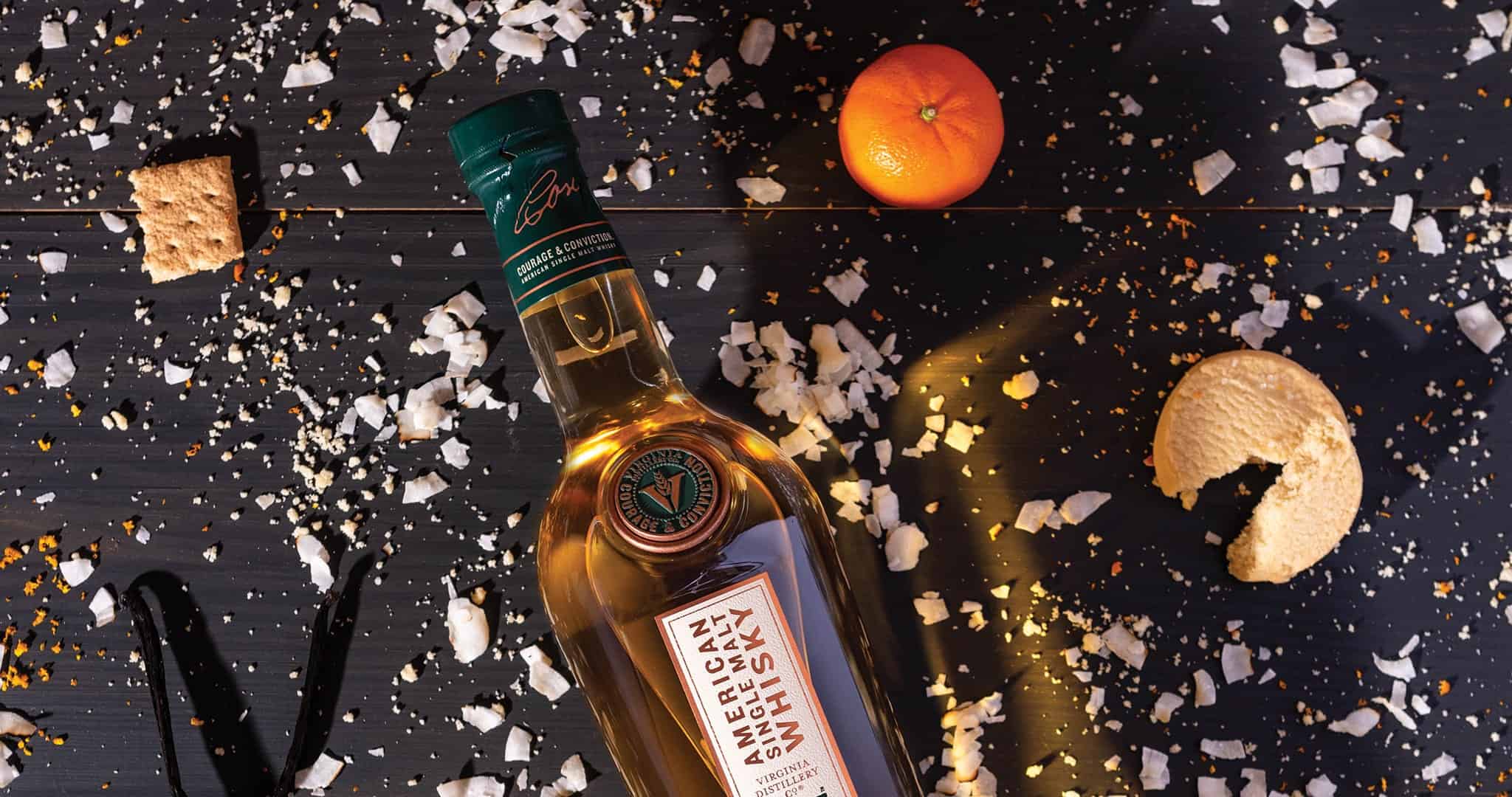
When it comes to the vast and wonderful world of whisky, it’s all about the barrels. (For novices or clear-liquor types, whisky is typically aged in a variety of casks that mature the spirit, enhancing its aromas and flavors. (The more you know!) For Virginia Distillery Company, it’s bourbon, sherry and cuvée casks that round out the flavors in the Lovingston, Virginia-based distillery’s new product line, which was released in North Carolina this past summer. (And, yes, that’s whisky without the “e,” the more universal spelling of whisky that originated in Scotland.)
These new-to-the-market whiskies are line extensions of Virginia Distillery Co.’s flagship American single malt Courage & Conviction line, launched in 2020 and consisting of a combination of roughly 50% former bourbon casks from Kentucky, 25% former sherry casks from Spain and 25% European cuvée casks. The three Courage & Conviction expressions (Courage & Conviction Bourbon Cask, Courage & Conviction Sherry Cask, and Courage & Conviction Cuvée Cask) allow Virginia Distillery Co. to highlight the robust flavors from each of those casks in its full entirety—while giving whisky lovers a range of tasty flavor profiles to enjoy.
“One part of whisky that people don’t really think about is: They figure if you have a good whisky in a cask and it’s ready to go in the bottle, you just dump it in,” says Virginia Distillery Co. CEO Gareth Moore. “But picking the right casks and batching them together and then reducing them to bottle strength—that’s really its own art in itself.”
Beyond the casks, one of the other main things that helps Virginia Distillery Co.’s whiskies stand out are the grains used in production. Instead of corn and rye (standard in American whiskies like bourbon), Virginia Distillery Co. uses only malted barley. “You get a lot more flavor out of the grain,” explains Moore.
The single-malt focus is one that Moore upholds from his father, the late Dr. George G. Moore, who started Virginia Distillery Co. in 2011 (taking the helm in 2013—then “for better or worse, very naive” and knowing only about the drinking portion of the business, he jokes). It was dad George who inspired the name of the Courage & Conviction whisky line—“Have the courage of your convictions,” was a saying he often repeated to his friends and family.
“He wanted to follow his passion for single malts and make the next great American whisky company,” says Moore. “We’re honoring the traditions that have been honed over many years—not trying to reinvent the wheel—and do it in a way that’s going to take advantage of our local climate.”
The casks, the grains and Virginia’s environment (think hot and humid summers and cold, snowy winters)—plus the team of knowledgeable consultants that Moore brought in to help with production and other parts of the whisky-making process—are all what make Virginia Distillery Co.’s products so unique. And, to hit you with a little bit of science, it’s the temps that make the expansion and contraction of the casks more defined (between the seasons and even day to day)—and result in the full-bodied flavors enjoyed in the Courage & Conviction line.
“We’re definitely a discovery brand,” says Moore. “We’re trying to break the preconceived notion that American whiskies are just bourbon or rye, and also the preconceived notion that single malts are only from Scotland. The goal is to make something unique that has a sense of place—that was clearly made here.” Bottoms up, Raleigh! vadistillery.com
Closer to home, Zebulon-based Olde Raleigh Distillery offers its own artisanal blended bourbon whiskeys, while hot spots like The Blind Barbour and Whiskey Kitchen offer a vast selection of intriguing bottles.
NC Dems and GOP reach across the aisle to find common ground on alcohol & football.
Intoxicating news that deserves a cheers: Gov. Roy Cooper recently signed House Bill 890 into a law, which loosens a number of regulations covering the sale and consumption of alcohol in North Carolina (hint: open container may be in Raleigh’s future…). Effective Oct. 1, the bill allows cities and counties to create social districts—aka areas where it’s legal to mill around with a drink. (The social districts will be ordained and created on a city-by-city basis.) The bill also permits individuals to order liquor from ABC stores online (!) for in-person pickup. And—Wolfpack fans, this one’s for you—HB 890 also allows fans at college sporting events to buy two drinks at a time—so now your whole crew doesn’t have to leave the stands (Doeren will be so thrilled) to get a brew. It’s sure to be a game-changer. Pour one out for your liver…
WEB EXCLUSIVE Last week, the North Carolina Association of ABC Boards adopted a measure to allow bars and restaurants to sell unopened bottles of alcohol back to ABC stores.
The bottle buy back, which the state’s 170 local ABC boards may opt in to on a board by board basis, could provide some relief for bars and restaurants that have not been allowed to sell liquor on their premises since March when Gov. Cooper ordered all bars, restaurant dining rooms and patios to close.
So far, more than a dozen local ABC boards, including those operating in Durham, Mecklenburg and Wake Counties, have opted to allow bars and restaurants to sell their bottles back.
In Wake County, businesses can make an appointment to return any unopened, ABC-stamped bottles of liquor bought after January 1 of this year for the original sales price minus the mixed beverage tax paid on the bottle.
So far in Wake, around 20 local businesses have taken advantage of the measure since the commission started buying back bottles on April 6, says Ike Wheeler, the general manager of Wake County ABC. Businesses have until the end of the month to return their bottles.
“Most bars and restaurants have responded positively and really appreciate [this initiative],” Wheeler says. “Some of the bigger companies, I doubt they will bring any bottles because they can withstand this, they know this will pass over. But some smaller bars and restaurants who may operate their books month to month or every 60 days, they want to generate some funds.”
“I’m a firm believer that it’s not the general with the biggest army who wins but the one with most options, so the fact [the Association of ABC Boards] is giving us options helps,” says Kevin Barrett, who co-owns the downtown cocktail bar Dram and Draught.
Just before the shutdown, Barrett says he and Dram co-owner Drew Schenck purchased a $2500 bottle of Macallan Scotch whiskey aged 25 years; they may sell that bottle back to the ABC, Barrett says, but likely not much else.
“Our opened bottle had one serving left and we planned out and bought another bottle,” Barrett explains. “It hasn’t been opened, so to return it and get it a couple months after reopening makes perfect sense now. It helps but for us, a bar that is 100 percent planning to reopen whenever the day comes, it does not make much sense right now to sell back well stuff or our basic inventory.”
Wheeler says after they’re accounted for, all returned bottles are sanitized and then go back into the ABC stores’ inventory to be resold.
“During this time of crisis, all North Carolinians must do what we can to help our friends and neighbors in need,” said Miles Davis, president of the NC Association of ABC Boards, in a statement. Guy Zander, chairman at the NC ABC Commission, has also voiced his support for the idea of buy backs, according to a spokesman.
Reforming North Carolina’s ABC system will benefit hospitality industry professionals, consumers and the local economy.
This year, state lawmakers introduced a raft of bills aimed at modernizing liquor sales in North Carolina, and with good reason: The current system looks much like it did back in the Prohibition era. The state’s role in selling spirits—currently it functions as a monopoly with 170 local ABC boards in a state comprised of 100 counties—makes buying and selling liquor inconsistent, inefficient, inconvenient and unsustainable for businesses, proponents of the legislation say.
“All restaurants and bars have to navigate this and we are all frustrated beyond words,” says Cheetie Kumar, co-owner of downtown Raleigh restaurant Garland and the adjacent Kings and Neptunes music clubs. “As the food industry [in North Carolina] has evolved and gotten so much national recognition, our hands are tied behind our back when it comes to the cocktail portion.”
Hospitality industry professionals say the outdated system makes doing business difficult for them, that their customers can’t get spirits available for sale in other states, and that local distillers can’t sell their products to them directly or even in many county ABC stores.
Among other complaints, bar owners and restaurateurs can’t sample spirits they may want to sell beforehand; they have to order from their local ABC board, which may or may not have what they want in stock; they have to order in bulk or make a special order, for which there’s no tracking system; they have to send an employee to pay in person with a check, load bottles into a personal vehicle and drive them back to the bar; and, if they want to carry a spirit their local ABC can’t or won’t stock, well…they’re pretty much out of luck.
“There are products we would like to carry, a greater selection of bourbons, of North Carolina-distilled product,” says Jim Beley, general manager of the Umstead Hotel and Spa. “The [Wake County] ABC decides what they’ll carry, so a lot of guests staying here, from the U.S. and internationally, are surprised that we don’t have certain quality scotches and bourbons. But we’re just not able to get them. And we want to carry local products as much as possible, but the local ABCs can refuse to carry certain products made in our state.”
Among the bills introduced this session (see below) is House Bill 971, which modernizes the licensure model for liquor sales and would see the state treat spirits sales the same as sales of beer and wine. It would dissolve local ABC boards and allow private businesses to operate wholesale and retail liquor sales. Under the bill, the state ABC Commission would still oversee liquor sales permitting, and the ALE would still oversee law enforcement; the revenues from liquor sales would still be disbursed to state and local governments that could use them for substance abuse prevention and other programs. Privatization would ensure that hospitality industry experts rather than state employees are making decisions about what local bars and restaurants can stock, the bill’s backers say.
“Our [customers] are becoming more and more sophisticated and they’re demanding a higher quality experience,” says Nick Hawthorne-Johnson, co-founder of Durham’s Cast Iron Group that operates Ponysaurus Brewing Co., The Cookery and Dashi, among others. “We want to provide that for them but it makes it difficult for us when we can’t get spirits because the people who stock spirits for the state don’t necessarily know a lot about the products. It’s time we let the state do what it does best, regulate, and let people who know how to supply boutique products supply them.”
Among the backers of the current bills proposed for ABC reform in the General Assembly are the North Carolina Restaurant and Lodging Association, or NCRLA, and the North Carolina Retail Merchants Association, or NCRMA, groups who say reform will benefit consumers, businesses and, largely, the state economy overall.
“[These laws] are not about more alcohol, or making alcohol easier to access for consumers,” says Lynn Minges, the NCRLA’s president and CEO. “They’re really about improving and modernizing a system and improving inefficiencies, making them more customer service- oriented.”
“It is a major policy shift, so it takes getting the legislation correct, explaining it to [lawmakers] and making sure they understand the community is not going to be detrimentally impacted,” says Andy Ellen, president and general counsel at the NCRMA. “Money will still be flowing into substance abuse programs.”
Ellen says he is optimistic about the chances of at least some of the provisions in the reform bills passing this legislative session, especially if lawmakers are able to get replacement ABC revenues streams in the budget into place. And with recent shifts in the law, such as legalizing Sunday morning alcohol sales, that optimism seems warranted.
Kumar, Beley and Hawthorne-Johnson are glad lawmakers are finally talking about ABC reform, a conversation they say has long been overdue.
“The motivation for people being into spirits isn’t to get intoxicated,” says Kumar. “That’s not what it’s about. It’s the reverse—the enjoyment of this craft. At this point, we would take anything to get three or four little things in place that would make it easier.”