Major airlines and RDU Airport ditch mask mandates—effective immediately!
Wheels up—masks down. “Finally!” exclaimed passengers as the news reverberated around the nation last night. Notching a major milestone in the social pandemic recovery, major airlines (and RDU Airport!) have ditched mask mandates—effective immediately! (That feeling you’re feeling is the sensation of fresh air on your face, the freedom to breathe freely…and the sound of erupting cheers and exuberant relief that could literally be heard from boarded planes and runways.)
In short, the CDC’s mask mandate, which was originally set to expire Monday, April 18, had been extended until May 3 to give more time to study the BA.2 omicron subvariant of COVID-19. But, on April 18, U.S. District Judge Kathryn Kimball Mizelle nullified the decision–saying “the federal mandate exceeds authority from U.S. health officials”—and ruled it is now up to each individual transit system to decide whether or not to require masks.
Concurrently, major airlines United, Delta and American ditched mask mandates Monday, among others. And, closer to home, after RDU Airport officials first said it would keep the mask mandate, less than an hour later, the airport announced in a tweet that mask requirements would be dropped effective immediately.
Beyond the friendly skies, Uber has also abandoned the mask req. for riders or drivers, and with it, abolished the no-front-seat policy. However, the website states that “to give drivers space, we ask that riders only use the front seat if it’s required because of the size of their group.” Uber also points out that this decision means masks are optional, so some may still choose to wear them. (Update: Tuesday evening, April 19, Lyft joined the ranks to make masks optional.)
So after two years of wearing masks on buses, taxis, planes, etc., you can finally take a deep breath (literally). Cheers to that!
WEB EXCLUSIVE Hearing someone speak through a mask is hard enough already, but imagine how much harder it would be for someone who is deaf or hearing impaired. Many people who are hard of hearing rely on lip reading or facial expressions, which cannot be comprehended through a traditional mask. Additionally, Dr. Sheri Mello, Au.D., owner and doctor of audiology at Raleigh Hearing and Tinnitus Center, says that masks cut down at least 10 decibels of sound which makes voices muffled.
Dr. Mello noticed that this was becoming a major problem for her patients back in March, and so she set out to do something that would help them. She found a deaf college student that was studying deaf and hard of hearing online who came up with a mask pattern that has a clear window around the mouth area, allowing lips and expressions to be seen while still covering the nose and chin. Dr. Mello obtained the pattern and asked furloughed patients of hers if they would be interested in sewing the masks. Although she didn’t expect many to volunteer, her patients ended up making and donating hundreds of masks, which Dr. Mello then sent out nationwide, from teachers of autistic children to lawyers in courtrooms.
“It was just amazing how big of a reach it went to—not just deaf people but people that were a little bit hard of hearing and couldn’t hear in a classroom situation from a distance, things like that,” Dr. Mello said.
Dr. Mello says that, for her, the masks were significant in providing that good feeling we were all seeking out once the pandemic hit and everyone was forced to quarantine and businesses were closing down. Once she got the word out about the masks she was featured on WRAL, ABC and CNN and people from all over the country were asking for them. Instead of just saving them for her own patients or asking for money for them, she happily donated the clear window masks to folks both near and far—as far as California and Florida.
“To see the look on the sewers faces dropping off the masks and the look on the recipients faces receiving the masks, it was just a great feeling—everybody wanted to feel good at this point during the pandemic,” Dr. Mello says. “I think it was important for me because not only did I help people who needed the masks—my hearing impaired patients—but I also helped people find something good to do in sewing the masks. I think it was important all the way around.”
For her hard work and compassion, Dr. Mello was nominated for hearing aid manufacturing company Oticon’s Focus on People Awards and is now one of three finalists in their Hearing Care Practitioner category. Although Dr. Mello’s masks are now depleted, she says clear window masks can easily be found online with a quick Google search.
WEB EXCLUSIVE As cases of coronavirus continue to rise every day, it has become increasingly important to make sure you’re wearing a face mask when going out in public and in situations where you can’t practice social distancing.
In an effort to set an example for the general public, Duke Health recently launched a masking campaign with the goal to “engage all Duke Health employees to be leaders in wearing a mask—both at work and in their communities—as an effective public health measure to decrease the spread of the coronavirus,” according to Duke Health officials.
Part of the masking campaign uses visual reminders and signage at all three Duke Health hospitals—Duke University Hospital, Duke Regional Hospital and Duke Raleigh Hospital—that reinforce the importance of employees wearing masks for the benefit of coworkers, patients, visitors and the greater community. These banners emphasize how wearing a face mask shows kindness to others and keeps those around you safe.
Social media engagement, bus wraps and billboards are also a part of the campaign. Duke Raleigh Hospital has shared posts on Facebook educating the public on mask safety and social distancing practices in order to help reduce the spread of COVID-19 in the community.
“Our number one priority is, and always has been, caring for our patients, their loved ones and each other,” one Duke Raleigh Hospital Facebook post reads. “Right now, part of that commitment to caring includes wearing a mask—when we’re at work, in the community and around others. Because for us, wearing a mask isn’t just about protecting ourselves, it’s about protecting everyone.”
Leigh Bleecker, Interim President of Duke Raleigh Hospital, says that masking is just one example of how Duke Health is helping to keep our community safe and protect the public from the spread of infection.
Some frontline hospital workers wear up to four face masks when they’re on the job in order to prevent themselves from spreading the virus to others. The least you can do is wear one mask when you go to the grocery store—by wearing one, it shows that you care about others, not just yourself.
As businesses and borders begin to reopen, many of us are asking ourselves the same question: “Just because we can go out, does it mean we should?”
A pandemic is a head game. We don’t quite trust the safety of our environment anymore, but we also yearn for normal routines; the grocery store can be the one destination enticing us out of our homes only for so long.
According to a recent CNN poll, just 49 percent of Americans feel comfortable returning to their routines. It is up to us, and the businesses to which we venture, to create a ‘new normal,’ one that makes us all feel safe.
In Raleigh, businesses are doing what they can to achieve that goal, including sanitizing surfaces, offering masks to guests and requiring staff to wear masks and gloves and checking their temperatures before each shift.
“I don’t know anyone who’s not being cautious at this point,” says Trey Bailey, the CEO of Bailey’s Fine Jewelry, about venturing back out. “All of our jewelry is being disinfected and we put out cleaner at each jewelry bay. There’s a lot of change for people operating.”
Sanitation station at Bailey’s | Photo by RDP3 Photography
Bailey says he understands his business meets a specific purpose. If someone is thinking about jewelry as a gift or if they need a piece repaired, they’ll don a mask and brave the elements, so to speak. Crowds are not an issue, especially in his 11,000-square-foot Cameron Village store, so there is a perceptible element of security in social distancing. Jewelry is also tactile. Whether a piece costs $50 or $5,000, people like to touch what they’re considering buying.
“We didn’t know what was going to happen,” says Bailey, who reports a record May in sales and says he is experiencing “very good” June traffic. “We were prepared for half of our business to be virtual appointments and that’s not the case. It’s more like 5 to 10 percent. Some older clients are asking what’s new by Facetime. That definitely wasn’t happening pre-COVID.”
But that balance of wanting to get back to a normal routine while still being cautious is real, an internal battle waging in us between what are known as explicit and implicit behaviors.
“As we’ve been spending time at home, people have been explicitly saying they are ‘trapped’ or ‘stuck’ and desperately want to go out and do fun things,” says Stacy Wood, a marketing professor in NC State’s Poole College of Management. “But, implicitly, they’ve been developing good attitudes toward their new home activities—comfy pajamas, adventures in baking, time for hobbies and movies and books, connection with family, video calls with friends—and to the convenience of staying home; no traffic, no organizing, no getting dressed up, no bother.”
So when it comes right down to the decision about going out to a restaurant one night, our implicit attitudes creep in. People may think that it would be great to go out but then find themselves dragging their feet. Part of that, Wood says, is because we’ve become more aware of how germs are spread.
“For those who find this new knowledge hard to ignore, activities with few ‘touch-points’ will seem more attractive,” Wood says. “Businesses, like arcades, where patrons move around and touch the same points, will have to give people some level of control like having wipes they can use to wipe down buttons. Stores may have to change their layouts to make people feel able to move out of crowded sections easily. This will be tricky for retailers; having less dense product layouts can increase costs and decrease margins.”
For Raleigh resident Maggie McDonald, it’s not quite time to leisurely browse the racks of her favorite stores.
“I’m comfortable in a normal shopping routine as long as employers and other customers are adhering to guidelines,” McDonald says. “I like being at stores when they open and I wear gloves and a mask. If it’s crowded at all, I leave. I’m definitely shopping online more, though it feels wasteful with so much cardboard and emissions with every package.”
McDonald says she feels caution is important and wants to take time to make sure she and her family of four are safe when they do decide to get back into a normal routine.
“I’ll go back to stores, but probably not until there’s a vaccine and enough people have had it to make it work properly,” McDonald says. “I can’t tell you how many things I’ve had to return.”
With the coronavirus here to stay for the foreseeable future, we break down mask etiquette that will help keep us all safe.
Raleigh teenagers Dylan and Connor Clark have gotten ahead of the curve in terms of one of the biggest changes we all can expect in our daily lives in the coming months: wearing masks.
The brothers, both students at Cardinal Gibbons High School, launched CopperSAFE, a mask company that consists of copper-infused specialty fabric that are lightweight, breathable, reusable and worn around the neck. Copper is a naturally occurring antimicrobial, self-sanitizing element and the masks comport with CDC guidelines advising people to wear cloth face coverings in public settings where social distancing is difficult to maintain.
“When out in public, we recognize the lack of proper facial coverings available to most people,” says Dylan, 14, CopperSAFE’s chief executive officer. “We were seeing people agitated with the masks they were wearing and wanted to come up with something easier, smarter and more comfortable.”
Connor, 16, the company’s chief marketing officer, says CopperSAFE wants to offer a variety of mask sizes to fit wearers of all ages.
“When we first launched our website, we had 13 and under and adult,” Connor says. “We recently got an email from a grandmother who has a heart valve problem saying the mask was too small and too tight for her, so we made a mask for bigger people. We hope to help as many people as possible and our goal is to put a CopperSAFE mask around the neck of every American.”
CopperSAFE masks now come in three sizes and are made exclusively in North Carolina; they have already shipped to half of the 50 states.
To Mask or Not to Mask
There are differing opinions about mask wearing but medical professionals by and large side with the CDC. With myths and misinformation floating around, the dos and don’ts of wearing a mask can get confusing.
“This is an era of constant access to ‘news,’ where articles are debunked rather quickly and there is a lot of misinformation out there,” says Jessica Dixon, an infection prevention specialist at WakeMed. “The CDC guidance is what we should follow. If they say wear a mask when you’re close to people, then wear a mask when you’re close to people. This is not an airborne disease, but a disease spread by droplets. I have to get my secretions from my eyes, nose or mouth into your eyes, nose or mouth.”
Basically, if you are in an outdoor setting where you can’t social distance from people, then you should wear a mask. If you are walking down the street in your neighborhood, then no.
“You need to use some common sense,” says Dixon. “Walking by somebody isn’t significantly dangerous, but if you’re hanging out with somebody, like in the pre-COVID world of concerts, then it might make sense to wear a mask. It’s not necessary when walking your dog.”
Dixon also highlights that the mask is there not to protect you from anyone else but to protect people from you.
“It’s what the CDC calls source control,” says Dixon. “If the droplets from your mouth and nose can’t come out and get on anything, you can’t get anybody sick. If I keep something between my nose and mouth and your nose and mouth, that is containing secretions.”
As to wearing a mask habitually, Dixon says there are certain protocols to follow. First and foremost, wash your hands before putting it on and after taking it off. Hold the mask by its ear loops if it has them, or ties. If you have a surgical mask, place the white side in with the colored side out. The white side absorbs liquid while the colored side repels it. Also, make sure the mask covers both your nose and mouth. If your mask gets wet, you need to change it because it’s not going to be as efficient of a barrier anymore.
“As much as we’ve been telling to people to wear masks, I don’t think we’ve done enough of telling people about hand hygiene and how to handle them,” says Dixon. “Masks are the best thing we have combined with social distancing to prevent transmission at the moment, but they don’t help if you don’t do it right. I cannot overemphasize the importance of hand hygiene. All of the masks in the world won’t do anything if you don’t keep your hands clean.”
Picking Your Mask
N95 masks are the most effective for keeping out particles but the CDC doesn’t recommend them for use by the general public; instead, N95 masks should be reserved for health care workers and medical first responders, as they continue to be in short supply.
Surgical masks are lightweight and disposable. They are not very effective in keeping particles out but help block large droplets from the wearer when they cough or sneeze. Each mask should be discarded after every use and should not be re-worn.
There are different degrees of surgical masks and what you can order online may not be the same quality that you would find in the hospital.
“Anything that you purchase that doesn’t have ASTM (American Society for Testing and Materials) levels on it, I would treat just like a cloth face covering,” says Dixon. “These have multiple layers, but they can’t make any claims about protection, about filtration and fluid prevention. It’s impossible to judge the quality.”
Cloth face coverings don’t hold the same protection as surgical masks, but can still be effective as long as they are continuously laundered.
Making Your Own Mask
Even if you don’t know how to sew, you can make your own mask. Just check out YouTube and there are instructions of how to make masks using sheets, shirts and bandanas. If you can sew, there are more patterns and options available, with and without elastic since elastic is difficult to come by right now. Here’s how to make a mask using pillow cases:
No-Sew Pillowcase Masks
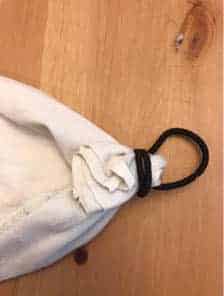
Materials: pillowcase, scissors, four hair ties.
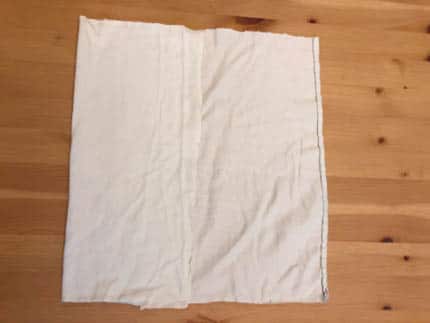
Step One: Cut through each fold and up the center to make four pieces.
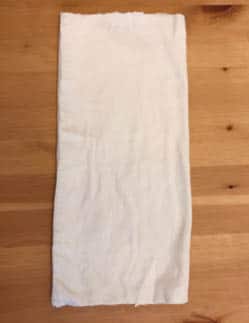
Step Two: Fold the bottom third up and the top third down. If you are using a patterned pillowcase, the pattern should be on the outside.
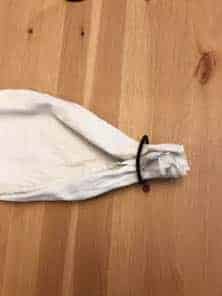
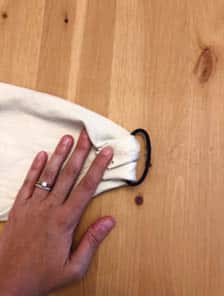
Step Three: Pinch the end and add one hair tie, fold the fabric over it and secure with a second hair tie. Repeat on the other side.
Do this with the three other pieces and you’ll have four masks.
Buying a Mask
Of course, if you aren’t the type of person to DIY, or if you just want a product better than what you could craft, there are many options for purchasing a cloth mask. From locals making masks from their homes to fashion designers adding some flair, there are different avenues you can explore.