by Melissa Howsam | Dec 2, 2024 | Buzz, December 2024/January 2025
With Election Day in hindsight, Raleigh readies for its next chapter.
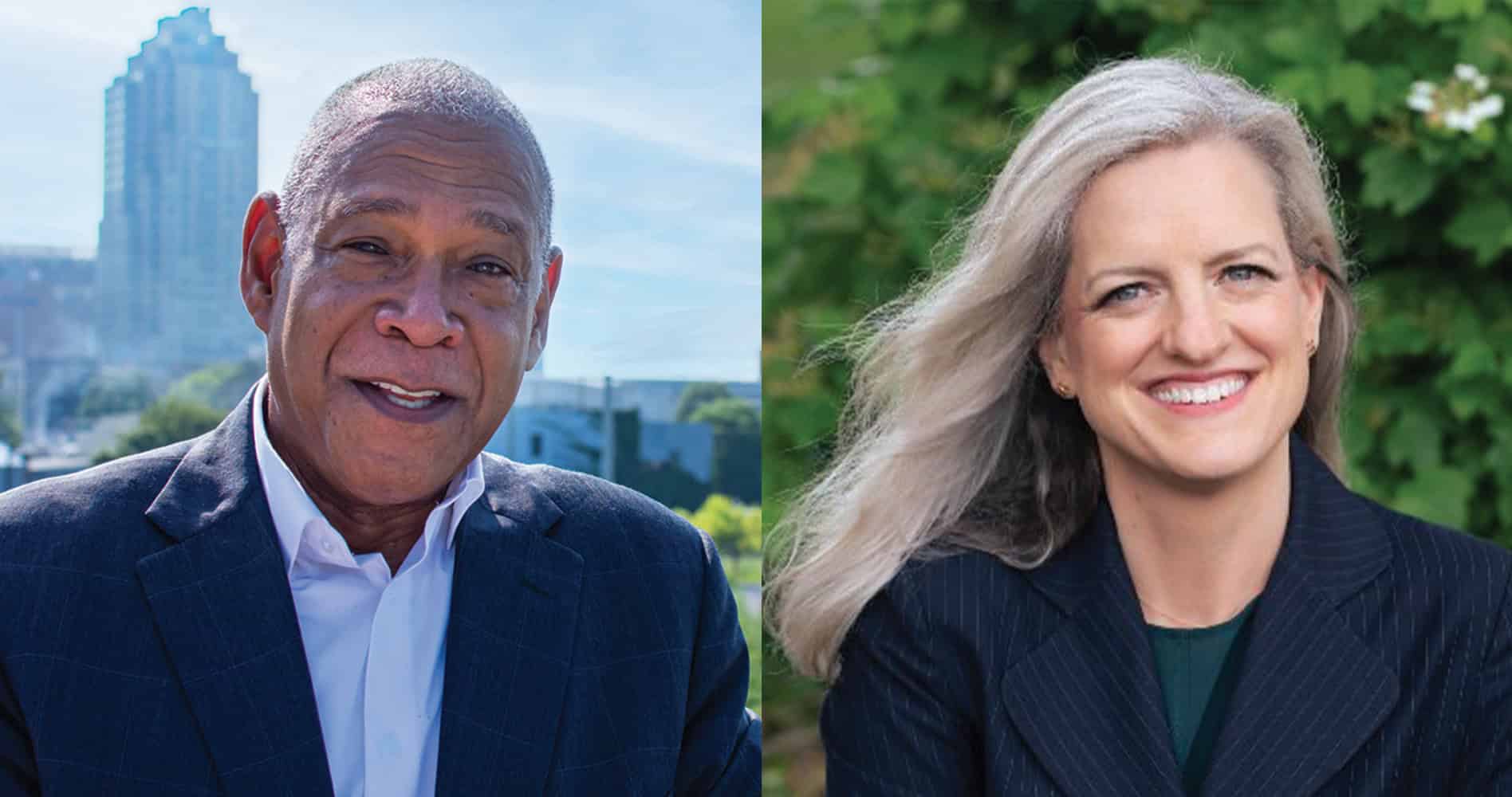
Election Day has—thankfully—come and gone, and Raleigh’s next City Council is slated to be sworn in Dec. 2 at Memorial Auditorium, with six council members returning, alongside the addition of familiar faces: former City Planner Mitchell Silver (District A) and Mayor Janet Cowell, replacing Mary Black and Mary-Ann Baldwin, respectively.
Now the Cap City’s third-consecutive—and fourth-ever, behind Baldwin (2019–2024), Nancy McFarlane (2011–19) and Isabella Cannon (77–79)—female mayor and the first new mayor in five years, former Dix Park Conservancy President and CEO Cowell returns to govern. Having previously served as Raleigh city councilor (2001–05), state senator (2005–09) and state treasurer (2009–16), Cowell comes ready to serve.
“I look forward to working with all of you on the first 100 days, the first year,” said a Cowell on Election Night, after winning in a landslide, adding: “and planning that transition to get really good things done for Raleigh—and make it a city that works for everyone.”
Now, Cowell takes the helm over a city council—save Silver—who has been much maligned during Baldwin’s tenure for its apparent lack of respect and professionalism (e.g. sass and eye rolling at meetings, etc.), as well as issues arising from a voting block by three or four council members. When asked what management style she would employ to both foster collaboration and get stuff done, Cowell is clear she means business.
“Voters made clear in the city election that they want candidates who are respectful of each other, city staff and residents of the city,” the mayor-elect tells Raleigh Mag. “They want candidates who focus on strategic priorities—not personal conflicts. As part of the transition, I will be sitting down with councilors and staff and talking about rules of engagement, how we want to work together, etc. I know and have a good working relationship with city councilors and city staff. I want us to all work together and support each other to accomplish city priorities.”
Cowell cites housing/housing affordability as the biggest issue facing Raleigh and says she plans to address it head on with such early actions as accelerating city affordable housing projects like the old NC DMV site and the renovation of Heritage Park, inventorying city land that might be used for housing, and partnering with the faith community to pursue innovative models of affordable housing.
Beyond providing more housing and affordable housing, Cowell names “giving police and firefighters the resources they need to keep our community safe,” as another priority, as well as “working with Wake County to provide alternative response to those suffering from mental illness and housing the unhoused.”
The campaign is over—and the first 100 days start now. January’s first City Council meeting will serve as a good barometer for where we are headed. “Raleigh is a great place to be,” says Cowell. “As mayor, I will build on past efforts to make it a city of inclusion and belonging, opportunity and empowerment, collaboration and innovation, and nature and green spaces.”
Term Changes
Everybody elected this November is serving a two-year term that will end in December 2026. Mayor, one at-large seat, and Districts A and B will run for four-year terms in 2026. The other at-large seat, and Districts C, D and E will run for two years in 2026 and run again in 2028 for four years, creating staggered four-year terms.

by Melissa Howsam | Nov 30, 2022 | Buzz, December 2022/January 2023
Raleigh’s newly elected city council
A new city council is being sworn in Dec. 5 at Union Station, including four new faces: Mary Black, Megan Patton, Jane Harrison and Christina Jones. Many have described this council as divided—and reelected Mayor Mary-Ann Baldwin as having to govern a council pitted against her. But, for her part, the mayor is optimistic. “People always want to paint negative pictures,” said Baldwin in a conversation with us one week post-election.
“This is the most diverse council in the history of Raleigh—and probably the youngest,” she said. “So I’m thinking, ‘I can’t wait to hear new ideas and these perspectives.’ And we have to respect that and all work together.” During and since the election, the council has been cast by nearly everyone as anti-growth vs. pro-growth. But the mayor doesn’t see it that way. “They actually are not anti-growth. They fall across lines of smart growth, and I think we share common values,” she said, including affordable housing, transit, small business and climate change, to name a few.
In talking to new council members, Baldwin says she thinks there could actually be a lot of unity and consensus within city council, which begins with building relationships and trust, listening to one another, and a willingness to compromise. Bottom line: “The campaign is over,” said Baldwin. “Now we govern. It’s not about activism. It’s about doing what’s best for our community.”
Are CACs the most divisive issue?
A hot-button issue leading up to the election and now anticipated to be one of the most divisive issues facing council are Citizen Advisory Councils (or CACs). If you aren’t familiar, you’re not alone. According to a city survey, more than 90% of residents had never heard of or been to a CAC—meaning this is a “hot-button issue” for a select few. That said, reinstating or revamping these advisory councils was also the central issue fueling some candidates to throw their hat in the ring for city council.
In short, CACs were intended to be nonpartisan advisory boards representing different geographical regions of the city, comprised of nonelected citizens. These councils routinely held meetings as a way of dispersing information and gathering public input. The CACs were disbanded without public input or notice in early 2020, a move for which Mayor Baldwin took much ire in the media. But, she says, her goal was to actually make community engagement more inclusive—not eliminate community engagement altogether. “My feeling is that CACs were exclusive, not inclusive, and we’re looking at ways to make community engagement inclusive.”
For their part, new District E Council Member Christina Jones served as former chairperson of the Raleigh Citizen Advisory Council. And new District D Council Member Jane Harrison reestablished the West Raleigh Community Advocacy Council and has vocally advocated for reestablishing robust community engagement. “Economic development should be community-centered, and city decisions must recognize the voices of the most affected groups, including historically marginalized communities and neighbors adjacent to a development,” Harrison told Raleigh Magazine. “We need forums like CACs and neighborhood associations to convene across the city, sharing information and developing leadership capacity to bring the best ideas forward.”
We asked Baldwin for her take on the return of CACs, and she nodded to the active community engagement board that council has asked to come up with ideas to move things forward. “I would like to see that community engagement board do its work and let us listen to them about what they think is needed,” she said. “And I hope we allow the community engagement board to do its work.”
Hot-Button Issues
4–4
4–4
4–4
- Missing Middle Housing
- Allow duplex, triplex & townhomes next to single-family homes
- Nays: Black, Harrison, Jones, Patton
5–3
- Reinstate Citizen
- Advisory Councils
- Nays: Baldwin, Forte, Melton
2–6
All In Favor
8–0 VOTE



