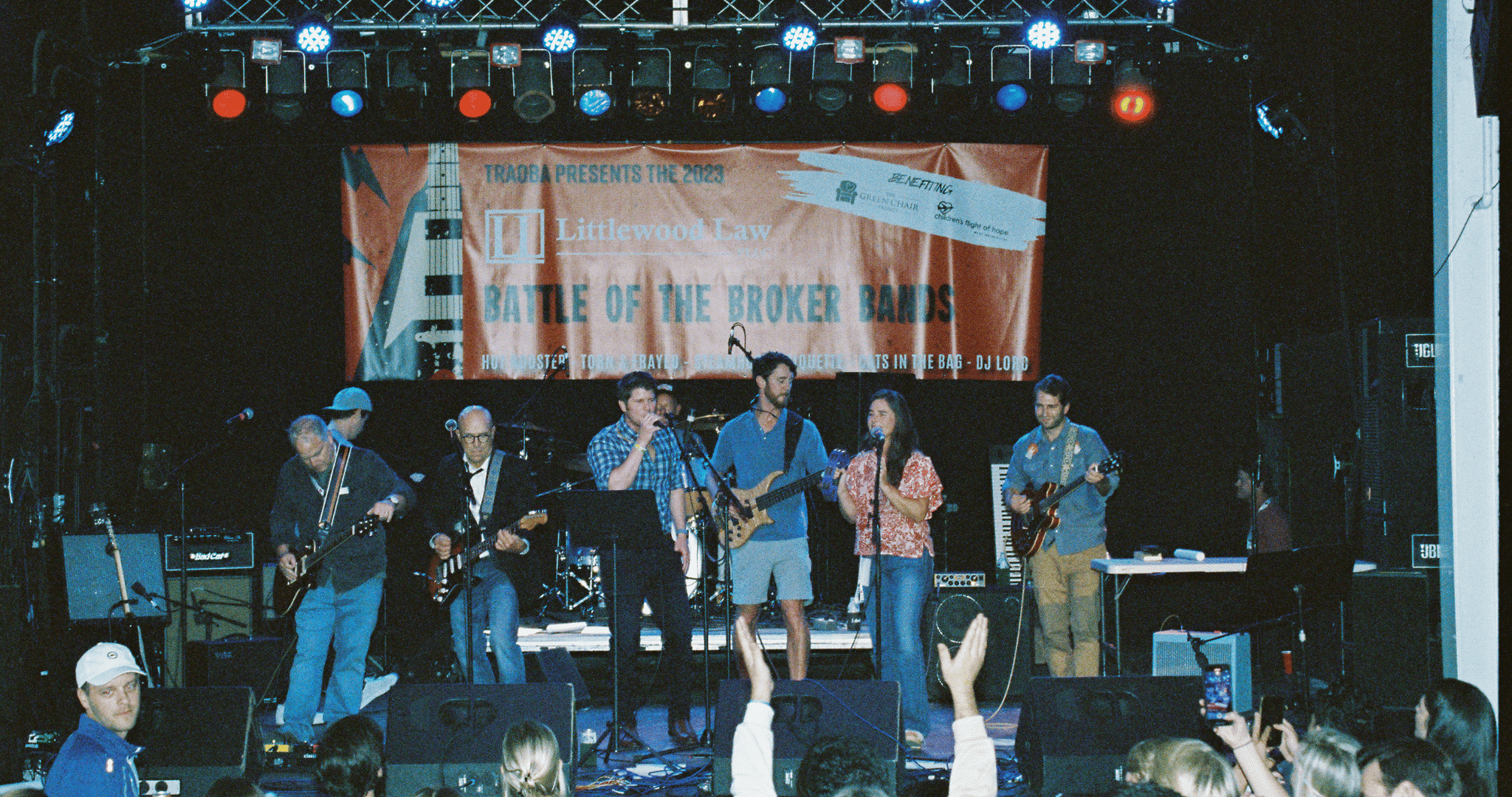
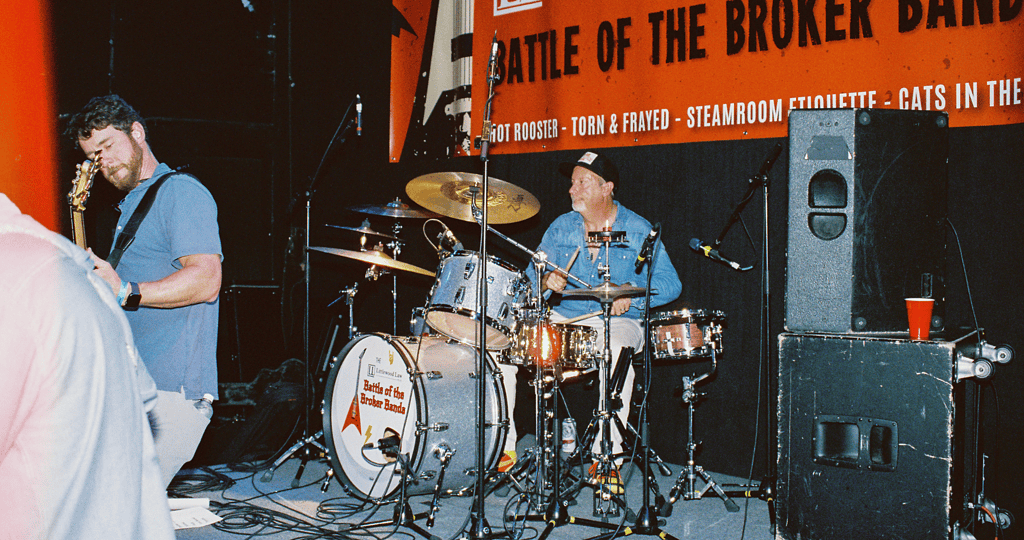
The idea for the annual battle was born in 2015 by Robin Anders of NAI Tri Properties— also of the band LowBröw, which would perform at holiday office parties—and Brian Farmer of Lee & Associates. Together, the duo thought the event would be a great way to “combine our love for live music with our friendships in the commercial real estate industry, and give back to our local community at the same time,” says Anders. “No one else was doing this, and we had no guard rails to go by, but we bet big.”
And, so, the duo hosted the first Battle of the Broker Bands to benefit the Food Bank of NC at now-closed Southland Ballroom—and have been participants in their respective bands and active on the planning committee ever since.
“In the past two years, we’ve raised $66K for four amazing charities with the help of 28 donors, TRAOBA members and the entire brokerage community,” boasts TRAOBA board member Ginny Hager. To boot, the org has raised over $111,000 since the initial event.
At this year’s benevolent battle, APATT’s The Travelin’ Table food truck will be dishing out eats to fuel your rhythm as you cast your vote on the four bands (at least one member of which must be an active broker)—though “the real winner is the charities,” maintains Hager, adding: “It’s just a really good way for industry people that all work for different companies to come together for the greater good.” Rock on! traoba.org; lincolntheatre.com
“Battle of the Broker Bands is my absolute favorite networking event of the year. From performing with a band in 2019 to serving on the board from 2023 to 2024, this event has been instrumental in building valuable professional and personal relationships, all while having a ton of fun!” —Ginny Hager, TRAOBA board member
Local nonprofit sets a new benchmark for unhoused people—and other cities are taking notice.
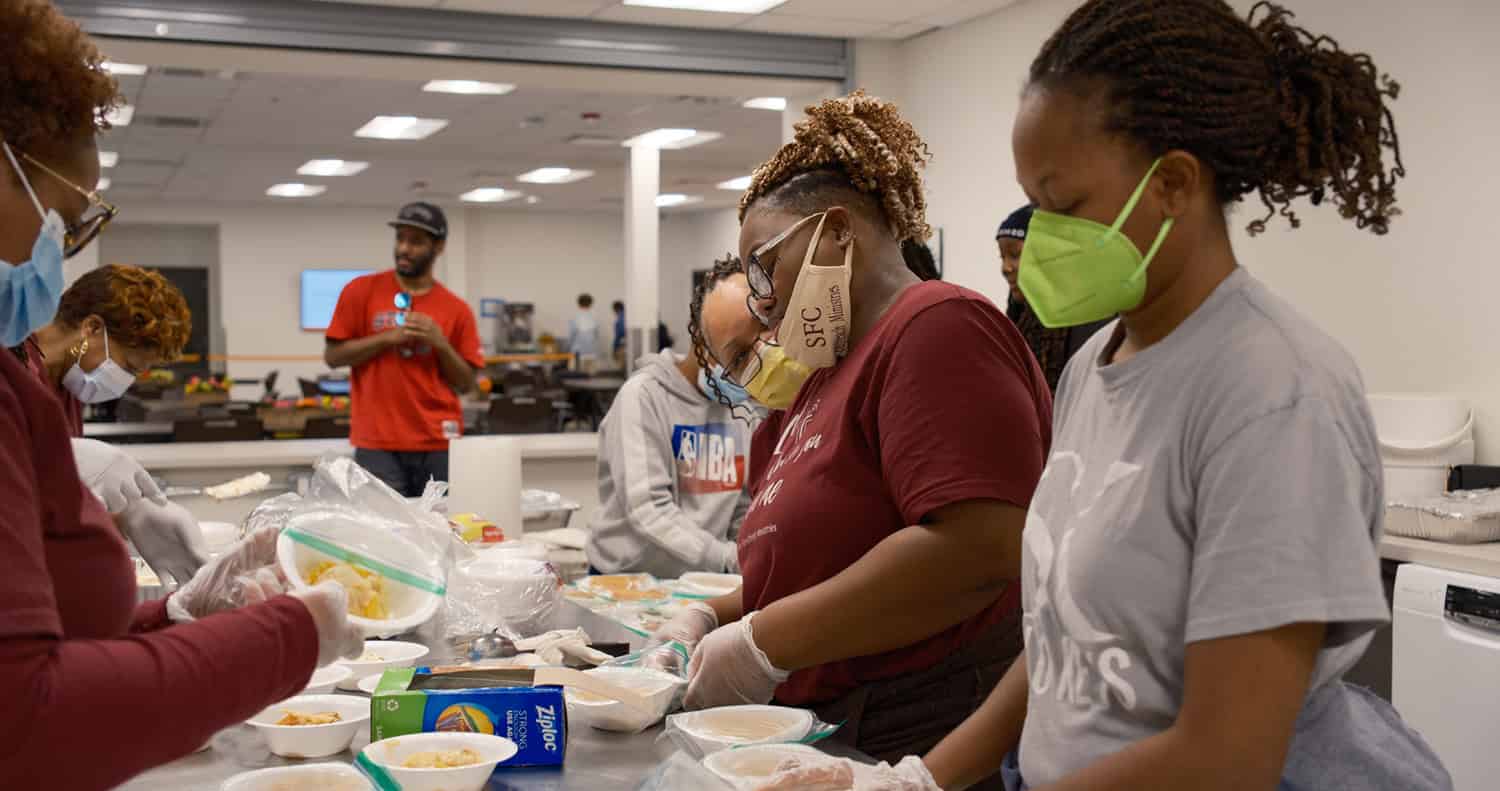
Oak City Cares has a firm vision that no person should experience homelessness alone. And the organization has gone above and beyond to make that a reality, establishing a one-stop shop for individuals to build trusting relationships and connections to coordinated services necessary to reestablish a home.
Yet, while Oak City Cares has garnered attention across the country for this innovative model, the nonprofit hub is so much more than just a service center. For the guests who come through its doors, Oak City Cares is family.
The local org’s emphasis on collaboration—combined with a heart for what Executive Director Kathy Johnson calls “radical hospitality”—is its secret sauce. Beyond providing meals daily and covering basic needs, Oak City Cares boasts an always-evolving care coordination program incorporating 25+ partner providers in the community. Read: Instead of having to trek all over town, individuals can have all their needs—from primary health care and mental health services to veterans’ services, food stamps, employment training and more—addressed “effectively and efficiently in one location,” she explains.
“Maybe people don’t need all of those things; maybe they just need some,” continues Johnson, “I think what is so subtle—but is the most important thing we do—is connecting [people] to the right service in the right order.” She adds that for a population who can often be given the run-around and easily loses trust, this is “life-changing.”
Today, as everyone grapples with the ripple effects of inflation, Oak City Cares is experiencing a staggering level of growth due to an increasing demand for its services, and is expected to quadruple its numbers of people served from 1,500 in 2021–22 to 6,000 by the end of 2024.
Despite the challenges of these rising numbers, Johnson is confident her team, alongside Oak City Cares’ ever-growing list of community partners, can continue to meet the needs of their guests—“an amazing group of people who touch my heart every single day,” she shares. And not only will they meet the needs, but they will meet them in a way “that is still consistent with who we are,” says Johnson. “We will continue to know people by name and know their stories and become even a surrogate family. It will just be a much larger family now.”
To wit, Oak City Cares is leading the charge nationwide. Already, the org has been contacted by cities across the state—as well as Florida and even Alaska—that were inspired to rethink the way individuals experiencing homelessness are cared for.
“We are eager to figure out how we can collaborate and share funding to do things and do it better. That lends us to be a model for others. Everyone comes together here to serve our neighbors, which is just awesome. … I love that we get to be the convener of that.”
Cooper Charitable Foundation is now providing housing stability grants to Raleighites in need.
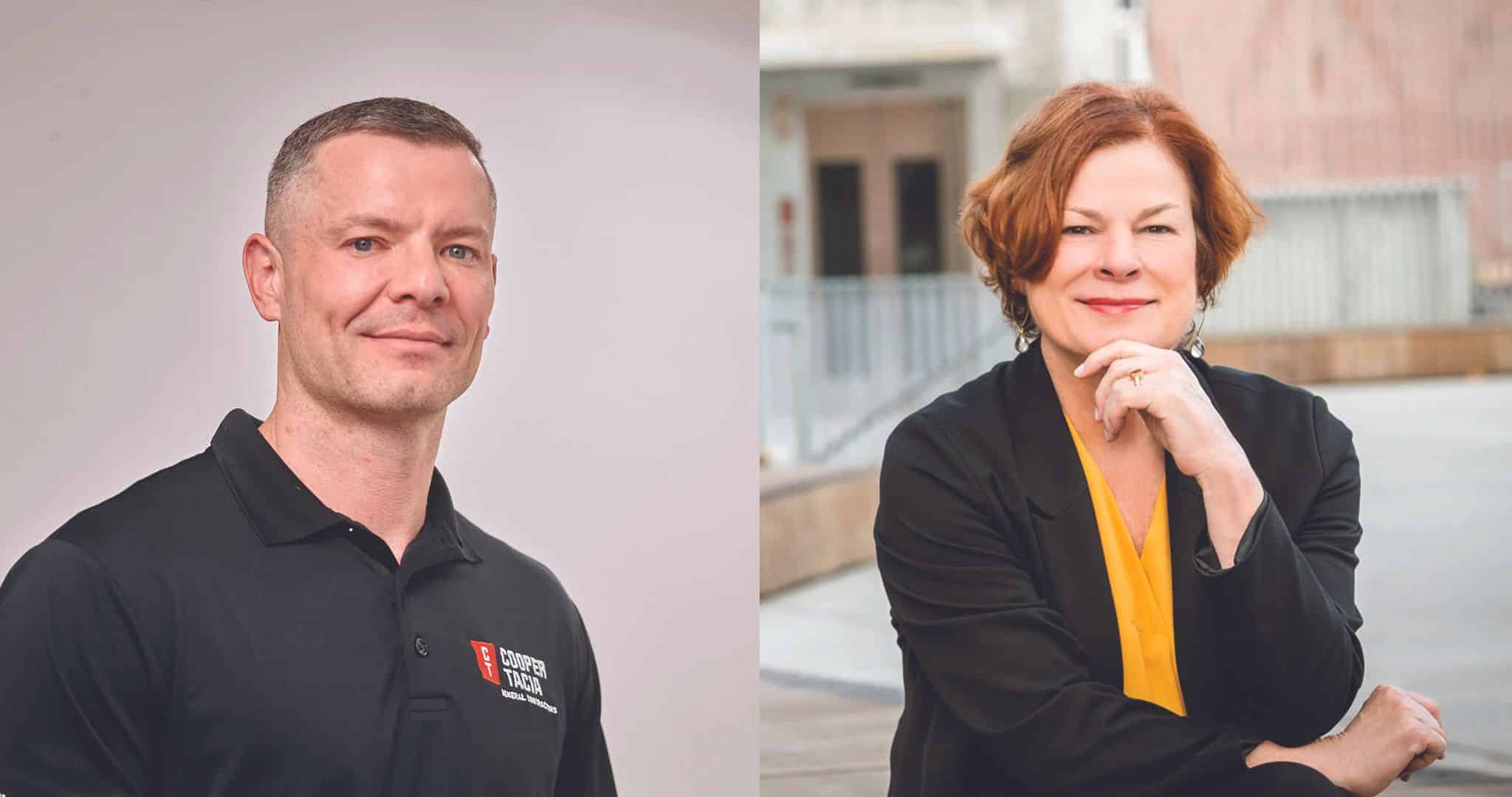
“There is housing around us. It’s just not always affordable.” So says John Cooper, founder of the Cooper Charitable Foundation, a recently debuted nonprofit with a mission to provide support to locals who need help to secure housing or remain in their homes via housing stability grants.
The foundation’s operations will be overseen by longtime affordable housing advocate Mayor Mary-Ann Baldwin, who is positioned to further her passion for positive change via her recently instated role as executive director. “This spoke to me because of the mission,” shares Baldwin. “I’ve been working on affordable housing, housing choice and providing more housing—that’s been my top priority since I’ve served on the city council and as mayor—so this seemed to be a natural progression. And I have to say, I’m really excited.”
The grants—poised to provide more immediate housing assistance—will operate as a means of bridging the gap for those working to meet their expenses but unable to keep up. Essentially, if someone can afford a rent payment of $600 per month and applicable housing options cost $900, the housing stability grant provides that $300 difference. Note: The grants run between one to six months, with each amount given dependent on the situation at hand.
Cooper, also the president of Cooper Tacia General Contracting, has a personal stake in the cause that led to the founding of this benevolent endeavor. Growing up, his mother worked multiple jobs and struggled to get by while experiencing domestic violence, and his grandmother lived on a meager fixed income. And, so, when his grandmother passed, Cooper sought a way to memorialize her, landing on the cause for housing assistance due to the steadiness she offered him during his youth.
“She provided a lot of stability for me in a childhood that was often chaotic,” he recalls. “That was the foundation of me going to college, starting a company and pretty much every achievement I’ve ever had.”
Truly paying kindness forward, Cooper is now funneling a personal contribution to the cause by making the first $100,000 donation—plus covering all overhead expenses—with the foundation’s first public fundraising event slated to take place June 12 at Mulino.
What’s more, the Cooper Charitable Foundation is teaming up with a trio of local nonprofit organizations: Wake Tech’s Fostering Bright Futures program, Oak City Cares and Healing Transitions to assist with verifying circumstances, identifying locals in need and connecting them in a process positioned to fulfill grant requests fast.
“These organizations are working with the people needing the grants—and they know them,” says Cooper. Adds Baldwin: “We are looking to get this streamlined and simple [in partnership with] organizations that do this all the time.”
Fueled by the mission to spark positive generational change in families, Cooper’s inspiration stems from a desire to show those in need there are people out there who care. “To put your hand out and tell someone, ‘You matter’—that’s a lot of encouragement to folks.” Clearly, caring about your community carries power indeed.
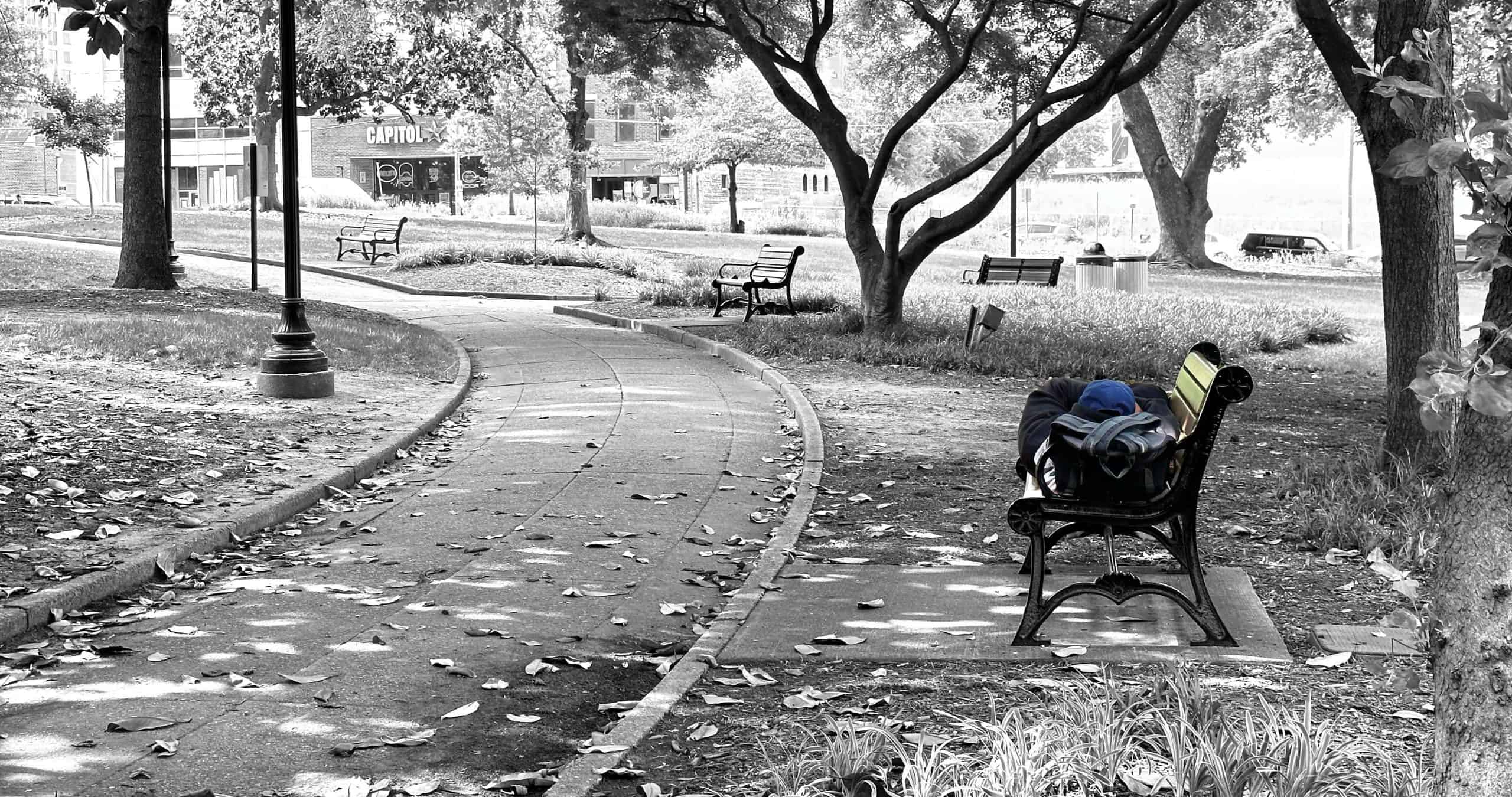
Raleigh’s homeless numbers are on the rise. Four Raleighites share their personal stories into what homelessness is like—and what we as a city need to do about it.
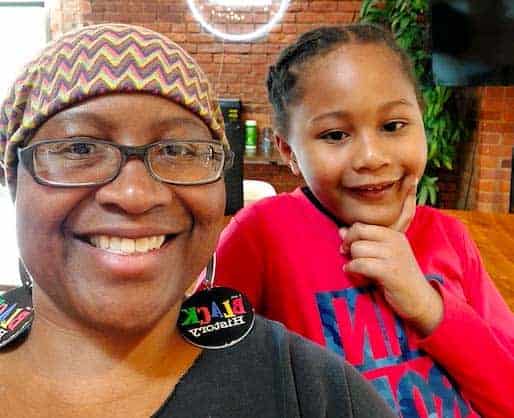
“We need to see the humanity of every person as a person,” says local Kara Sanders, a single mom who is currently living in her car with her 7-year-old son, Wisdom. “We need to see their brilliance beyond their bank account.”
A walk Downtown quickly reveals that homelessness is more abundant—and visible—than ever before. It’s pervasive, affecting vast ages, races and backgrounds. And while our community boasts a host of local organizations and resources for people who are homeless and/or food-insecure—A Place at the Table (APATT), Housing Options for Students Today (HOST), Raleigh Rescue Mission and ACORNS, to name just a few—the problem continues to escalate.
These organizations have seen alarming increases in the number of those seeking help. Oak City Cares, for example—a multiservices center that connects Raleigh’s homeless population and those at risk of homelessness to services that put people on a pathway to safe and stable housing—cites a shift from ~900 individuals seeking assistance in 2019 to 1,500 in 2022, and more than 2,220 in the first nine months of this fiscal year.
And according to Raleigh Rescue Mission, homeless rates in Raleigh and Wake County are rising by 8% each year. A shocking ~6,000 youth in Wake County schools are homeless, while almost 100,000 local people experiencing poverty walk the fine line between housing insecurity and losing their homes altogether—and just one minute financial hiccup could teeter to homelessness.
APATT founder and Executive Director Maggie Kane has witnessed Raleigh’s rising homeless rates firsthand at her pay-what-you-can cafe. Pre-pandemic, 50 to 60 people might come in on any given day in need of a meal, she says, whereas, now, those numbers have skyrocketed to 100 to 150.
Meanwhile, we’re inundated on the daily with how extraordinary our city is—decorated with an array of accolades and approval ratings ranging from entrepreneurship to wellness to point-blank the best place to live. But these shiny achievements don’t tell the full story for everyone who calls Raleigh home. In fact, when it comes to economic mobility, Raleigh tops the list as one of the worst—meaning, in Wake County, if you’re born poor you’re more likely to stay poor.
Homelessness is an epidemic—and it impacts Raleigh’s future growth and vitality. “Our city has gone beyond burgeoning. It is now bursting at the seams,” says Rev. Frank White, pastor of Antioch Bible Fellowship and a member of the Raleigh Area Land Trust board of directors, who spoke on the issue at Raleigh’s first meeting of its joint homelessness committee in May. That population boom met with rising rental rates and stagnant minimum wage are key components contributing to homelessness.
Amid massive efforts to revitalize Downtown Raleigh—from the Fayetteville Street revamp to new business and apartment complex openings—the homelessness epidemic needs to be addressed, both for the housing insecure and for the residents who frequent our city streets. And while we can all point fingers to myriad contributing factors affecting the homeless hike—both in and beyond our control—pointing fingers doesn’t solve the problem.
This crisis is heavily affecting all Raleigh residents—and it could happen to any of us. It could happen to you. Who are the people affected? How did they get here? What are their stories? And if we are to say we love our city, it leaves us with this: How will we put our heads and hearts together to fix Raleigh’s homeless hike?
Kara Sanders Homeless since 2020
Kara Sanders, aka “Momma Kai,” came to Raleigh from Connecticut a little over three years ago with her 7-year-old son, Wisdom. They initially came to NC looking for paternal support—and when that support wasn’t there, Sanders chose to be unhoused to keep both herself and her son safe due to threats from his father.
Throughout that time, she and Wisdom have bounced around from her car and other people’s homes to hotels and even their storage unit. Sanders is on the board of Wake County and the City of Raleigh’s recently launched joint homeless effort—and she brings a positive outlook about her situation by staying involved in civic engagement.
Sanders prioritizes both her own and her son’s well-being—bringing him to storytime at the local library and taking him to play at parks most mornings (they’ve been to over 40). The two have a place to go for a shower and to store their food while they’re living out of their car.
As she considers her future, Sanders is in the early stages of opening a business called L.U.V. Enterprise—aka “learn your value.” The motto “building the village, raising the child” briefly encapsulates how they’ll accomplish their committed, compassionate and crazy mission to eliminate homelessness, poverty and the next generation of prisoners. “The work you do now can change the course of your life,” she says.
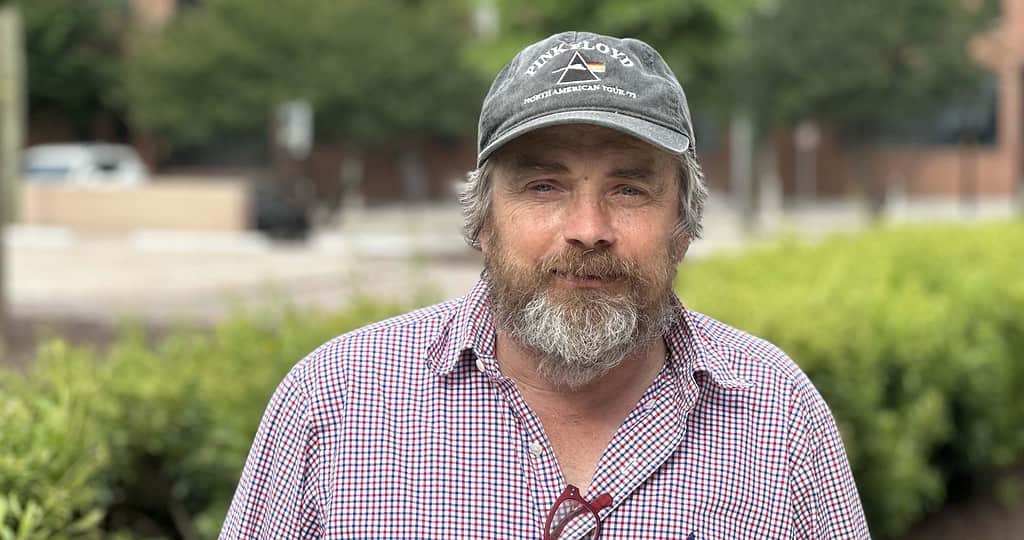
Nate Blackmon Homeless since 2018
“You’re worthless on the street. You have no money and no way to defend yourself,” says Nate Blackmon, who has been on the streets for the past five years. After his dad was diagnosed with stage 4 cancer, Nate Blackmon used his savings to pay for the family car lot business. When his dad passed, Blackmon’s mom and brother sold most of the cars in their name—depleting them from 98 to 17 cars—resulting in the loss of his home and a fallout with his family shortly thereafter.
Now, Blackmon hasn’t spoken to a member of his family in over two years. Almost every morning, he comes to A Place at the Table to volunteer for his breakfast, sometimes heading to City Market to read or use a microwave before pitching his tent for the night. He used to pitch it near Healing Transitions (“They have a dry place to sleep—it’s not very fancy, but they feed you,” he says); but, since being robbed at least nine times, he has now moved his tent into the woods. Twice a week, you might also find him at Pullen Memorial Baptist Church for a hot meal and clothing.
During his five years on the street, Blackmon has dealt with myriad mental health and drug issues and experienced the “every man for themselves” mentality from other members of the city’s homeless community. “I’ve let some of them into my tent and they thank me by stealing from me,” he says. “The community can be very violent and switch up on you—there was a time I thought I was crazy. … But I’m not crazy, I’m just in a bad situation.”
When he considers his future, Blackmon has plans to take hold of his situation for the better. He dreams of going back to school and using his background knowledge in coding to do cybersecurity, and getting a state license to sell used automobiles, make money and work to help break the homeless cycle.
“If I make money, I’m going to get a place to stay and be a different person than I was when I had money,” he says. “When I had money and I had a problem, money solved my problem. Now I have no money and a problem—so I have to use my intellect to solve it.”
He adds: “I’ve got maybe 10 years of viable life left. I don’t want to be an old man on the streets. I want to be a contributing member of society.”
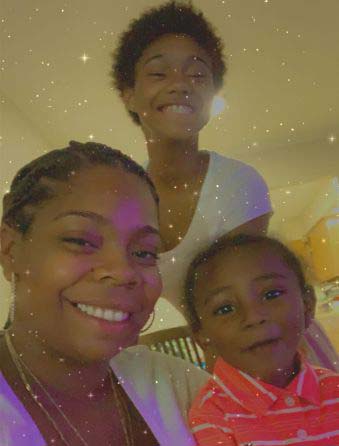
Regina Harper Homeless since October
“There are times when I just stay in my car because I’m sad,” says Regina Harper, mother of two. “I don’t want to be in the situation I’m in—and it’s never anything I wanted for my children.”
Harper, her 15-year-old daughter and her 5-year-old son have been living in a hotel room since being evicted from their apartment in October. When the pandemic initially hit, she was furloughed from her job as a store manager with Jos. A. Bank and didn’t receive an unemployment check until about a week before she returned back to work in June 2020. By August, the store managers were getting laid off or offered positions at lower pay.
“I wasn’t able to maintain my household,” she says. “I was able to use the House Wake! Program in partnership with the Telamon program. They helped tremendously to keep us in our apartment… but when the apartment agency no longer accepted the rental assistance and said it had to come from me—that’s when I couldn’t hold it afloat anymore.”
Harper currently works as a prep cook at Paragon Fenton in Cary and does valet trash at night. Maintaining two jobs while parenting and dealing with the stress of her family’s situation takes its toll. And with work, plus the responsibilities of motherhood—making sure her kids have transportation, finish their homework, have clean laundry, etc.—she doesn’t get to spend much quality time with her children.
“My daughter suffers from living in a hotel room every day,” says Harper. “There’s things going on out there, people overdosing—and we can’t afford to get a decent hotel room. One day we came outside and there were needles on the ground. … Not too long ago, my 5-year-old asked when we were going back to our old house, and it’s like, ‘We don’t have a home, baby… this is where we live.’”
Harper’s philosophy is to take each day one at a time—with the hope that tomorrow will be better than yesterday. And when she considers the homeless situation as a whole in Raleigh, adding more affordable housing options (plus making housing more accessible) and raising the minimum wage are two ways to start. “If you’re by yourself you can’t live on that,” she says of North Carolina’s minimum wage. “God forbid you have one or two children.”
Adds Harper: “I don’t want to say the pressure is unbearable, but it is. And I don’t have any option but to deal with it because I have two kids who are looking up to me. … My hope is for Raleigh to recognize that there’s an issue with homelessness. Even the shelters are backed up—we were told it would be three months before we would get a call back. I didn’t realize how much time that was until I had that much time. I don’t have three months to get my kids somewhere to live.”
Vision6 Productions
Roger Kornegay Homeless for 9 Months
Roger Kornegay—who now co-runs creator page Raleigh FoodTrap—experienced homelessness in high school. During his sophomore year, he came home to an orange notice on the door saying he didn’t have the right to enter, thus beginning a ~nine-month stint jumping from hotel to hotel with his parents and two siblings.
Kornegay was raised by parents who both worked full-time jobs. His family made the move from Goldsboro to Raleigh around 2000, and with their move came the purchase of a new home. But after his mom had to discontinue working as a result of illness, his dad was left to carry the weight of supporting the family on a single income.
“We lasted about a year before we started falling behind on home payments and the mortgage,” recalls Kornegay. After losing their home, his parents took the savings they had and put the family up in a hotel room—and each paycheck his dad received went right back to paying for that room.
At first, hotel-hopping was exciting for Kornegay and his siblings—but after a few months of staying at almost nine different hotels, the novelty wore off and the reality of the constant shuffle (a manager once kicked them out for eating too much food) and lack of privacy soon became draining. As a high school student living in a hotel room with limited belongings, Kornegay often found himself wearing the same outfits to school.
“When you’re in high school, that’s a big deal,” he says. “Kids notice you wore that shirt yesterday… and I only had two pairs of shoes. But the only way you’d know we were homeless was if you followed us to the hotel after school.”
To help get them back on their feet, White Memorial Presbyterian Church’s StepUp Ministry sponsored the family via a townhome in Downtown Raleigh that required very low rent. Today, Kornegay’s experience has shifted the way he works and lives.
“Because I’ve been through it and have my own family now—a 2-year-old and a baby—my grind is different than others,” the Raleigh FoodTrap creator shares. “I don’t want my kids to know what it’s like to wear the same outfits or live in a hotel.”
A PATH TO HOPE
Wake County and the City of Raleigh hosted the first meeting of the joint homelessness committee in May, aimed toward providing help for those experiencing homelessness in our community. The task force is armed with representatives from Raleigh City Council, City of Raleigh, Wake County Public School System, Raleigh Police Department, Oak City Cares and Healing Transitions, among others. The timely meeting acknowledged the long road ahead of us—and the groundwork that needs to be laid—to begin the process of solving Raleigh’s homeless problem.
Ignoring the issue only exacerbates it, and so we must acknowledge—and act on—the less enticing aspects of growth. The committee acknowledged it’s not a problem that exists in a vacuum—a look across the nation finds relative cities facing similar spikes in homelessness due to such issues as rising housing costs. Cities like Denver serve as a cautionary tale to determine what we want to emulate and what to avoid.
“The system is broken, and there are a lot of people trying to access services across the board,” says Raleigh Council Member Stormie Forte, co-chair of the joint homeless effort. “Being in this space and collaborating with people coming from different experiences is very important and critical. … I’m excited about the work we’re going to be doing.”
HOMELESS COLLEGE STUDENTS
For its part, HOST—the first program of its kind in the U.S.—was launched last year by NC State to bolster housing security by connecting students with a “host” family. According to HOST advisory board chair Mary Haskett, a 9.6% chunk of the student population experienced homelessness in 2017, and increased to 15% in 2020. “Given stagnant wages combined with increases in tuition fees and the cost of rent in Raleigh,” she says, “I would take a professional guess that we would see increases based on those factors.”
Folasewa Olatunde, an international graduate student at NC State, experienced transitional home insecurity during a six-week span of college. Not knowing where to go, she planned on sleeping in the library before finding a spare room where she could stay until flying home.
“I was overly concerned about where I was going to stay,” she recalls. “And it’ll impact your concentration in classes and your mental health.” Now, Olatunde works with the HOST program to help other students struggling with home insecurity. “I think in the last four to five years housing costs have gone up and income has not kept up,” she says. “I don’t know anyone whose income has kept up… and the cost of groceries and everything else has increased.”
When she considers what could be done to improve the situation, Olatunde points to the university providing transitional housing options for international and domestic students alike, and increasing stipends and pay for student employees.
HOMELESS KIDS
“We had a waitlist of about 125 families—each of those averaging around three kids per family—awaiting services that are critical to their well-being, not only now but later in their lives,” says Joy Guha, program coordinator at Passage Home Inc., an organization that exists to help break the cycle of poverty. “This is largely invisible. The common misconception is that there is no childhood homelessness, but it’s there. It’s just less visible than someone walking up to your car and asking for money.”
Guha works with a program called REACH (resilience, empowerment and access for children in homelessness), and she emphasizes the lasting impact that homelessness and home insecurity can have on kids that will impact them for years to come.
“Working with kids is an added layer,” she says. “There’s the turbulence of being homeless—lots of our families are in hotels and motels and move around pretty frequently based on hotel rates. In addition to food insecurity, that can be a trauma to young brains… and it’s a really large, complex problem to be working on.”
HOW TO HELP
Per A Place at the Table’s Maggie Kane, here are a few small places to start.
Talk to folks. Look people in the eyes and treat them as human.
Financially support organizations working with folks experiencing homelessness like Oak City Cares, Healing Transitions, etc.
Again… say hello. Treat them as human.
Buy Place cards from APATT so folks can get a meal.
Buy McDonald’s gift cards so folks can get a hot coffee or a quick meal and have a place to be for a bit.
Raleigh rolls out a slew of events to celebrate National Bike Month.
Wheels up! It’s National Bike Month, and Raleigh is kicking it into gear with a slew of happenings around town.
Sponsored and promoted by the League of American Bicyclists, National Bike Month, est. 1956, has been celebrated in communities countrywide ever since—with the City of Raleigh pedaling onboard for the past 15 years. Beyond getting to the cycology of the wheeliefab benefits worth taking a brake for, citywide monthlong events also tout the transportation triumphs of rolling around on two tires.
As a fast-growing community, Raleigh is experiencing more transportation issues than ever, so “it’s important for the City to promote Bike Month because biking and bike commuting are important for the long-term health and sustainability of our community,” says Andrea Epstein, senior communications liaison for the City of Raleigh’s Transportation Department. “The more people that start biking over driving, the better quality of life we create for everyone. By being a fervent supporter of Bike Month, the City proudly stands behind this vision, as well as providing cyclists of all levels and experience the information, tools and encouragement they need to be better cyclists, commuters and champions of cycling.”
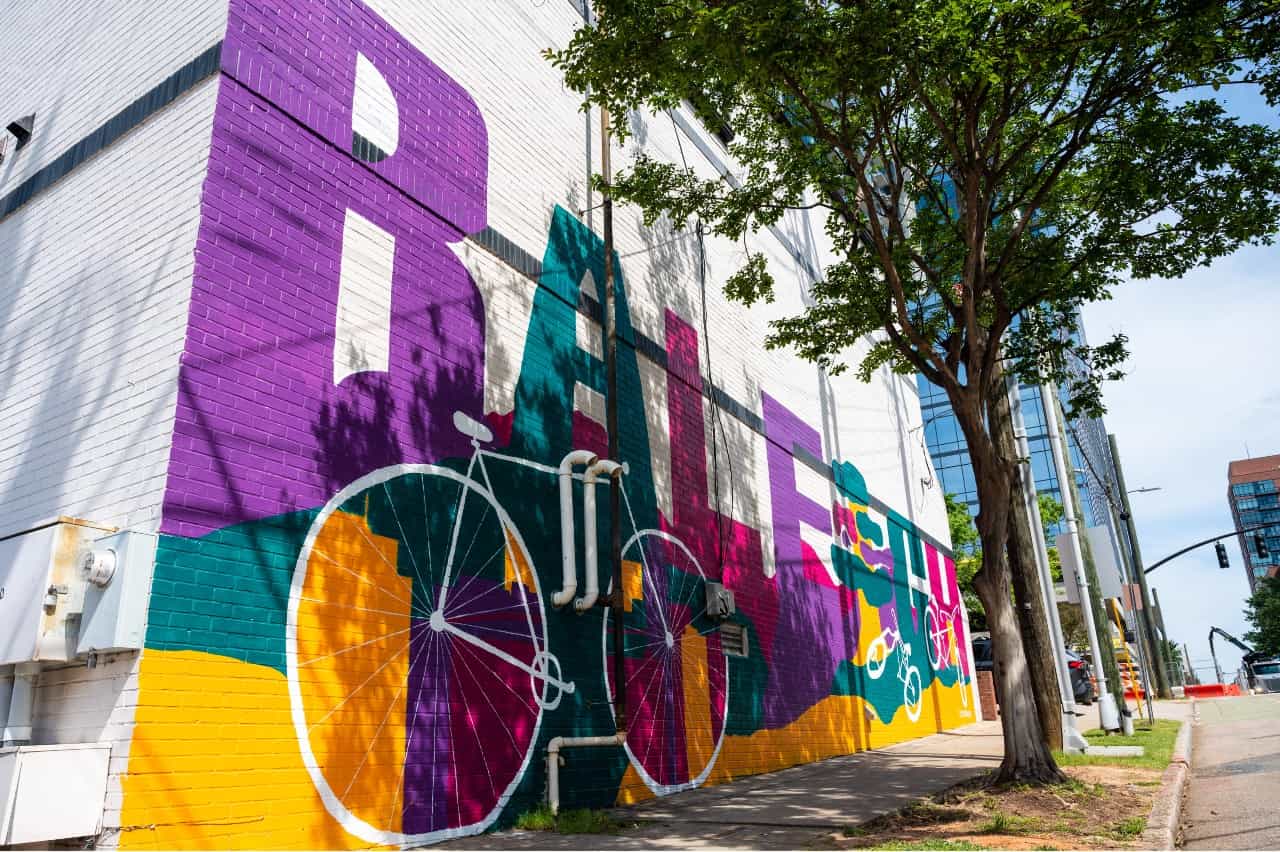
In a nod to those efforts, this year, the city rolled out its largest bike mural yet—parked at Exploris Middle School—by local artivist Mayanthi Jayawardena, who installed the mural during April as “an inspiring and prominent welcome to cyclists entering downtown Raleigh,” says Epstein.
“The City’s participation grows every year,” adds Epstein, “and we offer as much support as possible to our community partners as they are producing events. We also look every year at developing new programs and activities to support our growing bike community.”
So, in support of National Bike Month, here are some off-the-chain ways to rack up some miles and #bikethere on National Ride A Bike Day May 7, or make the most of those two wheels at any of these local events all monthlong.
Ditch four wheels for two! Oaks and Spokes, in partnership with Safe Routes to School Wake County, is offering free planning services to Raleigh schools to participate in National Walk, Bike & Roll to School Day May 3 (or any other day in May). The event inspires kids and families to take an active route to school, and Wake County Schools that register early can get free prize kits.
As part of DRA’s First Friday, Raleigh Union Station Plaza will be hosting a Bike Bonanza feat. beats, popsicles from Raleigh Popsicle Co., a photo booth, plus plenty o’ other vendors worth rolling out for. To boot, AAA of the Carolinas will be handing out free bike helmets (!); Raleigh Riders will demonstrate tandem bike riding and recruit volunteers for greenway rides; Raleigh Bike Polo will demonstrate and educate visitors on the sport; and Oaks and Spokes will host a bike decoration station and free bike servicing. 4–7pm, 510 W. Martin St.
You can never be two-tired for this kid-friendly event hosted by the Marbles Kids Museum in partnership with Raleigh Police District’s Southeast District Community squad and Oaks and Spokes. The Bike Rodeo teaches young riders and would-be riders about bike safety while practicing their riding skills vai obstacle course, plus other activities including a Bike Bling Make Shop, bike swap, helmet fittings and maintenance checks. 9:30am–noon, 201 E. Hargett St.
The best way to see all of Raleigh’s stunning murals is by bike, natch. Ride along with Oaks & Spokes to see the city’s finest street art, beginning and ending at the “It Starts Here!”mural in Dix Park. Post-ride, stick around for a showing of fam-friendly flick Inside Out. 6pm, 801 Biggs Drive
Just brew it and head to the Exchange Plaza for a morning treat and coupon for a free cuppa joe from Left Hook Coffee—NTM a complimentary bike tuneup for all DTR employees. 10am–noon, 219 Fayetteville St.
Slow your roll via this casual fam-friendly ride with Oak City Cycling—a special Bike Month edition of its Third Thursday cruiser ride. 7pm, 707 N. Person St.
Switch up your commute by biking to and from work—with pit stops along the way upping the fun factor. En route, make a pit stop at Oak City Cycling for coffee and mini scones from Yellow Dog Bread Co.—and grab a minor bike adjustment if needed—or swing by Crank Arm after work for happy hour brews. Other pit stops include the Raleigh Municipal Building, Raleigh Union Station and Toole Design Group. Cheers to a more sustainable commute!
We’re all for sustainability in numbers. This tour takes riders through DTR’s most sustainable spots, from Moore Square Park to Raleigh Union Station to 301 Hillsborough (which features a beehive and bike room). Post-ride, the City of Raleigh Sustainability Team will provide an overview of its Community Climate Action Plan along with complimentary bevs. 4–6pm, 201 S. Blount St.
Motley crew meets motley hues with Oaks and Spokes and Crank Arm Brewing’s brightest bike ride of the year! Deck out your bike, helmet and clothes with lights and cruise around town before parking it at Crank Arm to enjoy some suds, natch. Bonus: 10% of beer sales will be donated to Oaks and Spokes. Stay flashy! 7pm, 319 W. Davie St.
More of the trail-riding type? Book it to Forest Ridge Park throughout May for a series of events: Celebrate International Women’s Mountain Biking Day May 6 with a guided mountain bike ride specifically for female riders; bring your kiddos May 13 for a Balance Bike Obstacle Course; go on an intro to mountain biking group ride May 20; or learn how to change flat tires, adjust gears and brakes, and perform general maintenance on bikes via the bike maintenance clinic also May 20.
The bike fun doesn’t have to end with the turn of the calendar page. Stay tuned in as Oaks and Spokes and So & So Books pulls up the kickstand on their inaugural book club, focusing on the cycling book Just Ride by Grant Petersen which hopes to inspire riders to focus on the simple joys of cycling. 719 N. Person St.