by Jane Porter | Jul 16, 2018 | Eat, July 2018 / August 2018
A squiggly line of green acrylic paint is a chili pepper in “Chiles en Nogada.” Sand is a hamburger bun in “Royale Burger au Poivre Ailoi et Gruyere.” Blue and white seashells rise up from a canvas soup in “Zuppa Di Pesce,” nestled among more sand and paint, graphite and coffee beans.
In a series of paintings currently on display at The Block Gallery, Raleigh-based artist Georges Le Chevallier takes inspiration—and materials—from the culinary world to deconstruct and reimagine some well-loved dishes from nine of Raleigh’s top chefs. It’s an exhibit born of an existential dilemma Le Chevallier experienced around five years ago, as well as a tribute to the deep and diverse talents comprising Raleigh’s food scene.
Burnt out by the frenetic pace of life in an overly connected world, and the pressure to be in constant communication with others via technology, Le Chevallier stopped looking at art and, for a spell, even stopped painting. Instead, he contemplated shibui, a Japanese term that refers to a simple, understated sense of aesthetic beauty. At the same time, Le Chevallier, a former employee of the fine dining industry, rediscovered a love for food.

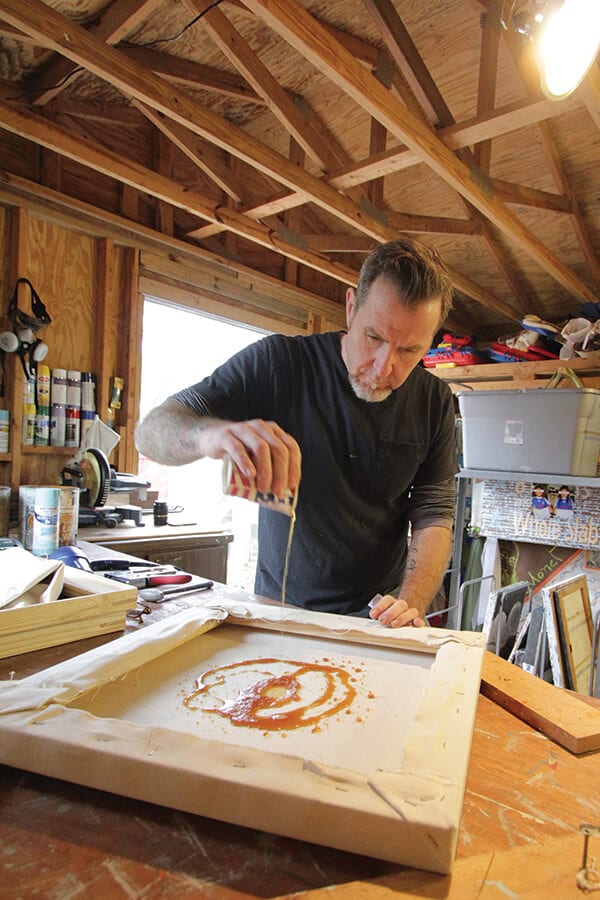
Georges Le Chevallier creating in the studio.
“I started reading about food, watching documentaries about food, and I’d see a lot of similarities in painting and food,” Le Chevallier says. “Shibui is a way of deconstructing, taking out what’s not essential. This led to me painting these minimalist, more simple paintings.”
With this new series, Le Chevallier explains, he wanted to capture chefs’ personal connections to the food they make for others to enjoy.
For “Jamaican Curry Goat,” for instance, Le Chevallier approached Oro’s executive chef Chris Hylton, who told a story of making the dish in his home country of Jamaica for the first time, hoping to impress his grandmother. Hylton recalled his grandmother tasting the curry and telling him how much she enjoyed it. And, for “Dahi Puri,” Garland Chef Cheetie Kumar talked about eating the chaat snack with her family growing up in India, but only on special occasions—they bought the dish from street vendors, and her parents worried about whether the food had been safely prepared.
“These chefs are human beings and they are inspired by food and, yet, we don’t usually talk about what inspires them,” Le Chevallier observes. “We always talk about their backgrounds, restaurants, work, but we don’t go into the essential. I wanted to touch something more personal.”
The nine paintings are unique in that, in an artistic turn on the tradition of molecular gastronomy, they incorporate ingredients from the individual dishes that inspired them. “Rice Congee” uses rice and green tea; “Salade Frisee aux Lardon avec un Oeuf Dur” uses olive oil and grapefruit juice and “Chilled Espresso with Ginger Beer and Rosemary-Grapefruit Bitters” uses coffee beans and raspberries.

“Royale Burger au Poivre Ailoi et Gruyere”
“Olive oil was not too great as a stain,” Le Chevallier says. “But the green tea was amazing, I loved the green tea. It made this beautiful green.”
Le Chevallier, who spent his youth between France and Puerto Rico, and has lived in Los Angeles and New York City, moved to Raleigh with his wife, Carrie, 18 years ago. He marvels at how much the city has grown, and at how diverse and vibrant its food scene has become.
“We have chefs from Colombia, Laos, India, Jamaica, France, Italy, it’s amazing,” Le Chevallier says. “When I started this project, I didn’t realize how many quality chefs we have from different parts of the world. We are really lucky for that.”
The Block Gallery is located on the first and second floors of the Raleigh Municipal Building. The exhibit is on display through August 24.

by Jane Porter | Apr 1, 2018 | 2018, April 2018, Do
North Carolina artist Elizabeth Bradford will open two concurrent shows at The Umstead Hotel and The Mahler art gallery downtown. Bradford began her career painting the farms and gardens of the elderly residents who populated the rural community near her family’s farm in north Mecklenburg County. She watched as years passed and the farms and gardens gave way to subdivisions and shopping centers.
 “I was glad to have painted my elegy for the way it had been,” Bradford says. “In some way, it gave a sense of permanence to what was impermanent.”
Bradford’s exhibit will feature her latest work, “Wild and Sacred,” realistic depictions of nature ranging from tree roots growing into a creek bed to cattails flourishing in a duck pond.
“I learned I could sit in one spot in the woods and paint for hours, lost in the natural opulence,” Bradford explains. “Animals and birds would cease to see me as a threat because I was still for so long. I have come to believe that I am now painting the permanent…”
Bradford’s work is featured in permanent collections across the state, including UNC-Greensboro’s Weatherspoon Art Museum, the Mint Museum, the Kenan Center and UNC Rex Heart and Vascular Hospital.

by Alexandra Drosu | Mar 1, 2017 | Buzz, March 2017
After a decade, a community service mural finally gets a new home

For more than a decade, a small community mural project languished unfinished. It was housed in the old Osceola Recording Studios before the studio relocated to its current Capital Boulevard location. The new owner, Riley-Lewis General Contractors, was in the process of renovating the building when they stumbled across the incomplete mural, an eclectic collage of various musical performers across different musical genres. Instead of demolishing the wall, Sean Riley and Dave Lewis salvaged it and put the mural into storage.
“We always had the intention of having an artist come in and add more depth,” says Riley. After construction on the new building was complete, it was left to Project Manager Amy Adams to figure out how to accomplish Lewis and Riley’s goal. First, though, she wanted to know the history of the piece and after a little sleuthing she tracked down those responsible for it.
 In 2006, professional writer Judith Guest was leading a free summer youth enrichment program called the Jambalaya Project through her work as the Executive Director of the Latta House Foundation. The focus of the project was to enhance reading and writing skills through a journalism program; many of the kids came from underserved communities, group homes or shelters, she says. As part of that effort the kids, ranging in age from 12 through 17, would have an unbelievable opportunity—to interview then 16-year-old R&B star Chris Brown.
Dick Hodgin, the owner of Osceola, often let Guest and the students use the recording facilities, and so she fashioned a team-building project with the kids to say thank you to the music producer. She enlisted the help of local artist Gregory Paige, and they set about working with the kids to create a mural that showcased the diversity of music. Paige met with the teens to choose artists who would represent the spectrum of musical genres—from Johnny Cash to Michael Jackson.
“They would come in and paint and participate, but it had to be carefully orchestrated. We put 30 to 35 hours into the painting,” says Paige. “I like to expose kids to art because it expands their mind and lets them know what they are capable of.”
Though the group spent a significant amount of time on the mural—and in fact Chris Brown attended the ribbon cutting for it—the project was never fully finished. However, more than 10 years later, Riley-Lewis would commission artist Dan Nelson, known for his live event painting, to finally complete the work.
“We were really honored and taken aback to learn that [they] were interested in preserving our mural and its backstory,” says Guest. “It was refreshing to learn that they share in our passion for music and the diversity that it brings.”
Nelson, for his part, was intrigued by the purity of the project and the fact that it was both visually and historically stimulating. “It was sincere and authentic,” he says, adding that he was also impressed that Riley-Lewis salvaged the work. “It was an extremely fine gesture.”
Left with the task to complete the montage of musical icons, Nelson did his best to track down the images Paige and the teens used for the renderings, and in most cases he was successful. But there were instances where he had to resort to using a different pose; however, he succeeded in retaining the original intention of the work.
In mid-February, Riley-Lewis invited the various individuals involved in the mural to see the finished result. The gathering was a casual tribute to how artwork can bring together communities while also preserving the story of these young, aspiring journalists.