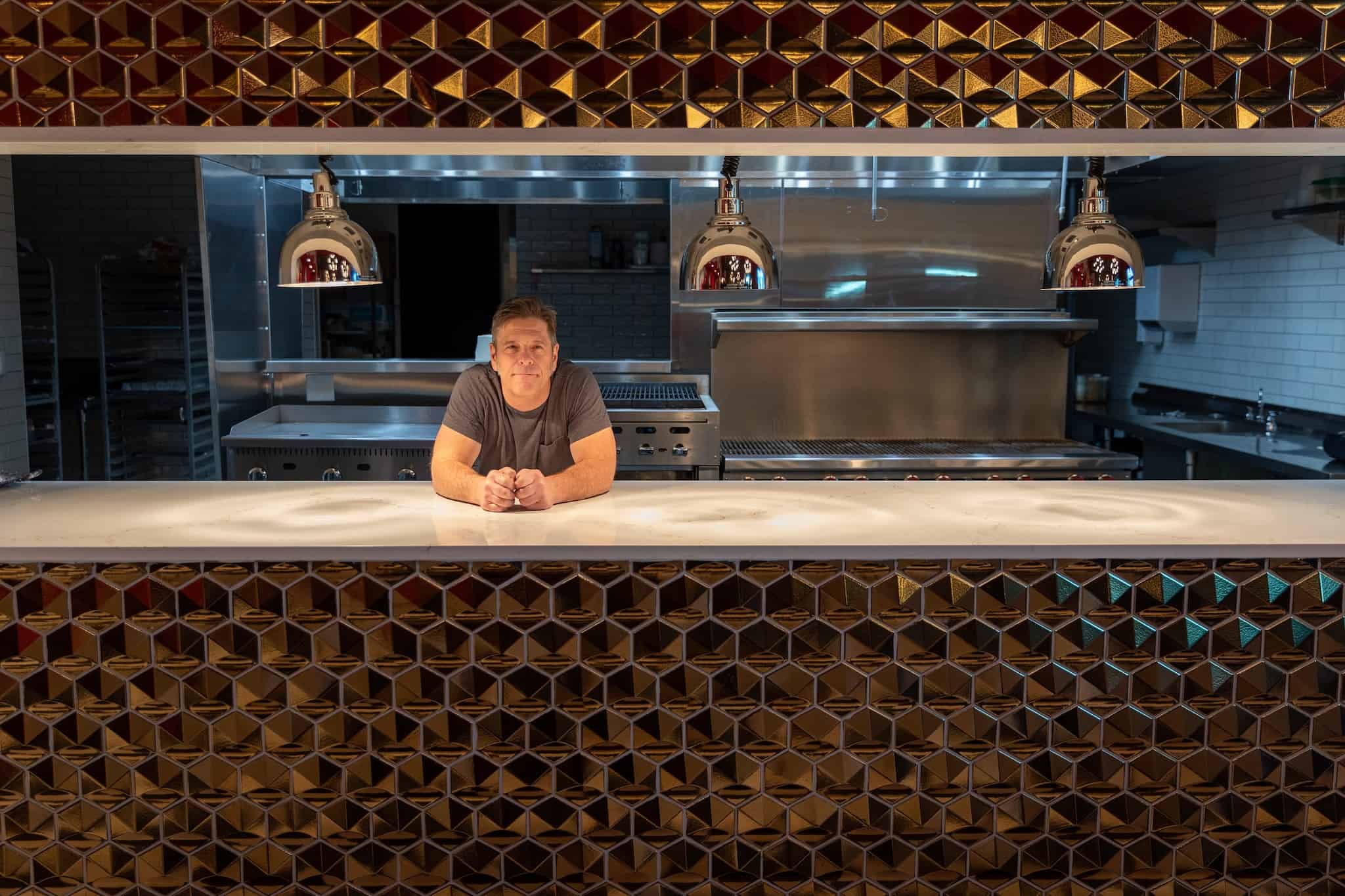
Raleighites may know D’Auvray from his first Raleigh restaurant, Fins—which, after he opened in North Raleigh in 1997, catapulted him to star status as one of the big-name chefs in the City of Oaks (to boot, the restaurant earned both a four-star (out of four) and a five-star (out of five) review from the News & Observer’s now-retired longtime and highly revered restaurant critic Greg Cox).
But it was 1988 when the dynamic duo’s story began. D’Auvray was working at a wood-fired pizza oven concept in Greensboro that Bakatsias (who owned former Greensboro restaurants Nicholas and April) often frequented. “It was amazing, amazing food,” says Bakatsias. “I said if pizza could be this good, I wonder what else he can cook.”
And, so, when Bakatsias’ Durham restaurant Parizade opened in 1992, he tapped D’Auvray as the opening chef (the pair also opened Cafe Giorgios together pre-Fins). But when D’Auvray closed Fins after 13 years, he moved to Florida to spread his wings and consult at various restaurants—including one with Bakatsias.
Upon returning to the Triangle in 2016, the LA-bred chef consulted at Vidrio and Parizade; then opened now-shuttered Lula’s (an ode to his great grandmother’s Southern comfort cooking) and still-thriving LuLuBangBang, which specializes in Asian street food, with Chapel Hill Restaurant Group.
But, like two magnets, D’Auvray and Bakatsias found their way back to each other yet again. “It’s an inseparable romance!” jokes Bakatsias. … The pair met for coffee a few months ago, and D’Auvray fell in love with the East End Bistrot concept and space—naturally. “Our energies started humming like an engine again,” says D’Auvray. “He and I have done so much with each other, and we feed off of each other’s creativity. He’s just incredible—what he can do, what he’s done. … And I can fill in his blanks.”
The restaurant will no doubt be a legacy for both the chef and restaurateur: It’s the first big project in NC for D’Auvray since Fins, and it’ll be Bakatsias’ most elevated restaurant experience in Raleigh (meanwhile, Bakatsias’ smaller-scale restaurants Las Ramblas and Giorgio Pizza Bar are both opening in North Hills this month).
“This is more in my wheelhouse, more of what I want to be doing, more of what I did to make a name for myself,” says D’Auvray. And as contemporaries who, in a way, grew up at the same time in the industry, the partnership will allow the pair to both get back to their roots and work together in a fresh and unique way.
“The creative part of it, the creative energy, that’s what makes it fun,” adds D’Auvray. “The day-to-day grind of a restaurant is a constant—that’s always gonna happen. But then the creative part really, really made me excited to do this with him. Because I get to play. We get to play.”
Giorgios Bakatsias seeks to create a “restaurant row” with two new concepts at North Hills.
Blink and Giorgios Bakatsias will have opened five new restaurants this year.
At a time when many restaurateurs are struggling after two years of fluctuating regulations and risk, Bakatsias is emerging from the pandemic like an unstoppable juggernaut. He’s building out two new concepts in North Hills alone, along with a third in the upcoming East End Market and others farther afield under construction. While some are tepid about the industry’s future, Bakatsias is all in—that’s the only way he knows how to operate, he told Raleigh Magazine in an exclusive interview.
“Am I a risk-taker? Yeah, of course,” Bakatsias said nonchalantly. “But I do it with calculated energy and a great team around me.”
Giorgios Bakatsias (Forrest Mason Media)
Bakatsias is the affable elder statesman of the Triangle’s restaurant scene, a Greek immigrant often found sporting his signature newsboy hat and white button-down. His Giorgios Hospitality & Lifestyle Group has long been an anchor in Chapel Hill and Durham with mostly European-style mainstays including Kipos Greek Taverna, Vin Rouge, Parizade, Bin 54, Local 22 and, more recently, the acclaimed Italian spot Osteria Georgi. In Raleigh, his revered Rosewater Kitchen & Bar will soon be joined by Las Ramblastapas restaurant and Giorgio Pizza Bar in North Hills, as well as East End Bistrot, a high-end French bistro in East End Market.
It should surprise no one that Bakatsias was named 2022 Restaurateur of the Year by the NC Restaurant & Lodging Association, given his prolific range and seemingly endless growth. He’ll soon own 14 unique concepts in the Triangle, all while beginning a statewide expansion of Kipos. Wilmington is first, but Bakatsias also admitted that he’s planning versions of the Greek staple across the state.
It wasn’t always like this, of course, and for years, Bakatsias skirted Raleigh, expanding his reach to Wake Forest first. Reluctant to say anything critical of the City of Oaks, Bakatsias fairly points out that Raleigh had long cultivated a love affair with chains.
“Raleigh is a very strong restaurant town,” he said. “I like it more now. Now it’s balanced out.”
Bakatsias grew to Raleigh almost by chance. In town for a dinner meeting, he noticed commercial space with “a beautiful garden” nestled in North Hills and felt immediately drawn to it. Soon after, Rosewater Kitchen was born.
That process is not dissimilar from Bakatsias’ general approach. He usually doesn’t go out looking in a specific area, but sometimes a space “winks” at him, Bakatsias said. In North Hills, a good relationship with the developer and an opportunity to create “a little village” inspired him to double down and open two more restaurants nearby.
“My intention is almost to create a ‘restaurant row’ with concepts that are unique.”
—Giorgios Bakatsias
“My intention is almost to create a ‘restaurant row’ with concepts that are unique,” he said. “When I saw turnover in chain spaces, I said, ‘I think this is a good opportunity to provide more local concepts.’”
Las Ramblas—named for the iconic tree-lined boulevard popular with Barcelona tourists—promises to be an electric and celebratory tapas bar, replete with “brilliant tile work,” high-energy music, toasting guests and “bold” small bites, said Bakatsias.
Brian Jenzer will take over the kitchen and join Las Ramblas as a partner along with Laszlo Lukacsi, co-owner of Las Ramblas and Rosewater Kitchen and Bar. Meanwhile, the Momofuku and Culinary Institute of America alum will keep his role as executive chef at Rosewater. Bakatsias is also promoting from within for Giorgio Pizza Bar, tapping Osteria Georgi’s chef de cuisine Jefe Lubiano to helm the operation. It’s a natural pick, as Lubiano formerly ran his own Pop’s Back Door South pizzeria until 2016, and he brags a range of experience including a stint at the popular Durham Hotel.
Having a deep bench of talent is a cornerstone to Bakatsias’ meteoric growth. He’s quick to praise his whole team, adding that Lubiano has been “instrumental” and calling Jenzer a “rock star.”
“You have to provide space for them to grow,” he said. “It’s not just a paycheck—though of course that’s important—but it’s also a chance for them to curate their craft, a chance to experiment.”
The proximity of the restaurants allows for easier management and oversight, Bakatsias said, but he also thinks the three distinct menus will complement each other and add vibrancy to an area that’s still growing. Bakatsias took a similar approach with Parizade and Local 22 in Durham, two markedly different restaurants that compete for parking space.
While the forthcoming pizza bar may be more casual and takeout- friendly and Las Ramblas will be the kind of place to celebrate a birthday among friends, East End Bistrot will be a high-end special occasion date-night spot that’s decidedly more intimate. It is slated to open this fall, while the other two should be ready in July or August.
Despite their differences, it’s safe to assume each will be impeccably designed. From afar, Bakatsias may look like Taz, a ball of energy blazing a zigzagging path that places him everywhere at once. But he never skimps on the vibe—“That’s one of my love affairs,” he said—because he wants each restaurant to grip patrons as they walk in the door, pulling them in. Clearly, his seduction is working. giorgiosgroup.com
When people think of French cuisine, they think of nice restaurants, impeccable service and high-end fare. When Indian food comes to mind, many of us think of a folded-up takeout menu with red cartoon chilies to indicate spiciness.
Chef Floyd Cardoz—an Indian-born, New York-based culinary icon—had a problem with how the Western world perceives Indian food; he also had the dream, talent and gumption to alter this perception.
In late March, the 59-year-old died tragically from coronavirus, but his life’s work remains intact: Cardoz’s vision lives on in the hearts and knife-wielding hands of his contemporaries and peers. His influence is so far-reaching, you can even experience it right here in the Triangle.
I was fortunate to befriend Cardoz following an introduction from a fellow culinary enthusiast. I had watched him winning “Top Chef Masters” and was eager to get into the kitchen with him. He graciously let me tag along as an extra set of hands at a charity dinner. Less than a year later, I became his line cook in Manhattan.
Chef Floyd was more than a great teacher. He taught his cooks to celebrate food at the intersection of culture, history, science and art. He taught us to be thoughtful—even under pressure—to honor our farmers by honoring our ingredients and to treat the dishwasher with the same respect as we’d treat the chef.
Cardoz asserted that Indian food is a powerful voice in global cuisine, the facets of which are infinitely applicable. Although he was classically trained in French cuisine, Cardoz became famous for applying his knowledge and passion for Indian food to the freshest local ingredients.
Raleigh’s own James Beard award-nominated chef, Cheetie Kumar, shares Cardoz’s penchant for celebrating local ingredients as well as his Indian roots. Although most local restaurant-goers consider Garland—Kumar’s outstanding downtown Raleigh restaurant—an Indian restaurant, Kumar defines it as “seasonal-Southern.” She utilizes flavors and techniques from India and Asia, and she likens the cornucopia of North Carolina agriculture to what her parents used to pick up at the markets in Punjab, but her work is entirely in the context of where she is.
Kumar recalls Cardoz’s influence on her from the inception of her cooking career.
“There was permission in [what Cardoz was able to accomplish],” she says. “Every time you see somebody echo something you’ve thought about, and you thought you were the only one thinking, it gives you a sense of confidence and affirmation.” Kumar paused. “It was the same feeling I would get if I saw a woman playing guitar on stage and slaying,” she continues. “I’d be like, ‘Yeah! We can do this!’”
Executive chef Jason Lawless of Durham’s Parizade spent his early career in Manhattan working under some of the country’s best chefs. Although he currently cooks Mediterranean food, the lessons he learned from Cardoz enrich his kitchen life daily.
“His influence is more than a certain dish,” Lawless says. “It’s technique and layering flavor, with sugar, acid and spices. I remember him telling me, something that makes a chef special is adding [hot] chili. Even if you don’t taste the chili, if it’s there, it will bring a dish to a higher level. Most chefs don’t realize that.”
Chef Floyd taught his cooks to use spice almost like salt—to enhance the flavor of the ingredients without overwhelming them. People already do this, to an extent, by adding salt and pepper to food. Chef Floyd encouraged us to refine this habit by diversifying the heat, using chili oils and finely minced fresh peppers instead of (or in addition to) black pepper. This philosophy, like many others he taught, extended far beyond Indian food into everyday cooking.
Cardoz was also a pioneer as an elite chef in the way he lived outside the kitchen.
Chef Eric Gabrynowicz, culinary vice president for the Tupelo Honey restaurant group, recalls his early years under Cardoz.
“Floyd would come into the restaurant early in the morning, work a lunch service, go to the gym for an hour, come back. He’d never throw it in anyone else’s face that he’s taking care of himself, but he was, and you always saw it. When you respect someone so much through food and through your passion and you see the other things they’re doing to keep their mental health and their family life intact—I didn’t realize until later how much that shaped me as a person. Floyd knew to never sacrifice any of the important things and he made sure we were all taken care of the same way.”
Floyd Cardoz is survived by his two sons, Peter and Justin, and his wife, Barkha—as well as by hundreds of people who were lucky to call him “chef” or “friend.” Cardoz also leaves behind a living mission to elevate Indian food to the stratospheres where it belongs and the dozens of beneficiaries of his mentorship who will pass on his uncompromising love of food—and life—to generations of cooks to come.