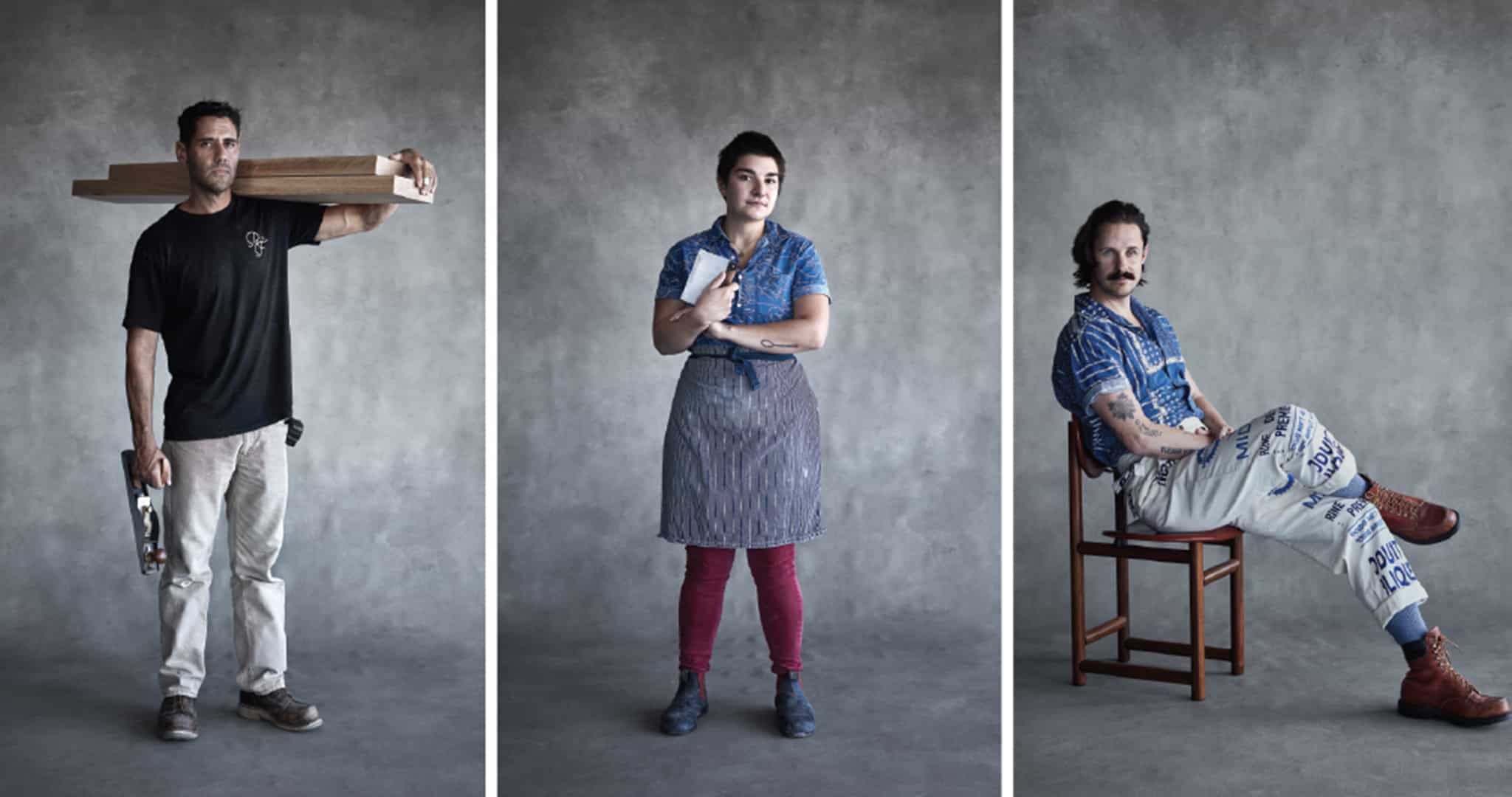
Local photographer Tyler Northrup focuses his lens on the people who make Raleigh tick.
The names of Raleigh’s movers and shakers are well known—the mayor, the city councilors, the famous chefs and the big-name real estate developers. What is perhaps less well known are the names of the folks who work outside the spotlight to make and maintain the city’s image. These are the carpenters who are renovating homes and building furniture, the bakers who fill pastry cases and hungry bellies, the folks who design the signs that adorn those famous restaurants… in essence, the tradespeople who continue to breathe new life into vocations that have been at the heart of human existence for centuries.
Hoping to turn the spotlight on these very people, Tyler Northrup has begun a new project titled Homage. The Clayton-born photographer, who took inspiration for the project from Irving Penn’s seminal Small Trades series of photos, has so far photographed more than a dozen people from different disciplines across the city. There’s Brian Chiarizia, the woodworker and fabricator behind Rebuild Fabrication Co.; Taylor White, a painter and muralist; and Maria Luna, one of the bakers at Andrew Ullom’s Union Special (Ullom is also part of the series).
“I’d always wanted to do portraits of prominent Raleigh people,” explains Northrup, “but the way I wanted to do it never really materialized.” Penn’s Small Trades was a longtime favorite of his, and Northrup quickly realized he could do something similar.
“It just kind of clicked, to combine the two things,” he says. “I love the city of Raleigh and the people that make it what it is.”
Northrup selects subjects who come from historically vital trades and shoots them all against the same backdrop and in the same light and style, equalizing all of his subjects. His dedication to emulating Penn’s original concept included finding a space with the same kind of north-facing windows as Penn’s sixth-floor walk-up studio in Paris. He even custom-ordered a backdrop from a business in Serbia that specializes in Irving Penn reproductions.
Northrup is equally as excited about emulating his idol Penn as he is about working with his local subjects. “These are the people that make everything go round,” he explains. “These are the people you don’t see very much, but who are vital to the fabric of Raleigh.”
He adds, “Ashley Christensen couldn’t do what she does without all the cooks. Raleigh Denim couldn’t do what they do without seamstresses.”
Chiarizia was his first subject—and someone that Northrup immediately had in mind when he began to dream up Homage. “I wanted to include him,” says Northrup, “but the ancillary benefit was getting to meet him and chat with him.”
“I get to meet and talk with all these people, so many of whom I really love what they’re doing. So much of this is a project that I have wanted to do for a long time. It feels right to do it for me, and I hope that other people enjoy it too.”
—Tyler Northrup
Northrup asks his subjects to bring some tools of their trade with them to the photo session. You’ll see Chiarizia holding a wood planer and some pieces of lumber, Ullom with a bench scraper for dough, and interior designer and art director Bryan Costello perched on a midcentury modern chair.
When shooting chef Jake Wood of Lawrence Barbecue, Northrup says he expected Wood to show up with a knife or cleaver. Instead, Wood showed up with an ax.
“He explained that he chops wood every day for the smokers with that ax,” says Northrup. Without that ax, without the wood, there is no barbecue.
As it stands, Homage has an open-ended timetable, and Northrup is not exactly sure what the final project will look like—be it book or exhibition or just letting it exist in the digital atmosphere. For now, he is content to keep photographing and featuring the people that he sees as the beating heart of Raleigh.
“I get to meet and talk with all these people, so many of whom I really love what they’re doing,” says Northrup. “So much of this is a project that I have wanted to do for a long time. It feels right to do it for me, and I hope that other people enjoy it too.”
For now, peek the first few photographs of Homage on Northrup’s Instagram account, @tylernorthrup.
Taylor White, painter/muralist Matt Byrd, sculptor/stonemasonBrian Chiarizia, woodworker/fabricator, Rebuild Fabrication Co.Maria Luna, baker/chef, Union Special Andrew Ullom, baker/chef, Union Special Joseph Giampino, sign painter, SpclsignsSteven Keeling, pipefitter/welder, Local 421Bryan Costello, interior designer/art director
The final transformation of a tintype portrait takes about five seconds. Durham-based photographer Riley MacLean thinks it’s like watching a Polaroid from 1850. In five “Mississippis,” the image flips from a slightly eerie negative to a beautiful likeness.
“I think it amazes people,” MacLean says. “It still amazes me, after a couple thousand portraits I’ve made. I’ve never seen someone not be excited about that.”
Artist Riley MacLean
A penchant for photography has run in MacLean’s family for generations and he still uses some of his grandmother’s cameras. But MacLean came to photography in college after falling in love with the darkroom and seeing an image emerge from chemicals. After moving to the Triangle a decade ago, MacLean began experimenting with a new (or rather, rediscovered) medium.
“I realized, working as a professional, that I spend most of my time in front of a computer, and very little time in a darkroom, or making art with my hands,” he says. “I love digital photography, don’t get me wrong, I think it’s wonderful. But I missed that.”
To begin, MacLean devoured every resource he could get his hands on, including an early 20th century Kodak manual, and compiled a list of chemicals he would need. He planned to use the same large-format (read: boxy, supported by spindly tripod legs) camera he had used in college, but needed to adapt the film holder. Instead of holding film, it had to accommodate a thin sheet of metal. The glossy black metal turned out to be one of the more difficult items to acquire; MacLean buys it now in 10-by-20 foot sheets, and has it cut down. All of the tanks and chemicals required could be repurposed from either science equipment or traditional darkroom uses, but there were regulations around some of the chemicals (for good reason; ether, for instance, boils at 95 degrees Fahrenheit).
Finally, research done and materials gathered, MacLean set up his first test shot: a simple still life of a chair. It wasn’t perfect, but it held promise. The promise must’ve been strong, because after that first shot, MacLean says, a “hilarious amount” of test shots didn’t work out. He eventually found his footing, using a mix of old and new technology. These days, he opens up his orderly studio about once a month for tintype portraits.
MacLean’s voice, typically even and steady, becomes animated by two things: his work and his two Australian shepherds, who are padding around the studio during every session.
Tintype portraits begin in the darkroom, with MacLean prepping a metal plate, a fan whirring in the background. Sparing details to maintain some mystery, MacLean applies a combination of chemicals to the plate which become sensitive to light, ending with a silver bath. Once the plate is removed, the clock is on. The plate has to get into the camera, the focus double-checked, and then the shutter slides open, exposing the plate for a split second to the subject, who is engulfed with ten-thousand watts of light. After the plate is exposed, it’s carefully returned to the darkroom for more treatments: development (bringing out the negative image), rinsing and then one final bath to transform it into a positive image.
The finished product
It’s a process that feels like magic, but MacLean compares it to cooking. Certain things have to be precise—down to a tenth of a gram—and others are to taste, changing (literally) with the weather. In the darkroom, some of the tools are basic household items, while others are combinations of hard-to-find ingredients. In the precise method of making a tintype, MacLean explains that the image is deconstructed, tactile and enduring.
“I wanted to make a photo that if someone wanted to airbrush, they’d have to hire a painter,” he says. “If you wanted it cropped, you’d have to take it to a metal shop.”
When MacLean began plotting tintypes, he loved the historical idea of a portrait: environmental factors are taken away, and you are left with the person themselves, pure and distilled. There’s an intense, no-lies-told result.
It is, as he says, “someone’s likeness, burned onto a plate.”