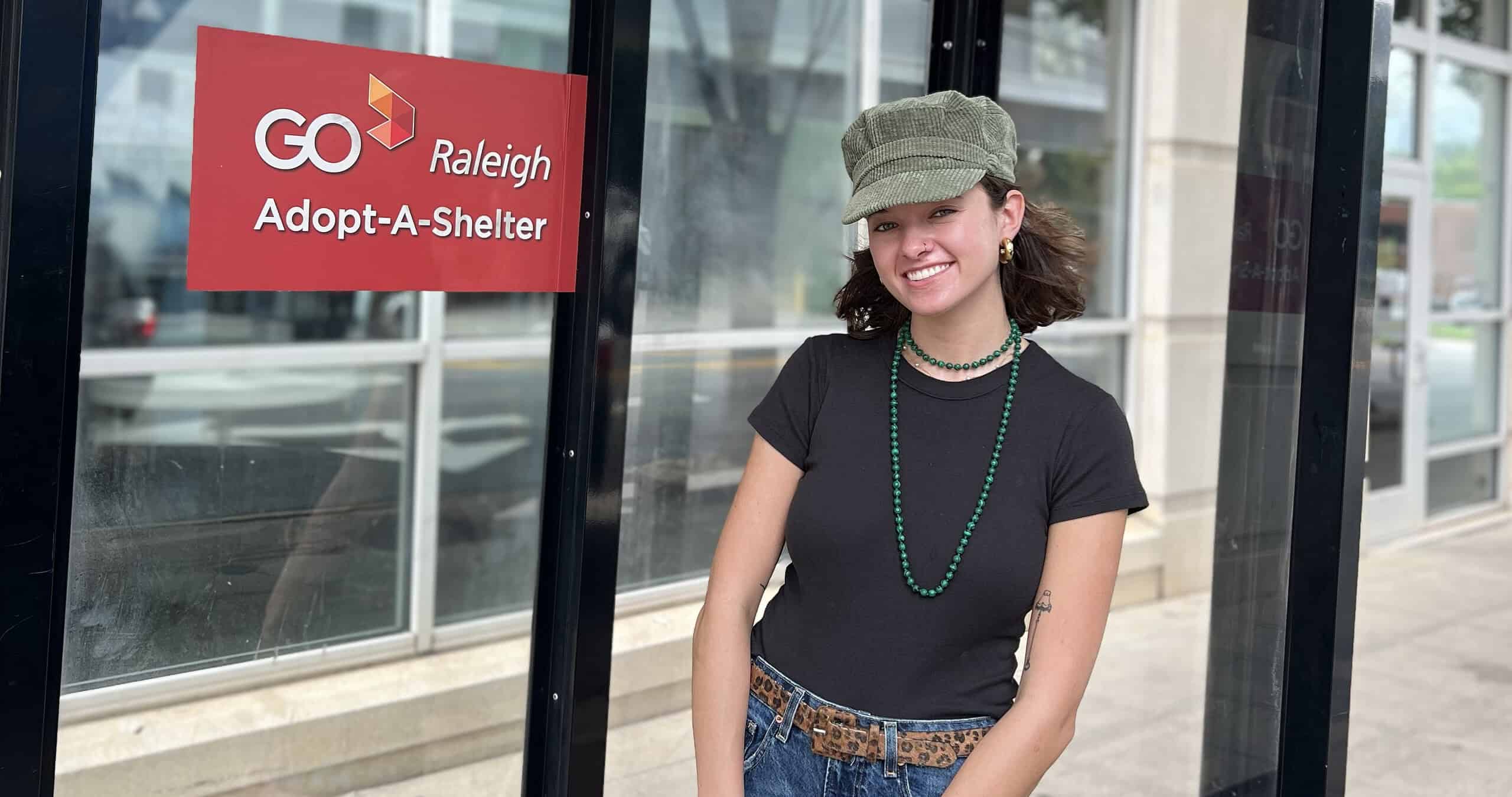
I took the bus everywhere for a month—here’s how it went.
Turns out, Raleigh’s public transit system isn’t as bad as you may think. It’s not what I would have expected after encountering the sights and smells of various bus stops I’ve trekked by in the past, but my forced four-week stint on public transit proved otherwise.
I wouldn’t go as far as to call it a civic masterpiece, but the GoRaleigh system is like most cities’ public transit service—somewhat efficient, a little gross, but will reliably transport you. And it’s far better than many transit services in much bigger cities (looking at you, LA).
From the jump, the majority of common stereotypes of public transit I expected to encounter weren’t a problem—namely, the buses aren’t overwhelmingly crowded; pickpocketing isn’t an issue; and drivers follow the rules of the road. Beyond these cliches, GoRaleigh actually has a wealth of pros.
Compared to complaints about GoTriangle—you may recall our coverage last summer re: its constant cancellations and no shows—GoRaleigh exceeded my expectations. Of my 51 total bus rides, I only experienced one no-show, and all other 50 came within ~five minutes of their scheduled time—though I acknowledge a no-show or extra five minutes may be more of a casualty for riders with less flexibility.
To be fair, five minutes late is *technically* on time in public-transit speak, where on time is typically defined as no more than one minute early or five minutes late. Plus delays are obviously part of any mode of transit, and the top public transit systems in the U.S. still experience them frequently—for example, the F line in NYC is delayed 30% of the time. That said, these delays could possibly be offset by more frequent buses—specifically in less urban areas—but is a hard sell during the multimillion budget deficit Raleigh transit is facing.
That assumed inconvenience led me to initially plan to only take the bus to work, but after seeing how easy the system was to navigate, I took it everywhere—occasionally, I even opted to hop on the bus and ride to bars over ordering a $10 Uber. This wealth (!) of knowledge was hacked by savvy transit users long before me—according to the American Public Transit Association, bus riders save an average of $1,100 a month and are 10 times safer per mile than those who drive an automobile—not to mention I never had to worry about parking.
But let’s be real—there are definitely aspects that need improving. Buses can be very gross. In a 2023 GoRaleigh survey, frequent riders cited cleanliness as an issue—and I concur. White jeans and open-toed shoes were temporarily retired after I noted the amount of dirt on the floor, and, after my second ride, I opted to stand rather than sit after grazing a damp seat. While the grime isn’t ideal, public transit is *public* after all and won’t ever be perfectly spotless—and GoRaleigh is still one of the cleaner transit services I’ve experienced.
Those surveyed also cited personal safety as a concern—but I never felt in danger on the bus. The bus stops, though, were definitely a little sketchy, and I briefly considered walking home once when a fellow passenger waiting for the bus started yelling and hitting surrounding objects with a leather belt. Ultimately, though, both on and off the bus, if you make a point to stay out of others’ way and mind your own business (read: no staring), you’re less likely to be bothered.
So, after a month of riding the bus, I settled on the conclusion that anyone who refuses to ride is—to be frank—being dramatic. Public transit cannot and does not cater to each individual, rather every individual must make it work for them.
How to Get Started:
Download Transit, or just use the public transit option on Apple Maps
Start with a short, easy-to-navigate ride—save the day trip for later.
Zip up your purse and keep any baggage out of the aisles.
Mind your own business and stay out of the way of other passengers.
Wear comfy, closed toed shoes. If you’re wearing light-colored clothing, don’t sit.
The 411 on a multitude of Raleigh projects taking shape.
There’s no doubt about it: Raleigh is on the rise. The City of Oaks was named one of the top 25 fastest growing places in the U.S. in 2023, coming as no shock to any local who has spotted the scad of construction projects popping up left and right around town.
The burgeoning developments are poised to benefit all—from one-of-a-kind office spaces to a public transit update coming down the pipeline (crappy commutes, no more?!). Here, we delve into projects coming out of the ground now or slated to break ground soon. Look at you grow, Raleigh!
Keep your eyes to the skies as a new high-rise is coming to Downtown. The 17-story tower sitting at the corner of Hargett and McDowell streets (aka the previous RPD HQ site, defunct since 2010) aims to align facilities, staff and technology with organizational needs and establish a centralized campus for city staff and citizens alike. As part of the Percent for Art program, 1% of the planned budget is eligible to be used for public art for the structure.
Current status: The construction crew is continuing to destroy sections of the building and sort debris, with a completion date TBD.
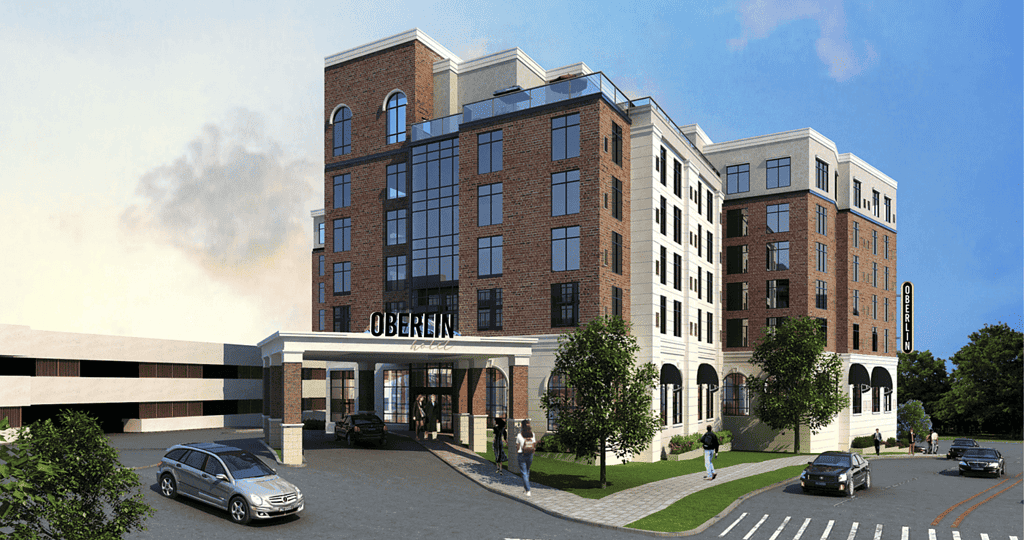
Current status: Construction is underway for Oberlin Hotel, with an anticipated 2024 opening; and Camden Village District is slated to be move-in ready by fall 2024.
Oberlin Hotel | Rendering courtesy of Quality Oil Company LLC/Quality Hospitality
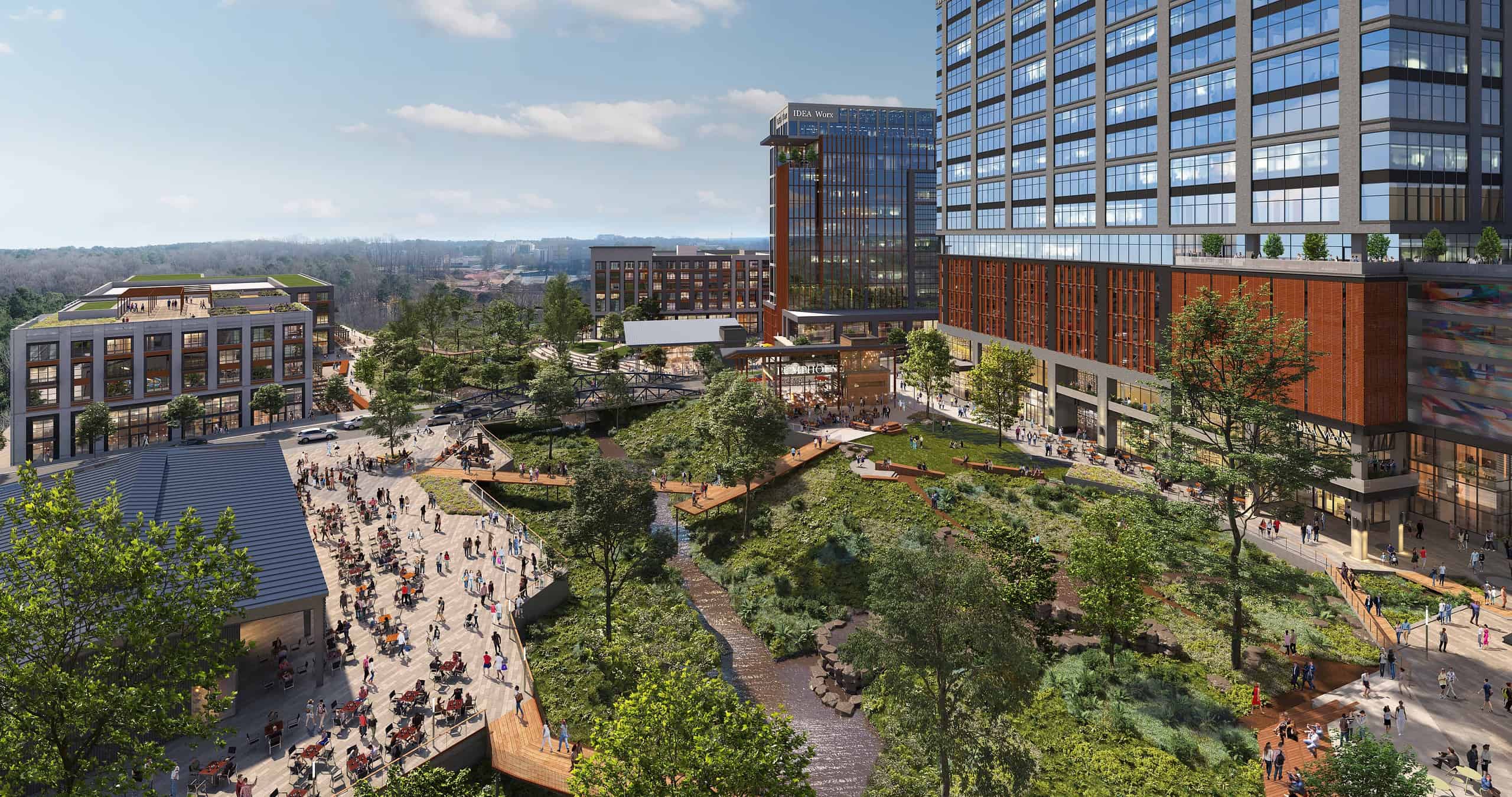
Big things are on the horizon for North Hills. The area’s newest sector spans 33 acres across central Midtown (and stacks up to the tune of $1 billion) with infrastructure geared toward preserving green space and bolstering local businesses. One high-rise making its debut is the 17-story Tower 5, boasting 322,000 square feet of office space, common areas and ground-level retailers—including indoor cycling studio HomeTurf. And when it comes to residential and retail spaces, the district doesn’t lack. Find in-the-works St. Albans Lofts gearing up to offer high-class living spaces, and Makers Alley, the district’s micro-retail shopping area located under the Channel House apartments, hosting seven local and female- or minority-owned storefronts opening in the coming months. Tributary, a mix-used complex named for the adjacent creek, is also shaping up to benefit small business owners with the addition of “live-work” units, where they can open up on the ground level and live directly above.
Current status: Tower 5 construction is well underway and slated to be completed by summer 2024; St. Albans Lofts are scheduled to be completed by the end of 2025; and Makers Alley will open seven storefronts this spring. Tributary is scheduled to begin construction mid-2024.
Bus Rapid Transit
Raleigh is growing and going. Bus Rapid Transit is cruising to Wake Co. with fast, reliable and frequent transit—not to mention ~20 miles of routes along main corridors. What’s more, planning and design for the New Bern Corridor, which will connect DTR to WakeMed and New Hope Road, has been completed and construction is set to break ground in mid-2024 after a public preconstruction meeting is held.
The Southern Corridor, set to link Raleigh and Garner; and the Western Corridor, connecting Raleigh and Cary, are still in the preliminary design process—read: finishing 30% of the final product design. The Northern Corridor, which will bridge Downtown Raleigh and North Raleigh is still in the planning stages. Note: Don’t sell your car for parts just yet—the project isn’t expected to be fully up and running until 2035.
In 2019, according to the GoTriangle FY 2021 Annual Bus Service Performance Report, the average number of weekday riders was 7,512. The pandemic impacted daily ridership, dropping the weekday average to 3,936 in 2021. Throughout 2022, I usually took the bus from Downtown Raleigh to the Durham Station three times per week—and have witnessed a gradual return to ridership.
For many, the bus is their only transportation for work, social services, doctor visits and more. Unfortunately, we’ve seen multiple bus line disruptions—whether canceled services or no-shows. My inbox would fill up almost daily with notifications of canceled routes, leaving myself and other riders scrambling to find other ways to get home or to the next destination.
While GoTriangle worked toward solving these issues, many riders were concerned about impacts on their schedules, lack of communication, and headlines touting new buildings and routes while current services needed to be addressed. Besides digital transmissions, information was hard to come by—and often came as a surprise, leaving many frustrated, constantly thinking their voices weren’t being heard over all the talk about what new things were coming.
In some instances, unfortunately, these even had tragic results. On one occasion, one of my fellow daily travelers boarded a later bus, trying to muffle his sobs as he got on, after the first was canceled. When I asked if things were OK, he replied this would make him late again and likely cost him his job. I didn’t see him on the commute the following week. We should address these challenges before we have more photo opps with buildings and ceremonial shovels.
I applaud the efforts of GoTriangle to navigate these difficult waters. At the same time, I believe they should pay equal attention to what transit users have to say about how this impacts their lives. Instead, when I ask fellow riders, the response is often: “No one talks to us,” or, occasionally: “They said this is just the way it is.”
The future success of our transportation programs strongly relies on the riders and the services the city provides. And hosting public meetings to discuss changes/request public opinion during daytime hours eliminates many riders’ opportunities to attend.
Our growth will continue to climb for years to come. While we plan for and celebrate these milestones, I hope everyone will be able to provide their voice and experiences to the process. Onward and upward, Raleigh.