The 90-minute rez is changing how Raleigh dines—and not everyone is on board.
What isdining out for anymore? In a time when what you drop on dinner for two can rival a tank of gas to the coast, the expectation isn’t just for good food—it’s the experience. The chance to sit, settle in and stay awhile.
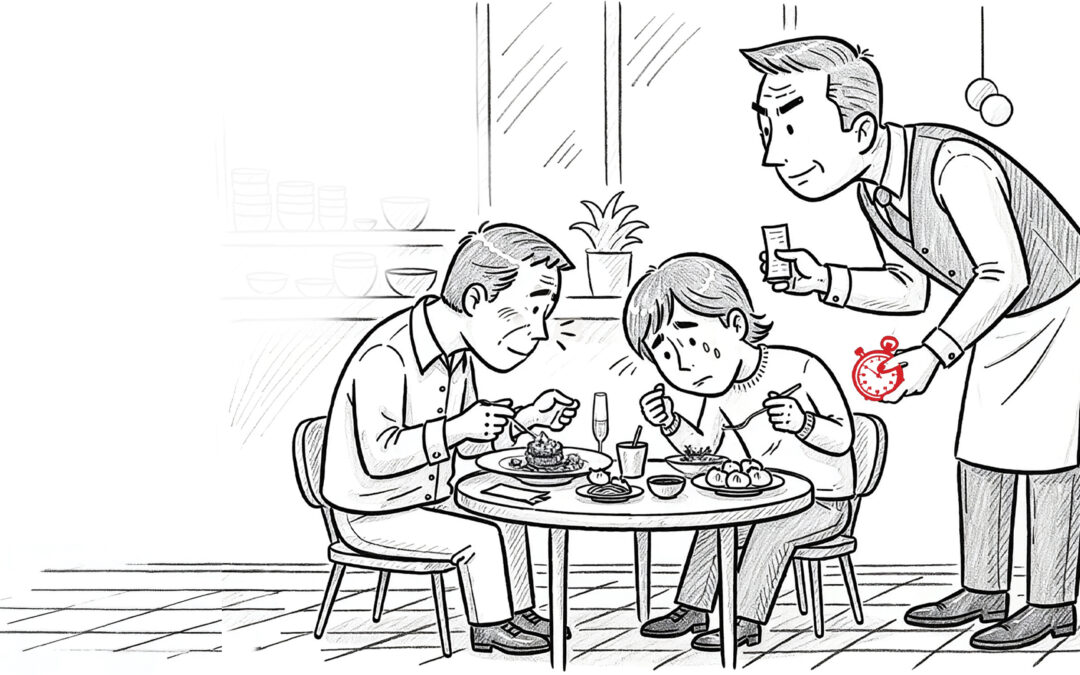
But increasingly, that window is narrowing. Across the country, time-capped reservations (often 90 minutes) have taken hold—a pandemic-era shift that’s stuck. In Raleigh, it’s showing up in select spots, and for some diners, it’s a dealbreaker.
“If a restaurant tells me I’ve only got 90 minutes to eat and enjoy my dinner, I’m already out,” one local tells RM. “Hard pass.”
While not new, time-capped dining has become a go-to for high-demand restaurants managing tightly booked reservation boards. What began as a way to manage spacing and staffing during the pandemic has, for many, remained part of the playbook—or a play more are starting to adopt.
The math is simple: fewer seats, tighter margins and the need to maximize each service. Time limits help ensure tables turn, reservations hold and revenue stays predictable—especially during peak hours when demand is high.
While some diners have expressed surprise, caps are often disclosed at booking with messages like “table reserved for 1 hour 30 minutes”—which is exactly how technology is helping cement the model. Platforms like OpenTable and Resy have normalized time-capped dining by making it easy to set expectations—read: restaurants don’t have to say over the phone, “Sure, reservation for two at 7pm is confirmed, but please leave by 8:30.”
In some cases, the window is flexible by party. Hummingbird has Resy set to 90 minutes for two-tops, adding 15 minutes for each additional guest. “If we can move the next reservation to another table, we will,” says Hummingbird’s Erin Barrett. If not, she says, they regretfully offer to have them continue at the bar.
Figulina allows 105 minutes for parties of three or less, and an extra 30 minutes for larger groups, while Mulino frames it more loosely, recommending a 90-minute window on its site.
But even with that flexibility, some restaurants are quietly operating on a clock—posted or not—and it can feel, well, uncomfortable. At a recent dinner at Mala Pata, a table was cleared the moment dessert ended—waters included.
“It’s not a perfect system,” acknowledges Barrett, noting most of the time it’s not an issue—though one recent guest posted a bad review saying they were “kicked out of the restaurant”—which is never the intent. “We had a two-top for brunch that stayed through dinner,” she says. “They were comfortable, declined a table change—we just refreshed their water and reset the table.”
Even as dining rooms have returned to “normal,” the economics have not—and the tighter the margins, the tighter the squeeze. At the same time, diners—who see a night out as both a splurge and a reset—are finding that leash harder to justify and are starting to push back.
“After grinding through a full workweek, managing a house and kids, that rare night out with my husband isn’t just ‘dinner,’” says another local. “That’s my time to breathe. I’m not showing up to watch the clock, rush through courses or feel like I’m being politely pushed out the door.”
That tension—efficiency vs. experience—is the friction. “I want to sit, talk, laugh, linger and actually enjoy the experience,” she adds. “That’s the whole point. Dining out should feel like a break—not a timed event.”
The lowdown on restaurant reservation etiquette—and other oft-unspoken restaurant rules
Recently buzzing on X: A would-be patron last-minute canceled his reservation at a chic Boston restaurant due to a health emergency. When unable to obtain a refund directly, the diner reimbursed the whopping $250 cancellation fee via his credit card’s travel insurance. … End of story, right?
Fast-forward to the patron receiving a snarky personal DM from the restaurant’s owner accusing him of “screwing over” her business and its staff (no, chef)—only erupting into further mayhem from there. While this scenario seems shockingly extreme, it sparks the discourse: How should patrons navigate the ever-evolving restaurant reservation scene—and what do Raleigh industry professionals have to say on the matter?
If you think DM cancellations are acceptable, think again. Per a former restaurant industry professional: “The host is not hanging out on the company’s Instagram. If you DM them, save your breath—it’s the same as just not showing up.”
The Cancellation Fee Kerfuffle
The reviews are split. A lineup of well-known Raleigh restaurants charge a last-minute cancellation fee (think Mulino, AC Restaurants and St. Roch) while others elect to waive the charge and cut their losses if patrons flake.
“We try to be understanding of people’s ever-changing and busy schedules, so we don’t charge cancellation fees,” says Scott Crawford of his policy for parties of four or less. “[But] diners should be aware that not showing up or calling to cancel really does hurt small businesses. We understand plans change—and having communication allows us to pivot and achieve our revenue goals.”
Meanwhile, DTR’s cool Mexican cantina Centro maintains a charge of $10 per guest for a no-show or cancellation with less than 24 hours notice. “There is a huge impact if someone reserves a table during peak hours and doesn’t show up,” says chef Angela Salamanca. “But if someone calls to cancel because they’re sick, we don’t charge. We aren’t in the business of cancellation fees—we want people to come dine with us.”
North Raleigh outpost Cucciolo Terrazza currently opts for no fee for small groups but does require a credit card on file for parties of 10+ due to additional setup, extra staff and more food prep. “A table for two to four is easy for us to fill with a walk-in,” explains Director of Operations Andrew Robinson. “But larger tables are limited—and without sufficient cancellation notice, we are left without time to reach out to other parties and offer them the space.”
Party Size in Flux
Managing dinnertime reservations can be compared to a “good game of Tetris,” according to Giorgios Hospitality Group, due to the tedious task of continuously optimizing flow throughout the night based on arrivals and departures. That said, if you realize your group is shifting in size, it’s always good to give a heads up ASAP.
That sentiment seems to stay true across the board. “If your party changes, we will try to accommodate that,” notes Salamanca. “It’s an unideal curve because we’ve already set the floor—but we always try to make it work. [That said], I really appreciate when people call.”
Courtesy Calls
A good rule of thumb: Communication is key. If you realize ahead of time your dinner party is shifting in size, you’re running late or need to abort your meal plans altogether, tell the restaurant. It’ll assist a smooth run-of-show, allow time to readjust seating arrangements or open up a spot for walk-in patrons.
“If you show up 15 minutes late and there are people waiting, your table is gone,” says a longtime hostess. “There are exceptions: If you call and explain extenuating circumstances—you give time [for us] to rework the plan and ensure everyone can still get in efficiently.”
Ultimately, when you book a rez, a restaurant is planning for your butt—and business—to be in that seat. So show up, enjoy a good meal, support a local spot (and avoid the aforementioned social media war…)—and everybody wins.