Ira David Wood III may be best known for his role as Ebenezer Scrooge in Theatre in the Park’s production of “A Christmas Carol,” but he’s anything but selfish in real life. For 45 years now, Wood has sacrificed much of his holiday time to direct, rehearse and perform in the show in Raleigh and Durham. Wood will tell you, however, that he is being selfish, because to him, he says, performing on stage is one of the most thrilling feelings in the world.
Wood came to the role of Scrooge after serving as North Carolina’s first theatre arts consultant, a job he took after declining an invitation from Andy Griffith to play a role in “The Andy Griffith Show” because of the debt he felt he owed to his home state. Wood, who grew up in Halifax County, thanks North Carolina for offering him a way out of the agriculture industry, giving him the resources he needed to get into the Governor’s School—a publicly funded residential summer program for gifted students—and then into the North Carolina School of the Arts in Winston-Salem.
After successfully directing a production for the Raleigh Children’s Theatre in the early 1970s, Wood was selected to be the theater’s executive director. It was during that time that he changed the institution’s name to Theatre in the Park in order to broaden the scope of the theatre and to attract people of all ages to get involved. In 1974, while most Raleigh theaters were closed during the holiday season, Wood opened Theatre in the Park’s doors to encourage families spending time together around Christmas to come out and see “A Christmas Carol.”
“It’s an honor to have people make us part of their celebration of the holidays,” Wood says.
Ira David Wood III
Wood says he’s learned a lot from playing Scrooge for so long, namely about the spirit of giving and the message of the story, which, according to him, is “that we’re capable of transforming ourselves and becoming better than we were.”
“[Scrooge] has certainly made me better,” Wood continues. “At this point, it’s like meeting an old friend when I go into the dressing room.”
At 72, Wood is gearing up for retirement. On the 50th anniversary of A Christmas Carol, he will pass Scrooge’s signature tights and top hat on to his son, Ira David Wood IV, who has been alternating in the role with his father ever since Wood underwent open heart surgery in 2010. “Nobody wants to see a 72-year-old man in tights running around the stage,” Wood says with a laugh. “It’s time for me to hang them up.” Wood will continue to direct the production as long as his health allows, and son Ira, along with his daughter, the actress Evan Rachel Wood, say they plan to see to it that the show outlasts him. “That’s a very humbling thing to think, that you’ve created something that will outlive you and will continue to touch hearts and change lives.”
Wood says getting older has also given him a meaningful perspective on life in general. “Life is so short in the scheme of things and it’s so important, not just to live, but to celebrate moments,” Wood says. He says he’s learned to celebrate the fellow actors he’s worked with in “A Christmas Carol” and all the memories they’ve made, the simple pleasures that come with Christmastime and the happiness that theatre has brought him. Most of all, Wood says he hopes the production has brought joy to everyone who’s come to see it over the last 45 years, and that it will continue to bring joy to those who see it in the future when he’s no longer on stage playing Scrooge.
“We encourage people to laugh, to celebrate being together and to enjoy those tender moments,” says Wood. “And when you walk out, you’re better equipped to celebrate the holidays; you’re a better person than you were when you walked in.”
The Cardinal at North Hills celebrates the Art of Living Well® and is proud to commission this special editorial series. To learn more visit, lifeatthecardinal.com.
It’s that time of the year again—when we’re content to get lost for an hour or two in the rhythms of a dance, the drama of a play, the physical world of the visual arts or the melodies of musical composition. Raleigh’s cultural scene continues to thrive and this season of arts and entertainment promises all the excitement of live shows, performances and exhibitions of seasons past, and more. In our 2019 Arts and Entertainment Guide, we highlight, along with our arts and entertainment events calendar, some of Raleigh’s connoisseurs of culture, plus a few of the folks who work behind the scenes to ensure that all the shows go on.
Cultural Ringleaders
We spoke with the folks at the forefront of Raleigh’s arts and entertainment scene.
Eric Woodall, North Carolina Theatre
Growing up in Benson, many of Eric Woodall’s firsts in theater were an hour’s drive away. One of the first professional productions he watched was “Man of La Mancha,” featuring Ira David Wood, and his introduction to performing was on Raleigh Little Theatre’s stage. At 9 years old, the theater bug had a firm hold—throughout his youth, Woodall, now NC Theatre’s artistic director, was shuttled back and forth to perform with and learn from Triangle artists.
Woodall spent nearly three decades in New York, first as an actor and then as a casting director, interspersed with stints of directing back in the South. As a casting director, Woodall helped add sinew to Broadway productions including “Phantom of the Opera,” “Les Miserables” and “Falsettos.” Collaborating with our century’s gold standard of directors and producers influenced him in a thousand ways, Woodall says, adding layers to his creative process and preparing him for the full-time plunge in Raleigh.
In his new role, Woodall oversees the artistic vision and merit of the entire theater company. Every day, he must spend time on each of the six shows NC Theatre will stage this performance season—not to mention what the company plans to produce in 2021, the conservatory (the theater’s education department) and any other shows he’s directing.
“I ain’t gonna lie,” Woodall confides, “I don’t sleep a ton. I wake up with my mind and heart racing, because I take all of this so seriously.” A firm believer in preparedness (often fueled by strong coffee), in July, Woodall already had the cast and creative team for October’s production of “West Side Story” completely locked in, headshots lining his office wall.
“I am passionate about helping North Carolina Theatre find and re-establish its identity, so that theatergoers, or even non-theatergoers, in the area can begin to know who North Carolina Theatre is, and what we do and how we do it,” Woodall says.
In the upcoming season—Woodall’s first set of selections—there will be musicals from the Golden Age, modern classics and a couple of shows few will recognize. The casts and crews are comprised mostly of Carolinians and about a dozen New Yorkers. Woodall wants audience members to come in and see theater that is discovered, rehearsed and re-imagined in their backyard.
Woodall’s task is twofold: to continue the legacy NC Theatre began (without which, he says, he would not be here) and to challenge artists and audiences. These challenges manifest in many ways, from diversity in casting to offering more scholarships for the conservatory to engaging more with the community. Another closely held hope is to produce original work that other regional theater companies (and even New York companies) potentially could perform down the line.
“We’re moving in this upward direction of new ideas and wondering ‘What is possible?’” Woodall says. “So, it’s an exciting time to be here.”
For tickets or more information, visit nctheatre.com— Megan Dohm
Valerie Hillings, North Carolina Museum of Art
Valerie Hillings is absolutely overwhelmed by the love for, and pride in, the North Carolina Museum of Art that she encounters across the state.
“I’m excited to think about NCMA as a campus as a whole and how different elements can talk to one another,” says Hillings, who’s now 10 months into her position as NCMA’s director and CEO.
A Duke University graduate and curator at the Solomon R. Guggenheim Museum and Foundation for more than 14 years, Hillings is enjoying exploring the cultural landscape at NCMA, and, now that she’s settled in, she’s honing her insight into what the museum does best, including reimagining how art is shown across time and space.
“We’re starting to ask ourselves how to install the collection to tell new stories,” says Hillings, who has focused closely on art collections throughout her career. “Starting in 2020, we’re going to start shaking up the narrative, suggesting new ideas and opening up conversation.”
The museum’s fall and spring exhibitions will bring diverse material to the public.
“The public will be getting a varied menu of experiences that will show local, national and global perspectives,” Hillings says. Scott Avett, co-founder of the band The Avett Brothers, will have a solo exhibition featuring his large-scale oil paintings beginning in October. Also in October, the museum will feature an exhibition on Mexican Modernism with works by Frida Kahlo and Diego Rivera, along with art from the Jacques and Natasha Gelman Collection.
A high point on the spring calendar is “Front Burner: Highlights in Contemporary North Carolina Painting,” beginning in March. The exhibition urges viewers to slow down from the chaos of modern life and approach the paintings with “patience, critical thinking, and an open mind and heart.” Featuring 25 emerging, mid-career and established artists from throughout North Carolina, the exhibit highlights the different perspectives in painting across our state, from Raleigh’s Brett Baker and Shaun Richards to Charlotte’s Ashley Lathe.
Hillings emphasizes the idea that not everything will be a linear progression or just about geography. From portraiture to world religion, there are different ways of looking at the collections today. One way of viewing a collection, for example, is through thematic narratives, as in March when the museum created a gallery of works solely from women artists.
“We want to get the audience to look forwards and backwards by the way we installed the collection,” Hillings says. “There are different ways of looking at collections today. I like to say that all art was once contemporary and all contemporary art will become history.”
Zalman Raffael’s artistic journey began with gymnastics and a distaste for team sports and grew into a love for the power he found behind a ballet bar.
“It’s very internal, standing behind a bar, but external as well,” says Raffael, who was born and raised in New York City and received formal dance training at the School of American Ballet. “I couldn’t find a place to exert my energy until I found ballet. It helped me find myself and develop as a person.”
The 2019-20 season marks the beginning of Raffael’s role as CEO and artistic director of Raleigh-based Carolina Ballet. He takes the reins from longtime chief Robert Weiss, who is credited with the company’s success over the last two decades and will still remain involved.
“I really see the importance of not holding on so deeply to being a powerful person, but instead, to nurture the future generations,” says Raffael of his new role. “The power of art in the world contributes to the quality of our lives.”
This season, the Carolina Ballet has much to offer. From “Frankenstein” to the return of “Macbeth” to a classical production of “Cinderella” performed to live music, there’s something for everyone. This month, Carolina Ballet performs George Balanchine’s “Rubies” set to the music of Igor Stravinsky and featuring a new collaboration between Weiss and Raffael, along with Weiss’s “Thai Meditation” and his “Classical Ballet” set to the music of the Russian composer Sergei Prokofiev.
“I’m thrilled to have a partnership with the Chamber Orchestra of the Triangle,” Raffael says. “We have a live music series that’s really exciting. Robert Weiss is also teaming up with local artists for Beethoven’s ‘[Symphony No. 7].’”
For Raffael, or Zali as he’s known, being a leader in the arts world, especially in Raleigh, is meaningful. He says that while ballet doesn’t have to do with physically saving lives, it allows expression and the opportunity to look at ourselves deeply. He says his goals for the company are to continue to preserve and innovate ballet.
“I would love to continue to choreograph ballets but it’s important to bring in new choreographers and preserve the stronger ballets that have become a part of our history,” says Raffael, who has worked as a choreographer for the Carolina Ballet for more than six years. “Part of success for any dance company is to have staples, like our ‘Messiah’ or ‘Rhapsody in Blue.’”
Another goal is to find a balance of quality dancers by consistently creating ways to nurture dancers’ lives. Raffael says, for him, it’s important to make sure dancers are cared for after the performances end.
“We want to create an opportunity for employees to set up their lives and become immersed in what is Raleigh,” says Raffael. “There’s artistic growth, plus growth in the city.”
To see a full performance and events schedule, visit carolinaballet.com — Tracy Jones
en pointe
Dancers with the Carolina Balletseek out the perfect fit.
Kristen Klein fits a dancer with Freed of London pointe shoes at the Carolina Ballet.
A long row of cubbies is stuffed with light pink satin pointe shoes. Dancers, both seasoned and green, slip shoes in different sizes and shapes onto their feet in search of a Cinderella moment: the perfect pair, the flawless fit. A tall, slim woman with a perfectly coiffed dark bun—a ballerina herself, and a choreographer and artistic director—greets the dancers one by one, peppering them with questions about shoe size, their preferred shape and pliability and what they’re ultimately looking for in a pointe shoe.
This is the scene in a back room at the Carolina Ballet company’s headquarters on Atlantic Avenue and the woman, Kristen Klein, is a custom pointe shoe fitter for the storied dance shoe design and manufacturing company Freed of London. Freed, founded in the British capital in 1929, has supplied Carolina Ballet with shoes since it launched as a professional company in 1998; each year, Klein travels to Raleigh to facilitate custom fittings for Carolina Ballet’s dancers.
“They require so much from their shoes,” Klein says. “They’re their tools—they need them so they can do their jobs.”
Freed’s pointe shoes are all handmade by (mostly British) cobblers. Compared to other pointe shoes on the market, Freed’s designs are traditional, constructed out of satin on the outside and a canvas and burlap lining on the inside. The block of the shoe, which dancers rely on to carry themselves on the tips of their toes, is made using a flour-based glue, layered with paper or more burlap and baked into the shoe in a giant oven to harden. As dancers work in the shoes over time, the block will begin to break down. But, due to the shoes’ time-honored quality of materials, they’ll also begin to mold to the dancer’s foot “like an extension of the leg,” in Klein’s words.
Each cobbler at Freed churns out 30 to 40 pairs of pointe shoes each day, and each pair is stamped with a symbol denoting the shoes’ characteristics: a triangle represents a tapered pointe shoe with a small platform; a star signifies a boxier shoe with a platform that’s larger. For the dancers, Klein organizes the shoes by shape and most of the ballerinas know their preferences. “A lot of these dancers that have worn Freed know what maker they like and it creates a special feeling for them,” Klein says. “It’s like a ‘this is my maker’ type of thing.”
While the process of finding a new pair of pointe shoes is relatively easy for Klein when she’s working with more experienced dancers, first-pair fittings can be challenging; dancers are still getting accustomed to Freed’s uniquely designed pointe shoes and learning how their feet will fit them. But, as Freed employs so many different cobblers, Klein says that 99 percent of the time, dancers can find a pair of shoes that work with their feet.
Today, this is evident. Following several rounds of try-ons, dancers test their shoes in front of mirrors. Then, they sashay out of the fitting room, away from Klein, with a promising new pair of pointe shoes in tow. The pink satin will shine from the stage; the solid blocks will carry the dancers into their new season of performance. — Lauren Kruchten
Ushering In
Usher Millie Bozek
Lights ripple in the fountain out front. The Greek Revival structure rises into a deep blue sky. Warm light draws you indoors. Approaching downtown Raleigh’s Duke Energy Center for the Performing Arts on a performance night can feel like the whole place has been waiting just for you.
“I think it’s the most beautiful building in downtown Raleigh,” says usher Millie Bozek. “When I come here, I feel like I’m someplace special.”
Ushers are the human element to creating this welcoming feeling and, according to front-of-house manager Courtney Bisbe, the first qualification for the job is that an usher can talk easily to anyone. Follow-up traits include the ability to work hard, to be a team player and readiness to spend hours on one’s feet. To the public, ushers act as vested guardian angels, guiding the way.
Before the audience arrives, the theater is steadily preparing. While artists warm up, ushers fold inserts and take marching orders from the head usher. When Bozek was readying for her first night on the job in 2002, she arrived half an hour early, for one last chance to walk the red rows in Memorial Auditorium—the center’s largest—and test her memory of the sections.
Seventeen years of experience on the job and assisting thousands of people have stacked into quiet self-assuredness. With friendly blue eyes, a Brooklyn accent and a ready smile, Bozek is a comfortable presence. She does not particularly care what assignment she receives, or where she’s placed in or around the building. She’s there for the people. Other than the theater name and uniforms—a cranberry blazer has been exchanged for silver vests and bowties are no longer required—Bozek says not much has changed about her work.
When the tall glass doors open, ushers have manned their assigned spots. Those at the front door are the first faces patrons see. Bozek says she always tries to offer a welcome or hello, no matter how busy or rushed she is. Once the interior house doors open, the lobby and hallways are flooded with people. Some are season ticket holders who know exactly where they’re going, others are setting foot in the theater for the first time. Bozek says it’s important not to profile guests when there are multiple events in the building; sometimes the guy in blue jeans who looks like he’s headed for the bluegrass concert is actually destined for the symphony. After the audience files in, it is an usher’s job to maintain order and comfort, to be guides during necessary exits and to deal with what Bozek calls “situations,” should they arise.
“And they always have situations,” she says.
Situations include heavily perfumed patrons sitting near others with scent allergies who need re-seating, tipsy patrons and would-be backstage interlopers—all managed with tact. When the lights go down, the ushers’ navigational skills are put to the test. Bozek says it is still possible to get turned around, especially if she’s preoccupied.
At intermission, the ushers guide a flurry of coming-and-going and guard doors that would lead away to other auditoriums; once, they had a woman start out at one show, get turned around, and watch the second half of another show next door. They ring oversized brass bells to signal the end of intermission.
After the final note plays and the last bit of applause dies down, the theater empties as quickly as it filled. The ushers send their guests into the night with gratitude, appeals to come back and wishes for a safe journey home (and, for regular attendees, a quick hug). As the audience departs, the ushers finish their evening’s work. The theater resumes its waiting once again. — Megan Dohm
Check out our 2019 Fall Arts & Entertainment Calendar!
“The Rocky Horror Picture Show” is honoring its onstage roots in a live production at Cary’s Koka Booth Amphitheatre. Outside, under the stars and just before Halloween, audiences can expect to be chilled, thrilled and fulfilled with this rock musical-slash-science-fiction horror comedy.
Frank, Brad, Janet, Magenta and Riff-Raff, played by YouTube sensation Penn Holderness, will take the stage for two nights only, along with the rest of a very talented cast.
“Seriously, the cast is amazing!” says producing artistic director and Broadway veteran Lauren Kennedy Brady. “We have some of the funniest actors around and killer singers. Plus, we have Abbey O’Brien directing the production.”
O’Brien is fresh off of working on “Jagged Little Pill,” the Broadway-bound musical based on Alanis Morissette’s music. She worked on “Waitress” on Broadway recently, as well.
After last year’s successful production of “Rock of Ages” at Koka Booth, Theatre Raleigh was eager to team up with the venue for another production this year.
“‘The Rocky Horror Picture Show’ struck us like a lightning bolt, right when we are about to give up on ideas,” Brady says. “To me, when you’re picking a show to do in a venue like the Booth, it has to feel right.It has to be the right experience. And I think ‘The Rocky Horror Picture Show’ is perfect.”
Fans of “Rocky Horror” know that the experience goes beyond quietly watching a show from their seats. Dressing up, shouting at the screen and throwing objects are all part of the fun. To encourage these traditions, the theater will be selling “Fun Packs” for an additional $5; they’ll contain everything you’ll need to participate, from toast to water guns to rubber gloves.
For those unfamiliar with all that “Rocky Horror” entails, have no fear. “Virgins,” or first-time Rocky Horror participants, aren’t expected to know anything.
“No one will razz you or belittle you,” says Brady. “As a matter of fact, we’ll have experienced diehards scattered about to help those who feel in the dark. And we are hoping to have the callback lines up on a big screen.” Callback lines are the phrases audience members shout back at the screen or stage during specifically scripted moments.
Koka Booth isn’t merely playing the movie on a big screen with a shadow cast in front of it. Instead, the production will feature an elaborate set, a live, six-piece band and 15 actors singing and dancing their hearts out.
“We’re going to create an experience that the Triangle area will not soon forget!” Brady says.
To purchase tickets, visit boothamphitheatre.com. Reserved seats are $35 and lawn seats are $22.50.
Theatre Raleigh kicks off Hot Summer Nights at the Kennedy Theatre with a new adaption of Charles Dickens’ “The Mystery of Edwin Drood” written and composed by Rupert Holmes. Holmes has adapted the play for smaller theatres, and the scaled down, 90-minute version will debut in Raleigh May 11th through 22nd.
We asked Holmes to talk about the show, Pina Coladas and Charles Barkley singing his hit song.
What motivated you to adapt “The Mystery of Edwin Drood”?
I was haunted by a relatively obscure, unfinished novel by Charles Dickens about a handsome schizophrenic choirmaster who frequents the opium dens of London and is madly in love with his beautiful music pupil Rosa Bud, a young woman betrothed to the choirmaster’s devoted nephew Edwin Drood, whom the schizophrenic choirmaster wishes to murder. I felt the novel could make an intriguing musical…or an episode of “The Real Choirmasters of Sussex County”. Small problem: Mr. Dickens died halfway through writing the novel.
So you had to get creative with the ending. Where did you get the idea to have the audience vote on it?
While I was wondering if I dared to create an ending that Charles Dickens didn’t live to write, it suddenly dawned on me that the most outrageously and richly theatrical way to conclude the story would be to structure the musical so that the audience could vote on several key questions [and] a new ending could be performed at every performance. It was also the perfect antidote to the dreaded “spoiler”.
You’ve streamlined your original version into a one-act show.
We’re doing it the way I originally conceived it, in the cozy, intimate setting of an English music hall “pub” where there are all stars and no ensemble. The audience is warmly regarded as “regulars,” like the gang at “Cheers.”
What’s your favorite ending?
There are eight possible murder suspects at each performance but there are actually 960 combinations, including many I’ve still never seen after all these years! As for my favorite, that depends a lot on the mood I’m in and the performers I’m watching. Some are serious and surprising, others simply hilarious.
What is your favorite part of the production?
I’m incredibly proud that two of the most personally meaningful songs for me in the show are sung by two such bright Broadway lights as Sally Mayes and Raleigh’s own Lauren Kennedy. But I suppose my very favorite moments in Edwin Drood are when, as invariably happens, the audience becomes a kind of runaway jury and starts to make mischievous, even devilish decisions about the ending.
I’ve loved “Escape” (The Pina Colada Song) for years! Is it inspired by a real life experience?
The question I’m asked most often is, “Did that song really happen to you?” and people dearly want me to say “yes.” I hate disappointing anyone so let me confirm that, yes, it did happen to me. Most of my songs are inspired by real-life situations not only in my own life but what I’ll observe at airports, in restaurants, or at the corner of Walk and Don’t Walk, and imagining “What if?” or “If only…” which often becomes a song, a play or pages in a book.
Do you drink Pina Coladas?
I’d never actually tasted one until after the song became a hit. Of course, once it went to #1 everyone in the world thought they were the first person to buy me a Pina Colada. I didn’t want to seem ungrateful, so there was a three-year period where I tasted more Pina Coladas than Jimmy Buffett has slurped Margaritas.
Have you seen the ESPN Capitol One commercial with Charles Barkley singing Pina Colada?
I was damn pleased to see three guys who are as cool as anybody on the planet [basketball legend Charles Barkley, director Spike Lee and actor Samuel L. Jackson] singing my song together on a road trip. And it’s fantastic that for once Capitol One owes me money instead of the other way around.
What’s one thing people don’t know about you?
For most of my life, whenever I meet or work with a person—man or woman—who’s gracious, extremely intelligent and charming, and I ask them where they were born or grew up or went to school, it seems more than half the time they tell me Raleigh, Chapel Hill, Durham or Duke. I don’t know what it is about this part of the country, but many of the best people I’ve known, who have so affected my work and my life, [have lived within] a 50-mile radius of where we’ll be premiering the Theatre Raleigh “Mystery of Edwin Drood,” making this production all the more meaningful to me.
Local theaters bring creature comforts and nostalgia.
It was a bad year at the movies. You might even call it a dud.
According to a CBS News poll, 2014 saw the lowest box office take for Hollywood in 19 years. More Americans, some fed up with the average $8.17 movie ticket price, were watching more movies at home with On-Demand, iTunes, Netflix, Hulu and Amazon.
Theaters responded. Last year two luxury-type theaters in Raleigh upped the ante.
• Raleigh Grande, owned by Charlotte-based Carolina Theaters, renovated its 16-theater building on Grove Barton Road, re-opening in November. Upgrades included plush leather recliners, reserved seating and a renovated refreshment and lobby area. Beer, wine, soda-refill stations, gourmet popcorn that’s popped on-site and additional food options, such as hummus and fresh bread from Raleigh’s Neomonde—not to mention fountain Cheerwine—are big draws.
“Once you have a beer with a movie, how can you not have a beer again?” Steve Scruggs, Raleigh Grande’s general manager laughs. “Honestly … [with reserved seating] there’s no rushing, pushing and shoving, especially on opening weekends. It takes the stress out of going to the movies.”
Scruggs says that, pre-renovation, Raleigh Grande’s ticket prices were the least expensive in the city. Today they’re on par with traditional theaters’ pricing, but offer non-traditional comforts. Adult prices for weekend matiness are $8 per person; evening is $11. (With the exception of 3D movies, which are $3.25 more.) Tuesday’s ticket prices are $6 all day, he adds.
• Cary’s luxury theater, CineBistro, opened in Waverly Place in September. Owned by Cobb Theaters, which has nine other CineBistro locations in the U.S., CineBistro’s edge is the dinner-and-a-movie idea coupled with oversized recliners and adults-only atmosphere for shows beginning after 6 p.m. (Those under 21 are welcome at earlier shows when accompanied by a parent or guardian.)
Raleigh resident Sarah Norris, who saw “Star Wars: The Force Awakens” with friends and her 7-year-old son, says the extra cost (ticket prices between $12 and $14.50) is worth it considering the seating and unlimited popcorn.
“I never once had the chaotic crowd feeling, which is huge when you have a child,” she says. “The stress of lines inside and out are completely taken away.”
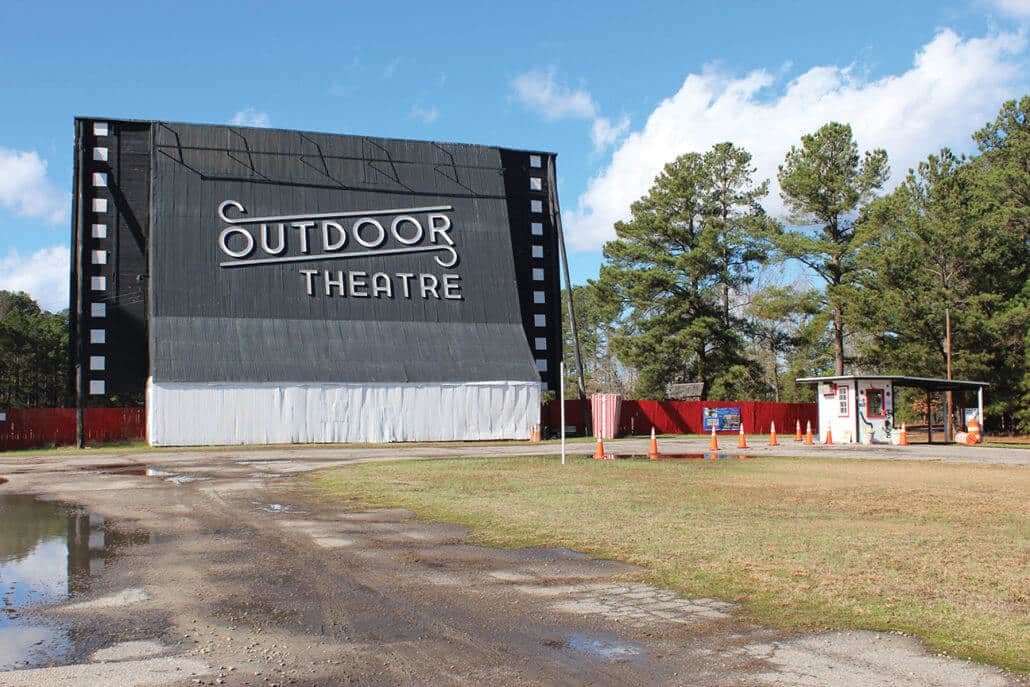
• Another theater, Henderson’s Raleigh Road drive-in, attracts patrons with current releases, fresh air and nostalgia. The outdoor theater is open Fridays and Saturdays from March to December and movie-goers pay per person (rather than 1960s “by the car” style.) Tickets range from $4 to $7. Perks include a pet-friendly environment, double features and a playground. You can sit in your car or outside on lawn chairs or blankets.