The Scoop on Mrs. Cooper

The Scoop on Mrs. Cooper

Sometimes a bug hits a person. I’m not talking about the flu, but something equally as nauseating: me on a stage. That was where I found myself in the fall of 2011. It was just a mild case of the acting bug so I signed up for a drama class at Raleigh Little Theatre.

I spent Sunday evenings in that class with 13 other students, including my sister. Some were in college. There was one mother-daughter pair. And there was a witty gal named Kristin. I knew she was from Oklahoma. I knew she was an attorney, and a mother.

And somewhere between stage direction and tongue twister lessons, I learned she could laugh at herself, genuinely compliment others and self-deprecate with the best. It wasn’t until the end-of-class program, though, that I realized she was married to Roy Cooper, North Carolina’s [then] attorney general. She never mentioned it, but anyone who had ever picked up a newspaper would have recognized him in the audience. 

After the show, we all said our goodbyes. I ran into Kristin a couple of times over the years – always at a show. Kristin often volunteered at the theater assisting backstage and with costumes. But last year, worlds intersected again when I volunteered to help put on the N.C. Governor’s Inaugural Ball with the Junior League of Raleigh, which has hosted it since 1933. Kristin, now North Carolina’s first lady, would be the star of that “show.” Every time I went to an Inaugural Ball meeting, I thought about the personable lady I’d met five years earlier.

Right before Christmas, Kristin invited me to her ball gown fitting and I felt like a kid getting to open presents early. Fashion and the first lady? I was in. I laughed when the designer asked her what bracelet she’d be wearing and she replied, “Not my Fitbit?”

There it was that off-the-cuff wit from a lady who might just surprise you. Here are a few other things you probably don’t know about North Carolina’s First Lady.

She’s no stranger to playbills.

Over the years, Cooper found her place on stage in North Carolina’s community theaters. She and all three of her daughters—Hilary, Natalie and Claire—starred together in a performance of “Camelot” in Rocky Mount. In Raleigh, she and Claire took the stage as Mrs. Frank and Anne Frank in “The Diary of Anne Frank” play. And the Cooper ladies worked together on “The Best Christmas Pageant Ever” in the roles of mother and children.

She’s part of a knitting circle.

You may find Cooper at a craft store picking up yarn and needles. Knitting is a top hobby. She could make a scarf, sure. But her knitting prowess goes beyond to projects such as sweaters (with pockets) and hats. “Knitting makes me feel close to my great-grandmother, who was a master knitter, crocheter, and quilter,” Cooper says. “I like to knit projects that are a little too hard for me. I enjoy the challenge.”

Friend Greg Moore, who calls himself a knitting novice, enjoys the challenge with her. Moore is part of a knitting circle that Cooper leads. During the last two months he’s made three scarves and learned how to make the purl stitch. “I am not a good student, but she’s a good teacher,” he laughs. “She’s so patient and one of the dearest friends.”

She has a soft spot for paws.

Cooper has a big heart for cats and dogs. Her cats Adelaide and Alexei and dog, Chloe, are rescues who have found their way to the mansion on Blount Street. They’re part of a new Facebook page, First Pets of North Carolina, where you’ll also find photos of her daughter Hilary’s dog, Ben.

She’ll scoop in and help.

For over 12 years, Cooper, an attorney who graduated from Campbell Law School, used her legal training to represent foster children in court as a volunteer guardian ad litem. She also served two terms on the North Carolina Arts Council, working to support arts organizations across the state. She served on the board at North Raleigh Arts and Creative Theatre, and is in her second term on the board at Raleigh Little Theatre.

“Kristin is so dedicated and genuine. The thing about her is that she just wants to help,” says Charles Phaneuf, Raleigh Little Theatre’s Executive Director. “She’s great in the board room with strategy and big picture thinking. She’s helped with ticket taking and backstage [tasks] … and she’s even scooped ice cream at a donor event.” 

Bida Manda: Family Ties

Bida Manda: Family Ties

This month marks Bida Manda’s fourth birthday, and the milestone will be celebrated with two guests of honor who have a strong presence in the restaurant yet they’ve never stepped inside. After a 12-year struggle to secure travel visas, owners Vansana Nolintha and his sister Vanvisa Nolintha will finally welcome their parents to Bida Manda—a restaurant named in their honor—for the very first time.

Bida Manda is the ceremonial term for “father mother” in Sanksrit, and the restaurant is a loving ode not only to family but to the Nolintha’s homeland—one that combines culture and cuisine—and transports diners to a far off destination. Sure, the wood that decorates the walls—oak, birch and maple—is all from North Carolina, but the food on the table has exotic origins rooted in Laos, a landlocked Asian country about the size of Illinois.

“We always felt a sense of responsibility to represent an introduction of an entire cuisine. Last year, we served over 100,000 people. That’s 100,000 introductions to Laos,” says Vansana. “We have decided that we should focus on the things that we truly enjoy. So we dig deep into our parents’ recipes.”

DSC_2705aA sacred experience

Thanks to the Mekong River, rice is plentiful in Laos. And thanks to a culture of hospitality, it’s ingrained in a common greeting, “Sabaidee, Kin Khao Leo Bor,” that means both hello and “Have you had rice yet?” says Vansana, 30, who was born Laos.

Rice is a fundamental staple at Bida Manda, offered in a beloved crispy form or sticky texture. There are other favorites authentic to Laos, too. Consider the lemon grass sausage, pork belly soup and spring rolls, which are rolled by hand and—in a moment of reverence—blessed by Noy, a Laotian woman who prepares them.

“Preparing food is a sacred experience in our culture…the craft of making the rolls with intention is very important,” says Van, of Noy’s ability to turn a mundane task into a meaningful practice. “Her gentleness is really contagious in the kitchen.”

Asian Soul Food

What’s on the simple blue and white plates isn’t often called “ethnic food,” though. Bida Manda found a way to bypass that sometimes misunderstood term entirely. Its patrons, the ones lucky enough to get a table, just think of it as food. Good food. And they’ve been raving, posting and sharing about the downtown eatery since it opened in Raleigh’s Moore Square in 2012.

A weeks-long wait for dinner reservations isn’t unusual. But the Nolinthas are determined that each patron feels consideration no matter how popular the eatery.

“If we are not honoring that, we are just going to become a busy restaurant,” he says. “And we really want to focus on relationships, authenticity and community.”

Nolintha’s thoughtful and peaceful approach to the community he serves is one element that distinguishes Bida Manda from other restaurants in the vicinity. Peace is important to Van, who studied design at N.C. State University and international peace and conflict at Trinity College in Dublin, Ireland. It may not seem that those studies would be connected, or even connected to the food industry, but they are to Van.

“Peace is a construction through the community—a comprehensive experience,” he says. “Dealing with peace on a human, day-to-day level is looking at peace as community building.”

The Nolintha’s will open a new gathering place later this year in the 9,000-square-foot space that used to house Tir Na Nog. The space will feature a brewery and Dim sum restaurant with a small retail area that celebrates flowers and books. Van was inspired by the notion of creating a community living room where artists, residents and young creatives, amongst others, could meet.

“The project has its own heartbeat,” he says. “The space will evolve.” But for now, he’s enjoying the mystery of the process and looking forward to celebrating with his mother and father.

Neighborhood Kitchens

Neighborhood Kitchens

At JMR, dining and community join together

Walking into a restaurant where the servers know your name, where you wave to familiar faces, may seem like an image from a bygone area, especially in today’s world of chain establishments and revolving wait staff. But this wistful nod to a neighborhood joint is exactly what Ryan Riek and his brother, Justin Riek, are trying to accomplish, albeit it in a more upscale, contemporary way. Together they are the J and R of JMR Kitchens, with Justin’s wife Miranda as the M and third partner.

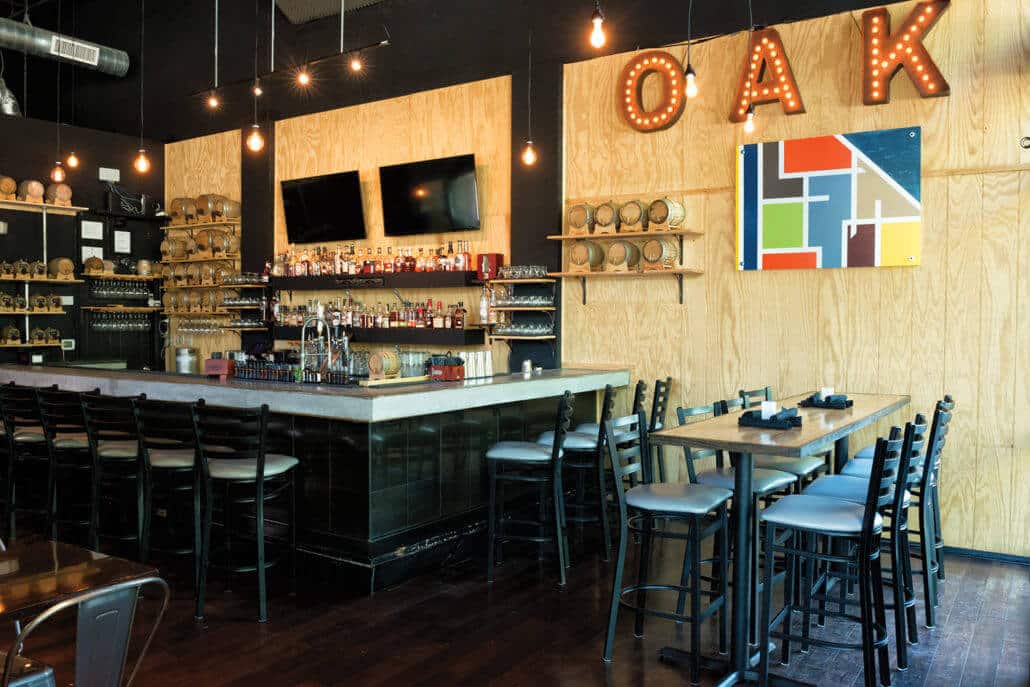
Each JMR restaurant – More, The Oak and Taste – is intimate, with an average seating capacity of 127. And each is nestled in or near a residential area. Downtowners can get to More on foot. The Oak is walkable from neighborhoods such as Meredith Woods. And Taste, located off of Dixie Trail, draws from areas like Sunset Hills. The trio hopes to redefine the customer experience through this hyper local theme, earning repeat patrons who feel comfortable at their establishments.

To earn that repeat business, JMR strives to know their guests, and it requires collaboration amongst the staff. Employee isn’t a word Ryan uses, he sees it as a team effort.

“We stress with all of our staff to know who is in the restaurant, build a rapport, remember who drinks what, and what their food preferences are,” says Ryan.

He enjoys the fact that each establishment attracts different kinds of locals, and as long as people enjoy what they bring to the proverbial table, they’ll continue to build on the concept. For Ryan, the driving force is a passion for the industry he is now trying to redefine, visiting each restaurant two to three times daily.

“You have to love what you do,” he says, adding that he started as a dishwasher at the age of 13. From there he held numerous other restaurant-related positions, including server, corporate trainer, general manager and, even, sous chef. The exposure to so many aspects of the industry has given him a unique and comprehensive vision for JMR Kitchens.

DSC_5698acmykmagNaming Rights

“Taste is our first child and will always hold that special place in our heart,” says Ryan. Rebranded in 2013, the small eatery is its most popular. The surrounding neighborhood quickly embraced the fresh menu (there’s no fryer), larger tapas portions, called morsels, and getting to know Ryan.

Ryan, a wine connoisseur, would bring limited production bottles into Taste to enjoy with customers who shared a similar love of wine. From there the list grew into about 50 bottles at various stages of aging. In the know customers can still ask for a bottle off this unofficial list.

At More, Ryan and Justin decided to cater to vinophiles through personalized wine lockers, a 7in x 5in, vintage-looking locker with customized nameplate. Some members add a first or last name others – such as “hot babe” and “el presidente” – play it up. Whatever works in 15 reasonable characters.

At $115 a month for six months (and six bottles) or $95 a month for a year (and 14 bottles), the program might seem pricy, but the selections are not grocery-store finds. The restaurant features limited allocations, such as a 2009 Barolo single vineyard. Bottles are stored in lockers on the first Friday of each month, and members receive detailed emails about the wine. Some enjoy it at More, others choose to take it home.

Re-aging bourbon

The Oak opened in 2014 under the JMR umbrella. Its niche includes an adopt-a-barrel bourbon program, which has had a waitlist since its inception. Barrels range in size from 2-liters (which the program uses) and five, 10- and 20-liter sizes that the restaurant uses for the house.

Here’s the idea: they pour under-aged bourbon into custom-built, North American White Oak barrels. (Under-age means about two years; most bourbon is aged between eight and 12 years.) The flavor enhances, color darkens and sweetness grows thanks to notes of honey, vanilla and citrus.

“The surface to mass ratio is very intense,” Ryan says. “Three months in a 5-liter barrel is adding quite a bit of age to a product.”

Renting your own barrel creates a sense of ownership and camaraderie at The Oak. Guests invite friends to sample their cask, creating a community of bourbon lovers who share similar interests—contributing to Ryan’s and Justin’s vision of a place where everyone knows your name.

Second Empire – Sweet.

Second Empire – Sweet.

Chef Amber Atkins with her chocolate raspberry pecan layer cake with fresh fruit and house-made pecan butter.

Standing in the basement bake shop, Amber Atkins says she’s a traditionalist. You know: butter, sugar, eggs and flour. The baguettes in the oven and pound cakes on a nearby rack attest to that.

But there’s an oil-based, vegan chocolate cake on the counter, not to mention vegan ice cream made with coconut and cashew milks.

Chef Amber Atkins

Chef Amber Atkins

This pastry chef, it seems, adapts.

If you look at the path that landed Atkins at Raleigh’s only AAA Four-Diamond restaurant, it’s a little untraditional. More than a dozen years ago, she didn’t necessarily love to bake. She hadn’t gone to culinary school. She was a recent high school graduate from Virginia Beach who landed in Raleigh because of her father’s career.

Atkins needed a job, and Second Empire Restaurant needed a pastry assistant. When she walked into the restaurant – located in a renovated circa 1879 home – she didn’t think she had a chance.

“I mean look at this place,” she says today while standing in the east main dining room with its white tablecloths, soaring ceilings and grand wooden staircase nearby.

She was hired, plating desserts at night under the guidance of executive chef Daniel Schurr, or “chef” as she calls him.

“He welcomes anybody that is passionate and wants to work,” she says. “This is definitely a teaching kitchen.”

For Atkins, it was a trial-and-error type of education. Learning by doing. She worked at Second Empire for three years, then left to work in a bakery. It wasn’t the right place for her, though, so she returned to the downtown Raleigh restaurant responsible for her first break.

Atkins learned the house desserts. She learned elements and textures. She was allowed to slowly develop. Atkins still gets a little emotional when she talks about getting a white chef’s jacket with her name on it and being promoted to pastry chef.

“Coming from where I came from, I didn’t think that was possible,” she says. “It was a great feeling to earn that trust from chef.”

It’s a trust she shares with co-workers in the bake shop, where a shelf with ingredients has containers playfully marked: bakin’ soda, cocoa pow and brown shuga.

Some say she’s too trim to be a pastry chef. There’s a difference between eating and tasting, Atkins laughs. It’s about quality control. Plus, she adds, the pastry staff has a lot of stuff—pots, bowls and strainers—to carry up and down stairs.

There’s an elevator, sure, but she doesn’t take it.

Fresh Off the Farm

Fresh Off the Farm

Each Saturday Chef John Ford prepares a farm-to-table dinner — in addition to everything else on his plate.

Stroll the State Farmers Market on a Saturday morning and you may see John Ford.

Sporting a black chef’s jacket, he’s been known to catch the occasional photo request, not to mention a grimace from a Red Sox fan eyeing his navy blue Yankees cap with white, embroidered team logo.

“That’s all right,” Ford, 30, says, grinning about the rivalry and his hat. “It always stays on.”

When Raleigh Magazine caught up with him earlier this year, he was preparing for a farm-to-table dinner at Cameron Bar & Grill. Ford began the special, Saturday-night dinners in May 2015. The meal is an addition to the regular menu, which is available, too.

To many, that may just sound like more work on an already-busy day in the restaurant world. But, for Ford, it’s an opportunity to be creative and use local, in-season produce.

“It gives me something different to do,” he says. “And I have great respect for fishermen … and the farmers who work so hard to bring us the amazing produce and meats. It’s not about slapping something on a grill and calling it a day. It’s about taking something farmers have and making something really awesome for guests.”

Each weekend he hits the market, often with his wife Natasha, and selects ingredients for side dishes; he picks the protein ahead of time. Ford purchases and cooks for about 20 portions. And the meal almost always sells out, he says.

To go with NC black sea bass, Ford buys turnips. But they’ll roast to a white hue, so he picks up oriental purple potatoes to bring color to the plate. Ford has favorite farm stands, such as the one with an array of herbs like Thai basils.

Working with food has been part of his life since he was a teenager growing up in northern New Jersey. His choice to attend culinary school at the Art Institute of Raleigh-Durham was no surprise to those close to him.

“My dad always told me, ‘If you’re gonna do a job, make sure you enjoy it,’” says Ford, who has been head chef at Cameron Bar & Grill for 15 months. “I enjoy it and take a lot of pride in what I do.”

And he’s willing to make it fun for those around him. Just ask the staff, especially the guy who likes to work to constant Whitney Houston music, which is fine by Ford.

“As long as they’re happy,” Ford laughs. “Because when we’re working and we’re happy, time goes by quicker and people are more willing.”

Fresh Off the FarmIt’s Dinnertime


Chef John Ford preps a farm-to-table dinner each Saturday night. Here’s one example: North Carolina black sea bass, purple mashed potatoes with Goat Lady goat cheese, caramelized turnips sautéed with local spinach and topped with lemon-chive beurre blanch and sautéed leeks. (Beurre blanch = white butter.)