Collaboration and big-picture thinking produce a proposed new district.
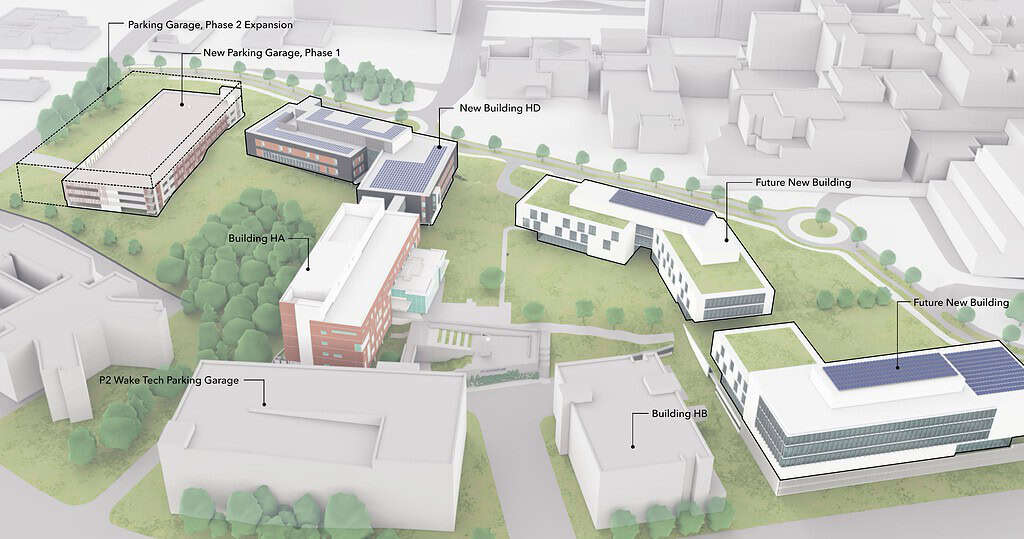
If you’ve seen Yellowstone, you know property ownership and inheritance dealings can turn ugly quick. But when Wake County, WakeMed and Wake Tech VIPs assembled to discuss the future of the area surrounding WakeMed’s campus off New Bern Avenue in Southeast Raleigh—where each institution owns a portion of land—there was no contention. Instead, the three parties decided to throw out property lines and work together to create a health and education district that would benefit everyone.
A remarkable unprecedented move spawning a major impact on Raleigh for years to come, the project will be transformational not just for Southeast Raleigh, but for the entire New Bern Avenue corridor—aka “the gateway right into Downtown,” says Tom Cavender, WakeMed’s VP of facilities and construction. Think green space, pedestrian- and bike-friendly paths, and a quad-like feel augmenting the area and adding to the bus rapid transit construction already underway.
“The synergy that will come from this collaborative effort will reach far beyond the borders of these three institutions to impact the entire community in a very positive way,” says former Wake County Commissioner Sig Hutchinson—“from affordable housing to active lifestyles to creating healthy communities to health care services to educational opportunities.”
According to Cavender, what spurred the project was “essentially a confluence of energy between Wake Tech, WakeMed and Wake County… a situation where the sun, stars and moon all aligned.” In short, Wake County received bond money to build a replacement public health center at New Bern Avenue and Sunnybrook Road—nearly adjacent to both WakeMed and Wake Tech—at the same time Wake Tech and WakeMed were collaborating on long-term plans.
So Cavender called Jeff Carter and Mark Forestieri, his Wake Tech and Wake County counterparts, respectively, and said, “What if we just sat around a table… and thought through a way we can better utilize what we have available to us? It’s a great public-private partnership.”
They gathered key players from each org, and “we said, ‘Peel all your allegiances away: What’s best for all of us when we look at this massive 135 acres of land we have between us?’” Cavender recalls. Everyone was on board—and the idea for a health and education district was born.
“It truly was this notion of an opportunity for everybody to win, and I think that’s what’s going to happen,” says Wake Tech President Dr. Scott Ralls. “Health care needs from our area are going to continue to grow because we’re growing—and we’re growing older at the same time. … We’re the largest higher-ed provider of health care in Wake County and one of the largest in the region, so that’s a key expansion area for us.”
While WakeMed will inherit adjacent land from Wake County for replacement facilities, Wake Tech will gain significant acreage from WakeMed on the Falstaff Road side to achieve its desired growth. “Right now we’re investing $121 million in the initial expansion for our education part of the campus, so it’s going to mean some big opportunities for Wake County and for the future,” reveals Dr. Ralls.
According to Cavender, the entire district is currently in the rezoning stage and will most likely go to City Council for approval by the end of 2024. If it passes, we could be seeing cranes in the sky by this time next year. The rest is still unwritten because, as Hutchinson points out: “These three institutions erased the property lines and redrew them so each institution would benefit from what they needed versus what they owned. Nothing like this has ever been done before.”
Cavender notes the trio served as the “key component to get this thing off the ground and rolling.” But now he’s hopeful more of WakeMed’s partners and developers willing to invest in the area with speculative incubator buildings will want to join the district.
“We’re being very judicious and purposeful in our thinking,” says Cavender, nodding to child abuse prevention nonprofit SAFEchild’s 20,000-square-foot facility on the campus as an initial partnership to pave the way for further such community collaboration. He also hopes it will serve as a magnet to draw people to the school and to businesses in the area.
“I’ve never seen anything like it,” says Hutchinson. “There is such tremendous leadership in all three of these institutions, and I just continue to be amazed at what they can deliver as a model for not only North Carolina, but also for the rest of the country.”
Wake Tech Phase 1 Plans
New parking garage
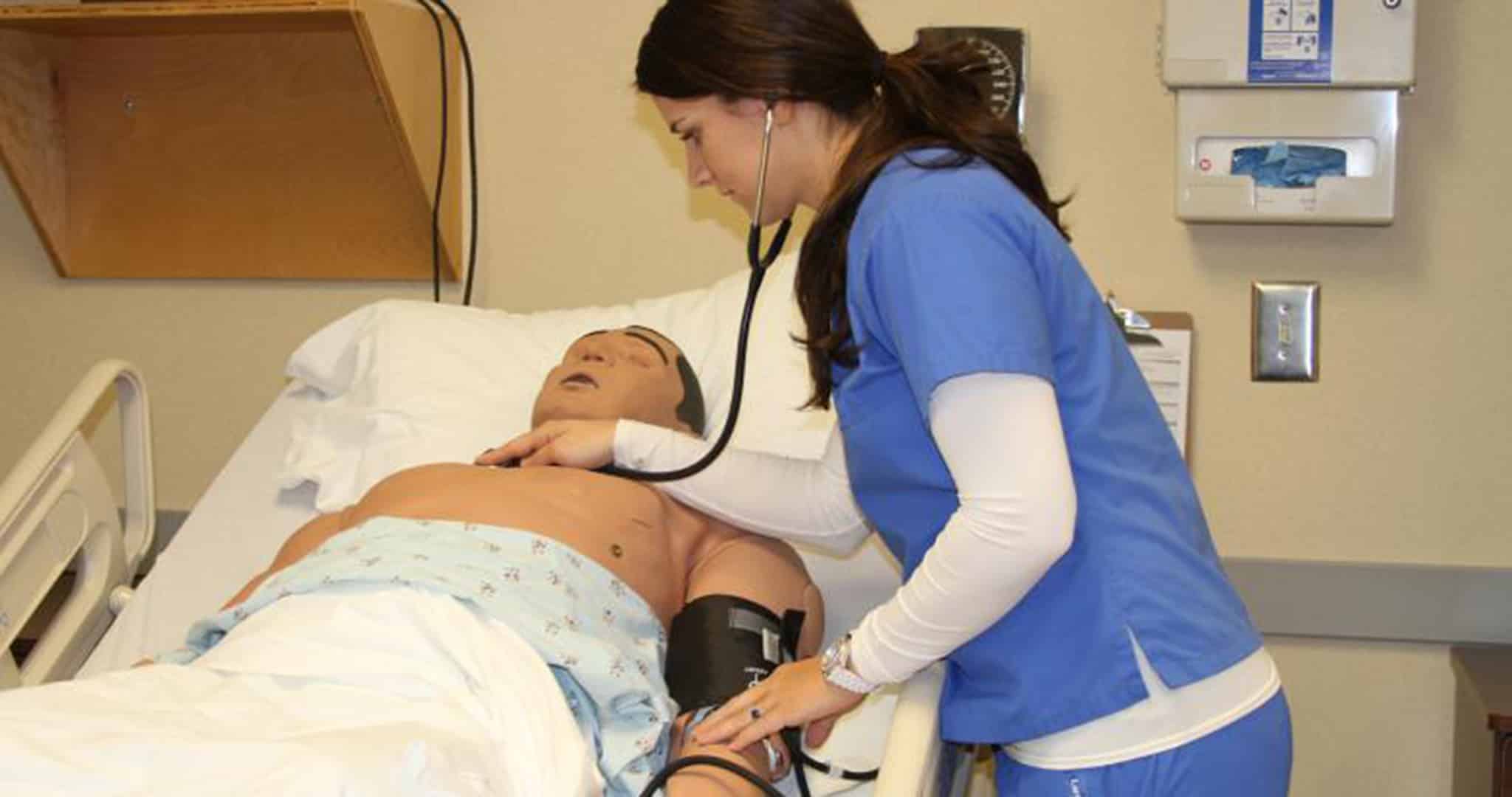
Cutting-edge 106,000-square-foot addition to its Perry Health Sciences Campus—approximately half of which will be a simulated hospital
Expansion of the nursing program and imaging program
Imaging program will boast a partnership with Siemens, making it one of the most high-tech training centers in the nation.
Two additional building sites available to support Wake Tech’s long-term future growth
We tapped our Impact 50 Raleighites for the pods they keep on repeat.
Podcast Raleigh By Raleighites, for Raleighites and about, you guessed it, Raleigh! … Explore topics keeping up with the pulse of our city while staying up-to-date on citywide scoop about everything from foodie news and entertainment to legislation—coming straight from the mouths of local leaders. Picked by: Adrienne Cole, president & CEO, Greater Raleigh Chamber of Commerce
Sibling Revelry Oh, brother! Revel in the banter of celeb sibs Kate and Oliver Hudson as they get real by diving into the evergreen conversation of family dynamics feat. universal tales of siblings, from the awws to the uglies. Picked by: McGavock Edwards, partner/SVP, strategy and client service, E&V Strategic Communications
What Now? With Trevor Noah Join Trevor Noah and guests (think CEOs, athletes, actors, etc.) as they keep things real and candid with what might typically only be heard behind the scenes. Picked by: Stephen Mangano, health care exec, TeamHealth + entrepreneur
Finest Worksongs “Let’s discuss the great albums, they said. Let’s listen, you said.” … Tune in as a duo of Raleigh residents unpack your fave albums and deliver thoughtful commentary on music intel—The Smiths discussion TBD. Picked by: Danny Rosin, co-founder, Brand Fuel and Band Together
Wake Tech is doing its part to address economic mobility head-on by reaching kids early and rallying around them as they climb to success.
It’s that time of year when we find ourselves reflecting on milestones and achievements as we resolve to take the next year next level. For Raleigh—a city that’s grown pretty accustomed to topping “best of” lists—2023 brought numerous accolades. And, yet, in our November Money Issue, we found the city still stacks up as a relatively affordable place to live.
But here’s the catch: not for everyone. The proof lies in one not-so-flattering stat—a lowest of lows that haunts us like the ghost of Christmas past. In 2014, a study led by Harvard economist and professor Raj Chetty revealed Raleigh ranked 48th on a list of the 50 biggest metro areas in the country when it comes to economic mobility. In other words, a child born poor in Raleigh is more likely to stay poor in Raleigh compared to other metropolitan areas. Cue record scratch.
“It’s the opposite of what you think it should be,” says Dr. Scott Ralls, president of Wake Tech, NC’s largest community college. “My first thought was, ‘We can’t be that bad.’ But even if Chetty’s numbers were off by a little bit… it shouldn’t be that way in Raleigh, a place with so much opportunity.”
Now, as we close in on a decade since those startling results from Chetty’s project were unveiled, it seems Raleigh has done little to improve its position (unlike Charlotte, which, after being ranked dead last, took it personally—and jumped into action). But Wake Tech is working to recast the narrative. In 2021 the college introduced a strategic plan called Reach and Rally, which structures programs to foster economic mobility based on a philosophy called ladder economics. “The thing about a ladder is it’s not about how high you can jump,” Ralls explains. “You’ve just got to get from one rung to the next.”
The base rung: outreach. “If you’re going to have an economic mobility impact, you can’t take students—you have to reach them,” says Ralls. To do so, Wake Tech aims to connect with students from families of limited economic means, often with limited exposure to higher education, through embedded supports at Title I high schools—and by cultivating partnerships with orgs such as Communities in Schools,Juntos, and Boys & Girls Clubs serving Wake County.
“Our executive vice president, Dr. Nicole Reaves, says this: ‘If it’s not in your neighborhood and if you don’t really see it, then you don’t dream to be it.’ So we have to kind of broaden what the neighborhood of Raleigh is because Raleigh’s broader neighborhood includes every opportunity imaginable,” says Ralls. “But… you first have to know it’s there; then you have to know it’s possible—and possibility becomes ladders; possibility becomes support.”
That’s where the “rally” aspect comes in. Wake Tech works to keep students tethered to their “ladder” through a robust support system made up of advisers, success coaches and career development specialists.
And thanks to Reach and Rally, change is happening—albeit slowly. “[Economic mobility] will not be impacted by Wake Tech overnight, but it will be made better by Wake Tech,” Ralls emphasizes—“and I think we can say it is being made better by Wake Tech.”
Ultimately, Wake Tech is, in many ways, Raleigh’s best answer to the question: “How can we offer children the best chance to rise out of poverty?” As we embark on a new year, it’s imperative our city’s collective New Year’s resolution be to make Raleigh a good place to live for everyone. So, let’s invest in our community now—and perhaps stage a comeback more rewarding than any accolade Raleigh’s seen yet. waketech.edu
“A place like Raleigh shouldn’t have [poor economic mobility] because there is opportunity here, and there is a place like Wake Tech here, and you don’t have to be rich to go here. There is a way to change what that study is saying.” —Dr. Scott Ralls, president of Wake Tech
Sassool invites the city’s foodies to pick up a Triangle Food Passport and discover the joy of “traveling” to new local restaurants throughout the year.
Grab your passport (and my hand). … Sassool’s latest venture will take you on an international culinary journey—sans the long flight. Enter the North Raleigh Mediterranean market and resto’s recently launched Triangle Food Passport, a collaborative effort with 12 area restaurants, cafes and grocers designed to inspire diners to branch out and boost local small businesses.
Sassool co-owner Noelle Saleh says a lightbulb went off while gathering with fellow restaurateurs during one of their family dinners last year. “We were trying to think of ways that we could support each other as restaurateurs other than giving advice or lending an ear,” she says. “We wanted to find a way to cross-promote each other and get our customers to try out restaurants that we love but maybe haven’t tried yet.”
Together they launched the Triangle Food Passport, which boasts exclusive offers from local businesses including Sassool, Raleigh Rolls, Big League Waffles, Cheeni Indian Food Emporium, Bitten Bakery, Alpaca Peruvian Charcoal Chicken and more. Diners who purchase the $25 passport can visit each participating restaurant to redeem the offer in exchange for a “stamp,” making any midday coffee break or meal with friends suddenly feel like a jet-setting adventure.
“The passport came from the fact that many of our businesses offer food from around the world,” says Saleh. “We wanted to give people an opportunity to travel the world without leaving the Triangle.” Best of all, the new program further bolsters the food and beverage community by donating a portion of all proceeds to the Wake Tech Foundation to assist a full-time second-year student at Wake Tech with a culinary scholarship. What’s not to love?
Ultimately, the initiative offers a chance to have fun and explore by playing tourist in your own hood for a change. “Our greatest hope is that Raleigh diners discover their new favorite restaurant, bakery or food establishment,” says Saleh. “The Triangle is ripe with talent and hosts a super passionate restaurant community. We want you to experience our passion through our food.” Get ready for takeoff!
One of the state’s premier providers of health sciences training, Wake Tech is planning a 120,000-square-foot facility on its Perry Health Sciences Campus if the Wake Tech Workforce Forward Bond passes in November. The $353 million bond will fund a four-year plan for growth, and also includes the construction of a permanent Western Wake Campus in Apex and a new cyber/science training facility on the RTP Campus.
Perhaps the most significant plan for the new facility is a simulation hospital that will offer human patient simulation, virtual reality, task trainers and computerized simulation, complete with a nurses’ station, hospital rooms, control rooms and debriefing rooms. The facility will also house state-of-the-art labs for imaging programs, including medical sonography, radiography, CT, MRI and mammography.
“Our new building will be critical to taking Wake Tech’s health sciences programs to the next level,” says Wake Tech Provost Dr. Angela Ballentine. “The simulation hospital will allow students in multiple disciplines to learn in a real-life setting while incorporating new training technologies to prepare students for high-demand jobs.”
Wake Tech’s health sciences programs already serve nearly 6,000 students annually, and the Martha Mann School of Nursing is the largest associate degree nursing program in the state, enrolling 300+ students each year. The addition of the new facility—slated to begin construction in 2025, with expected completion by 2027—will help the community college prepare the many skilled professionals who are so vital to Wake County’s longevity and quality of life, according to Wake Tech President Dr. Scott Ralls. Wake Tech would also add new programs in areas like mental health, respiratory therapy and disability support.
“Wake County’s population is not only growing, it’s getting older,” says Ralls. “As one of our state’s premier providers of health sciences training, we’re committed to expanding capacity.”
Ultimately, this is up to you, Wake County. Don’t forget to vote Nov. 8. There are three bonds on the ballot: Wake Tech Workforce Bond, Raleigh Parks Bond Referendum and Wake County Public School System Bond.