NC State’s engineering program expands to meet the growing STEM needs of the Triangle.
North Carolina’s growing tech economy demands a larger skilled workforce—and NC State is stepping up to the plate, expanding its engineering and computer science program by almost 40% over the next five years.
“It’s very exciting to see Raleigh and the Triangle experiencing such dramatic economic growth,” says NC State Chancellor Randy Woodson. “We’re very involved with economic development. A lot of the companies that were looking to come to the Triangle—NC State was very involved in recruiting them here.”
It is no secret that the Triangle has become a tech hub, from existing companies like IBM and Cisco to the announcement of the arrival of Apple, Google and FUJIFILM Diosynth Biotechnologies. By adding 2,000 graduate and 2,000 undergraduate students in needed disciplines, the state’s largest public university is positioned to help contribute to the growing workforce.
“It’s important to us to meet the growing needs of the state,” says Woodson. “Our growth is really a response to the critical needs of the state of North Carolina, and we’re pleased to be the driver of the economy of the state.”
The growth will be funded by Engineering North Carolina’s Future, a state legislative initiative that will provide $50 million to hire faculty and support staff, as well as upgrade facilities. (Engineering NC’s Future is also providing funding to NC A&T and UNC Charlotte.)
“The legislature has always been very supportive,” says Louis Martin-Vega, dean of NC State’s College of Engineering. “They also have made the connection very clearly between greater investments in engineering, computer science and economic development—not only in the Triangle area, but in the whole state.”
More recently, the commitments that have been made by worldwide companies to come here and expand and grow depend a great deal on talent in the engineering and computer science fields that are already here and have existed here for many years.
“I don’t think [the companies] would even be looking at coming to the Triangle or NC State if it weren’t already for the track record that there is,” says Martin-Vega. “Our graduates have already contributed significantly to the growth and development of so many companies in this area and in the state.”
Through growth, the university has the capability to keep potential students in the state. Last year alone, the College of Engineering denied admission to 1,400 undergraduate engineering applicants who had a 3.75 or higher unweighted GPA due to lack of space. Unfortunately, many of those students not accepted left North Carolina for other large engineering programs like Purdue, Virginia Tech and Illinois. Now, there will be fewer missed opportunities to retain those students.
“Our graduates want to stay here for the most part,” says Martin-Vega. “If there are opportunities in this area, this is exactly where they stay. It builds on itself. It’s been growing and building for years, and we’re really proud that our college has grown and now is going to continue to grow even more.”
Wake Tech 4.0
NC State is not alone in advancing their sciences. Wake Tech’s current main goal is to construct its East Campus, or Eastern Wake 4.0, with the focus of growing engineering, biopharm and applied engineering to meet demands. (The campus should start serving students in 2024.)
“We’re growing in our campuses, and we have a lot of opportunities directly in response to that growth and to support that growth,” says Keith Babuszczak, chief campus officer for the Wake Tech RTP Campus and Provost of Information Technology Programs.
Also, by having courses that easily transfer to its partnership schools like NC State, (including Engineering Mechanics – Statics; Engineering Mechanics – Dynamics; and Logic System Design) Wake Tech’s fundamental engineering courses are able to give students a head start in their engineering career. Additionally, Wake Tech is able to encourage high school students to enroll in its technical programs, preparing them for some of the opportunities coming to the Triangle.
“Wake Tech is uniquely responsive to help meet the needs of the existing labor market, as well as the companies coming in,” says Babuszczak. “We provide access for a wide diversity of students to enter into these high-tech fields, and companies say hiring a diverse workforce is important. Through multiple campuses, our mission as a community college is to provide access to a diverse population and provide access to graduation and jobs.”
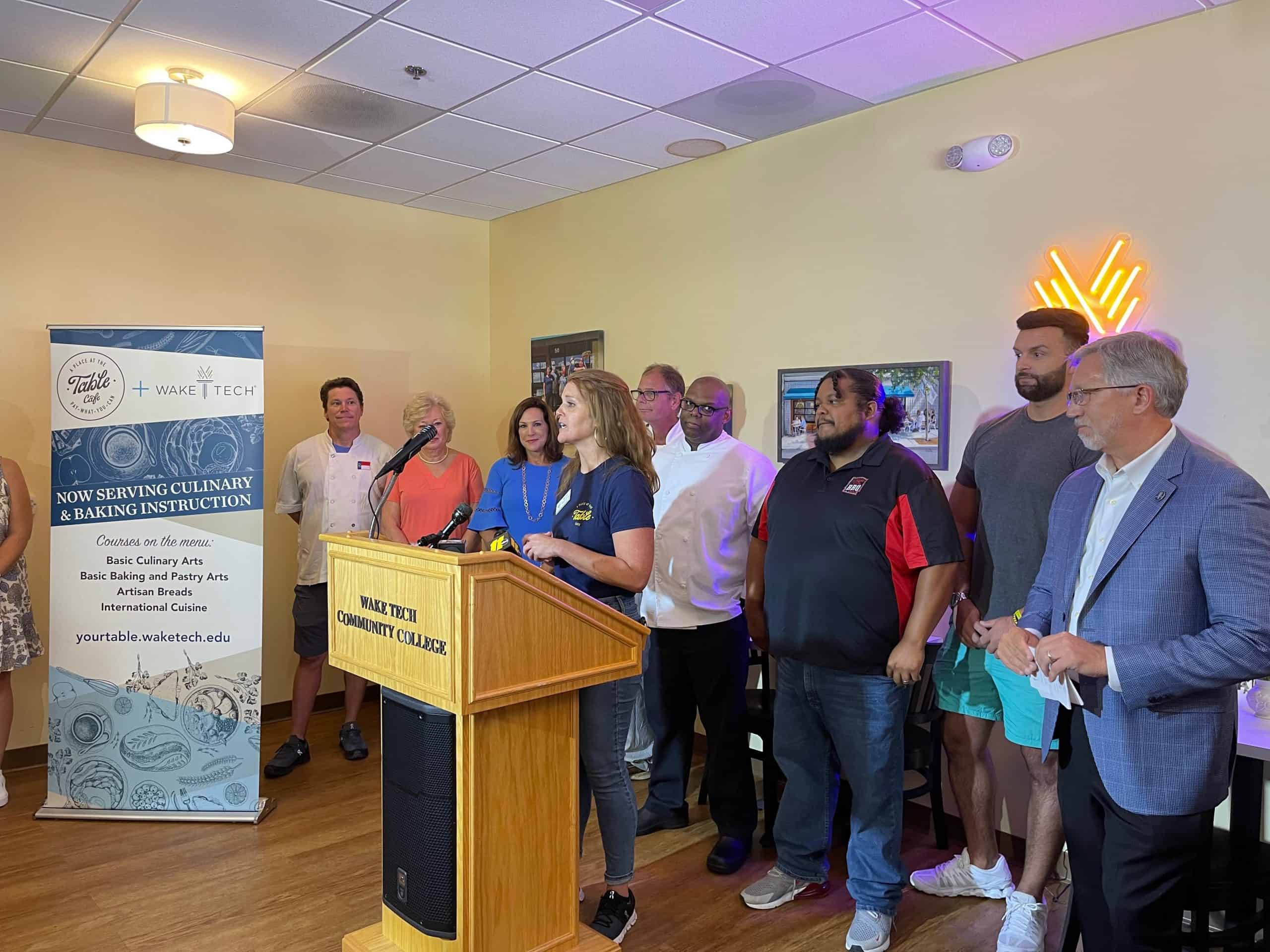
WEB EXCLUSIVEWake Tech and A Place at the Table team up to provide hospitality training to community membersin the wake of Raleigh’s struggling post-COVID restaurant industry.
If your favorite restaurant is still closed for lunch (or is reducing the number of days they’re open in general), A Place at the Table and Wake Tech Community College have a solution. The two local institutions have teamed up to train underemployed and unemployed members of the local community to work in Raleigh’s struggling restaurant scene during APATT’s off hours.
With the demand to dine out on the rise and a current shortage of trained hospitality workers, the launch of this partnership comes at a time when hotels, restaurants, bars, breweries and food trucks need employees now more than ever. Through the free hospitality training program, students will come in to APATT once it closes (Tuesday through Friday at 2pm) for on-the-job training. Students will learn hospitality and culinary skills that will result in industry-recognized certificates with the potential to open up a plethora of opportunities with local restaurateurs.
Wake Tech’s light will come on whenever classes are in session.
“Our goal is to be the place to go to find qualified help and funnel a pipeline of trained students who can work and grow in the companies that they get hired,” says Sameer Pawa, Wake Tech’s director of the hospitality workforce.
Wake Tech has been running its hospitality training program for more than a decade, placing over 70 percent of its students in the workforce in the process. The college chose APATT as its most recent program partner due in large part to the fact that the beloved cafe has recently expanded its space—and it closes early every day, allowing these culinary trainees to get experience in a real Raleigh restaurant kitchen.
“We love everything about Wake Tech and can’t wait for them to be in our space,” says Maggie Kane, executive director of A Place at the Table. “We believe everyone should have access to community and good food, but by bringing this awesome culinary program Downtown, folks will also have access to an affordable education and stable career.”
Adds Kane, “The culinary industry needs more awesome folks to join the industry and this will only bring valued employees to all of our restaurants, cafes and hotels!”
The program will begin on Aug. 16 and run for nine weeks. We’re hungry to see how much it helps Raleigh’s hospitality industry and can’t wait to see what kind of great talent comes out of it. Register here.
A Wake Tech course prepares students to navigate the shifting landscape of social media marketing.
Social media isn’t just for teens posting selfies; it’s how we keep up with friends and family, get our news and, increasingly, seek out goods and services. That’s why, whether it’s on Instagram, Facebook, Twitter or Snapchat, it’s especially important for modern businesses to maintain a social media presence.
This summer, Raleigh-based digital marketing agency Walk West partnered with Wake Tech to offer a new, 16-week course in social media strategy and management. The goal of the course is to introduce students to social media management with lessons around analytics, paid media, influencer marketing, writing marketing strategies and more.
“Social media is going to be a part of the customer journey,” says Ann Marie Taepke, director of digital media at Walk West who helped teach the course. Taepke has personally led digital marketing campaigns for well-known brands including Velcro and AstraZeneca at Walk West, shaping social media strategies through video production, influencer outreach, paid medium and other initiatives. “You want it to be part of what’s pushing someone down the funnel to convert into a purchase or a sign-up. People don’t realize that there’s a lot of fundamental marketing you need to learn about, even when you’re just applying it to social media marketing.”
Ann Marie Taepke of Walk West
During the Wake Tech course, students worked with real-life clients—all startup companies—to find out what the businesses’ goals were and to create and present social media plans for them. Benjie Davis, founder of personal styling business Wirl, served as one of the students’ clients; Davis says he had his own goals in participating in the course and learning about how to get the word out about his company.
“They gave me a different perspective on how other people view us,” Davis says of the students’ proposal. “I’ve been more mindful of that and how [people] might view us if they came across us on social media.”
While courses like the one Wake Tech partnered with Walk West on are relatively new, businesses have been using social media in their marketing for nearly two decades now. But, of course, social media has evolved since Facebook launched in 2004, with Twitter following in 2006 and Instagram in 2010. Taepke, who previously worked at Cary-based Ignite Social Media—the first solely social media marketing agency in the nation—says social media used to consist largely of professional, picture-perfect feeds that felt very impersonal.
And while that strategy is still relevant in some markets, Taepke says she’s noticed that most businesses on social media are leaning towards more authentic, less curated presences, which helps brands connect to their customers on a personal level and feel more relatable rather than as if they’re just trying to sell something.
“The whole reason why social media was big when it came out and is still relevant is because it is a two-way conversation with the brand and with the consumer,” says Taepke. “We need to be talking with these people, not at them.”
Brand Cam—an open-air digital photo booth which aims to create unique, intriguing content for its customers—is a case study in how brands can co-create content and maintain an authenticity that attracts more potential consumers, explains Raleigh-based entrepreneur and founder Cam Lilly. Brand Cam records GIFs, boomerangs photos and videos of people at events, conferences or simply within a business’s normal operating hours that are instantly uploaded to a gallery and texted to users.
Cam Lilly, founder of Brand Cam
This allows both the brand and consumers to upload live content in the moment and share it with their followers. It’s an exciting, approachable way to promote a brand and a way to stand out among competitors on social media.
“If these are your customers and they’re posting something on your behalf, it’s authentic,” Lilly says. “When folks see that social content from a person they know, they say ‘that’s a cool place, I should go there.’ So it’s more of a friendly, native way of advertising. And it’s also kind of fun.”
In the future, Taepke says she sees social media as lending itself to more micro-niches and intimate, private groups within the larger social media platforms that we see now, with even more emphasis on those aspects of authenticity and connectivity.
“It’s going to be interesting to see how we penetrate into that as brands and engage with users in a meaningful way, and in a way that they don’t feel encroached upon,” Taepke says. Whatever the future of social media marketing for businesses holds, one thing’s for sure — you’re not going to be putting your phone down anytime soon.
Wake Tech will offer the course in Social Media Strategy and Management again in the fall semester. Find out more at waketech.edu.
North Hills, Five Points, Cameron Village and Downtown. These are the areas Raleigh foodies typically think of when deciding where next to eat out. But there’s one hidden gem for dining that’s likely never been on your radar: Flavors, located at Wake Tech’s Southern Wake Campus, on Fayetteville Road.
Flavors is a full-service restaurant operated by students in Wake Tech’s Culinary Arts, Baking and Pastry Arts, and Hospitality Management programs. It’s open both to the public and to the college community and it boasts a range of gourmet dishes, with a menu selection that changes based on whichever cuisines and techniques the students are studying in the classroom at any given time.
Students of the program prepare you a gourmet, three-course meal for just $10, a deal that almost certainly tops any other three-course offering in Raleigh. Dishes include Sautéed Pecan-Crusted Chicken Breast with Apple Jus, Duck Confit Napoleon with Figs and Turnip Puree, Goat Cheese Ravioli, and Coconut Cream Cake for dessert, to name just a few of the delectable offerings.
Wake Tech’s 30th anniversary is next year, so now is a perfect time to visit the restaurant, which was integrated into the campus in 1996, chiefly as a teaching tool for culinary arts and hospitality students. With a state-of-the-art teaching facility, Flavors connects classroom instruction with workplace experience, providing hands-on contact while allowing students to practice, and show off, the skills they’ve learned in their kitchen labs.
Two different classes are integrated into the on-campus restaurant setting. One involves food and beverage service in the hospitality industry, which both culinary and hospitality students must take, requiring students to engage in and learn about front-of-house service. The other is a culinary class in which students learn back-of-house responsibilities and how to prepare the food that’s going out to customers.
Jeff Hadley, the administrative department head of the Culinary Arts program, says on-the-job learning is a vital part of Wake Tech’s associate degree, diploma, and certificate programs in the culinary and hospitality fields. Along with working at the on-campus restaurant, culinary students must fulfill a work placement requirement that entails completing credit hours of work in their selected discipline, a total of 320 credit hours per semester. Students are well-positioned and likely to obtain full-time jobs from these internships after graduating, securing their spots in the food and beverage industry and preparing them for further advancement.
You might not know it, but many of these graduates currently work at some of your favorite local dining establishments. One of Wake Tech’s most well-known success stories is that of Caroline Morrison, the owner and founder of Fiction Kitchen, a vegetarian/vegan restaurant serving thoughtfully prepared dishes with fresh ingredients.
A vegan herself, Morrison used what she learned working with meat in her classes at Wake Tech, and applied that knowledge to non-meat items in order to curate a completely vegetarian menu.
Additionally, many Wake Tech graduates work under renowned local chef Ashley Christensen. “It’s amazing when I go out to eat and come across someone I remember from the program,” says Hadley.
There’s a lot of talent within the classroom kitchens and in the on-campus restaurant at Wake Tech, with graduates making it big in both North Carolina’s food and beverage scene and beyond. Visit Flavors to taste for yourself the talent coming out of the college’s Culinary Arts program; who knows, the dish you enjoy might just come from from a future James Beard Award-winning chef. waketech.edu/flavors
It’s a college student’s dream: instead of going to class to learn about American history or biology, you’re going to learn about beer. With the trend of locally brewed craft beer growing here in Raleigh, it’s only logical that college students now have the opportunity to take courses in the trade, with hands-on training at various breweries included in the course descriptions.
The newest educational brewing concept comes to Wake Tech Community College in the form of a restaurant and brewery in the 5401 North neighborhood development. The as-yet unnamed space will offer students in Wake Tech’s craft beer classes access to commercial brewing equipment, classrooms and lab space.
The Craft Brewing Course at Wake Tech prepares students for entry-level work in craft breweries through lessons in fermentation, cellar operations, instruments, malting, hops, clarification, racking room operations, bottle shop operations and more. Students also get to produce beer as a group with their classmates.
Tin Roof Beer Concepts will open and operate the brewery-restaurant, providing a brew master who will advise the faculty and students enrolled in the course. Tin Roof is Baton Rouge, Louisiana’s largest craft beer brewery and also operates a local tap room near Louisiana State University.
“Wake Tech is excited to collaborate with 5401 North and Tin Roof Beer Concepts to provide classroom and hands-on training to prospective craft brewers in this new state of the art facility,” said Anthony Caison, vice president of Workforce Continuing Education.
Students of the program can expect a full-sized brewery, as well as a second, smaller brewing system that will accommodate Wake Tech’s brewing class needs and may also be utilized to make small-batch specialty beers. Additionally, a separate classroom-sized space was designed with lab equipment, which the restaurant can also use for special events or private dining functions.
The restaurant-brewery is expected to break ground by the end of the year in the 400-acre 5401 North neighborhood adjacent to Wake Tech’s Northern Campus in Northeast Raleigh.
“We are thrilled to be entering the distinguished craft beer market of Raleigh, North
Carolina where we know people have an appreciation for craft beer,” said William McGehee, co-owner of TRB Concepts.







 Flavors is a full-service restaurant operated by students in Wake Tech’s Culinary Arts, Baking and Pastry Arts, and Hospitality Management programs. It’s open both to the public and to the college community and it boasts a range of gourmet dishes, with a menu selection that changes based on whichever cuisines and techniques the students are studying in the classroom at any given time.


 “Wake Tech is excited to collaborate with 5401 North and Tin Roof Beer Concepts to provide classroom and hands-on training to prospective craft brewers in this new state of the art facility,” said Anthony Caison, vice president of Workforce Continuing Education.