by Adrienne Fouts | Dec 1, 2018 | December 2018 / January 2019, Polish, Stuff
Emily Neville wants to breathe new life into clothing.
We’re all familiar with the struggle of cleaning out our closets and finding old clothes that are no longer wearable, so we donate them, or worse, we throw them out entirely. For a select few of us, we even attach sentimental value to some pieces of clothing; they just sit, taking up space but are not being used.
 Neville says she notices a lot of that struggle as a student at NC State. Most people don’t have the time or resources to make their own updates to their clothes, as Neville loved to do growing up—she’s been sewing since middle school—so the world ends up with massive amounts of textile waste. This gave Neville the idea to transform old clothes into fresh products for their owners, and so, in the fall of 2017 during her sophomore year of college, Reborn Clothing Co. was born.
“I love fashion, I love clothing,” Neville says. “I think we really care about our clothing more than we sometimes think about. And I would like people to care even more about their clothing.”
People can choose a product they want on Reborn’s website—pillows, baby blankets and dog bandanas are a few examples—and then ship the clothing they want transformed to Reborn’s new headquarters/cut and sew facility. The Reborn team (about 15 people in total, including students from NC State’s College of Textiles who assist with sewing and product design) will then transform the garments and ship the new product back to the owner.

Reborn aims to fill a hole that Neville sees in the sustainable fashion market: a personal touch. While consumers today can easily buy products made from recycled materials, those hold less meaning than something made from their own garments, especially when there is a story attached. Just last month, a teacher sent about 20 T-shirts that she’d compiled over her years of teaching for Reborn to make into a blanket. Another woman whose friend’s baby had passed away sent in some of the child’s onesies, which Reborn transformed into coin purses.
“This isn’t new, this is something our moms or grandmas used to do, patch up clothing,” Neville says. “And we not only want to bring that back but actually add even more value to the garment than it had before.”
But Reborn’s operations don’t stop at the individual consumer level. The company recently announced a partnership with
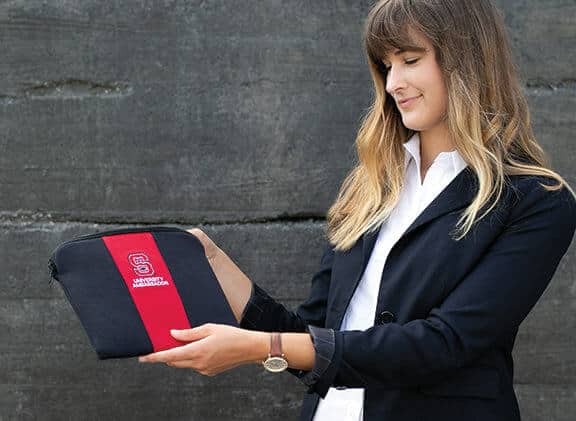
NC State, which stores a huge amount of unusable clothing and textiles from various departments, including athletics. The excess textiles are donated to Reborn, which then transforms them into products that can be sold in the university bookstore—what once was an old piece of athletic gear with the NC State logo might be transformed and sold as a Wolfpack laptop case or travel bag.

“What sets Reborn apart from other upcycling companies is that we use the logo and the value of that product as it is, so we’re not breaking down the clothing into new fibers and starting from scratch,” Neville says. “We’re able to really transform these garments into products that don’t look like the original garment, but they are—we’re preserving that original character.”
Neville’s vision for Reborn goes far beyond NC State—she plans to expand to other North Carolina universities and to out-of-state schools as well.
“Hopefully, our name and brand become recognized so that students across the country want to purchase Reborn upcycled products, and they know that it’s made from their own university’s textile waste,” she says.
Aside from universities, Neville sees a wide array of partnership opportunities ahead for Reborn. She has already worked with the Loading Dock, a coworking space, to improve its sound quality by creating acoustic panels from recycled textiles, and plans are in the works for opportunities with other local businesses.
Now a junior at NC State, Neville plans to stay with Reborn for as long as she can to help it grow to its full potential.
“I care a lot about creating something that’s able to be sustained and continuing to make that lasting impact,” she says. “We’ve been able to prove that there actually is a need for this and that we’re able to do really good, cool work with textile waste.”

by Adrienne Fouts | Sep 30, 2018 | Buzz, October 2018
They’ve taken over the streets of Raleigh: dozens of sleek, black, electric scooters, leaning up against buildings, hanging about on sidewalks or zooming around town under the feet of happy riders. As we reported last month, Bird, a dockless scooter-share company based in California, first arrived in the City of Oaks in July, with scooters popping up all over downtown early one morning and nary a heads up to anyone—except for a small group of people tasked with making sure these Birds stay flying.

 Allie Jacobs and Dylan Bouterse are two local Bird “chargers,” as they’re known, and both got involved in similar ways: After riding the Bird scooters in California, they signed up on the company’s website to work as chargers. Neither thought much about it until they received messages this summer, just before the scooters appeared here, asking if they were still interested. Jacobs, Bouterse and several others met for an orientation in early July, when they received a few chargers and scooters and were told to drop scooters off in designated locations by 7 a.m. the next morning, introducing Bird to Raleigh for the first time.
The Bird chargers use an app that’s similar to the one riders use. A map shows the location of each Bird, but on the chargers’ app, it also shows the Bird’s remaining battery life. All of the scooters become available to pick up beginning at 9 p.m. each night, or as soon as a scooter hits 15 percent battery life. Jacobs and Bouterse grab a couple of scooters on their way home from work, if they can, or else they head back out later in the evening to hunt for Birds, take them home and charge them overnight. Jacobs has six Bird chargers; Bouterse has 11. The scooters have to be returned to their “nests” or drop-off locations around the city, between 4 and 7 a.m.
“You can choose to charge as much or as little as you like,” Jacobs says. “There are some people who do this as their job, but I just do it for fun.”
For many chargers, the challenge of the “hunt” for Bird scooters is the best part.
“For me, I love seeing a scooter pop up on the map and knowing that it’s like a $5 bill sitting on the ground, running out and being the first person to get it, and then bringing it back to the safety of the nest,” Bouterse says. He compares the search for scooters on the app to the popular Pokémon Go game.

Chargers are paid per scooter, which range in value between $5 and $20. Bird incentivizes scooters that haven’t been found or charged in a while by raising their value; it’s rare to find a scooter close to $20, but it can be done. There’s really no cap to how much money you can make from charging Birds, depending on how many chargers you have and how much effort you put into the process. Bouterse and his wife, Karla, set a goal of paying for half of a wedding celebration, coming up in November, with money they make from charging Birds.
Although it’s a hobby for most chargers—Jacobs and Bouterse already have steady day jobs—for some, it can become almost an obsession, Bouterse says. “There’s a whole strategy to it, if you really get into it, to make the most of the chargers that you have.”
On a nice day, when a lot of people are out riding the scooters, Bouterse knows that they will likely run out of battery power a little earlier, so he’ll be able to go out and scoop some up in the afternoon or evening instead of waiting until 9 p.m. Some of the more dedicated chargers wake up in the middle of the night to swap out scooters (which are fully charged after about five hours) so that they can charge twice as many. Others go a step further and hoard uncharged scooters in their homes until they go up in value—though this is against Bird’s policy.
Bouterse, though, isn’t interested in the money as much as in the mission of providing a good experience for Bird’s riders. He runs a Facebook group for Raleigh’s Bird chargers, which he estimates about half of the city’s chargers belong to. “Our group is very much in line with the success of the program,” Bouterse says. “We’re doing this for the riders.”

When the scooters dropped without warning this summer, they were met with mixed reactions from Raleigh residents and city officials. Some voiced concerns about safety and called to regulate the scooters or even ban them entirely. Raleigh’s City Council is set to revisit the issue soon, and city staffers are currently working on drafting rules to potentially keep riders, and the company, in check. But other companies, including Lime, which also dropped scooters in Raleigh last month, not to mention the demand from riders for scooters, seem to be outpacing the city’s ability to regulate them.
Jacobs and Bouterse, for their parts, believe strongly in Bird’s business model and think that Raleigh, with its high population of young people, is an ideal city for the Birds to live in. Both Jacobs and Bouterse are advocates for public transportation, and urge Bird riders to be responsible—wear helmets and ride on the road, not on the sidewalk—so that the scooters can remain in town for everyone’s enjoyment.
“I’d love for us to be an example of being able to embrace this new thing,” Bouterse says. ■

by Adrienne Fouts | Sep 14, 2018 | Eat, September 2018
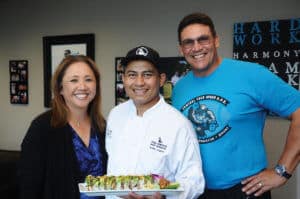 Sushi probably isn’t a food that comes to mind when you think of football. But this season, thanks to Carolina Panthers head coach, the play-calling risk-taker Ron Rivera, that’s not the case. Rivera has partnered with The Cowfish Sushi Burger Bar to develop the “Riverboat Ron Roll,” in support of a cause the coach cares about: promoting pet adoption. The delicious roll features softshell crab, kani and cucumber topped with avocado, eel sauce and spicy mayo, served with poke and avocado on the side. For every Riverboat Ron Roll sold, The Cowfish locations in Charlotte and Raleigh will donate $2 to the Humane Society of Charlotte and SPCA of Wake County. The Riverboat Ron Roll, which costs $17, is only available until the end of this month, so give it a try and celebrate an important cause as well as the beginning of football season. Go Panthers!

by Adrienne Fouts | Sep 7, 2018 | Do, September 2018
Twenty-seven artists, 27 pieces of art, 27 years: Works of Heart returns this month, with some changes, after a six-year hiatus. The art auction is revamping its format, moving to a new venue and scaling down in size, but still has the same goal of benefiting the Alliance of AIDS Services – Carolina (AAS-C). Works of Heart not only raises funds for the services and education that AAS-C provides, but also showcases the strong community of local artists, some of whom have donated to the auction every year since its beginning.
Preview some of the pieces that will be auctioned below, and hear what the artists have to say about their work and why they contribute to Works of Heart.

Kinston Swamp
Kinston Swamp by Lori White
As an environmentalist, Lori White is inspired by the natural world, and it shows in her art. Following a career in environmental science, White started to actively paint again in 2002 and got involved with Works of Heart soon after. This year, she is donating her painting Kinston Swamp, based on an area she stumbled upon along the Neuse River.
“I’ve donated foggy, surreal paintings to Works of Heart before, and this kind of fits in with that genre,” White says. “Using the word ‘swamp’ as a metaphor for something bad is not good because swamps are really essential for habitat and biological diversity. They get a bad rap and don’t deserve it.”
Sense of Gratitude by Grace Li Wang
“Gratified and blissful” are the emotions Grace Li Wang felt as she created Sense of Gratitude, her vibrant submission to this year’s Works of Heart and part of her art book, Radiance in Nature. “I just feel that radiance is what we’re about as humankind,” Wang says. “We receive the sun’s radiance as we go through life.”
Wang has participated in Works of Heart for over a dozen years, donating every year since she first discovered the auction. “Works of Heart is all local, so that makes it hard to do from scratch every time,” Wang says. “It’s a labor of love for a great cause and a great way for the artists to get exposure.”

Daybreak
Daybreak by Yuko Nogami Taylor
For Yuko Taylor’s first year as a Works of Heart contributor, she is donating Daybreak, a piece that was recently exhibited in the residence of the Japanese Chair of the World Bank in Washington, D.C. Taylor says she is excited to be part of an auction that is supported by, and supportive of, local artists.
“As it is important for me to be connected with locals and communities,
I pick three strong art contributions for great causes every year,” Taylor says. “HIV/AIDS relief has been something I wanted to support. Personally, I want the subtle strength and elegance of this work to speak strongly to our humanity and for this cause.”

by Adrienne Fouts | Aug 31, 2018 | Retreat, September 2018, Stuff
Photographs by Keith Isaacs
 Blending beautifully with its property, the Parks Residence is a woodland haven in the middle of a suburban neighborhood between West Millbrook and Creedmoor roads. Designed and built by The Raleigh Architecture Company and The Raleigh Construction Company, the house’s seemingly simple form and subdued materials harmonize with the surrounding forest, sloped land and flowing creek below.
The client’s requests for the space, and challenges with the property’s topography and adjacent homes, influenced the residence’s greatest features. The interior showcases the owner’s collection of art and unique objects, as well as her library of vinyl records, CDs and books, visible from downstairs. Several large windows, an open floor plan and a covered back porch allow for plenty of natural light and private views of nature from every direction.
“The house belongs to its location,” says Robby Johnston, co-owner of The Raleigh Architecture Company. “Knowing the house connects (the owner) to the land, and offers a deserving space to share her collection, is rewarding and humbling.”





