by Cameron Walker | Oct 22, 2018 | Buzz, October 2018
In September, 29 large, uncontained wildfires raged in the United States. And, if that isn’t scary enough, a new structure fire occurs somewhere every 66 seconds.
The men and women who fight these fires face danger from all sides, from flames, heat stress and falling debris to chemicals and airborne toxins that can cause cancer. But in Raleigh, a research center works closely with firefighters to improve their gear and extend their lives.
In a test chamber at the NC State College of Textiles, researchers watch as a column of flames engulfs a life-sized mannequin. In a nearby lab, a firefighter puts new turnout gear through its paces; outside, a high-temperature smoker turns up the heat on thermal protective gear. This is the Textile Protection and Comfort Center, or TPACC: A facility designed to save lives by furthering the science of protective clothing.

Photo by Marc Hall
“The research at NC State on structure firefighter gear is very important,” says Gregory Bridges, battalion chief for the Raleigh Fire Department. “[It] has and will continue to protect and save lives.”
TPACC’s research has led to the development of fire- and heat-resistant fabrics for firefighters, surgical gowns to shield medical workers from biological threats and turnout gear that protects first responders against carcinogens.
“We really listen to firefighters,” says Dr. Roger Barker, TPACC’s director. “We don’t just sit in our lab and come up with things we think will be great. …We say, ‘What do you want? What are your conditions?’ All of our projects begin that way.”

Students work in the TPACC, Textile Protection And Comfort Center. Photo by Marc Hall
Mannequins
TPACC labs are fitted out with a family of research mannequins that mimic the human body: PyroMan, a life-sized mannequin subjected to intense heat and open flames; SweatMan, a sweating mannequin with human-like skin that measures clothing’s resistance to sweat evaporation and cooling in motion; and the Man-in-Simulant Test Lab, a sweating, walking and breathing mannequin system to evaluate how first responder gear protects against harmful chemical and biological agents. Researchers use RadHand and
PyroHands to measure the efficacy of firefighter gloves, PyroHead to test the safety of first responder helmets as well as a small wind tunnel and a range of other sophisticated instruments.
Building a Better Fire Shelter
Wildland firefighters face dangerous, unpredictable conditions. Fires can shift suddenly, trapping first responders in an inferno, so they carry a last line of defense known as the fire shelter, a portable, tent-like structure made of fiberglass and silica fabrics with an aluminized outer shell. It doesn’t provide cover for long, however. Traditional shelters can withstand temperatures of up to 2,000 degrees, but fail after about 30 seconds.
With a grant from the Federal Emergency Management Agency (FEMA), TPACC set out to build a better fire shelter. Engineers created the stainless steel PyroDome in a test chamber, which allowed them to blast sample fire shelters, creating the intense conditions of a wildland burn.
“What we found was that the fire was creating such a turbulent, violent physical situation that it was literally tearing the aluminized layer off the fire shelter,” Barker says. “When that happens, it catastrophically fails.”
The team of university staff and student researchers engineered a shelter that could withstand conditions for twice as long, buying firefighters a minute or more.
“There is no such thing as fireproof, but what we’re trying to do is buy time,” Barker says. “A matter of seconds can be enough time for them to escape with their life.”

Photo by Becky Kirkland
Protecting the Protectors
“Traditionally, firefighters have worn smoke and soot as a badge of honor; the saltier the gear, the better,” says Dr. Bryan Ormond, an assistant professor at TPACC. “That was the mentality. The problem was, that stuff has been killing them. They have elevated risks of many types of cancers compared to the general population: testicular cancer, multiple myeloma, non-Hodgkin’s lymphoma, brain cancer and more.”
Firefighters’ turnout gear is similar nationwide: long trousers and coat with reflective strips, boots with handles, a helmet. They dress for emergencies in a flash—a combination of muscle memory and strategic placement—so any changes to their ensemble need to be seamless.
“Firefighters are very traditional,” says Ormond, who has also worked to create national standards for firefighter gear. “If they don’t like something, they are not going to wear it and it is not going to protect anybody.”
The team launched multiple research projects to address first responder occupational illnesses, especially dermal exposure to toxins in soot and smoke. They developed new gear to protect firefighters’ skin at the wrist, waist and ankles, places often left exposed by traditional ensembles, and a hood to protect the vulnerable skin around the neck and head. Raleigh firefighters tested each iteration of gear.
“The current testing … will help limit exposures to deadly carcinogens,” Bridges says. “Limiting this exposure will make a difference in the health of all firefighters.”

by Cameron Walker | Sep 7, 2018 | Eat, September 2018
 In a tent under an open sky, Bloomsbury Bistro chef-owner John Toler pondered what to do with his life. It was the late ‘80s; he traveled around the country replanting forests for a living, so he had a lot of time to think about his future. He kept returning to the idea of food—of cooking meals to share, of one day opening his own restaurant. It was a hazy dream he had held since he was a child, watching “The Galloping Gourmet” and Julia Child on television and testing out recipes from a children’s cookbook, a gift from his older sister.
So the West Virginia University graduate and U.S. Forest Service alum returned to school, enrolling in the world-renowned cooking school L’Academie de Cuisine in Bethesda, Maryland. He learned traditional French cooking techniques from the masters, both in school and during his half decade in the kitchens of D.C.’s toniest restaurants, including Jeffrey Buben of the Occidental and the late, two Michelin-starred Jean-Louis Palladin of his eponymous restaurant at the Watergate Hotel. Toler moved to North Carolina, where he worked with Rick Robinson as sous chef at Chapel Hill’s Mondo Bistro.
Then he had a moment of truth.
“For everyone in this business, after six, seven, eight years, there is a crossroads,” says Toler. “I was considering getting out—it’s a hard life.” But right then, as he toed the precipice of a career outside of the restaurant industry, he was offered an opportunity to buy Five Points Bistro, where Bloomsbury now stands. “I was at a point where I thought, ‘If I’m going to stay in this business, I’m taking the jump now.’ I wasn’t ready for it, by any means. I knew a lot about food, I knew how to run a kitchen, I knew how to manage people, but taking that business responsibility…if I didn’t do it then, I would have never done it.”
That was in 1995, and in the intervening years, the 53 year-old Toler has mastered the business end. Most recently, he updated the restaurant’s interior to reflect the tastes of a new generation of diners. But it is in the kitchen that he really shines, creating modern dishes with choice ingredients built on a foundation of classical French technique, such as Fossil Farms venison over mashed acorn squash; prosciutto and brie-stuffed Ashley Farms chicken breast over spice-roasted sweet potato; quail over green gumbo with crispy cornbread-wild rice salad; and stir-fried shiitake mushroom and local tofu steamed dumplings over coconut red curry.
“I cook what I believe people close to me want,” Toler says. “I’m not trying to reinvent the wheel. You’re not going to find any tweezers in my kitchen; there’s no liquid nitrogen back here. I’m fascinated by it, but it’s just not what we do. My basic philosophy is to get the very best ingredient and do the very least to it.” He feels a responsibility toward food, a love of creation but not ownership. The food he cooks belongs to the bistro and the community.
Toler’s way of thinking about the meals he prepares is tied to his childhood in rural West Virginia. He recalls Sunday dinners at his grandmother’s house, where she fed 20 of his uncles, aunts and cousins every weekend.
“She could have five different meats out, salads, three different pies and three different cakes in her cellar,” Toler says. For her, it was all about pleasing others, and Toler feels the same way. Along with a strong work ethic and a passion for cooking, he believes that what makes him or any chef successful is the desire to make people happy through food.
“There’s really nothing else like [being a chef] on Earth, where you can use your own hands, spend just a couple of hours, and make someone happy,” he says. “I mean, what else is there? Cooking for your family, cooking for friends, there’s a sense of responsibility that comes with that. And if you’re a chef, you have to realize how important it is to people. If they’re on a budget, going somewhere like this is a huge splurge and to let them down is just not acceptable.”
Toler asks his new hires and apprentices, many from the Culinary Arts program at Wake Tech, which he regards highly, to read Thomas Keller’s “The French Laundry Cookbook.” Keller writes, “When you acknowledge, as you must, that there is no such thing as perfect food, only the idea of it, then the real purpose of striving toward perfection becomes clear: to make people happy; that is what cooking is all about.”
At Bloomsbury Bistro, it’s a philosophy Toler has unreservedly taken to heart.

by Cameron Walker | Apr 1, 2018 | 2018, April 2018, Retreat, Stuff
Raleigh is flocking to Little Birdie Hatchery, a family-owned farm and one-stop shop for backyard poultry keeping.
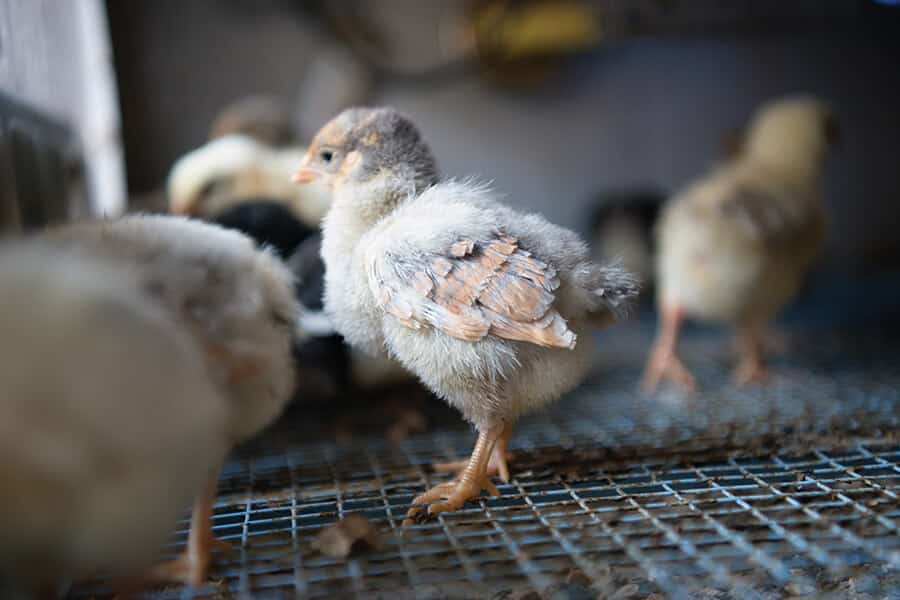
Ameraucana, Lavender Orpington, Speckled Sussex, Black Star—these aren’t racehorses or artisanal cocktails. They’re chickens, and if you live in a growing number of Raleigh neighborhoods opening up to personal poultry flocks, they may be nesting in a yard near you. A local family farm has been supplying these hand-raised chicks for years, and they have everything you need to start your own backyard flock.
Little Birdie Hatchery sits on a quiet cul-de-sac in a neighborhood on the outskirts of Wake Forest, marked only by a small sign in the  front yard.

“I have to bribe the neighbors with eggs,” laughs owner Ann Larsen, who took over the company a year ago from father-son team Mike and Ben Alig.
She is preparing for her second spring at the helm of the hatchery, and business is booming. In this busy season, the hatchery can sell 250-350 chicks a week, at prices that range from $6 for more common varieties to $40 for exotic breeds. Customers drive from all over the East Coast to hand select chicks and get Larsen’s advice on caring for them.
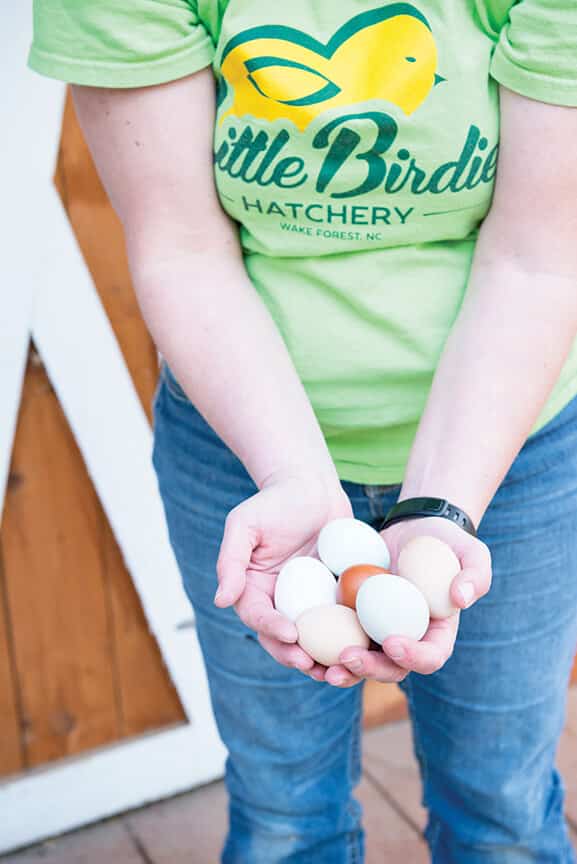
“Raising chicks is really not as hard as people think it is,” she says. “You start out with a cardboard box or a Tupperware container, a heat lamp, feeder and water, and the chicks…and that’s about it.” The price is pretty cheap—that setup for three or four chicks costs about $65, including a bag of locally milled Little Birdie feed. And the chicks all come with a no rooster guarantee, meaning they will take back and rehome any chicks that turn out to be male. There are no minimum purchase requirements, but Larsen suggests purchasing at least two, as chickens are flock animals.
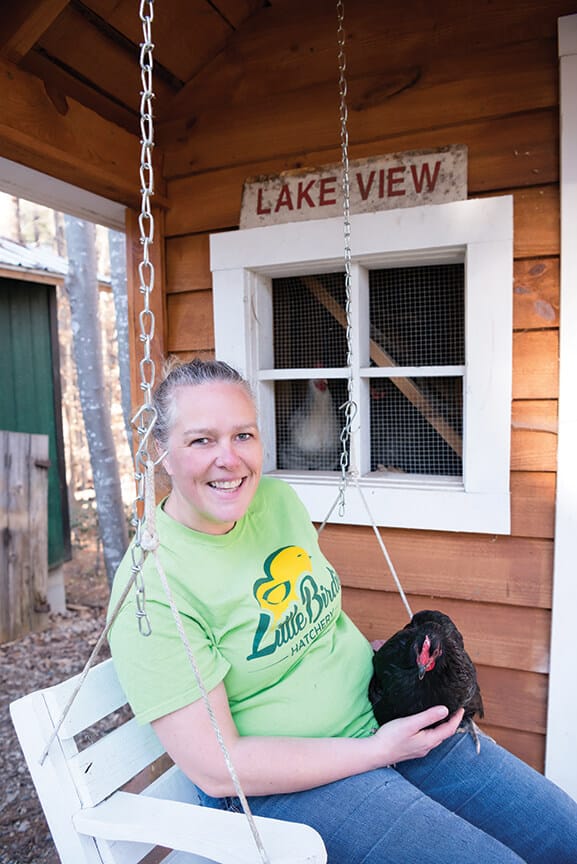
Ann Larsen
Once the chicks grow out of their boxes, a typical quarter-acre lot should be plenty of room for a small flock. Free-range poultry (or those confined to moveable “chicken tractors”) are unmatched at pest control, foraging for ticks, Japanese beetles, slugs and more. This “fresh air and freedom,” according to Larsen, means the chickens produce eggs that taste far better than any you will find at the store, with dark orange yolks and, depending on the breed, a range of shades and colors. Each breed has its own personality. The Buff Orpington, for example, is known as the golden retriever of chickens; it’s docile, friendly and often comes when called.
“I get a lot of people that want them for the eggs and also as pets,” she says. “They make great pets, they really do! It’s not as big a commitment as a dog or a cat, because they are somewhat self-sufficient. As long as they have clean water and food and a place to sleep, they’re good.”
Larsen, who was raised on a small farm in Denmark, left her job teaching preschool to take over the hatchery.
“I love kids,” she says. “My favorite part is when people bring their kids and grandkids, to see their excitement. It’s a fun place to come and pick out chicks. People are surprised that it’s not a big farm, but it’s just a small family business—and we try to keep it that way.”
For more information, visit littlebirdiehatchery.com
 Little Birdie Hatchery will be participating in the Raleigh Tour D’Coop on Saturday, June 2. All proceeds from the chicken tour event go to support Urban Ministries of Wake County. tourdcoop.urbanmin.org

by Cameron Walker | Feb 28, 2018 | Buzz, March 2018
IF YOU’VE BEEN TO a comedy show or concert at one of the Triangle’s larger venues recently, you may have been asked to lock up your phone. Of course, you’ll be reunited with your cherished device eventually, but for many of us, not having constant access to our text messages, emails and social media platforms for even a couple of hours can be nerve-wracking, worthy of more than just a little bit of separation anxiety. Graham Dugoni sought to change all that.
The Duke University alum wants you to put your phone down and be present in the moment. That’s why he invented Yondr, a deceptively simple pouch that locks up your phone while you enjoy some real-life entertainment. The synthetic rubber pouches are growing ever more popular with touring comedians and musicians and, as a result, your entertainment experience is about to change, if it hasn’t already.
In the past few years, comedians Dave Chappelle, Chris Rock and Ali Wong have brought Yondr on the road with them, as have The Lumineers, Jack White, Guns N’ Roses and Alicia Keys. Fed up with playing to distracted fans bobbing in a sea of bright screens instead of laughing at jokes or dancing to music with their upturned faces, these artists contracted with Yondr to provide a phone-free environment, where they can interact with an engaged audience.
At Durham Performing Arts Center this January, guests were asked to secure their phones in Yondr pouches ahead of comic Joe Rogan’s show. The venue had only used the technology once before, at the behest of comedian Chris Rock at his show last year. Perhaps surprisingly, fans seemed to embrace the break from their digital devices. “It’s been a lovely concert experience,” says Jenny Fornoff, DPAC’s director of audience and event services. “The response has been pretty positive. It’s kind of funny to say, but people really talk to each other, they talk to the people around them, they have fun with their friends when they’re not on their phones—because they’re not able to be.”
Raleigh Magazine creative director Caitlin Harrison was at the Rogan show with her husband, Drew, and says the experience revealed how dependent on our phones we can feel, and how freeing it can be to forget about them for a while. “It was definitely crazy, but at the same time…nothing happened,” she says. “I had no missed messages. I didn’t need it. But it was a weird feeling, since you’re so used to having your phone accessible.” She adds, “It was like a weird social experiment.”
HOW IT WORKS
Guests put their phones on silent mode and slip them into the gray neoprene pouch, which is then locked with a proprietary technology similar to that of an anti-theft ink tag. They get to keep their phones in their purse or pocket, but they’re unable to use them, or even view their screens, during the show. Yondr basically turns a device into a brick for a few hours, but in case of emergency—or social media withdrawal—fans can visit the lobby to have their phones unlocked for a few minutes of phone calls or screen time. At the end of the show, they line up to have their phones freed by a row of staff.
GENESIS
In 2012, Dugoni was at a music festival when he witnessed two strangers film a video of a man dancing with (likely drunken) abandon. The pair then uploaded the video to Youtube. Dugoni found the incident unsettling and for him, it raised questions about connectivity, privacy and community in a tech-centric world. “Graham was looking at how modern life was unfolding and the amount of time people were spending in front of screens and computers and he anticipated a point in modern life when people would necessarily need a reprieve from that,” says Kelly Taylor, marketing and public relations director at Yondr. “So this concept of phone-free spaces, to him, it was something that would inevitably happen.” But rather than wait for it to happen, Dugoni set out to create a solution on his own. The 31-year-old former pro soccer player started working on prototypes and raised $100,000 from friends, family and investors to start San Francisco-based Yondr. He worked out a trial run with two Bay Area nightclubs and demand grew organically. Now, the pouches are becoming popular outside of concert halls and event venues. By the beginning of this year, 600 schools nationwide introduced Yondr, and educators were reporting dramatic improvements in grades and discipline. Courtrooms, call cen ters and hospitals are using the pouches to guard privacy, and businesses and organizations all over the world—from churches and libraries to hotels and summer camps—are discovering that the newest thing in tech just maybe less tech.
“We exist to put a spotlight back on human interaction,” says Taylor. “We’re hearing from people all over the world that not only want to experience more phone-free spaces, but to actually create them themselves. What’s really special about Yondr is that it really is a grassroots movement. There’s this thing that everybody’s feeling—this tension, this restlessness—and we feel like we’re here to help.”

by Cameron Walker | Feb 14, 2018 | Eat, February 2018
Capital Club 16 is a labor of love and a peek into the past
Passing through the curtained vestibule of Capital Club 16 is like stepping back in time to yesteryear, a golden age, the good old days. Soaring ceilings, dark wood, antique paintings and expansive windows lend the space on the ground floor of the historic, Art Deco-style Capital Club building a classic feel; it’s a timelessness that’s reflected in the restaurant’s menu, which brims with hearty but refined fare.
Owners Jake and Shannon Wolf opened the downtown eatery the better part of a decade ago with an old-fashioned aesthetic and a perennial desire to feed their community.
“Building something from the ground up, having it be worth its weight and creating an energy, creating a vibe, creating a place where people can come hang on a special occasion…and seeing it take off and become what it’s become, is rewarding,” says Jake Wolf, who is also the executive chef.
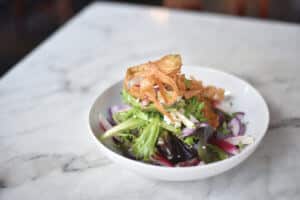
Photo by Jason Wolonick
Guests come for the food, a mix of traditional American and European dishes with a German influence, and often leave as friends.
“We’ve met so many people who came in as customers and now they’re good friends of ours,” says Shannon Wolf, who runs the back end and plans the restaurant’s many events.
This summer, the co-working community HQ Raleigh expanded into the Capital Club building’s top five floors, giving the space a makeover and a shot of enthusiasm with HQ members adding to Capital Club 16’s already lively business.
“We’re excited that the building has this new life and energy,” Shannon says. “You can tell that they all love being here.”
Jake and Shannon first met growing up together in Southern Pines. They went their separate ways, he to culinary school at The Culinary Institute of America at Hyde Park, and she to the University of North Carolina at Chapel Hill and then to Furman University in South Carolina before earning a master’s degree in writing from the University of North Carolina at Charlotte.

Photo by Jason Wolonick
Ten years later, they reconnected. By then, Jake was an experienced chef with stints in Atlanta, Telluride, Boston, and at a destination hotel in Schwendi, Germany. Shannon was living in New York City, working as a writer and producer on shows for networks, including Oxygen, Discovery and CBS. Jake moved to the Big Apple to be with Shannon, but when she became pregnant with their son, they moved back to North Carolina with their dog Tiny, a Brussels Griffon they call the “queen of the house.” They decided to open their own place.
“We looked at other areas, other towns, but we really liked the energy here in Raleigh,” Jake says. “There was a lot of restaurant activity going on (at the time) and we liked downtown.”
The couple’s restaurant vision shifted as they toured various listings but when they viewed the space at the corner of Martin and Salisbury Streets, they knew exactly what they wanted Capital Club 16 to be.
“We just fell in love with it,” says Jake. “We were still living in New York when we signed the lease so then we had a really fun time going around New York City trying to figure out some decor items that would fit in this place.”
They chose furnishings with history: Art Deco chairs from the now defunct Horn and Hardart automat, a restaurant with banks of coin-operated compartments filled with single-serve sandwiches and pies; tables built from salvaged North Carolina-milled heart pine lumber; a bar top crafted of wood once used to build docks along the Neuse River; and a bar and backbar made from reclaimed wood from the famous Lüchow’s Restaurant, a onetime mainstay in New York City that remained open for a century.
The couple decorated the walls sparingly, with family paintings and meaningful mementos, and they carried the heirloom idea through to the menu. The kitchen offers legacy recipes, such as Jake’s grandmother’s sausage gravy—a popular dish for Sunday brunch—as well as sausages and dumplings he learned to make in Germany.
The menu also offers seasonal and locally-sourced produce from area farms, including Raleigh City Farm, Laurel Branch Gardens and Farmers’ Collective, plus regionally-raised meats, sausages from Weeping Radish and Carolina coast seafood from Locals Seafood.
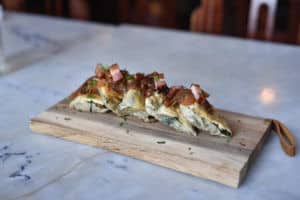
Photo by Jason Wolonick
Dishes are eclectic, with a mix of carnivore and vegetarian fare. Items like the Farmer’s Veggie and Rice Bowl and The Sparrow sandwich with Carolina Moon brie, provolone, spinach, apples, caramelized onion and sunflower seeds share billing with the Bavarian Sausage Platter and the Rahmschnitzel. The brunch menu boasts favorites like the Steak and Eggs, a full English breakfast and Challah Bread French Toast with bourbon syrup and a cheese grit cake.
Capital Club’s drink menu is well-curated, with local and European beers, wines and classic cocktails, including the Old Fashioned and the Dark and Stormy. It’s no wonder the restaurant hops on the weekends, with busy dinners and bustling Saturday and Sunday brunches.
“What we do here is what we would do at home, what we’ve always done,” says Jake. “It’s a very comfortable feel, a culmination of different places that I’ve cooked and the food that I like to eat, and the food that Shannon likes to eat…We’re very happy here, and it’s a fun thing to be able to work for yourself and with your partner, and I wouldn’t want to change any of it.” ■