
by Heidi Reid | Feb 25, 2025 | Buzz, March 2025
Raleigh rallies around House of Art.
When local pillars falter, Raleighites always pull through—it’s in our DNA. On Jan. 7, tragedy struck when the beloved eclectic House of Art was devastated by an early morning blaze that took 30+ firefighters to extinguish. While no one was physically hurt, the building was all but unrecognizable—leaving locals from all walks of life to mourn the “nontraditional museum” and bar built on and known for its “all are welcome” MO.
Those feelings of loss and defeat, though, quickly turned to hope as Raleigh and surrounding communities rallied to raise the funds to rebuild—from a dozen-act-led benefit concert at DTR’s The Pour House to a Durham V-Day party at The Fruit inspired by House of Art’s annual celebration to a March 2 dinner and silent auction at Knightdale’s Haven Farm. NTM the whopping $30K the cause’s GoFundMe has already raised as of press time. And on the shoulders of a community that truly uplifts its own, now, the house—which doubles as a home to so many—looks to be in full bloom again soon.
@houseofartnc; gofundme.com; eventbrite.com
by Heidi Reid | Feb 25, 2025 | Buzz, March 2025
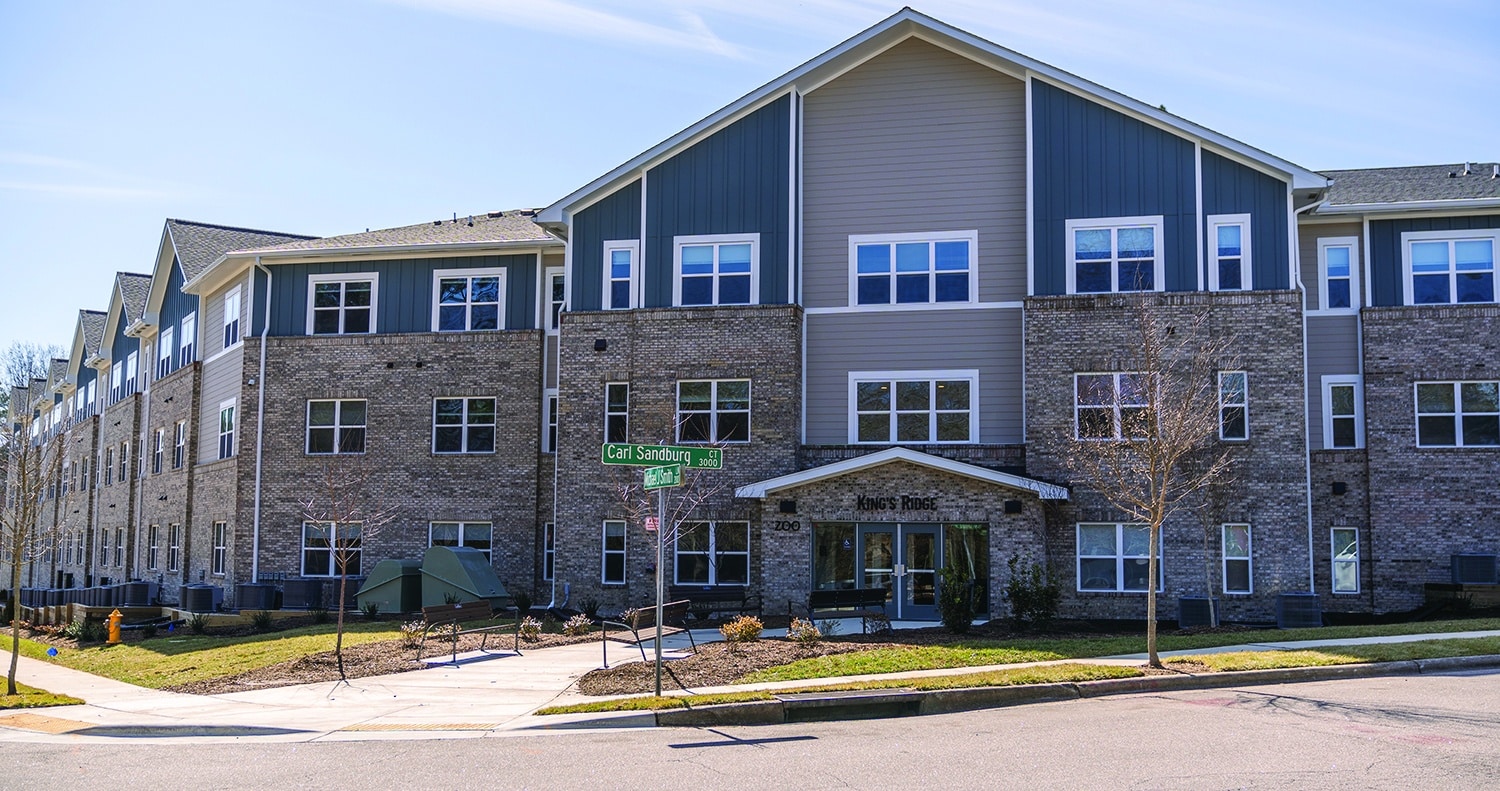
King’s Ridge takes a step toward ending homelessness in Raleigh.
Raleigh is one step closer to solving homelessness. It’s an epidemic on the rise—including on the very streets we all walk every day. In fact, according to the Wake County Point in Time Count, ~1,000 individuals are currently experiencing homelessness on any given night—a 200% increase since 2020.
Now, a cutting-edge concept has made an immediate 15% dent in those stats. Expected to take ~148 people off the street, the freshly debuted King’s Ridge serves up 100 one-, two- and three-bedroom units designated and designed for individuals and families who have a history of homelessness and insufficient credit to qualify for conventional housing.
Chronically homeless people make up:
33% of ER visits costing $44K a year/person
Permanent housing reduces:
Health care costs by 59%
ER costs by 61% Hospitalizations by 77%
Named for the late former CASA CEO and affordable housing champion Debra King, the Triangle-based affordable housing nonprofit’s most ambitious project to date has already assigned all units in collaboration with street outreach and shelter providers. “We went to the folks that did this work every day to give us our residents,” explains King’s Ridge Director Erin Yates of the community’s efforts to ensure a true focus on Raleigh’s most vulnerable. “We wanted to make sure they follow a housing-first model—meaning there are no requirements before you move in. You don’t take a class or have to be part of a program.” In short, the housing complex meets residents where they are—all of them are able to move in exactly as they are.
While King’s Ridge isn’t free, residents only pay one-third of their monthly income for rent each month and can renew yearly. According to housing affordability devotee and former Mayor Mary-Ann Baldwin, the largest barrier for the homeless isn’t affording rent—at least 60% of Raleigh’s homeless population have jobs. The real barrier is the ability to put down a security deposit plus first and last month’s rent.
But the monumental project wasn’t realized overnight. It’s been seven years since Molly Painter—now chair of the King’s Ridge Campaign Leadership Committee—picked up Kathy Izard’s The Hundred Story Home. Upon learning of Charlotte’s housing for the homeless, Painter resolved Raleigh could and would achieve the same. A whopping $23 million later—raised in partnership with CASA—the East Raleigh project broke ground in 2022.
“It feels like home,” Painter tells RM—“which is exactly how we want it to feel. The community said yes [and] was very generous—the county was very generous. … Individuals and corporations came together to make it happen.”
Now, locals are finally beginning to move in. One resident who, after a car accident, was rendered unable to work and experienced homelessness, moved into King’s Ridge last in February. “[The resident] said after a couple nights’ sleep, ‘I realized there is a word I’ve never used for myself: I feel calm,’” shares Yates.
While similar housing-first models have been around for decades, they’re new to Raleigh, emphasizes Yates—and she hopes to show the model gives long-term stability for the homeless. “We’ve already had conversations with folks in Asheville, Greensboro and Wilmington,” she adds.
Baldwin, who, during her mayoral tenure, advocated for $10 million for King’s Ridge from the city—and now continues her passion for the cause as executive director of the Cooper Charitable Foundation—is also eager to see how the project inspires other cities’ affordable housing options. “People were like ‘Oh, [$10 million] is a lot of money,’ but so is treating homeless people in emergency rooms—that costs more money than sheltering,” observes Baldwin, noting, too, it is far less expensive than providing health care to people living on the streets. In short, providing shelter isn’t just the compassionate thing to do—it’s also the best financial move for the city.
Baldwin’s backing stems from King Ridge’s wraparound on-site supportive services for residents. “A home and the services they need to stay sheltered—that is what really sold me,” she reveals.
Two medical clinics, case managers and ample community space will supply the necessary tools to heal. To boot, the complex is ideally situated near WakeMed’s Raleigh campus, Wake County’s health services building and the future bus rapid transit line.
Mirroring other conventional apartments, King’s Ridge residents have full control of their schedules and can come and go as they please. The model recognizes the prominence of housing as the first step in handling other challenges—and the apartment’s services will help tackle these lingering obstacles. Backed by the community and aligned with a housing-first mindset, King’s Ridge is setting the bar—and taking a large stride toward ending homelessness.
Upcoming Affordable Housing Projects
Hope Village at Method: Under construction
Housing and support for Raleigh youth aging out of foster care located in the Method neighborhood
Maple Ridge Apartments: Construction slated for 2025
146 affordable units with 30 units in NW Raleigh for those with disabilities or who are experiencing homelessness
Strickland Apartments : Construction slated for 2025
148 affordable units with 30 units off Strickland Road for those with disabilities or who are experiencing homelessness
Moore Square Apartments: Construction slated for 2025
160 affordable rental units with 32 units in DTR for those with disabilities or experiencing homelessness
Innovative Solutions
Eden Village | Wilmington
- Tiny home village of permanent supportive housing
- 31 homes on 4.2 acres
- Turnkey cost of $6M and unit cost of $80K
- Eden Village in Springfield, Mo., has purchased 3D printers to loan to other Eden Village projects, cutting costs $40K per unit
- 94% success rate of residents remaining stably housed after one year
The Melody | Atlanta
- Downtown camp with crime and drug activity
- 90-day construction
- 40 units produced at $5M
- Permanent supportive housing with wraparound services
- All 40 camp residents were offered units, all but two moved in
- Ample outdoor spaces and dog park

by Heidi Reid | Feb 25, 2025 | Buzz, March 2025
Could the LA insurance debacle happen in NC?
In a devastated LA County, thousands are without homes—and without any home insurance to cover their losses. Before fires burned over 10,000 structures, insurers decided against renewing thousands of home policies in areas they deemed to be at high risk for wildfires.
Case in point: Last March, Cali’s largest home insurer State Farm General announced they wouldn’t be renewing 72,000 home and condo policies upon expiration. Meanwhile, premiums in some neighborhoods more than quadrupled, and many who couldn’t get onto the California FAIR Plan (the state’s public insurance op) had to opt for no insurance at all.
Chubb Insurance halted new policies for homes at high wildfire risk in 2021 and Allstate stopped writing new policies altogether in 2022. Now, State Farm General is seeking an avg. 22% emergency rate increase. So, while some residents have been able to maintain coverage, they, too, will still face an incredibly steep price increase on insurance.
Here in NC, as we’ve especially seen in the past year, we are no stranger to natural disasters.
Houses are falling into the ocean due to flooding in the Outer Banks. WNC still looks like a war zone after Helene demolished entire towns that may never fully recover. And every year, the coast must brace for hurricanes that are slowly but surely becoming more ferocious and catastrophic.
In the face of imminent calamity, we tapped NC Insurance Commissioner Mike Causey with pressing questions about the state of insurance amid natural disasters—and what’s stopping insurers from pulling the rug out from under NCers like they did in LA.
How did this happen in California? Could a massive insurance withdrawal like this happen in NC? No. Poor decisions in California’s leadership have allowed extreme environmentalists to override common sense fire safety in wooded areas. Additionally, repeated denial of insurance rate increases forced insurers to stop writing new business.
What should you do if you can’t find affordable coverage?Our No. 1 tip is to
shop around. Second, consumers should check with any independent agent with access to [public] state plans available through the NC Joint Underwriting Association or the NC Insurance Underwriting Association.
How do natural disasters affect premiums?They have long-term consequences in making insurance in those areas more risky and causing increases in rates. The solution to keeping costs down is to rebuild to more resilient standards that are stronger than code.
What actions should you take if insurance is dropped or prices spike after a disaster? Call the ‘Big I’ (Independent Insurance Agents of NC) to shop around, or call the NC Department of Insurance.
What risk-reducing measures can consumers take to keep their premiums low? Higher deductibles, fortified roofs and minimizing fire hazards
Where can residents find risk maps for their area? NC provides the Flood Risk Information System, containing digitally accessible flood hazard data, models, maps, risk assessments and reports that are database driven. This site also provides geospatial data, along with hydraulic and hydrologic models available for download and use. fris.nc.gov

by Heidi Reid | Feb 25, 2025 | Buzz, March 2024
Taxes on sports-betting winnings may be more than bargained for.
The first official tax season after the legalization of sports betting is here. After NCers spent the first year placing bets and raking it in, now, it’s the government’s turn to get their due. Betters wagered over $5 billion in just 10 months—and thanks to a rule NC and only six other states uphold, some gamblers may be paying a lot more taxes than they bargained for.
To start, NC does not allow gambling losses as an itemized deduction. Read: In some cases, when you are both earning and losing money on a business endeavor, you are able to deduct the amount lost and only fork over taxes on the profit—the losses and successes wash each other out.
Gamblers don’t have that same luxury. Taxes must be paid on your total winnings, regardless of the amount lost. So, if you won $10K but lost $9K, you’ll be paying taxes on $10K, not $1K. Whether you’re up or down doesn’t matter. Revenue is taxed, not your profit.
So, what will the gov do with this huge sum of tax dollars? According to the NC Department of Revenue, the purpose of the 4.5% tax is to establish a fund to promote travel and tourism, grants for youth sports, gambling addiction education and treatment programs, and collegiate athletic departments and other public projects.
Even though sports betting is still relatively new for NCers, this part of tax season isn’t. Ben Micham, president of local accounting firm Micham & McSwain, has clients who have gambled in years past (scratch-off games and the like) and says most lose more than they win. “If you are just a gambler for fun and you made $5 and you lost $10, you’d like to think you can deduct it, but you can’t,” explains Micham. “That’s just the way the rules are.”
But, if you’re currently in the red, there is hope. The newly introduced NC House Bill 14 would amend this rule and allow a state income tax deduction for gambling losses against winnings. As of press time, the bill is lingering in committee, but it will apply to the 2024 tax year if passed in time. So, all bets are not off.

by Heidi Reid | Feb 25, 2025 | Buzz, March 2025
Raleigh is once again asking nightlife establishments to keep it down. Just one year after the previous update, City Council amended noise ordinance rules in January.
Known as the “Turn Down the Sound” ordinance, the amendments require those who receive citations to lower their volume immediately—and amplify the city’s authority. If the offenders don’t comply, the City can now issue a second citation promptly, doubling the fine—and all noise citation appeals go directly to the city manager, giving full discretion to the city, rather than the legal system.
Also once cited, establishments must move all amplified sound inside for 24 hours. Met with widespread outrage from district bargoers, the public outcry from bar owners in Glenwood South has been far louder—and lawsuits against the city are imminent.
“RPD and our attorney’s office shared general concerns about the inability to enforce the ordinance due to the prior penalties,” elaborates At-Large Councilmember Jonathan Melton. “The attorney gave us a few options to consider, and we approved moving forward with the options [earlier this year].”
2024 addresses cited*:
*Includes establishments with 12 or more complaints; data provided by RPD
According to the N&O, an attorney representing some nightlife establishments affected called the updates “constitutionally dubious” and says it “effectively shutters” businesses, resulting in the loss of tax revenue for the city.
In terms of the city’s motivation for making the modifications: RPD reported 346 total noise complaints at 37 locations in Glenwood South last year alone. A whopping 288 of those were targeted to just eight locales, and only two bars—Cornerstone Tavern and The Village Nightlife Complex—were allegedly responsible for 172, just about half of the total complaints.
While speculation is swirling surrounding the city’s perceived attempt to gain control of a few problem children with these ordinance updates, Melton tells Raleigh Magazine this wasn’t targeted—and it wasn’t aimed only at Glenwood South. So, although allegedly not directed at specific repeat offenders, the updates clearly give the city far more authority—and at least potentially force the entertainment district to tread a little lighter.



