by Heidi Reid | Aug 27, 2024 | 2024, Buzz, September 2024
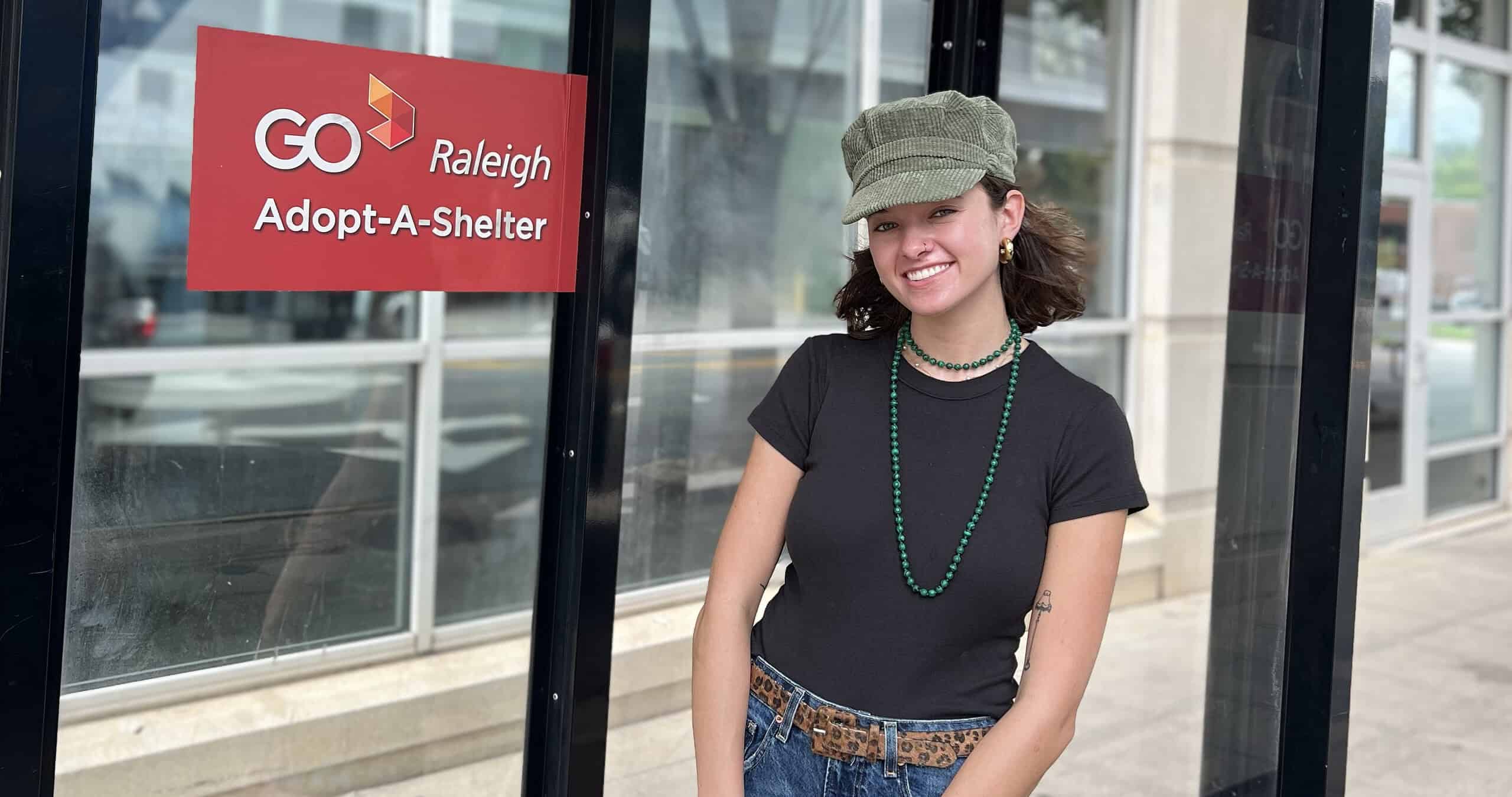
I took the bus everywhere for a month—here’s how it went.
Turns out, Raleigh’s public transit system isn’t as bad as you may think. It’s not what I would have expected after encountering the sights and smells of various bus stops I’ve trekked by in the past, but my forced four-week stint on public transit proved otherwise.
I wouldn’t go as far as to call it a civic masterpiece, but the GoRaleigh system is like most cities’ public transit service—somewhat efficient, a little gross, but will reliably transport you. And it’s far better than many transit services in much bigger cities (looking at you, LA).
From the jump, the majority of common stereotypes of public transit I expected to encounter weren’t a problem—namely, the buses aren’t overwhelmingly crowded; pickpocketing isn’t an issue; and drivers follow the rules of the road. Beyond these cliches, GoRaleigh actually has a wealth of pros.
Compared to complaints about GoTriangle—you may recall our coverage last summer re: its constant cancellations and no shows—GoRaleigh exceeded my expectations. Of my 51 total bus rides, I only experienced one no-show, and all other 50 came within ~five minutes of their scheduled time—though I acknowledge a no-show or extra five minutes may be more of a casualty for riders with less flexibility.
To be fair, five minutes late is *technically* on time in public-transit speak, where on time is typically defined as no more than one minute early or five minutes late. Plus delays are obviously part of any mode of transit, and the top public transit systems in the U.S. still experience them frequently—for example, the F line in NYC is delayed 30% of the time. That said, these delays could possibly be offset by more frequent buses—specifically in less urban areas—but is a hard sell during the multimillion budget deficit Raleigh transit is facing.
That assumed inconvenience led me to initially plan to only take the bus to work, but after seeing how easy the system was to navigate, I took it everywhere—occasionally, I even opted to hop on the bus and ride to bars over ordering a $10 Uber. This wealth (!) of knowledge was hacked by savvy transit users long before me—according to the American Public Transit Association, bus riders save an average of $1,100 a month and are 10 times safer per mile than those who drive an automobile—not to mention I never had to worry about parking.
But let’s be real—there are definitely aspects that need improving. Buses can be very gross. In a 2023 GoRaleigh survey, frequent riders cited cleanliness as an issue—and I concur. White jeans and open-toed shoes were temporarily retired after I noted the amount of dirt on the floor, and, after my second ride, I opted to stand rather than sit after grazing a damp seat. While the grime isn’t ideal, public transit is *public* after all and won’t ever be perfectly spotless—and GoRaleigh is still one of the cleaner transit services I’ve experienced.
Those surveyed also cited personal safety as a concern—but I never felt in danger on the bus. The bus stops, though, were definitely a little sketchy, and I briefly considered walking home once when a fellow passenger waiting for the bus started yelling and hitting surrounding objects with a leather belt. Ultimately, though, both on and off the bus, if you make a point to stay out of others’ way and mind your own business (read: no staring), you’re less likely to be bothered.
So, after a month of riding the bus, I settled on the conclusion that anyone who refuses to ride is—to be frank—being dramatic. Public transit cannot and does not cater to each individual, rather every individual must make it work for them.
How to Get Started:
- Download Transit, or just use the public transit option on Apple Maps
- Start with a short, easy-to-navigate ride—save the day trip for later.
- Zip up your purse and keep any baggage out of the aisles.
- Mind your own business and stay out of the way of other passengers.
- Wear comfy, closed toed shoes. If you’re wearing light-colored clothing, don’t sit.
- Carry pepper spray, just in case.
- Say thank you to your drivers!

by Heidi Reid | Aug 27, 2024 | Eat, September 2024
Locally owned coffee shop and eatery Fare&Fellow is set to start brewing at Raleigh Iron Works in early 2025.
If your good mood—or entire being—is sponsored by coffee on the daily, get ready to get your grind on at Fare&Fellow. Slated to start creating buzz at Raleigh Iron Works from the Bow Truss Building in early 2025, the Durham-based drinkery + eatery crafts coffee and espresso bevs and chef-curated meals with an emphasis on fresh hyperlocal ingredients—think bread from Union Special, dairy from Homeland Creamery and beans from local roasters.
“As lifelong residents of Raleigh, we are ecstatic to join the amazing community at Raleigh Iron Works,” says founder Lindsay Gresock. “This is a dream come true, and we can’t wait to continue to plant our roots here and serve the incredible community that has supported us for so many years. We’re excited for you to join us at the table.” So, prepare to pull up a chair and perk up! fareandfellow.com

by Heidi Reid | Aug 21, 2024 | 2024, Do, July 2024/August 2024
Is it time to trade cigarettes and strobe lights for clean-girl elegance?
While some of us are still bumping it through brat summer, others have already turned in for a demure fall. If you’re in need of a quick pop culture rehash, here’s how the two cultural phenomena came to be—and how to live them out around Raleigh.
British pop star Charli xcx released her newest album brat on June 7—and so sparked brat summer. The aesthetic of the lime green-hued album can be described, in a word, as camp, but the essence of brat summer is eye-catching, messy and unapologetically confident. In short, anyone can have a brat summer, whether you choose to sport the color palette or not.
On the opposite end of the season’s spectrum, being demure recently exploded after TikTok creator Jools Lebron described her makeup as “very demure, very mindful”—going against doing “too much” or wearing a “green-cut crease” to work.
As a green-cut crease is very brat, the two aesthetics seemingly clash, but at the same time overlap as they both beg to be noticed—just for opposite reasons. Brat garners attention with confidence, while demure earns recognition through being put-together.
Living It Out Locally
🍸 Demure is two glasses of wine at Barcelona Wine Bar and ubering home at 10pm; brat is three martinis at Highgarden and going to work hungover the next day.
🕶️ Demure is Dose Yoga and a smoothie at 6am; brat is a hot girl walk in flip-flops and sunglasses at 1pm after just rolling out of bed in last night’s makeup.
🚬 Demure is a date night with your fiance in STEM who works at RTP; brat is smoking a cigarette with your situationship who works in hospitality outside The Cardinal on a Tuesday night.
🧺 Demure is a picnic after strolling around the NCMA; brat is booking it through CAM 30 minutes before it closes for a literal culture shock just to say you did something productive that day.
👢Demure is casually browsing the racks in Village District on a Saturday morning after hitting the State Farmers Market; brat is rummaging through the clearance section of Urban Outfitters a half-hour before you need to be at an event in said outfit.
⛳️ Demure is playing Putt-Putt at Hop Shots with your friend’s kids after enjoying an early weekend brunch; brat is slugging mimosas at Jaguar Bolera then cutting in line to play duckpin bowling.
by Heidi Reid | Aug 19, 2024 | Buzz, September 2024
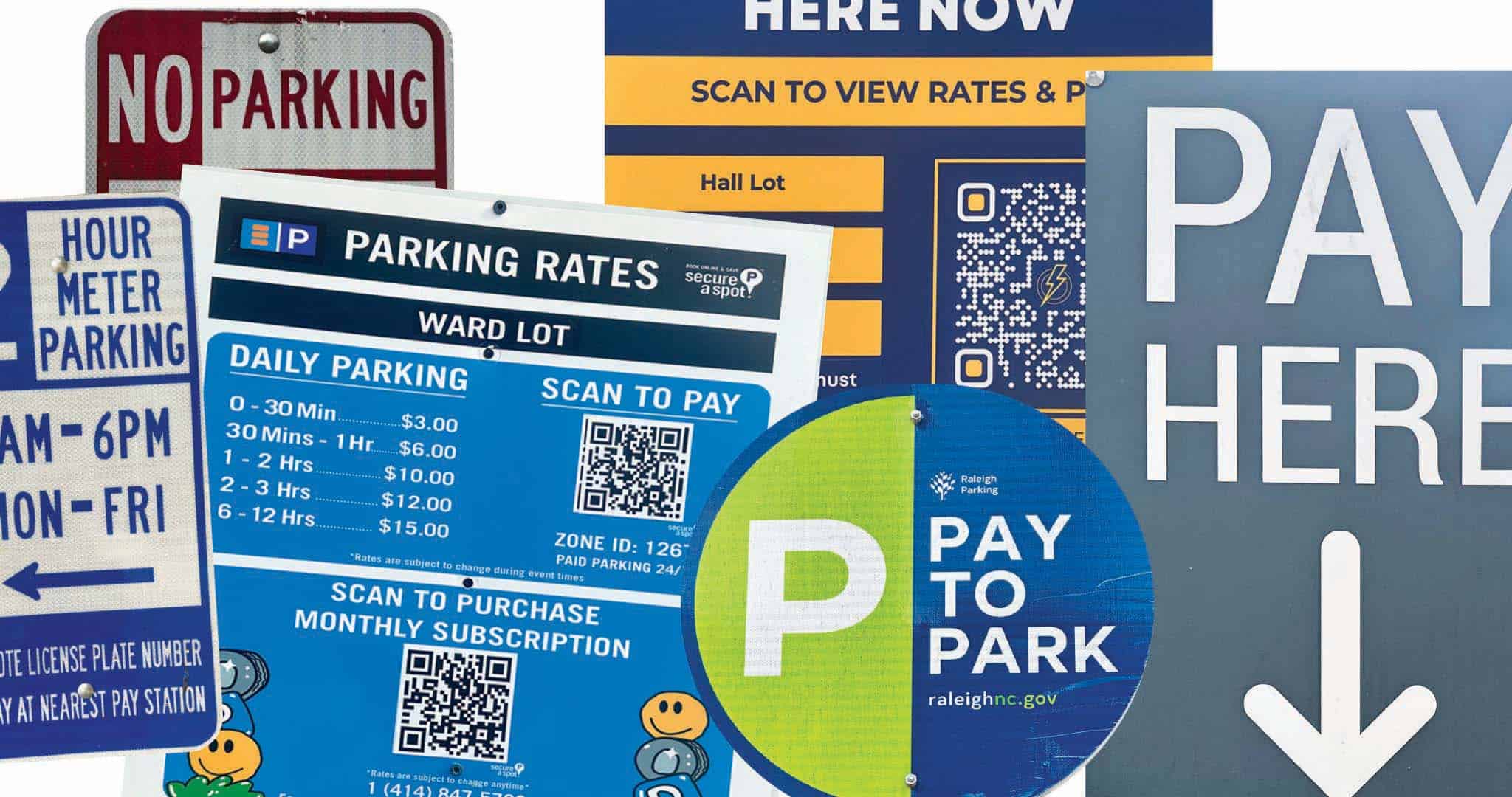
Like a virtual corn maze, maneuvering Raleigh’s ever-growing amount of DTR lots and apps can be overwhelming—but how did we get here? And how do we navigate it?
Ask any Raleigh resident their feelings on going Downtown and you’ll hear the same narrative: Figuring out where and how to park and pay is the worst. Read: an overwhelming maze of public and private parking options people would sooner skip than solve—especially given the costly consequences.
You know the drill. You’re endlessly circling for a street spot before giving up and pulling into a private lot, where you’re forced to find or download yet another parking app to then get gouged for $20—only to return some five minutes late to a ticket upward of ~$125. Such scenarios are playing out across DTR on the daily, prompting residents and visitors to weigh venturing Downtown—where every lot is a puzzle of rates and rules—against alternative live-work-play districts dishing plenty of free parking (think North Hills, Village District, Fenton—though those areas can come with their own lot battles and endless hunts).
So, how did we get here? A quick refresh: Longtime Raleighites may remember the infamous McLaurin Parking monopoly. Rolling out their empire in 1948 on South Salisbury Street behind the Sir Walter Hotel, the McLaurin family was the name in NC parking for 70 years—managing both public and private parking locally, including a city contract of 8,000+ parking spots.
Fast-forward to 2017 when the McLaurins sold their parking conglomerate off to The Car Park of Boise, Idaho. From there, enter the swath of parking management czars we love to loathe today—including Secure Parking, ParkMobile and more. And, with them, the exorbitant rates and fines—aka the measly ~$18 private parking violation from 2015 has septupled to up to $125, with hourly rates currently clocking in at $6+.
Despite the melee, DTR’s popularity peaked this summer, seeing its highest post-pandemic monthly foot traffic. Still, parking accessibility remains a hot-button topic to keep Downtown thriving—and the exorbitant fees, fines and frustration have yielded new efforts to curb the parking fluster.
One idea currently being kicked around includes making the first two hours of public parking free in city-owned garages. “The matter is still under consideration,” explains Parking Superintendent John M. Wynn.
And contrary to public perception, Downtown is actually overflowing with available parking options. “Current supply of parking, particularly off-street, is plentiful and more than meets current demand,” says Rob Murray, communications analyst for the City of Raleigh Transportation Department. And as “private developers are including parking to support their projects, the City of Raleigh does not anticipate building new parking.”
And they shouldn’t. Almost one-third of DTR is off-street parking, easily overshadowing the national average of 16%. So, ultimately, it’s a matter of education and accessibility—from knowing where to park for cheap to navigating the sea of parking apps.
Private vs. Public Lots
The cardinal rule for Downtown parking: Always opt for street and city deck parking. For starters, there’s the convenience. Street parking can be paid on-the-go via the Passport Parking app, and these spots, as well as city-owned parking garages and lots, are cheaper by the hour—not to mention city citation fines start at just $15 if paid immediately. It’s in your best interest to handle city-issued tickets promptly to ward off escalating fines and the boot—which the City can enforce once any vehicle racks up three 90-plus-day-old unpaid citations.
Private lots, alternatively, are infamous for pricey parking, camera-tracking cars and sky-high fines. Beware of multimanaged lots boasting confusing signage with a riddle of QR codes. While they are legally required to specify which spots are which, it’s your job to figure it out based on your colored wheel stop (aka that concrete block at your front tires).
DTR Parking Hacks
- Seven city parking decks are free on weekends.
- Street parking is free on weekdays from 6pm–7am unless otherwise marked.
- Once your parking fully expires, Passport Parking will allow you to reup your time limit.
- City parking decks charge a $10 flat rate during special events.
- If you park in a deck and pay at one of the kiosks, you can exit the deck without stopping via plate readers.
- If you pay for hourly parking, set a timer for a few minutes before your parking is set to expire.
- Park and ride—the R-Line is up and running again throughout Downtown Thursday through Saturday until 2:15am.
Apps and websites to use for parking Downtown in Raleigh
- Passport Parking
passportparking.com
City-contracted; zone-based
- ParkMobile
parkmobile.io
NC State-contracted; advance reserve via spot finder map
- ParkWhiz
parkwhiz.com
Compare prices; pre-purchase discounts; advance mobile event parking passes (Canes games, concerts)
- The Car Park
thecarpark.com
City-contracted lots/parking garages + private lots
- Honk Mobile
honkmobile.com
Prepaid parking credits
- Secure-a-Spot by Secure Parking USA
secureparkingusa.comOnline subscription-based parking; cash-back options
Private Tickets: Do You Have to Pay?
Legitimate parking tickets cited by private companies are civil matters—not criminal offenses. So while the government can’t come after you for any unpaid tickets, it can affect your credit score (though not your car insurance rates) if reported to a collections agency. So—arguably smarter to shell out the ~$60 than gambling on your credit score. Plus, like government-issued tickets, private tickets grow exponentially in price the longer you wait to pay them—some upward of a whopping $125.
The lack of legislation involved with private lots has its pros and cons. While it means repercussions for unpaid citations are harder to enforce, it also means lots can charge any amount they wish for hourly parking and violations—and there are few laws defending you when a problem arises. In fact, certain law firms won’t even touch private parking tickets.
And because the number of citations issued is so high, parking ticket scams are more common in private parking lots—especially ones using QR codes to collect payment. Pro tip: If a ticket requires payment via reloadable debit card or wire transfer like Cash App, Zelle or Venmo, it’s a fraud. Always visit the website listed before paying to confirm it’s legit.
Beyond scam alerts, navigating the private lot violations is often overwhelming, including receiving aggressive letters in the mail threatening to impound or immobilize your car a mere 60 days post-ticket. (Don’t forget: Your plate is tied to your home address—and they will find you.) While the parking company cannot hunt down your car and tow it from just anywhere, they can legally tow or boot your vehicle the next time you park in that lot or another lot they manage. While these arguable scare tactics prove obnoxious and stress-inducing, private lots are private property—and if you break the contract (aka the terms and conditions you opted to skip over) the companies are legally permitted to defend themselves—even if it feels predatory.
According to The Car Park VP of Marketing Cory Collins, who manages several private and public lots in Raleigh, violations are not given a flat rate—but based on the offense. “We believe strongly in the importance of keeping an ADA parking space available for those who need it,” explains Collins, “so the violation for parking in an ADA space will be more than for expired time.”
Although The Car Park doesn’t use a collections agency, they, like all other private lots, reserve the right to. “The majority of our revenue comes from folks paying for parking, not parking violations,” adds Collins. “Enforcement is about keeping parking accessible and fair. … Most people choose to do the right thing and pay the violation if they owe it. We’re often lenient and work with folks when there’s a reasonable mistake that’s led to
the violation.”
Pro Tips:
- Ensure the parking spot color correlates with the color on the sign you scanned.
- Verify how long you paid to park in the lot
- Camera recordings mean mailed tickets if you try to play the system.
- Don’t pull into a private lot at all if you don’t plan to park there
How Raleigh Stacks Up
Fun fact: Relative to other comparably sized cities, the City of Raleigh’s fine is extremely low, starting at just $15—and only charges for Downtown street parking from 8am to 6pm. Meanwhile, cities like Nashville and Kansas City charge to park on the street around the clock, and Sacramento charges $62.50 for parking violations. Ultimately, pricing, fees and location are parking problems that any healthy, thriving metropolis must tackle. So how have other cities handled these growing pains?
What Not to Do:
- Pricing based on location. Like Raleigh, New York City uses an app so drivers can pay for parking “in a New York minute”—but, unlike the City of Oaks, metered parking can cost up to $13/hour. Hence, most New Yorkers opt for public transit.
- Privatizing more parking. After the infamous $1 billion deal in the midst of the 2008 financial crisis giving private firm control of all metered spots and pricing, Chicago must now buy or rent street spots back if they want to build a bike lane or host a street fair.
- Require parking minimums. Atlanta aimed to tackle parking problems via minimums to ensure enough spots for all. Instead, many lots sit vacant on the busiest nights, thus driving up the cost of living, creating heat islands and resulting in lost city revenue.
Best Practices:
- Progressive pricing. To increase parking turnover, Austin’s on-street parking is adjusted by the hour—first two hours, $2 each; third hour, $1; each subsequent hour, +$0.50 more than the last—with an hourly maximum of $5.
- Collaborative parking. Houston’s Community parking plan expands curb parking, allowing permitted residents and employees to park in metered spots, plus nonpermitted visitors for up to three hours.
- Extensive research. In response to the higher demand for parking in its two main districts, Charlotte is slated to implement infrastructure changes based on the research from its 139-page strategic parking plan including studies of 15+ other cities.
by Heidi Reid | Aug 13, 2024 | Buzz, July 2024/August 2024
Red Hat Amphitheater could permanently close to save a single DTR block that sees hardly any traffic.
The future of Downtown Raleigh is at stake—and Red Hat Amphitheater sits at the center of it all.
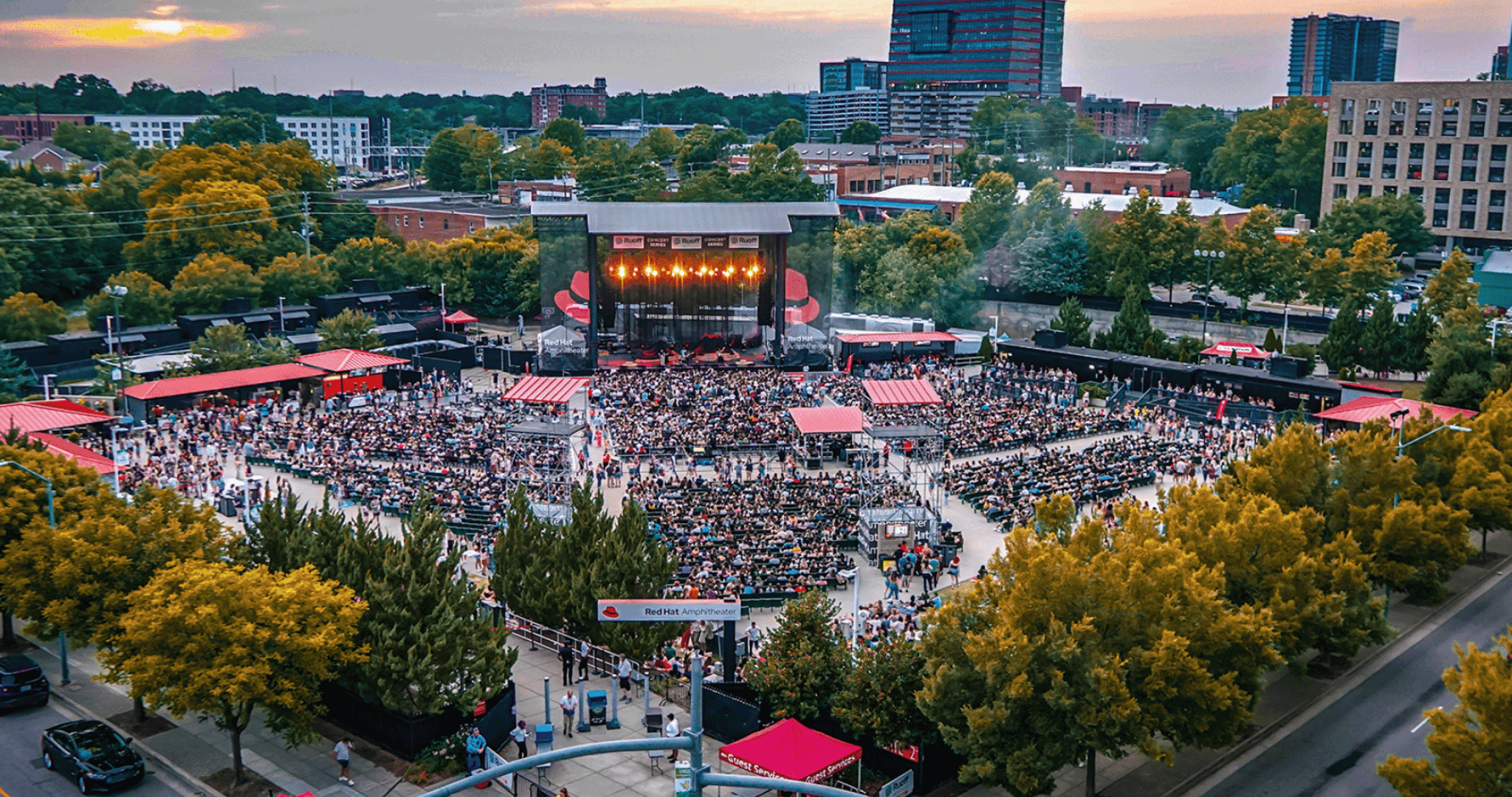
While Red Hat was initially intended to be a temporary venue, the City has long planned to move and update the amphitheater to sustain the amount of traffic it attracts. The planned expansion would accommodate ~1,000 more seats and a larger loading dock and backstage area, as well as increased concessions—and the only “cost” of that expansion is the closure of one block of South Street—a road that sees just one-third of the traffic it was built for.
The proposed update has been in the works since city leaders agreed to shift Red Hat slightly southward in order to expand the Raleigh Convention Center. Now, as pushback mounts for the street closure, Red Hat’s—and Downtown’s—future is hanging in the balance. And if City Council doesn’t pass the proposed plans to expand it, Red Hat will be demolished for good—along with the millions of dollars in economic impact it brings, and the future viability of many DTR businesses.
“Red Hat is the one thing that brings people Downtown in large numbers consistently through the summer months,” emphasizes Crank Arm Brewing owner Adam Eckhardt. “If the amphitheater does not open in the current proposed location in Downtown Raleigh, many small businesses will close.”
Thus, major city players and business owners are vying for Red Hat’s survival for good reason. In 2023 alone, the amphitheater generated ~$17.5 million in economic impact from its 26 shows. This year, show offerings have more than doubled with a record-breaking 51 shows, yielding comparably greater financial impact with them. The absence of Red Hat would directly affect the shops, restaurants and bars who rely on foot traffic from locals and visitors alike attending those concerts all days of the week.
“State of Beer sees a big increase when there are shows,” says Trophy Brewing partner David Meeker, “and Trophy Brewing on Morgan Street sees a solid increase too, even though we are several blocks away.”
For her part, mayoral candidate Janet Cowell, also the CEO of the Dix Park Conservancy, has expressed concerns about the expansion because of the partial closure of South Street and how it would affect connections between Downtown and Dix Park. But some have expressed concerns that her push against Red Hat is centered around advocating for the proposed outdoor amphitheater at Dix Park, which is a “potential alternative to Downtown’s Red Hat Amphitheater,” according to the park’s master plan.
“The consequences for Red Hat Amphitheater leaving downtown would be devastating to many small businesses owners who rely on crowds pre- and post-shows all summer long. Our city leaders would be wise to reconsider the thought of moving something that creates such a large financial impact to small business owners, many of which won’t make it with a loss of that magnitude.” —Matt Coleman, owner, The Davie
However, it’s clear an amphitheater at Dix wouldn’t have the same economic impact for any district, much less Downtown—especially given the much-denounced lack of connectivity between DTR and Dix—and Raleigh already has a similar venue to the would-be Dix Park amphitheater (Coastal Credit Union Music Park at Walnut Creek), in addition to one in Cary (Koka Booth Amphitheatre).
“Many of our small businesses rely on [Red Hat] to get them through slower summer months and see their sales more than double on a concert evening versus a non-show night,” says Downtown Raleigh Alliance President/CEO Bill King. “Placing the amphitheater in the heart of Downtown has demonstrated how much more economic impact is possible for venues when they are surrounded by small businesses for patrons to visit before and after shows.”
Plus, Live Nation, Red Hat’s booking manager, isn’t going to wait around for a Dix Park amphitheater to get off the ground—meaning if Red Hat goes, many artists won’t make stops in Raleigh at all. Read: If Downtown doesn’t have an amphitheater to accommodate 7,500 guests, other cities will garner the economic benefit. “Live Nation… will skip us for Charlotte and Wilmington,” maintains Eckhardt. “Durham may even build an amphitheater of this size to accommodate.” So, not just a loss for Downtown, but for the city as whole.
Red Hat’s fate adds to a long list of concerns about the current state of Downtown Raleigh already being raised by local business owners. And potentially demolishing one of DTR’s only entertainment draws isn’t sitting well with those trying to up the district’s allure to save their businesses—and their livelihood.
“Red Hat Amphitheater is a fun draw for Downtown. The Canes are at PNC; DPAC and the Bulls are in Durham—so it’s really our only entertainment draw Downtown,” says Meeker. “A lot of our employees at our restaurants are young, 20–35 years old and have no kids yet, and the thing you hear constantly is that Raleigh is a boring place to be young. We need to change that, not lean into that. I hope Red Hat Amphitheater comes back bigger and better than ever, even if that means adjusting South Street.”
How to Help Save Red Hat
Right now it’s unclear if Raleigh City Council has the votes necessary to save Red Hat. If the proposed plans don’t pass by majority, Red Hat Amphitheater would be demolished for good. You can help save Red Hat—as well as multiple DTR businesses and Downtown’s livelihood—by reaching out to your city council member at emails listed below. Find your district here.
Mary Black, District A, [email protected]
Megan Patton, District B, [email protected]
Corey Branch, District C, [email protected]
Jane Harrison, District D, [email protected]
Christina Jones, District E, [email protected]
Jonathan Melton, At-Large, [email protected]
Stormie D. Forte, At-Large, [email protected]
Editor’s note: This story was updated Aug. 13.



