City leaders have said it’s badly needed and, last month, Raleigh’s City Council took steps toward making it a reality: An anchor hotel located just steps away from the Raleigh Convention Center.
Council members voted unanimously to seek out teams interested in redeveloping two Fayetteville Street parking lots into two mixed-use towers, including an upscale, full service, national brand hotel with 500 rooms and meeting space. The second tower will serve as a headquarters site for the convention center incorporating offices, ground level retail, residential units and “other creative ideas,” with below-grade parking underneath Fayetteville Street.
City officials will receive ideas from interested developers for the 2.5 acre site by the end of March.
“I want to emphasize that we are looking for great design,” said Mayor Mary-Ann Baldwin during the January council meeting where city officials introduced the project. “[The city owns] these sites so we have some say and I hope [interested developers] set the bar especially high. This is our waterfront property and we want [it] to reflect great design. People are coming here from all over the world. That is what they’re going to see, so let’s make it all it can be.”
Council member Nicole Stewart said she is looking forward to seeing a residential component in the mixed-use tower, as that part of downtown “is a little unbalanced right now, it gets pretty quiet at night,” and that she hopes the city can prioritize local partners for the project. Council member David Cox added that he would like to see affordable housing included.
Downtown Raleigh attracted 3.4 million visitors in 2018, an increase of 47 percent over 2007. Last year, Raleigh and Wake County approved $14 million from hospitality tax revenue to buy land near the convention center for future use and committed $5 million in 2021 to improve and optimize the center. The city and county have also planned a $230 million convention center expansion in the next decade.
Note: pertains to hotel, office, multifamily, properties over 100k sq. ft. Also shown are select publicly-owned buildings. Photo source: JLL, CoStar, Google Maps
1. Duke Energy Center For the Performing Arts 2. 1,030-space parking deck 3. 175-room Residence Inn 4. 6,000-seat Red Hat Amphitheater 5. Raleigh Convention Center 6. 401-room Marriott 7. Charter Square | 243k sq. ft. Class A office 8. 622-space below-grade parking deck 9. FNB Tower | new multifamily/closest office tower 10. 992-space parking deck 11. The L Apartments | 83-unit multifamily 12. 500-space parking deck 13. Two Hannover Square/BB&T | 437k sq. ft. Class A office 14. 353-room Sheraton 15. The Sir Walter | 140-unit multifamily 16. One City Plaza | 373k sq. ft. Class B office 17. One Progress Plaza | 455k sq. ft. Class B office 18. 1,000-space parking deck 19. Red Hat Tower | 366k sq. ft. Class A office 20. Palladium Plaza | 65-unit multifamily 21. Capital Bank Plaza | 168k sq. ft. Class A office 22. The Edison Lofts | 223-unit multifamily 23. 715-space parking deck
4,131 students in Wake schools were without permanent housing last year. That number is poised to climb.
Groups of chattering elementary school kids, hair bows and glasses askew, spill into the lobby of the Raleigh Rescue Mission on East Hargett Street on an unseasonably warm January afternoon.
In the sea of small bodies hauling “Frozen” and “Spiderman” book bags are Jah’cere, 9, and his sisters, Serenity, 7, and Justice, 5. The school bus has just dropped them off near the Mission and the kids are excited to see their mother, Tiara Parks. Justice jumps in Parks’ lap as Jah’cere commandeers her smart phone. They’ll have a little time to spend together, along with their older brothers Sincere, 11, and Nicere, 10, before they head downstairs to the Mission’s dining room for supper at 5:30.
Parks has lived at the Mission with her children since August. Her Section 8 housing voucher expired and, after staying at her sister’s home for several months, Parks couldn’t find another place for the family to live that she could afford. Parks works at the Mission as a cleaner and she’s saving her money and looking for a job in security or customer service. Her partner, the kids’ father, will reunite with the family this month after completing a five-year prison sentence.
“It’s so hard,” Parks says. “I’m ready to start working and to get to the next step to be on my own. With what my kids have going on, sometimes I’m ready to have a panic attack. I need to be in my own space.”
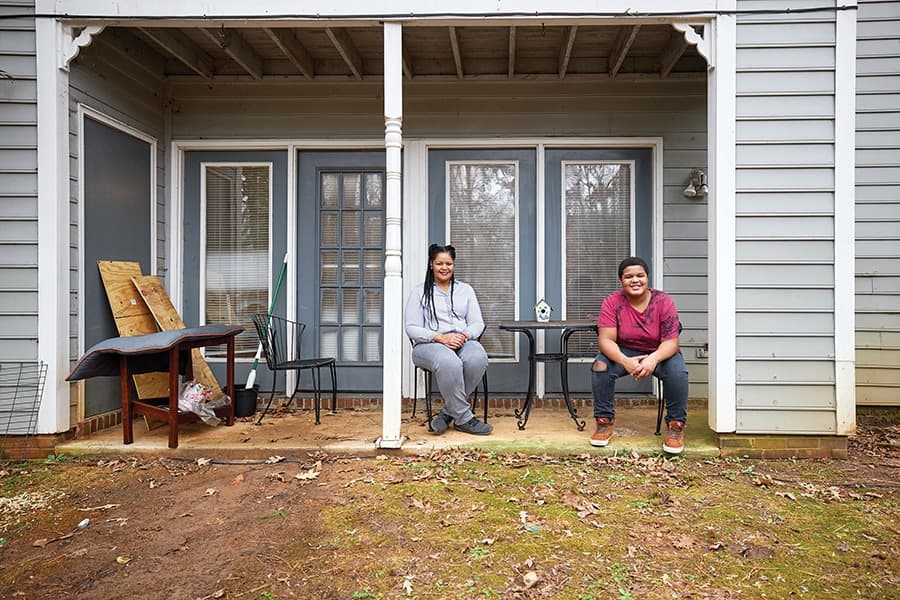
Tiara Parks and Jah’cere, 9, Serenity, 7, and Justice, 5, pictured in downtown Raleigh | Photo by f8 Photo Studios
Data from the Wake County Public School System for the 2018-2019 school year put the number of students in K-12 experiencing homelessness at 4,131—roughly 3 percent of all students—with an additional 231 younger children in the county in need of stable housing. The numbers include kids living in shelters like Parks’ family, “doubling up” with relatives, acquaintances or strangers, living in motels, out of cars, couch surfing at friends’ homes or, especially for older teens, living without any kind of shelter at all.
And the numbers have been climbing, marking a 55 percent increase since the 2014-2015 school year and an 86 percent increase over the last decade. This year’s numbers are expected to soar even higher, a trend that’s tracking seamlessly with the county’s explosive growth and burgeoning affordable housing crisis. In general, stagnant wages, a dearth of well-paying jobs for workers without college degrees and high costs of medical care compound the problem. In the last decade, according to data from the U.S. Department of Education, there was a 70 percent jump in homelessness for K-12 students. Nationally, around 1.3 million students experienced homelessness during the 2016-2017 school year.
“Years ago, I would have said that there were different rates of homelessness in schools across [Wake County],” says Michelle Mozingo, the McKinney-Vento district liaison for students in Wake schools. Mozingo manages services for students who have been displaced and is responsible for collecting data on their numbers. “Now, I really can’t say that. Every school has kids who are identified. Pre-school through high school. It’s much more spread out. There are no pockets anymore, like we used to see.”
Under the federal McKinney-Vento Act, Mozingo and a team of more than 100 social workers in Wake schools work to ensure students can stay in the schools they were attending when they were displaced, that they have transportation to and from school and that their basic needs—food, hygiene, healthcare—are met. Stability, Mozingo says, is crucial for students’ success.
Sandra Baker* can attest to that. She fled Los Angeles for Raleigh (where she had family living close by) two years ago, after her longtime partner, her children’s father, became violent and abusive. Finding herself and her then-3-year-old daughter, Brienne,* and infant son, Chris,* without a home, and in need of a job—she had worked in the film industry back in LA—Baker connected with the local nonprofit Families Together. The group agreed to pay for a deposit and the first month’s rent for an apartment while Baker got back on her feet.
“My daughter had a speech impediment,” Baker explains, a condition she says she attributes to the violence Brienne witnessed paired with the family’s stint of not having a stable place to live. “I hired a speech therapist to work with her. Within the first six months of her being [in a permanent home], she thrived. Her Pre-K teacher said how thoughtful and intelligent she is. The hidden gem is stability for children.”
Brienne is now in kindergarten at Beaverdam Elementary School, where, Baker says, she continues to flourish. Chris is a lively, fun-loving two year old with a mohawk and a gap-toothed smile. He goes to day care while Baker splits her time between work and school.
“[Brienne’s] teacher says she is top of her class,” says Baker. “She’s taking the lead, teaching her peers, helping to calm them. She just has that spirit in her which didn’t come out until we got her to a place where we felt settled.”
That place wasn’t easy to come by. Again and again, Baker says she ran into obstacles from landlords unwilling to rent to her.
Lisa Rowe, executive director of Families Together, the nonprofit that helped Baker and assists families in transitioning to permanent housing, says that this is a common problem in Wake County. Landlords charge high rents because they can. Sometimes they’ll demand tenants make up to three times the monthly rental price before they’ll lease to them. Many refuse to accept housing vouchers or won’t rent to people who have prior evictions on their records.
“We’re finding it increasingly difficult to find housing and wages aren’t keeping up,” Rowe explains in a conference room at the nonprofit’s headquarters, a house off of New Bern Avenue with four units upstairs that Families Together uses to house families in urgent need of shelter. The building is located near motels, including a Budgetel Inn, where dozens of parents currently stay longterm with their school aged children. Rowe says four years ago, 225 kids enrolled in Wake schools listed a motel as their address; for the 2018-2019 school year, that number jumped to nearly 1,000.
“The goal is, someone shouldn’t be paying more than 30 percent of their income in rent,” Rowe continues. “The reality is, poor people do. They are living on the edge because of it and having to make decisions every day about medication versus food versus rent. They can pay it. They shouldn’t have to, but they can. But [landlords] won’t even accept them, even if they have a clean credit history, a full-time job. If the rent is $1,000, and they don’t make $3,000, they can’t rent it.”
Mozingo, the district liaison, says most of the families her team works with are working families, parents who hold sometimes multiple low wage jobs.
Penny Thornton, a mother of two boys, Kaleb, 12, and Zuri, 19, is one such parent. Two years ago, Thornton lost her full-time job. She couldn’t make rent and she, Kaleb and Zuri were evicted from their north Raleigh home. Families Together gave them a temporary shelter while Kaleb finished out fifth grade. The family transitioned into permanent housing a year and a half ago, when Kaleb—an amiable, soft-spoken almost-teenager who plays guitar, loves walking his black lab, Mars, and riding around on his red bicycle—was attending middle school at Moore Square Magnet.
Thornton works five jobs, including as a teacher’s assistant at Longview School, as a personal care aid for a little boy who is paralyzed and at a chiropractor’s office. She says the experience of losing their home still haunts them. Once she and her boys secured their own place—an apartment in a run-down complex off of Raleigh Boulevard for which they pay $850 a month in rent—Kaleb was transferred to Leesville Road Middle School, on the other side of town, for 7th grade. Thornton requested to have Kaleb transferred back to Moore Square but was denied.
“He was looking forward to connecting with the old staff, his mentors, his teachers,” Thornton says as we sit at her kitchen table in the apartment she’s decorated with family photos and her own colorful paintings. “I couldn’t understand. They knew we had been homeless and they still said no. He can’t come back.”
The rise of what’s known as “situational homelessness”— what happens when a breadwinner loses their job, as in Thornton’s case, or in domestic violence situations, as in Baker’s, or when a family is evicted or, faced with crushing medical debt, or a spouse dies, or a home is destroyed in a fire—now accounts for some 70 to 80 percent of all people experiencing homelessness, says John Luckett, the Raleigh Rescue Mission’s executive director.
In other words, it could happen to virtually anyone.
Sandra Baker*, Brienne*, 5, and Chris*, 2, pictured at Union Station | Photo by Jennifer Robertson
“They’re the hidden homeless,” Luckett explains. “You walk by them and they have on decent clothes and you wouldn’t know they’re homeless. They don’t want you to know. They’re trying to get back into the mainstream.”
Luckett came to Raleigh from Atlanta nearly three years ago to help the 58-year-old Mission “become more effective in impacting individuals affected by the shift in the root causes of homelessness,” in his words. This includes looking not just at how to get families into the county’s dwindling stock of affordable housing but also at issues such as transportation, education, employment and the high cost of childcare.
For children, the Mission offers an onsite nursery and preschool, before and after school care, summer and track out camps, mental health screening, academic assistance and tutoring, field trips, family fun nights and homework assistance.
“Historically, the easiest way to break the cycle of poverty is to start with the children,” Luckett says. “They have a much better opportunity to break the cycle there. But our challenge is, 87 percent of children who are homeless are likely to drop out of school. That feeds into the school-to-prison pipeline.”
The parents of the children Raleigh Magazine spoke to for this story all say their kids have been impacted by their displacement, requiring counseling and other interventions to help them process the trauma of losing their homes. In the most serious case, Tiara Parks says her oldest child, Sincere, had to be hospitalized at Holly Hill last fall.
“He went through a phase where he felt like nobody liked him,” Parks says. “He wasn’t making friends. He just felt that no one would care if he wasn’t here. He was thinking about hurting himself.”
Parks says her kids are prone to tantrums and that she never knows what could set them off. She says her oldest boys go through phases where they’ll repeatedly get suspended from school.
But in most ways, Parks explains, her kids are like any others: they love reading, running around outdoors, riding on scooters, playing computer games. They like to go to Marbles Kids Museum, to baseball games, to the movies or to Disney On Ice.
Despite what the family has been through, Parks says, she is optimistic about the future. She says she hopes getting their own place, and the kids’ father coming home, will bring some calm and stability back to their lives.
Sandra Baker, mom to Brienne and Chris, and Kaleb’s mom, Penny Thornton, say their kids are doing much better now that they’re in stable homes.
Kaleb, who is currently home schooled, will turn 13 in July and Thornton says she is hopeful that he’ll get back into Moore Square Magnet School, where the new school year starts this summer, to finish out his middle school career. Kaleb says he has maintained his friendships and has continued learning the guitar on his own, practicing bar chords and holding impromptu musical performances.
Baker started a course in city planning at East Carolina last month. She says she loves the family’s home in Raleigh’s Hedingham neighborhood, where they’ve been living now for a year and a half.
“Resilience became a big thing that came into play,” Baker says. “Don’t let it break you. We fell on hard times but we are not defined by that. Sometimes you just need a helping hand. Not a handout. A hand up.”
RDU Airport Authority halts unpopular plans to build a fence near Umstead State Park.
Hikers, bikers and and other Umstead users had cause to celebrate last month: the Raleigh-Durham Airport Authority hit pause on plans to build an 18 mile-long fence around the perimeter of land, known as the 286 tract, that the airport leases bordering the state park.
RDUAA, an eight-member board that governs development, operations and maintenance of RDU International Airport said it needed the fence to control trespassing on the 286 land’s unauthorized mountain bike trails. The 8-foot tall chain-link fence would have cost $2.4 million to build and would have bisected Umstead Park’s popular Reedy Creek Multi-use trail in two places.
In a two-page letter from the NC Department of Natural and Cultural Resources to Michael Landguth, RDU’s president and CEO, the office that oversees state parks outlined several reasons as to why it felt the fence was a bad idea.
Thousands of hikers, cyclists and equestrians use the Reedy Creek trail each year, the letter states, and the fence would degrade the visitor experience; the proposed fence would have crossed streams and damaged stream banks and wetlands, impacting water quality; it would block movement of wildlife, trapping animals between airport fences, and it could jeopardize the park’s status on the National Register of Historic Places.
Instead, the letter proposes enhancing law enforcement on the property and the Department says it is “interested in working with RDU and our respective state and federal partners to pursue a purchase of the 286 property affected by mountain biking and add it to the park.”
Otherwise, the Department proposes a lease agreement between the airport and Wake County by which the county parks and state parks offices would collaboratively manage and enforce the trails on the property. Local groups, including Triangle Off Road Cyclists (TORC) and the Umstead Coalition, have lobbied for this proposal and for building a trail center on the property they say will preclude the airport’s need for a fence.
“Our goal is to find a compromise that allows the airport to secure its property while minimizing the impacts to Umstead State Park and their concerns,” said Crystal Feldman, a communications officer for RDUAA, in a statement.
But RDUAA says it still intends to pursue its Vision 2040 master plan which includes a proposed rock quarry on another 105 acres of land it leases from Wake and Durham Counties and the Cities of Raleigh and Durham known as the Odd Fellows tract. The quarry has been a contentious proposal from the outset, with opponents arguing it will destroy forested land, provide inadequate buffers and watershed protections and, with a payout of $20 to $25 million to the airport over 25 to 35 years, is just a bad deal: The airport needs some $4 billion over the next two decades to modernize and expand. It faces a $1 to $2 billion shortfall regardless of whether the quarry moves forward or not.
When Wake County residents show up to vote in North Carolina’s primary election on March 3 (or during early voting in February), they’ll receive a long ballot—ranging from presidential hopefuls at the top on down to district court judges, two county commissioner seats and the county’s register of deeds—with plenty of candidates running for offices in between. We’ve compiled a list of all primary contests that will appear on ballots for residents in Wake County, as well as a step-by-step guide on how to vote. For more information on who’s running for what office, check out ncsbe.gov.
How Do I Register to Vote?
First, you have to be eligible. This means you are: • 18 years old • a U.S. citizen • a resident of the county of your registration for 30 days prior to the election on March 3
If you are 17, but will be 18 on the day of the general election on November 10, you are eligible to vote in the March 3 primary.
To register, fill out a voter registration application (download at ncsbe.gov) and mail it to the Wake County Board of Elections at 1200 N. New Hope Road, Raleigh NC, 27610 on or before February 7. The board of elections will mail you a voter registration card within one to two weeks. Or, register to vote during the early voting period.
When Is Early Voting?
Early voting runs from February 13- 29.
During early voting, voters in Wake County may vote at any one-stop voting station countywide (not just in their assigned precinct) and they may register to vote at the polling station on the same day if they are eligible and can prove their residence in Wake County.
You DO NOT need to bring photo ID to early voting if you are already registered to vote.
If you want to register to vote, bring a North Carolina driver license or other government-issued photo ID with your name and current address and a copy of a current utility bill, bank statement, paycheck or other government document showing your name and address. If you’re a student, a college photo ID card paired with proof of college residence will work.
Most early voting locations are open during business hours on weekdays and some are open for limited hours for voting on the weekend. Find out more at wakegov.com/elections.
How Do I Vote on Election Day?
If you are registered to vote, you can look up your assigned precinct and polling place at vt.ncsbe.gov/RegLkup/. You can also see a sample of what your ballot will look like (races and candidates will appear on your ballot for the primary depending on whether you’re registered as a Republican, Democrat, Libertarian or unaffiliated).
On Election Day, show up at your polling place. As long as you’re registered to vote, you DO NOT need to bring a photo ID on Election Day.
If you’re in line before polls close at 7:30 p.m., you will, by law, be given the opportunity to cast a ballot.
March 3 Primary Contests, Wake County*
Office
Parties with primaries
U.S. President
Democrat, Republican, Green and Libertarian and unaffiliated
U.S. Senate
1 Seat, D & R primaries
U.S. House of Representatives District 2
D only
U.S. House of Representatives District 4
D & R
NC Governor
D & R
NC Lieutenant Governor
D & R
NC Attorney General
R only
NC Auditor
D & R
NC Commissioner of Agriculture
D only
NC Commissioner of Insurance
R only
NC Commissioner of Labor
R only
NC Secretary of State
R only
NC Superintendent of Public Instruction
D & R
NC Treasurer
D only
NC State Senate District 18
D & R
NC State House of Representatives District 33
D only
NC State House of Representatives District 35
R only
NC State House of Representatives District 36
R only
NC State House of Representatives District 37
R only
NC State House of Representatives District 38
D only
NC District Court Judge District 10B Seat 03
D only
NC District Court Judge District 10F Seat 03
D only
Wake County Board of Commissioners District 01
D only
Wake County Board of Commissioners District 03
D only
Wake County Register of Deeds
D only
*Some contests do not feature primaries for both D and R parties
A New Rep. for Raleigh
Andy TerrellDeborah RossMonika Johnson-HostlerOllie Nelson
Come November, most Wake County residents will have a new representative in Congress. Following a state court ruling in the fall that found that Republican-drawn state maps were unconstitutionally partisan, lawmakers redrew congressional lines in the state that are likely to give Democrats an additional two seats in the U.S. House (Republicans currently hold 10 of the state’s 13 seats). The new map altered U.S. House District 2 (Rep. George Holding currently holds the seat) to encompass practically all of Raleigh, a traditionally Democratic stronghold that Rep. David Price in District 4 has long represented. Holding announced that he will not run for re-election this year. One Republican, Alan Swain, has filed to run for the seat and four Democrats have filed to run, meaning only the Democrats will have a primary contest for the seat in March. Democrats who have filed to run for the seat include attorney and former NC House member Deborah Ross, nonprofit leader and three-term Wake School Board member Monika Johnson-Hostler, entrepreneur Andy Terrell and former Marine and retired teacher Ollie Nelson. Don’t get used to the new map, though; North Carolina’s congressional lines will be redrawn again following the 2020 Census. The current map will be used for this single election only and North Carolinians will elect U.S. representatives in new districts in 2022.
At Rosewater in North Hills, it’s the little things that make up the beauty of the big picture: baskets full of lemons, roses in glass vases on round bistro tables, rose gold light fixtures and plenty of greenery.
Those who remember the Bruegger’s Bagels shop that occupied the space located between the Captrust and Bank of America buildings until 2017 would agree a substantial transformation has taken place. No more is it the generic bakery found in shopping centers and strip malls in cities large and small across the United States. Now, it’s the intimate, American-style bistro, serving Mediterranean small plates and comfort food dishes that Rosewater’s owner, Giorgios Bakatsias, envisioned.
“The space kind of winked at me,” says Bakatsias, a longtime fixture in the local dining scene. We’re sitting on Rosewater’s enclosed patio on a cloudy, rainy day but the space feels warm, like you’re in a greenhouse in wintertime, with its wood-paneled walls, soft lamplight and tall windows. “It was just a beautiful, sleepy garden and I saw it buzzing with energy, the piazza in the center of a community. I fell in love with the building, the architecture, the structure.”
Giorgios Bakatsias; Photo by Jennifer Robertson
Bakatsias, whose Giorgios Hospitality Group also owns Vin Rouge, City Kitchen and Parizade in Durham and Chapel Hill’s Local 22 and Bin 54, personally designs all of his restaurants. This space, too, Bakatsias has made his own.
“I wanted to mix the elements of what allows guests to feel happy,” he explains. “This, to me, felt joyful, whether rainy or sunny. I incorporated wood and elements of art and the right lighting. You feel it’s in this state of golden light, like at nighttime when everything radiates with it. It’s almost like a sunset, constantly.”
When developer John Kane of Kane Realty Corp. decided not to renew the Bruegger’s lease two years ago, he said at the time that he wanted, with this essential piece of real estate, to go in a different direction. Those wary of the chain restaurants and big box stores that often crop up in expensive new developments like North Hills were pleased to learn that the space’s new tenant wouldn’t be another national brand but a local entrepreneur.
Mike Smith
Mike Smith, the president and chief operating officer at Kane Realty, says the company is committed to supporting local restaurateurs and has been working intentionally to create great spaces for them and other local business owners. He points to Rosewater, as well as Coquette and Vivace, as examples of that commitment in North Hills.
Downtown, Luang Prabang, a Laotian concept from the owners of Bida Manda and Brewery Bhavana, will occupy the marquee ninth floor space in The Dillon. And the upcoming Smoky Hollow development on West Street will, Smith says, have “a very targeted focus on local operators,” including local restaurants, bars, cafes, retailers and other business owners.
“There are so many great local chefs and food purveyors in Raleigh and we are trying to create spaces and places in advance for what we believe is the need,” Smith says. “We know there is work that needs to be done together to make it a success. We want to make sure we’re thoughtful in the design as we think through it and try to anticipate what a local restaurateur is able to be.”
Bakatsias says roses signify balance to him, which is why he chose to name his newest restaurant “Rosewater.”
“Balance, whether it’s in food or spirituality, whether in fun and laughter, whatever life chooses to be and how it is, there is always some kind of balance that is necessary. [Here], we want to have this European romance but we spice it up some. I love the aroma of rosewater, but you have to use it in balance.”
Another aspect of life that requires balance? How we choose to build our communities.
“I guess chains are necessary for this community to be successful,” Bakastias says, “but I was delighted that [Kane Realty] was responsible enough to realize that [this space] is a little jewel and they wanted it to be independent. I saw it, we both met and it was like this perfect marriage. I’m excited to see more of this so we can have a balance in the community.”