Chef Scott Crawford’s new restaurant has finally arrived.
For Jolie, la petite fille du chef Scott Crawford, there was a certain je ne sais quoi about the City of Light.
On a family trip to Paris the winter before last, the then 7 year-old fell in love with its bistros and brasseries. She spoke French with the locals and became a connoisseur of the cozy blankets on offer at the city’s outdoor cafés. She tried beaucoup varieties of cheese.
“When we had to come home she cried and cried because she didn’t want to leave,” Crawford recalls.
And so, for the past two years, the owner of the Person Street mainstay Crawford and Son has been working to bring a little of Paris to his daughter, and to Raleigh. Crawford’s new restaurant, Jolie, opens this month in an all-but-forgotten shoe shop right beside his flagship.
Chef Scott Crawford
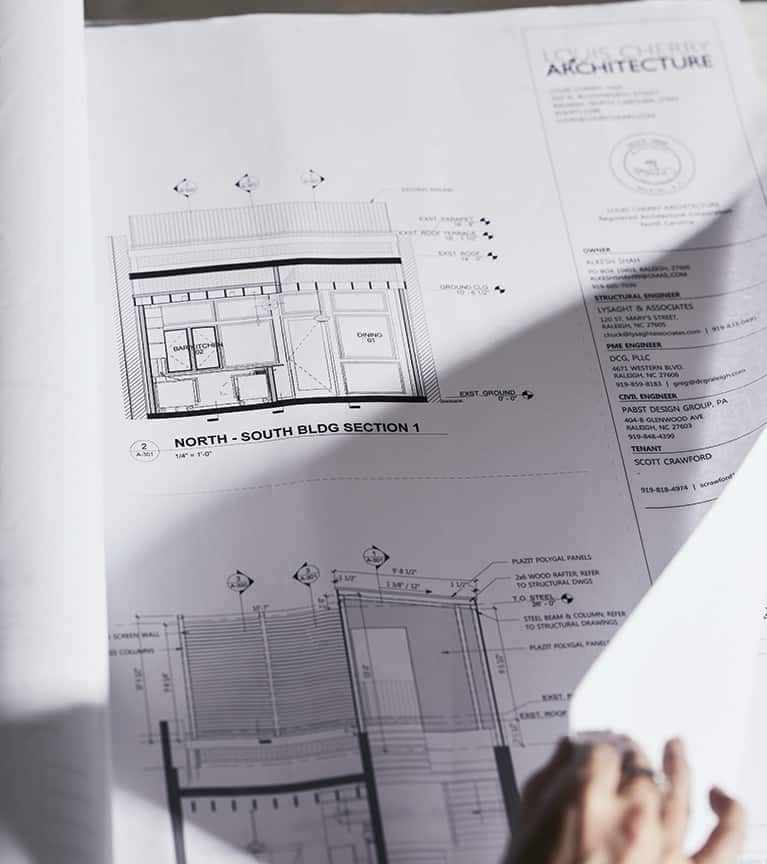
Raleigh architect Louis Cherry, who also designed Crawford and Son, describes his and Crawford’s vision for Jolie as something of a complementary contrast to its brother space (named for Crawford’s son, Jolie’s older brother, Jiles). The restaurants—both located in a subdivided building that dates to the mid-1920s—each seat around 60 diners, though Jolie is split between an indoor dining room on the street level and a rooftop patio.
Where Crawford and Son creates a deep, rich environment with its low lights and deep colors, Crawford wanted something brighter, more feminine for Jolie—in a word, pretty.
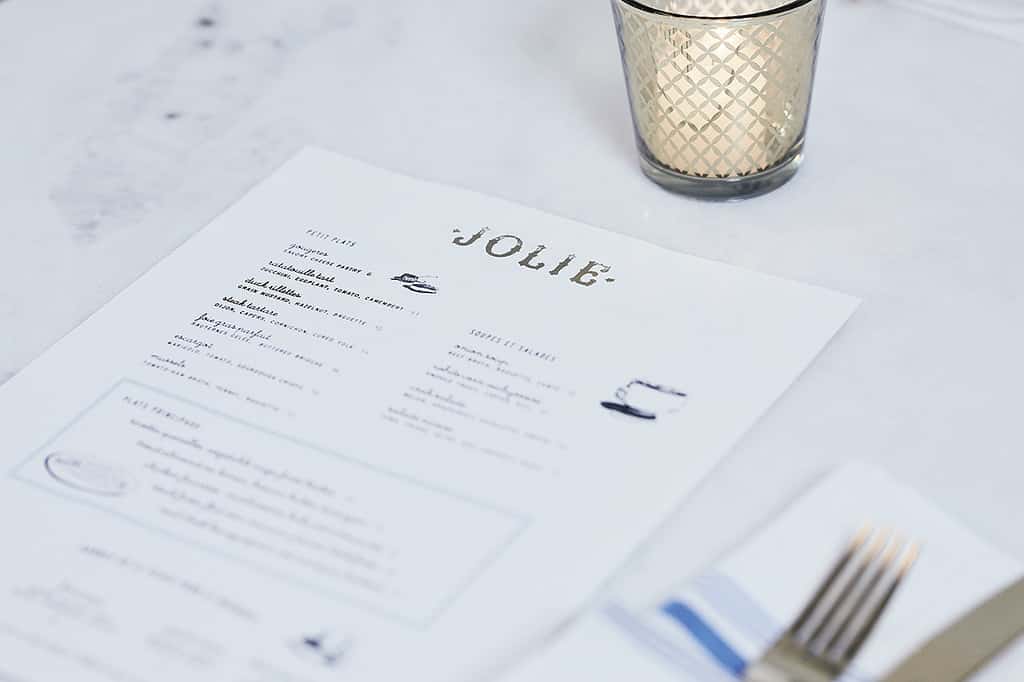
“Prettiness, it is different from beautiful even, it has a certain cheerfulness,” Cherry explains. “Aesthetically, we were going for a strong reference to the tradition of French cooking and French design. So it’s a modern, minimalist aesthetic overlaid with a set of traditional expectations—bistro chairs, tile, decorative patterns, pops of color.”
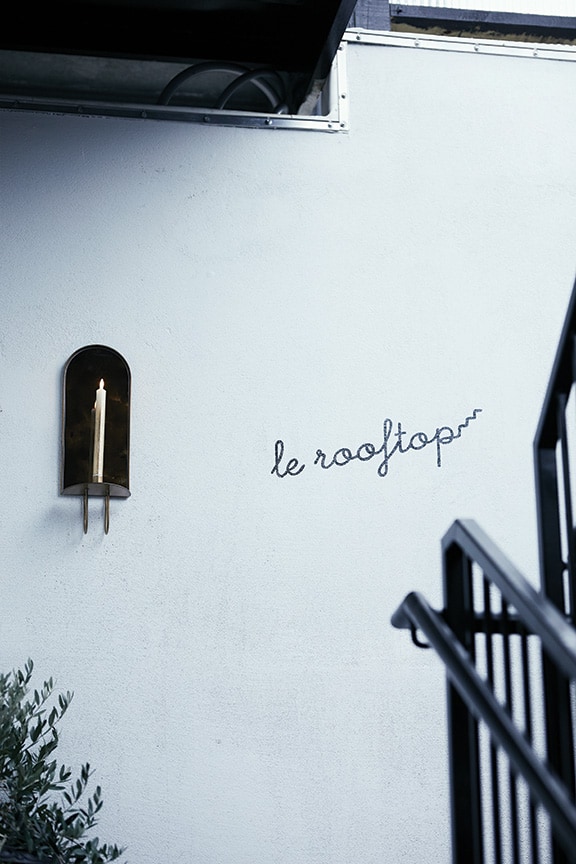
A neon sign and glossy black finish to the building beckon from the outside. Aged oak floors, white panelling and gold-colored antique mirrors greet you as you step in. To your right, framing the open kitchen space, a white marble bar top gleams; a long, tan leather banquette invites you to stay (in France, you have to ask for the check). French light fixtures, blue-and-white 1930s-style wallpaper and a kitchen service window lend the perfect of amount of whimsy to the space.
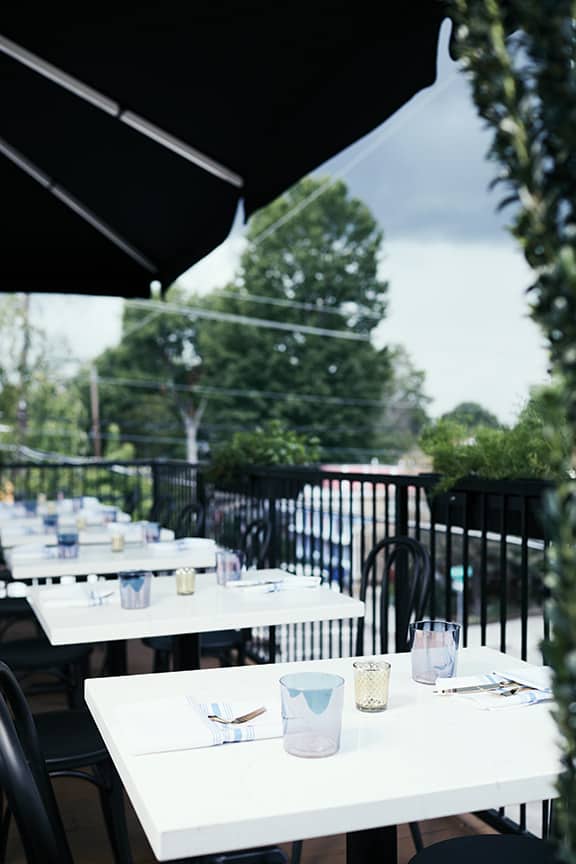
It’s a tight squeeze to be sure; there are maybe 3 feet between the banquette tables and the back of the bar stools. The rooftop patio—lush with trees sourced from Brewery Bhavana, wall planters, window boxes growing lavender and pots of French tarragon and basil—feels even more intimate.
Crawford wanted it that way.
“I enjoy [small dining spaces],” he says. “Not everyone does. At [the Charleston bistro] Purlieu, by the end of my meal, I was sharing dessert with an elderly couple sitting next to me. We’re talking generations apart, just laughing, having a great time talking about food and family. People who enjoy that are going to enjoy this restaurant.”
For Crawford, this sense of fellowship and community building is part of what dining out is about. It’s why, when he opens his concepts, his family is never far from his mind.
“I hope [as Jolie and Jiles] get older, they can learn how to fill roles in these restaurants, to learn how to be part of a team and how to earn,” he says. “Restaurants can teach you a lot of cool lessons in life.”
“These are neighborhood restaurants,” Cherry says. “They’re part of the fabric and very much intended to be part of a community, very urban and very much a great part of the city.”
A look at the challenges local chefs and restaurateurs face.
It’s no secret that Raleigh’s become a Mecca for dining out.
In addition to a deep bench of diverse, innovative restaurants, a foodie community that’s collaborative and supportive and a booming population that can sustain concepts both established and fresh, we’ve also got the nation’s reigning James Beard Award winner for outstanding chef in Ashley Christensen.
But still, the job of a restaurateur in this city—a relatively small market without the tourism muscle of places like Charleston, Washington, D.C. or New Orleans—isn’t easy. Bureaucratic red tape, staffing challenges, marketing pressures and rising food and real estate costs can put a strain on even the most seasoned restaurateur. That’s not even to mention the budgeting considerations inherent in paying for a new restaurant space or financing up-fitting for a second generation one, long working hours and the inability to, at least initially, offer benefits or other perks to employees that all new, independent restaurant owners have to deal with.
For our annual Best Restaurants issue, Raleigh Magazine spoke with eight local chefs and restaurant owners about the struggles they face in their line of work. Whether they’re opening a new concept or working to keep bringing customers through their doors night after night or lunch shift after lunch shift, the challenges they face here are real.
Red Tape from the City, County and State
When Scott Crawford’s second restaurant Jolie opens this month (see our story on page 42), it will be six months later—and to the tune of around $750,000 in lost revenues—than Crawford had hoped. The delay, he explains, had to do with an unexpected zoning issue around changing the use of the space in the Person Street building from retail—a long-since-closed shoe shop— to a restaurant.
“Because it is a change of use, it opened a gigantic can of worms for the whole property,” Crawford says. “The whole property had to be brought into 100 percent compliance with every single issue on site. It’s an unrealistic burden for a small business owner who’s trying to improve a neglected spot. And the city is making that almost impossible.”
Chef Scott Crawford of Crawford and Son and Jolie
Crawford says if he didn’t already have his already-successful restaurant Crawford and Son, he may not have been in a position to see Jolie through.
And it’s not just the City restaurateurs have to contend with.
Chef Jason Smith, owner of the 18 Restaurant Group (including 18 Seaboard, which closed this summer) recalls paying thousands of dollars to replace shelving at his venerable restaurant at the direction of county health inspectors. And Tom Cuomo, who recently opened the Italian-Japanese fusion concept Papa Shogun in a second generation space in Seaboard Station, had to deal with yet another bureaucratic hurdle, this time from the state’s ABC Commission, a board that’s legendary in its difficulty to do business with. To obtain a mixed beverage license, Cuomo learned that, to be considered a restaurant, he needed to have 36 seats (Papa Shogun has 28).
“I was baffled by that idea,” Cuomo says. “Who decided 36 seats is the number to be considered a restaurant [rather than a private club]?” Cuomo decided against the expense of petitioning the ABC board for an exception; Papa Shogun serves beer and wine.
Chef Tom Cuomo of Papa Shogun
Staffing Challenges
“The absolute number one challenge for a chef in this county right now is finding solid line cooks,” says Drew Smith, the executive chef at Cary’s ko•an, which will open this month with owner Sean Degnan and the teams behind Raleigh’s (now-closed) bu•ku and so•ca in Cameron Village. “[Line cooks] are just not here and I don’t know where they are. I’ve had an ad out for a week and a half and I’ve gotten zero candidates.”
Kristen Baughman Taber, owner and founder of Tabletop Media Group which helps several local restaurants and bars with their marketing strategies, says hiring is what she sees her clients struggle with most across the board.
“Sometimes the quality of the candidate might not be right for the restaurant,” Taber says. “Or you think you’re opening in August and it gets pushed back to October. You don’t want to hire too soon and the timing has to be just right for cash flow purposes.”
Raleigh restaurants, especially for front-of-house positions, tend to draw from a pool of college students who aren’t necessarily looking for careers in food service whereas in larger markets—think New York City and Chicago—there are more career professionals to choose from.
But Taber gives props to Wake Tech and its culinary program and groups like the NC Restaurant and Lodging Association that encourage young people to make careers out of cooking and hospitality by pairing them with mentors or helping them to secure internships. And chefs such as Crawford and Christensen, and establishments including Trophy Brewing, A Place at the Table, Carroll’s Kitchen and others, are finding non-traditional ways to find, hire and train staff—by taking them on as volunteers initially, for instance, and working with local nonprofits such as Healing Transitions.
“We’re creating new avenues,” says so-ca/ko-an owner Sean Degnan. “But it’s going to take a lot of effort to encourage kids going to Wake Tech to find higher end restaurant jobs.”
“But we’re always open to teaching,” adds Anh-Tuan Tran, who starts this month as chef de cuisine at ko•an. “We’re looking for people who have that motivation and drive to learn.”
Cash is King
In 2006, when Jason Smith opened 18 Seaboard (which became famous for its seafood), salmon cost less than $4 a pound. Now, it can ring in at just under $8 a pound. Though the price of the product has doubled, Smith says, salmon hasn’t gone from $17 a portion to $35 on the menu; it’s increased by just a few dollars, because that is what Raleigh diners will pay for.
“For high-end restaurants in Raleigh, that’s a hurdle,” Smith says. Another hurdle? Real estate.
“The cost of starting a restaurant now is so astronomical, compared to when I started out,” Smith says. “The idea of paying $35-$40 a square foot, you really have to have some big sales numbers to make that work.”
Jason Smith of 18 Restaurant Group
Drew Smith of ko•an says that, though it’s ideal in many cases, it can be challenging to balance buying locally as much as possible with buying affordably.
“Strip steak from Iowa is half the cost of steak from North Carolina, but that portion has to be the same for people to think they’re getting the value,” he says. “Vegetables are the same way. We have amazing local produce here but it’s twice the cost as grown in other places.”
And now, with the rise of social media, most local restaurants have to find room in their budgets to hire someone to do their marketing for them or risk being left behind.
“Most places are working with somebody or have a designated person in-house,” says Tabletop’s Taber. “Even if they’re just running social media, it is important to have someone doing that for you. Especially where the market is quite saturated like in downtown Raleigh, it is so important to have that marketing component.”
“PR is as important as paying your water bill,” says ko•an’s Drew Smith. “You have to do it but none of us have time to sit on our phones and computers and do all this stuff.”
But it’s no replacement for in-person interaction, says 18 Restaurant Group’s Jason Smith.
“The phone and the restaurant business are very integrated, social media, how’s that dish going to look,” 18’s Smith says. “But the part I love the most, greeting and talking to the customers, that’s so important. And in order to be a chef, to be good at it, you have to enjoy it.”
A Culture of Collaboration
Despite the challenges, local restaurateurs we spoke to all say they have a common source of support they draw upon, one that’s unique to Raleigh and likely doesn’t exist to the same extent in larger markets where the industry can be more cutthroat: the benefit of each other.
“Tons of people are so creative, left and right,” says Amanda Haisley, the former executive chef at bu•ku and pastry chef at upcoming ko•an. “It’s been cool talking to people from other restaurants. It’s a lot less egotistical and competitive and much more of a community vibe these days.”
Amanda Haisley of ko•an
“[The amount of talent in Raleigh] is an advantage for everyone,” says Taber. “What I love about Raleigh and the Triangle in general is how collaborative it is. We’re always doing charity dinners, raising money for nonprofits, hurricane benefit dinners. It’s amazing how our culinary community comes together to do some really phenomenal things.”
Editor’s note: The candidate provided written responses to these questions via email.
1. The City Council has proposed putting an affordable housing bond on the ballot next year. Do you support the bond and do you think that’s enough to address Raleigh’s affordable housing problem?
I think we’re missing the mark on affordable housing. This has become a growing social issue which continues to widen the economic gap between renters and owners. With any proposed affordable housing development, we need to ensure access to public services, education, healthcare facilities, recreational resources, transportation, and job opportunities.
Here’s the downside. Passage of an “affordable” housing bond by referendum will come at a significant cost to our citizens. The city of Raleigh has nearly $1.6 billion worth of outstanding debt obligations on the books. The ability to issue more debt is not a sustainable economic or social model for the city as the financial impact of these projects will be shouldered by residents through increased property taxes over time.
We should focus on the expansion of existing housing programs to enhance the marketability of our fallen communities through building code enforcement, rental vouchers, subsidies and the purchase of residential units to be added to the city’s existing housing stock. I would also direct our City Council to allocate more funding (general fund) to homebuyer assistance programs for first time low-income buyers and housing rehabilitation efforts to clean up blighted neighborhoods.
2. Raleigh’s Human Relations Commission recently recommended the city set up a police oversight board with investigative and subpoena powers. Raleigh’s Police Chief has stated she is not in favor of such a board. Does Raleigh need a board for police oversight?
My focus is the health, safety, and welfare of our citizens. I would approve a (community) oversight board comprised of citizens to foster strategic and collaborative partnerships between RPD and key neighborhood stakeholders. We need increased community engagement to ensure our safety needs are being met along with programs that focus on public safety education. I also believe there is a need for criminal justice reform through comprehensive officer training programs. However, we are currently hampered by budget cuts which may delay implementation along with a backlog of public safety equipment needs.
3. John Kane has proposed building a 40 story tower in the Peace Street area downtown. If elected Mayor, would you support the rezoning for that proposal as is, or try to negotiate for inclusion of affordable hosing units?
I would not support this proposal as is. However, I would consider an affordable housing cost share project with willing developers. The planning of this community would need to include extensive public input.
4. Does Raleigh have enough density and do we currently have the infrastructure to support more?
We are certainly headed in this direction. There are limitations to growth. Increased density will only strain our infrastructure and city resources (i.e. public utilities, public safety response, roadways, etc.). We experience this firsthand every day through congestive afternoon traffic patterns and the frequency of first responder sirens sounding every 15-20 minutes. This is a major issue. If anything, we will need to place greater emphasis on city infrastructure and asset management programs to streamline business and public safety operations in the most densely populated areas of the city.
5. CACs (neighborhood meetings) have traditionally been ways for citizens to engage with decisions that will go before the City Council. Do you support CACs or do you think, with a lot of these conversations happening online these days, that CACs have outlasted their usefulness?
I am a strong proponent of neighborhood meetings and town hall discussions. These public platforms generate thought provoking discussions on issues that directly impact residents at the local level. Elected officials should encourage public participation in the legislative decision-making progress on a regular basis. This feedback is extremely vital to the city’s social progress and long-term economic sustainability.
6. Are the current members of the City Council putting forward a strong enough vision for Raleigh’s growth?
Our needs are constantly changing. With the passage of our city’s capital improvement and operating budgets, we will need to reassess the appropriateness of specific projects in order to allocate taxpayer dollars to the greatest areas of need. I believe we need greater transparency throughout the budget process to identify the long-term financial impacts associated with capital investments. We can accomplish this through budget realignment efforts and greater input from the public. I would much rather commit taxpayer funding and resources towards affordable rental and first-time homebuyer assistance programs rather than miscellaneous municipal set aside projects that provide little value to our residents. We need responsible and effective budgeting strategies to address the true long-term vision for Raleigh’s progressive growth.
7. Are the city managers and staff doing a good job implementing the Council’s vision as stated and running the day to day operations of the city?
There must be a dynamic shift in how we do business in this city, how we govern as a collective body, and how we effectively manage city resources for long term sustainability and growth. This all begins with effective budgeting and sound fiscal policy. We must also take a closer look at how effectively our city is administering public programs and come up with more efficient methods to deliver public services and streamline existing business processes. I’m tired of the status quo. I believe we need a fresh perspective on local issues and that calls for new leadership from top to bottom.
8. Recently, the Council passed a suite of rules regulating Airbnb and electric scooters. Do you support the rules or feel they are too strict?
Our City Council is tasked with creating legislation that protects the health, safety, and welfare of our residents. I believe we are making progress in terms of regulating short-term rentals like Airbnb and electric scooters. I will reserve judgment until we have enough data to assess the effect of this legislation.
Last Word
We desperately need vibrant young leaders with executive level acumen who can turn civic dreams into civic reality. I was born and raised in Raleigh and maintain a vested interest in our progressive community and diverse residents which span all walks of life. The City of Raleigh is a complex government organization. I am confident that my years of managerial experience as a local business owner and dedicated career as a procurement attorney have uniquely qualified me to excel in this elected capacity.
The City Council has proposed putting an affordable housing bond on the ballot next year. Do you support the bond and do you think that’s enough to address Raleigh’s affordable housing problem?
Yes and no. It’s one of our greatest shortfalls. Although a bond is what you do when you have a onetime project that requires capital, the way our city is working and runs now, we absolutely need to do that. But a better answer would be, let’s not make affordable housing a bond issue. Let’s roll it into the budget and fund it every single budget year and we should have been doing that for the last 20 years. A bond is what you do when you want to fix a greenway. There are things we pass bonds on, school bonds. School bonds should just be something that’s taken care of. The things the city ends up paying money for, I wish the city had passed bonds on them. The problem with affordable housing here is…all the other candidates talk about it and talk about homelessness and transportation. It’s like they’re going back three steps to talk about a problem but they are not going back to what’s causing it at all. Which is our city subsidizes big companies to move downtown and they create jobs. They’re not hiring people who live here, like Red Hat or Citrix. They don’t hire me. They bring in talent and those people want to live downtown and what happens is everybody else gets pushed out. People that have traditionally lived downtown get completely scattered. Downtown for the last 80 years has been the place where working people lived. And for the first time in American history, there are more poor and near poor—poor is zero to the poverty line, near poor is poverty line to twice the poverty line—first time in U.S. history there are more poor and near poor people living in the suburbs. The problem with that is density. Working people who live downtown can walk to a bus station, if they’re hard on their luck they can walk to a soup kitchen, there are social services downtown. Everything is downtown for people who need help and the people who are living downtown are the people who don’t need help. And that drives me absolutely insane. What would I do for affordable housing? For one thing, all these condos that are going up, I would absolutely say the developers have to integrate affordable housing. That’s not sexy, it’s not fun, the developers certainly don’t want to do it. But if we said you have to put 20 percent in or you can’t build it, they’d still build it, the money is still there for them. They might not make $80 million, they might make $72 million. But the money’s still there and if they pass on it because we forced their hand to put affordable housing inside their projects, if they pass, another developer will come by and take it up. I wish the City Council would just stand up for the people of Raleigh who are here. That would be my first step, to actually make affordable housing downtown, roll it into the permits. Maybe the most important thing is to figure out how to make a law that binds the developers to it. Because right now, all they have to do is wait until a City Council comes along that is more favorable to business. I understand how this city works and if I am elected Mayor and I said I want to make it so developers have to do it, without a City Council that’s onboard, I would get nowhere.
Raleigh’s Human Relations Commission recently recommended the city set up a police oversight board with investigative and subpoena powers. Raleigh’s Police Chief has stated she is not in favor of such a board. Does Raleigh need a board for police oversight?
I believe that probably every police officer in Raleigh is a good person. They’re professionals, they wake up in the morning and put their pants on one leg at a time. They want to do the best. It gets thrown around that they need more training. Well, your average Raleigh police officer has 80 hours of training a year. That’s two weeks of training for every year they work. That is a lot of training. So people throw around platitudes like they need more training but don’t actually address what sort of….the training [that they say officers need], they’ve already got it. I don’t think police officers are inherently bad or inherently monsters. The Raleigh PACT (Police Accountability Community Taskforce), they got big news because they went in and they shouted down a City Council meeting. And they should have! There are people who are frustrated, people who are hurt, there are people in that group who have had their lives shattered through having someone that they love incarcerated or murdered. They deserve answers, absolutely. The problem with it all that I see is that humanity is inherently—we’re not an animal that appreciates equality. Like the Jews in Israel, the caste system in India, in America it’s white people and people of color…you just can’t get away from it. I don’t want to say that the police are racist. But the mechanism that drives racism—when you have a group of people who are in power and they want to maintain power and are able to oppress people that they put below them—it’s a trickle down thing. It only goes one way. The problem is you can have an entire police force of, it doesn’t matter if they’re white or black police officers, it doesn’t matter if they have done all the racial training in the world, it’s not a white-black thing. It’s a police-citizen thing. It’s the exact same mechanism. The police are in power, they hold it over the poor people. And the problem is until we figure out how to get around that, no police accountability board will ever work. There is no way until we get to the root of the problem. I don’t know what the answer is. Every city in America has been trying to figure this out. As far as I know, nobody has made it work. It’s an enormous problem, it has so many moving parts and I think if anybody thinks they’ve got the answer, they’re either delusional or they’re lying. I know I certainly don’t have the answer and I also know that a mayor can’t fix it. That being said, the least we can do is give the citizens more transparency and accountability. If that is a police oversight commission with subpoena power, that might be a first step.
John Kane has proposed building a 40 story tower in the Peace Street area downtown. If elected Mayor, would you support the rezoning for that proposal as is, or try to negotiate for inclusion of affordable hosing units?
People have pegged me as an anti-development candidate. I’m not anti-development. I wish Raleigh would grow organically. When I said the city subsidizes companies to come in, I think we’re growing way too fast. Raleigh is a small town. And that makes people mad when they hear me say it but downtown Raleigh is six blocks by six blocks. Most of the streets are two-lane. We’re not built for this kind of density. I want to say I am not an enemy of John Kane. John Kane is a developer and it is his job to build. That’s what he does. Being mad at John Kane for wanting to put a 40 story tower up is like being mad at a fox for eating a chicken. It’s his nature. Do I think we need a 40 story tower? The way Raleigh is growing, we need to do something but the bigger issue is we have grown too big and far too fast. I also think that Peace Street and Capital Boulevard are way too small to handle the traffic that would be coming in and out of that tower. I’ve heard it said that they are going to run a bus line right by it. Well, the people who are going to buy million dollar condos in a brand new 40 story high-rise, they’re going to have a car, they’re not going to ride a bus. So there is a very real over-exertion of the infrastructure on the street all by itself. I’m not even talking about sewer or water. I think it’s a bad idea. I also think it’s a bad idea because I believe we are in an enormous [real estate] bubble. And if it pops, it’s going to be really messy downtown. Like all these high-rises three quarters empty? Whoa, could you imagine. There’s two ways Raleigh will end up. We’re on a path, we can’t get off, we can’t back up. Raleigh’s either going to become San Francisco or Raleigh’s going to become Detroit. And if we’re really unlucky, Raleigh’s going to become San Francisco and then we’re going to become Detroit. But for people like me, it doesn’t matter, because I’m getting squeezed out no matter what.
Does Raleigh have enough density and do we currently have the infrastructure to support more?
I don’t think we do. In 1997, Falls Lake went really dry. We have a hundred thousand more people now. There’s only so much water that’s ever going to come down the Neuse River into Falls Lake and there is nothing a mayor or city manager can do about that. That’s 100 percent an Army Corps of Engineers issue. And they don’t care about whether we have water or not, their goal is to make sure our river systems are healthy. They’re not going to pump in water from some other river so we can water our lawns. That’s my No. 1 biggest concern. We have an amazing infrastructure for a town that’s half our size.
CACs (neighborhood meetings) have traditionally been ways for citizens to engage with decisions that will go before the City Council. Do you support CACs or do you think, with a lot of these conversations happening online these days, that CACs have outlasted their usefulness?
There’s something that’s definitely very quaint about citizens going in front of their councilperson or a councilperson going in front of their constituents. People online are horrible but if they make an effort to show up then I think that does have some weight. And of course, all elected officials are beholden to the people who elected them. Even if, like in Raleigh, it’s an amazingly small percentage of the registered voters who elect them. I did the math and if I wanted to win last time, I would have had to get something like 13,000 votes. It was pathetically low. Of course last time we had an incumbent. This time, it’s the Wild West. I don’t know if the city could be doing a better job of engaging citizens. I mean, their council meetings are open, you can go sign up and speak to them. I have definitely got CAC signs all over my neighborhood. I’ve never [gone to one] because I get mad every time I read the News and Observer. And that’s not what you need at a meeting. But I support CACs.
Are the current members of the City Council putting forward a strong enough vision for Raleigh’s growth?
They’re putting forward the wrong vision for Raleigh’s growth. I’m a proponent of organic growth, I’m not a proponent of artificially driven growth. We pay millions of dollars for economic development and we give tax credits where companies don’t pay taxes for years at a time. The ramifications of that are absolutely killing our city.
Are the city managers and staff doing a good job implementing the Council’s vision as stated and running the day to day operations of the city?
My father was a a civil servant. He worked for the Division of School Planning for 30 years, where, if you’re going to design a public school in Murphy and then you’re going to make one in Manteo, you’re not going to use the same blueprints because they’re different soils, they’re different topographies. You hire a local architect but then the plans come to Raleigh and my dad’s job was to check the blueprints against code. Like water fountains have to be a certain height in elementary school and a certain height in high school. You can’t have K-5 in a two story building because little kids can’t do stairs in case of an emergency. If you’ve ever been to a K-5 restroom…they make little bitty toilets but you can’t put them in there, you have to have full size toilets because the kids have full size toilets at home. So you have to honor the parents’ training them on a full size toilet. Otherwise the kids would go to the bathroom at school and they wouldn’t use the toilets at home. These are all nuts and bolts things but so my father worked for the Division of School Planning for 30 years and came in at the bottom and when he retired, he was the head of his department. That meant he was the one who went across Jones Street to the state legislature and gave presentations. He was the go-between. And I have so much respect for the professionals, the staff and city manger, they’re professionals. And politicians are at best amateurs and at worst, politicians. To watch my father, who was a professional, go and give his professional opinion, and then his frustration at what he was getting back…I have the utmost respect for professionals, and that includes the staff of the city and the city planners.
Recently, the Council passed a suite of rules regulating Airbnb and electric scooters. Do you support the rules or feel they are too strict?
With Airbnbs, you should be able to rent out a room in your house 365 days a year if you want. I wish we could get moving on the granny flat issue. I wish it were done today and if that were done, I think you should be able to rent out a granny flat on Airbnb 365 days a year. I don’t think you should be able to rent out an entire house on Airbnb. You can go to some cities, like San Diego, and the first quarter mile back from the beach is nothing but houses and condos that nobody lives in, they’re all Airbnbs. That hurts Raleigh’s housing market because there are fewer units available for people to live in and it increases the housing costs.
With electric scooters, everybody touts them as a last mile option. They’re not. Electric scooters are toys for people who can afford smart phones, they’re not handicap accessible, they’re not child accessible, so let’s just call them what they are: they’re a fun and very annoying toy. But they are not an option for last mile transport. And I know why the people in the city like to call it that. Because it relieves them of having to figure out actual last mile transport. But the people who need last mile transport are people who actually need it; they’re handicapped, elderly, people with children. A scooter is not going to help them. I’m also ticked off that they just showed up and figured they’d ask for forgiveness rather than permission. I don’t like them. I wish they would go.
Last Word
My first rule is no money. I’m what you call an impossible candidate. It would be such a long shot for me to win that I don’t think it’s ethical for me to ask for money to spend on yard signs or commercials or print ads when there’s hungry kids in Raleigh, when there’s homeless people, when we have such a need for help. It would be unethical for me to take that money from people who would want me to win knowing that. Rule two is no false hope. I want to get rid of scooters, I want to get rid of the roundabouts, I don’t like McMansions. That’s not giving anybody false hope. If you start saying I’m going to forgive your college student loan debt, well the mayor can’t do that, the governor can’t do that. Probably the government can’t do that but that is pandering and it would get a lot of people really excited. So no false hope, I’m not going to promise to help anybody who actually needs help. Although, I’m running because I want to help people who need help but I’m not going to promise it. The third thing I said is no mud slinging because as an impossible candidate, I have nowhere, such a small amount to fall, where everybody else has a long way to fall. So I don’t like any of the candidates, I have my reasons, but I’m not going to discuss it. I think that’s kind of classy. Except where I say I don’t like any of them, but it’s all of them….This will be Raleigh’s first million dollar mayoral election. Everybody who is running so far has a website with a platform on it. I would encourage everyone to look at all the candidates and please vote. If you don’t like me, that’s fine. But I want more than 7 percent voter turnout. That’s part of the reason I’m running. Because it is important.
Reforming North Carolina’s ABC system will benefit hospitality industry professionals, consumers and the local economy.
This year, state lawmakers introduced a raft of bills aimed at modernizing liquor sales in North Carolina, and with good reason: The current system looks much like it did back in the Prohibition era. The state’s role in selling spirits—currently it functions as a monopoly with 170 local ABC boards in a state comprised of 100 counties—makes buying and selling liquor inconsistent, inefficient, inconvenient and unsustainable for businesses, proponents of the legislation say.
“All restaurants and bars have to navigate this and we are all frustrated beyond words,” says Cheetie Kumar, co-owner of downtown Raleigh restaurant Garland and the adjacent Kings and Neptunes music clubs. “As the food industry [in North Carolina] has evolved and gotten so much national recognition, our hands are tied behind our back when it comes to the cocktail portion.”
Hospitality industry professionals say the outdated system makes doing business difficult for them, that their customers can’t get spirits available for sale in other states, and that local distillers can’t sell their products to them directly or even in many county ABC stores.
Among other complaints, bar owners and restaurateurs can’t sample spirits they may want to sell beforehand; they have to order from their local ABC board, which may or may not have what they want in stock; they have to order in bulk or make a special order, for which there’s no tracking system; they have to send an employee to pay in person with a check, load bottles into a personal vehicle and drive them back to the bar; and, if they want to carry a spirit their local ABC can’t or won’t stock, well…they’re pretty much out of luck.
“There are products we would like to carry, a greater selection of bourbons, of North Carolina-distilled product,” says Jim Beley, general manager of the Umstead Hotel and Spa. “The [Wake County] ABC decides what they’ll carry, so a lot of guests staying here, from the U.S. and internationally, are surprised that we don’t have certain quality scotches and bourbons. But we’re just not able to get them. And we want to carry local products as much as possible, but the local ABCs can refuse to carry certain products made in our state.”
Among the bills introduced this session (see below) is House Bill 971, which modernizes the licensure model for liquor sales and would see the state treat spirits sales the same as sales of beer and wine. It would dissolve local ABC boards and allow private businesses to operate wholesale and retail liquor sales. Under the bill, the state ABC Commission would still oversee liquor sales permitting, and the ALE would still oversee law enforcement; the revenues from liquor sales would still be disbursed to state and local governments that could use them for substance abuse prevention and other programs. Privatization would ensure that hospitality industry experts rather than state employees are making decisions about what local bars and restaurants can stock, the bill’s backers say.
“Our [customers] are becoming more and more sophisticated and they’re demanding a higher quality experience,” says Nick Hawthorne-Johnson, co-founder of Durham’s Cast Iron Group that operates Ponysaurus Brewing Co., The Cookery and Dashi, among others. “We want to provide that for them but it makes it difficult for us when we can’t get spirits because the people who stock spirits for the state don’t necessarily know a lot about the products. It’s time we let the state do what it does best, regulate, and let people who know how to supply boutique products supply them.”
Among the backers of the current bills proposed for ABC reform in the General Assembly are the North Carolina Restaurant and Lodging Association, or NCRLA, and the North Carolina Retail Merchants Association, or NCRMA, groups who say reform will benefit consumers, businesses and, largely, the state economy overall.
“[These laws] are not about more alcohol, or making alcohol easier to access for consumers,” says Lynn Minges, the NCRLA’s president and CEO. “They’re really about improving and modernizing a system and improving inefficiencies, making them more customer service- oriented.”
“It is a major policy shift, so it takes getting the legislation correct, explaining it to [lawmakers] and making sure they understand the community is not going to be detrimentally impacted,” says Andy Ellen, president and general counsel at the NCRMA. “Money will still be flowing into substance abuse programs.”
Ellen says he is optimistic about the chances of at least some of the provisions in the reform bills passing this legislative session, especially if lawmakers are able to get replacement ABC revenues streams in the budget into place. And with recent shifts in the law, such as legalizing Sunday morning alcohol sales, that optimism seems warranted.
Kumar, Beley and Hawthorne-Johnson are glad lawmakers are finally talking about ABC reform, a conversation they say has long been overdue.
“The motivation for people being into spirits isn’t to get intoxicated,” says Kumar. “That’s not what it’s about. It’s the reverse—the enjoyment of this craft. At this point, we would take anything to get three or four little things in place that would make it easier.”