
by Jane Porter | Feb 4, 2019 | Buzz, February 2019
A block in a thriving urban neighborhood. A 1920s brick warehouse that once served as the Carolina Coach bus depot. A cultural shift in how we eat, drink and interact.
These are the elements that will converge when Transfer Company, downtown Raleigh’s long-anticipated food hall, retail center and events hub, holds its grand opening next month. More than five years in the making, developer Jason Queen and team financed renovations of the 43,000 square foot indoor space, known as Stone’s Warehouse, and 7,000 square feet in adjacent outdoor parcels, through a combination of state and federal tax credits and loan programs.
“It’s been cool to see the building come back to life,” Queen says. “Slowly, in the next couple of months, the public will see the renovation and the building like it used to be.”
The existing historic buildings at 500 East Davie Street will house 15 anchor tenants in the main food hall, including a mix of food and drink vendors, plus rotating retailers selling handmade goods and other products weekly. Production facilities for Videri Chocolate Factory and Burial Beer Co. are located off of the main food hall along East Street, and are set to be fully operational this summer. A commercial grocery store and four tenants will go into a new building behind the warehouse, slated to open in late 2020, and 15 townhomes lining the property’s eastern perimeter along Chavis Way will be finished and sold by the end of this year.
Queen says he had only one expectation of the tenants he recruited for Transfer Company: They be the area’s best of the best.
“Ultimately, we wanted the top three vendors within their own subcategory within the food industry,” he explains. “So, if we couldn’t get one of the top three bakers in the Triangle, then we don’t do a bakery at all. We got really lucky and we did attract the best in the Triangle in any single category that we went for.”
Inherent to the renovation process was a commitment that the final product be something that the surrounding community could collectively be proud to take ownership of, while integrating into the fabric of the neighborhood without replicating any of its existing assets.
This commitment informed decisions around everything from parking—at some 50 spaces, there’ll be less of it in order to avoid breaking up the block, and to encourage people to walk from their homes, apartments and nearby parking decks—to the curated tenant mix to providing space for families, neighborhood meetings and community gatherings, for instance, in the new plaza and mezzanine areas.
“My big goal with Transfer Company is that I want it to be a constant celebration of food, knowledge and community,” says Nick Neptune, the food hall’s general manager. “It’s one layer after another to wrap your mind around what it means to be a part of that.”
He’s right.
The food aspect is straightforward, but constantly celebrating community and knowledge took some thinking through. Transfer Company’s design capitalizes on a cultural shift in how we have come to socialize and interact with one another in a way that’s more open, communal and connection-driven.
“There’s an innovation component to what we’re doing,” Queen says. “Innovation occurs with the transfer of knowledge across industries to people. Our role in that is to develop a space that maximizes the opportunity for the transfer of knowledge by developing a space that maximizes chances for social interaction. You make longer tables, have people sit together and, all of a sudden, there’s an opportunity for knowledge transfer and the creation of innovative products.”
To illustrate his point, Queen has an example at the ready. There’s a beer that Transfer Company tenant Burial brewed, mashed with spelt from fellow tenant Boulted Bread. A chai imperial stout, it’s called “The Crown of Divination,” and has notes of nutmeg, cinnamon, black tea, ginger and cardamon. It’s “a righteous crusade,” Burial’s website states, “upon a pathway divined by the hand of the supernatural.”
And, at 10 percent ABV, it’s a knowledge transfer that goes straight to your head.
Could anything be more Raleigh?
Transfer Company Vendors
Sweet Peas Urban Gardens
Grows and sells more than 55 certified, naturally grown microgreens and vegetable shoots produced in Raleigh.
ARA
Chef Jae Lee creates Izakaya street-style food featuring a special combination of Asian flavors.
Dank Burrito
The third NC location for chef-inspired tacos, burritos and bowls. Using flavorful bases that vary from Asian pulled-pork to shaved ribeye, Dank Burrito creates unique combinations that make for stunning results, including house-made salsas and pico with toppings like ginger slaw, kimchi and dank yum yum sauce.
Captain Cookie & The Milkman
Just what the name says: freshly baked cookies, local milk and ice cream sandwiches. The owners are UNC graduates who have two brick-and-mortar locations in Washington, D.C. This will be their first in North Carolina.
Chhote’s
Authentic Indian street food from the owners of Cary’s Biryani Maxx, Chhote’s will make you think you traveled around the world to Mumbai.
Che Empanadas (open now)
Owner Anabel Rossbach is finally making her adored Argentinian pastries available to the masses. Fan favorites include Carne Dulce, the basil-filled Caprese and the traditional Jamon y Queso.
Benchwarmers Bagels
Wood-fired bagels and slammin’ coffee from the owners of Jubala Coffee and Boulted Bread. Need we say more?
Locals Oyster Bar (open now)
Another masterful collaboration between Person Street Bar and Locals Seafood. Order a drink and dine in on fresh fish and steamed shellfish, or buy a fresh catch in the seafood market to take home.
Videri Chocolate Factory
A longtime resident of the Warehouse District Videri is expanding and will offer chocolate inspired desserts and pastries.
Burial Beer Co. (open now)
Known for crafting a range of beers from Belgian-inspired ales to bold American styles in Asheville. This location will sell core beers but also offer special bottle and can releases, as well as a draft selection of experiential, small-batch beers.

by Jane Porter | Feb 4, 2019 | Eat, February 2019
It’s late afternoon on a weekday at Raleigh’s new, Japanese cuisine focused restaurant O-Ku Sushi, located on the first floor of the Dillon building in downtown’s Warehouse District.
Servers and sushi bar staff, clad in telltale black uniforms, busy themselves with side work and bar prep in the warm, wood-toned dining room, replete with tall windows and funky modern light fixtures. Back in the kitchen, chefs are gearing up for what promises to be another long dinner shift. In many restaurants, the front of the house is the front, the back of the house is the back, and nary the twain shall meet. But at O-Ku, every day, this division is decidedly, deliberately discouraged by a tradition that’s not just reserved for the restaurant’s customers— the simple act of breaking bread.
O-Ku executive chef Richard Fong is running vats of broth, plates of chicken and beef, deep bowls filled with soba noodles, fried dumplings, veggies and bean sprouts, plus spoons, chopsticks and dinnerware, out to a long dining room table that serves as a buffet for the roughly two dozen staffers who have come in to work. Soon, everyone’s lined up single-file, holding their bowls, chattering and bobbing along to Michael Jackson songs, excited, clearly, to enjoy another “family meal” with their coworkers.
“At a lot of restaurants, you’ll see the front of the house and the back of the house don’t really speak to each other like they do here,” Fong says. “This way, everybody gets to know each other, gets a little closer, just like at home, having dinner with your family.”
It can be hard thinking up new ideas of ways to feed everyone before diving into work, Fong acknowledges. With a budget of $50 per day, he’s responsible for meals five days a week, while servers and other staff pitch in and buy and prepare meals for the other two. They’ve had Asian food aplenty, but also Italian dishes, tacos, shawarma, chicken fingers and sandwiches. Everyone seems to agree, the extra effort is worth it for the sense of camaraderie it fosters.
“We all need each other to be successful, so this is one of the best ways to bridge that [front and back] divide,” says Robert Locke, O-Ku’s general manager. “It helps you realize, these are a bunch of people just like you, they do stuff outside of here, they have hobbies and passions and kids. It just helps you connect.”
The concept of eating a family meal before work isn’t unheard of in the restaurant industry.
Raleigh restaurateurs, including Scott Crawford and Ashley Christensen, do similar things with their staffs, and there are even cookbooks available that describe family meals at the nation’s well-known restaurants. But, certainly, few places are so ambitious as to make it a point for their workers to eat together every day of the week. At O-Ku, it’s a tradition that’s become important enough that when the restaurant made the move to start serving lunch in January, it decided to close its doors between 2 and
5 p.m. so that the family meal time could be preserved.
“It’s just baked into the cake of what we do,” Locke says. “It’s part of who we are.”
The Indigo Road Restaurant Group, O-Ku’s Charleston-based parent company, places a premium on taking care of its employees in both small and big ways, says founder and managing partner Steve Palmer. The group, which owns 20 different restaurants in six cities in the Southeast, brings a creative approach to making hospitality jobs attractive to its current and prospective employees.
Along with the family meals, Indigo Road restaurants, including The Oak Steakhouse, slated to open in Raleigh this year, offer their employees services such as free culinary school training, mental health counseling, and even an interest-free loan when they’re ready to make a down payment on a house.
“We believe that if we take care of our workers, they’ll take care of our customers,” Palmer says.
It’s been a winning strategy so far. In an industry where the numbers of service and hospitality workers in the national market have recently been declining due to factors such as long hours, high stress and low pay, Indigo Road has grown, and rapidly, since its inception in 2009.
Chefs, especially, are allowed a large amount of creative freedom in devising menus. Each of the five O-Ku locations—in Charleston, Atlanta, Charlotte, Washington, D.C. and Raleigh—are all designed differently, with different menus, features and specialities according to the chefs’ individual talents. It’s not hard to see, then, why getting a free meal each day before a shift is an attractive option to would-be workers, especially in a restaurant market like Raleigh’s, where the labor pool is limited and competition for talented, reliable workers is near constant.
“We all work in this industry, and believe breaking bread with people is important,” Locke says. “People can cook at home but they come out for an experience. It’s really important for us to do that with each, other too.”

by Jane Porter | Dec 31, 2018 | Buzz, December 2018 / January 2019
North Carolina Gov. Roy Cooper added another furry friend to the First Family after a stray kitten turned up in the garage of the downtown Governor’s Mansion. Cooper happily accepted the cat into his family’s menagerie of first pets, which also include a rescue dog, Benjamin, and two other adopted cats, Alexei and Adelaide. He has named the small, black tortoiseshell cat Jennyanydots, after the character from Cats. It’s clear that this lucky little kitty found the right garage to wander into!

by Jane Porter | Dec 24, 2018 | Buzz, December 2018 / January 2019
Was it Gerald Baker’s opposition to ICE in a county that values the contributions of its immigrant community, or was he the beneficiary of a particularly good night for Democrats in Wake? We may never know the answer to that question, but, despite the low-profile campaign Baker ran, the Raleigh native unseated Wake County’s long-serving Sheriff Donnie Harrison on Election Night in November, taking 54.5 percent of the vote in an upset. Following 28 years of service in the sheriff’s department, he retired as a sergeant last May. Baker holds a degree in organizational management from St. Augustine’s and graduated from NC State’s Administrative Officer’s Management program. There is no doubt Baker has the experience and qualifications needed to take on his new role, but how will his tenure helming the department contrast with Harrison’s? For starters, Baker has promised to end Wake County’s involvement with the federal 287(g) program, a partnership with U.S. Immigration and Customs Enforcement (ICE) that transfers undocumented people arrested locally into federal custody. He has also promised to build trust with the public, to instill more transparency in the department and to demand more accountability from sheriff’s deputies. There’s a new sheriff in town, as the saying goes, and in a county that is growing explosively, Baker has got his work cut out for him.
by Jane Porter | Dec 10, 2018 | Buzz, December 2018 / January 2019
Many of us have fond memories of that teacher or professor who, when the weather got nice, let us learn outside. At Raleigh’s Campbell Law School, Dean J. Rich Leonard has taken the outdoor classroom concept to a whole new level.
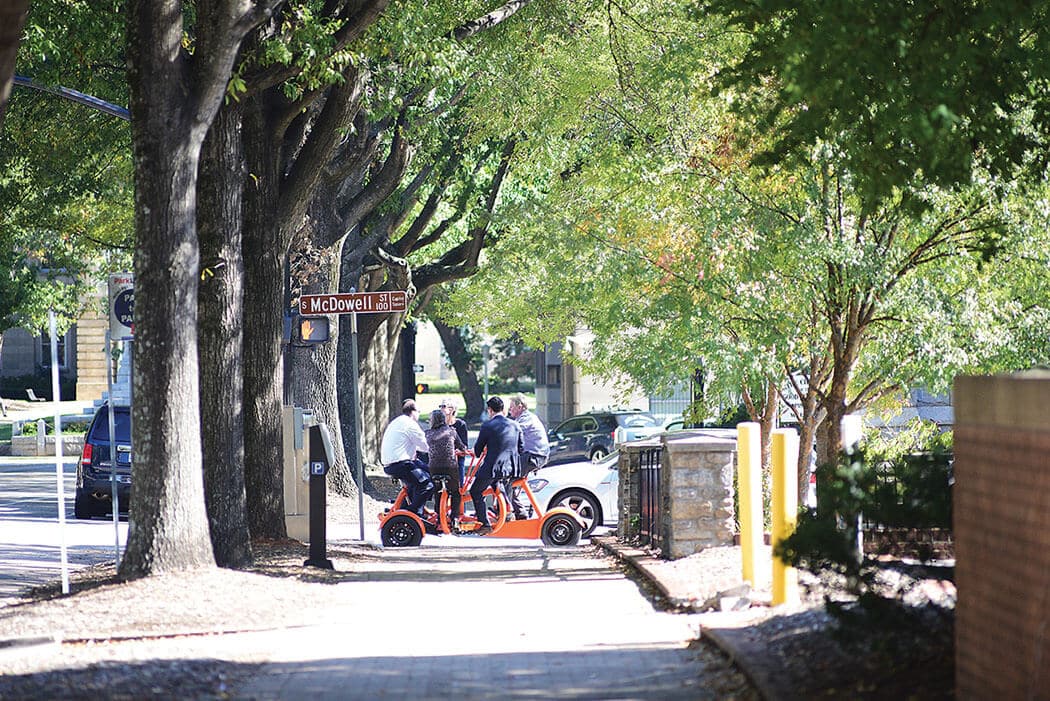
Last month, a bright orange, seven-seater Conference Bike—something of a cross between a tandem bicycle and the Trolley Pub—appeared cruising along the streets of downtown, just small enough to fit within the city’s bike lanes. It’s a new toy, or tool, for the law school’s students, staff and faculty members who want to take a much-needed break from the books and do something active while still being (somewhat) productive.
During a school trip to Vienna with students in April, Leonard noticed Conference Bikes, or CoBis, coasting down the Austrian capital’s streets, helmed by one person at the steering wheel, with six others working the pedals.
“The idea is a great one, where you could get a little exercise while you had a small group meeting,” Leonard says of his first impression of the bikes. “As long as the person who is steering and braking is paying attention, the others can really get engrossed in whatever topic or conversation that they’re involved in and be out on [a beautiful day]. Rather than sitting around in a conference room for an hour, you’ll be out in the sunshine, and get the same thing accomplished.”
Conference Bike is a Dutch company that manufactures the circular CoBis based on an original, nearly 30-year-old design from the American artist Eric Staller. Staller took up residence in the bike-obsessed city of Amsterdam in 1994, and evolved his design—formerly envisioned to accommodate eight, and known as OCTOS—into the CoBi-7 prototype. Staller says his mission is to “cover the world” with his invention.
Leonard, who started a standard bike share program—one of the first in Raleigh—at Campbell two years ago, saw the benefits of the Conference Bike for students. He persuaded Campbell Law School benefactors that buying a CoBi using donor funds would elevate the small school’s profile. Leonard put the order in this summer and received the bike in October, after Conference Bike was able to fabricate a CoBi out of galvanized metal in Campbell’s signature bright orange hue.
According to Conference Bike’s website, the 8-feet long, 6-feet wide and 4-feet tall bike weighs 440 pounds, can hold up to 1,500 pounds of riders’ weight and can travel up to 10 miles per hour. The CoBi-7 model costs $12,750, and has been sold in 16 countries, including for use at the Facebook and Google campuses in the United States. Leonard says he thinks Campbell is the only law school or higher learning institution in the country to offer a CoBi to students.
Now, students and faculty members can sign out the CoBi just as they would any of the other bikes in the bike share program and take it for a spin. (The school won’t be loaning the CoBi to outside groups for obvious liability reasons, but we’re taking bets on how long it will be before Raleigh companies and bike lovers invest in CoBis of their own). The Conference Bike isn’t difficult to steer, Leonard says, as he and some colleagues whip around the Campbell Law parking lot on a warm October afternoon. And, since most riders are only pedaling, sight-impaired students and others with disabilities are able to get in on the fun. But, Leonard says, though the bike has a five-year warranty, he’s not sure what he’ll do if something goes wrong with it.
“It’s a leap of faith, but when you do those sorts of things, you’re trying to get the name of the school out there and create a little bit of diversion for our students, who work hard here,” Leonard says. “If they can get out in the sun and do something like this for an hour or two, that’s just great. It was reasonably priced for what it does, and you get to see all these kids out and about—that makes it worth the while.”



