by Jane Porter | Dec 1, 2018 | December 2018 / January 2019, Retreat, Stuff
Photographs by Keith Issacs
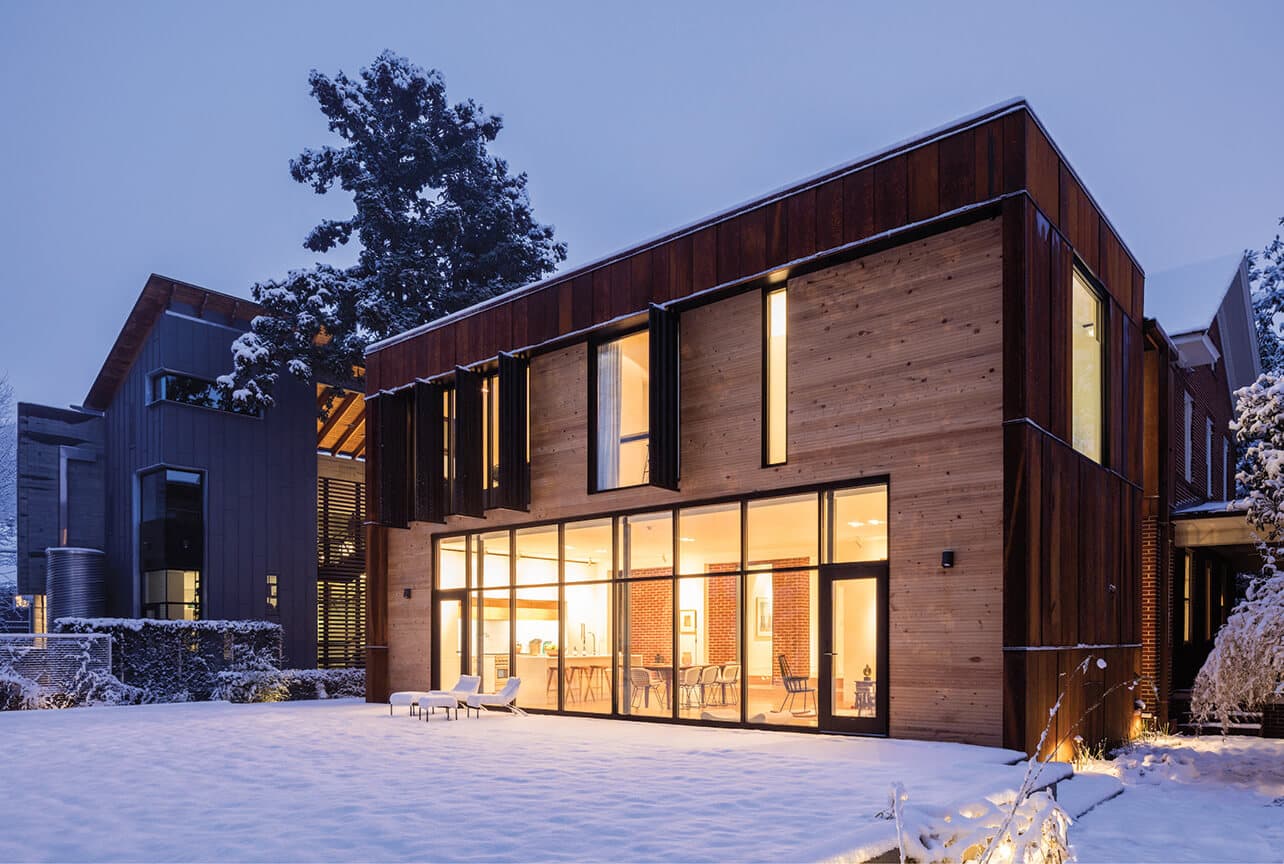
When old design meets new, there’s often an element of surprise to the final result. For a residence in Raleigh’s Historic Cameron Park neighborhood, architect Katherine Hogan and designer Vinny Petrarca, the principals of Tonic Design, created an air of the unexpected that’s seamless and deferential, but also practical and beautiful, all at once.
 The married partners added 1,600 square feet to a 1916, red brick Georgian Revival-style home located in a neighborhood known for its own blend of old and new, of parkland and residential lots and of public and private spaces. The addition, an open floor kitchen and living space on the first level and a master bedroom suite on the second, is bound by the mass of the existing house, unobtrusive in terms of its view from the street and in how it preserves, rather than absorbs, the lot’s spacious backyard.
“Our scheme maximized the backyard and really tried to make that a space inside the project,” Petrarca says. “This is a good example of being in an established neighborhood, adding what you want and co-existing with the old, versus just razing the whole thing and throwing it away.”
 Laney Brothers Construction built the addition using Corten steel, glass and natural wood siding, contrasted with the home’s old brick facade to facilitate modern living and an integrated relationship between the inside and the outdoors. No walls obtrude the space between the minimalist kitchen and dining area on one end of the structure and the cozy nook with a fireplace, framed by built-in shelves, on the other. Sunlight floods the bottom floor, while adjustable louvers shade the master bedroom up top. The old part of the home, a series of quaint rooms with small windows and charming features, including pocket doors and a hallway fireplace, is separated from the modern addition by a narrow, double-height, light-filled, interstitial space, helmed by a new perforated metal staircase and tall windows located at either end.
There was a functional reason for the separation in addition to its unique, pleasing aesthetic: it allowed the home’s old gabled roof to meet the addition’s flat one, preserving the home’s rear brick wall and windows and creating a smooth transition between differing floor and ceiling heights. “Our clients really wanted a modern floor plan,” Petrarca explains, “so we went with this separated addition, with this modern box in the back.”
For this Cameron Park addition, Tonic Design was honored with a 2018 Merit Award from the North Carolina chapter of the American Institute of Architects this fall, the 11th time Hogan and Petrarca have received an AIA NC Design Award. Their body of work includes the Form and Function building in Five Points and the Art as Shelter pavilion at the NC Museum of Art park.
“We really enjoy repurposing existing buildings and giving them new life,” Hogan says. “We wanted to preserve the integrity of the old house and the way that is addressed in the neighborhood. That was the shared goal of the clients and we wanted to respect that and to try to make it all work together.”

by Jane Porter | Dec 1, 2018 | Buzz, December 2018 / January 2019
As we prepare to stick the fork in another year passed, we thought we’d take a look back on the events and people that made Raleigh…well, not great, exactly, but certainly colorful. What was cringeworthy? Who got their just desserts? What is residents’ preferred means of exacting retribution? Turns out, we have strong feelings about hot dogs, dodged a bullet from Amazon and favor hitting our enemies with a car. On December 31, as we watch the acorn drop, we’ll let auld acquaintance be forgot—but here’s your chance to bring it to mind just one last time.
 AMAZON BOMB
“Surprise, we didn’t get Amazon!” quickly turned into “Yay, we didn’t get Amazon!” when news broke that the shipping giant would be locating its HQ2 not in Raleigh or the Triangle, but in the slightly larger markets of Washington, D.C. and New York. But, but…this was our chance to stick it to Charlotte as BEST CITY IN NC, and HQ2 was supposed to be looking at spaces downtown, and John Kane was planning on building a “Prime” corridor for the company’s real estate, and a deal with that other tech giant, Apple, was reportedly “imminent!!” Actually, we belatedly learned, local officials had had “no meaningful conversations” with Amazon since March. That, apparently, gave Raleighites enough time to have a good, hard think about realities such as our horrendous traffic situation, our inadequate at best, non-existent at worst transit infrastructure, our spiraling-out-of-control housing costs…and the 7 million gallons of sewage that, due to rain, spilled into local waterways, coinciding with the HQ2 announcement. Turns out, we probably can’t handle another 50,000 flushing toilets just yet, and, hey, at least we’re not Georgia, who sold its soul offering a state-funded academy to train Amazon employees, an exclusive lounge with free parking at Hartsfield-Jackson Airport (the world’s busiest!) and more than $2 billion in publicly funded incentives, just to also be told “thanks, but nah.” Didn’t we just have a blue wave here in Wake? So aren’t we kinda socialist now, and therefore opposed to providing incentives like the $100 million-plus in tax breaks we reportedly were willing to cough up in order to declare ourselves, officially, the next Seattle? Sure, that Alexa apology sort of stung, but New York City’s subway system is falling apart while its taxpayers will be lining Jeff Bezos’ pockets with billions of dollars. Of course, it was a shock to learn that all those lists we’re perpetually topping are actually, functionally meaningless, but sometimes when you win, you really lose, and sometimes when you lose, you win.
REGISTER OF PLEADS
It’s TFW when you steal hundreds of thousands of dollars in public funds, stash the money in suitcases throughout your million dollar house and count on the boobs in county government to keep bumbling along none the wiser, because the cash-only office is operating under the auspices of the honor system. Former Wake County Register of Deeds Laura Riddick was sentenced to up to seven years in prison under a plea agreement that will also see her pay back $926,615 in restitution. The Republican, who was elected in 1996 and served in the position until she resigned in 2017, had a penchant for traveling, it was reported, with trips to swanky inns and resorts in Florida, Blowing Rock and the marginally exotic locale of Waynesville, NC. Riddick also paid for spa treatments, landscaping, clothes, credit cards and the mortgage on her aforementioned house, while periodically depositing large amounts of cash into her personal bank account. Citing abuse and financial struggles as a child, as well as an ongoing heart condition, Riddick’s lawyers told a Wake County judge that their client had developed a “compulsion to hoard money.” Riddick will be allowed out of prison on weekdays for work release. Three other employees were also charged with embezzling from the Register of Deeds office.
 LAST CALL FOR DUANE HALL
It’s not 1952 (or even 2012) anymore and, thankfully, gross, high-profile men are being called out publicly for their bad behavior. In #ncpol’s very own brush with #metoo, veteran Democratic lawmaker Rep. Duane Hall of Wake County was shown the door by voters in his spring primary, after the left-leaning news outlet NC Policy Watch reported on a series of inappropriate sexual advances he was alleged to have made towards women colleagues. The charges included reports of lascivious innuendo and unwanted kissing, but Hall insisted on his innocence, even going so far as to accuse NC Policy Watch of fabricating the story to avenge a woman associated with the outlet with whom Hall had once had an ill-fated romantic relationship. Prominent state Democrats and Gov. Roy Cooper called on Hall to resign, but he clung onto his seat until he was ousted by Democratic challenger Allison Dahle in May. Dahle went on to win Hall’s seat in the November midterms, too, neatly tying up the matter with a big, red bow, and restoring our faith in…something.
 SOME LIKE IT HOT DOG
Raleigh proved its seriousness as a hot dog town when Tasty 8’s closed its doors this spring. And by proving its seriousness as a hot dog town, we mean, of course, that not enough self-respecting Raleighites were willing to pay upwards of $5 for a gourmet hot dog when they could get the Snoopy’s Famous for $2.49 (and $1.25 on Tuesdays!), or the Roast Grill’s stripped down, chili-and-mustard-only version, an outright rejection of all the fancy toppings that Tasty 8’s held on high. Speaking of the Roast Grill, and to further prove Raleigh’s commitment to hot dogs, 433 generous locals collectively shelled out more than $20,000 on GoFundMe, to pay for the 1940 eatery’s flooring, plumbing and electrical repairs. Then, this fall, one Gregory Wilson of Cary ate 27 hot dogs in under an hour, besting the Roast Grill’s former previous record holder, who ate (wait for it) 26 hot dogs in under an hour. “They really are good hot dogs. The chili was awesome,” Wilson told WRAL. Sir, the city salutes you.
 MY DAMN PHONE’S NOT WORKING
Who among us hasn’t, on occasion, really wanted to stick it to our failcompany of a telecommunications provider in the most dramatic manner conceivable? This summer, a Raleigh man took it there when he plowed his 2006 Volkswagen Jetta into the Verizon Wireless at North Hills, after showing up, broken phone in hand, only to find that the store had closed at the unreasonably early hour of 8 p.m. Six employees in the building were unharmed, and the man, Charles Michael Hager, 74, had kicked out the store’s glass door before charging into it with his vehicle. He backed out halfway, got out of the car and stood around in the parking lot “yelling and throwing stuff” for a while, per reports, presumably waiting to be arrested. His damn phone wasn’t working, he said. That’ll teach ‘em.
Photograph by itbinsider
CHICK-FIL-A-DOWNTOWN-MELTDOWN
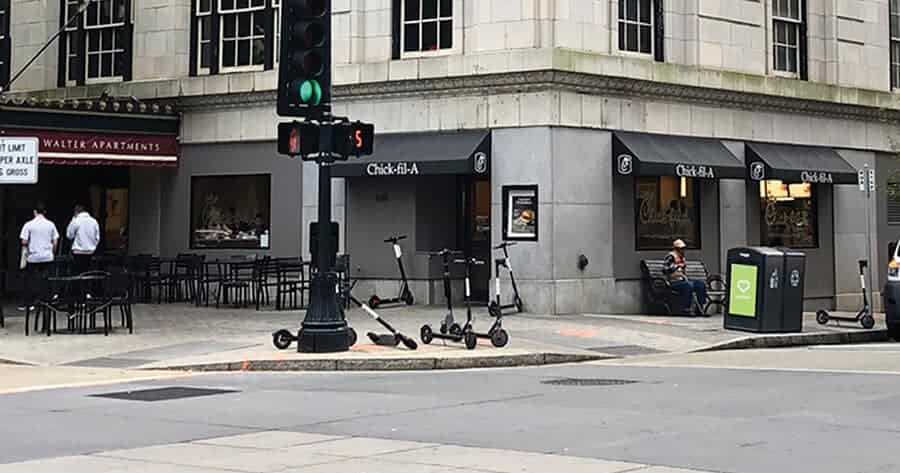
The Chick-Fil-A on Fayetteville Street announced its closing recently, and people lost their minds. Disregard that the restaurant was the size of a shoebox, about half as clean and kept fewer hours than the post office. Who cares that there’s more than a dozen other Chick-Fil-A locations within a 15-mile radius. Did we forget that there’s so many better places to get fried chicken downtown than at Chick-Fil-A (remember Beasley’s, anyone? Mecca? Clyde Cooper’s? Even Bojangle’s uses seasoning). But when it comes to the friendly fast food franchise with the right-wing agenda, we just can’t quit that delicious chicken. Lines formed out the door in the downtown Chick-Fil-A’s final days, comprised of folks who’d do anything for just one more hit, for old time’s sake, no matter how unhealthy, how many times they’d already been there that week, or how guilty it made them feel for betraying their friends in the LGBT community. Chick-Fil-A’s a heckuva drug, someone wise once said. Probably someone from Raleigh.
 SCOOT, SCOOT Y’ALL
Well, the electric scooters happened, and in those first heady, glorious summer months, we jammed the streets (and sidewalks) with them like broken heroes on a last chance power drive, fully expecting, any day, for the Birds and Limes to be ripped away from us as suddenly and mysteriously as they had appeared. But the scooters weren’t impounded or banished as in other cities. Instead, in a rare display of acting with some sort of a sense of urgency, the City Council rallied to get scooter regulations into place. The good news is, the scooters are allowed to stay. The other news is the number of scooters permitted to operate in Raleigh is capped, and each individual scooter incurs a onetime, $300 fee to the company that’s in charge of it. Maybe now we can think about getting some scooter docks, so they’re not littering the roadsides, greenways and parking lots from downtown to Brier Creek. Just as soon as we sort out bike share, backyard cottages and Airbnb.
WHEN U ONLY KNOW WHITE PEOPLE
The photogenic doctors at a local dental practice dabbled in a little cultural appropriation this spring, with an ad for free whitening—teeth whitening!—that portrayed them dressed in traditional Scottish, Japanese and Native American garb. (The dentists are white). The ad cleared at least one tier of editorial scrutiny to run in the May/June issue of a local lifestyle magazine, whereupon the chief of staff to NC First Lady Kristin Cooper saw it and tweeted out her disapproval. The ad quickly went viral, with outlets from Fox News to the Washington Post to everyone you know on Facebook and Twitter weighing in. To their credit, the dentists quickly apologized, calling the ad, in hindsight, “ignorant and offensive.” Our favorite reaction to this episode of local inanity came from the always funny Facebook page Fuquay-Varina Memes, with a simple, poignant, emoji-filled bit of incisive caption-as-commentary: “When you only know white people.”
GOP CHECKED
North Carolina Republicans have ruled the state with an iron fist since at least 2010, so they’ve been overdue for a bad year and some comeuppance for egregious missteps, like HB2. They finally lost their supermajorities in both the state House and Senate chambers due to blue waves in urban counties including Wake and Mecklenburg. What’s more, they played themselves when they decided to abolish judicial primaries and make state judge’s races partisan. Instead of splitting the vote among Democratic candidates running for a seat on the state Supreme Court as they’d hoped to do, the opposite scenario occurred when Raleigh attorney Chris Anglin changed his party affiliation from to D to R at the last minute and filed to run alongside incumbent justice Republican Barbara Jackson. No other Democrat challenged the eventual winner, Anita Earls, and Dems will now hold a 5-2 majority on the court. Progressives can’t even savor that schadenfreude too heartily, though. Thanks to gerrymandering, Republicans still managed to hold on to 10 of North Carolina’s 13 U.S. House seats, despite winning only 50.3 percent of total votes in the state for Congressional candidates.
Photograph by Simply Perfection Photography
CHRISTMAS MISCHIEF
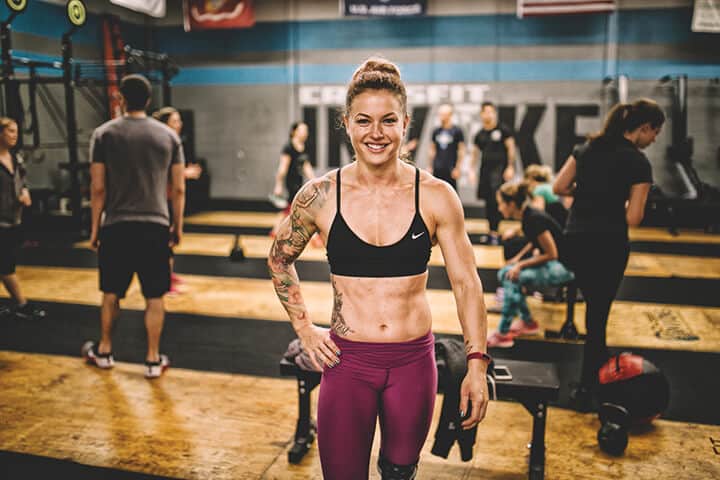
Local Big Brother star and CrossFit franchise owner Christmas Abbott was charged with felony criminal mischief after turning herself in to authorities in Florida in November. The arrest stemmed from an August incident where Abbott, several months pregnant at the time according to a colorful report from the celebrity news website TMZ, “drove to a Tampa gym to confront her baby daddy’s alleged side chick.” Police say Abbott hurled a cup of coffee, called the other woman a “pathetic home-wrecking little slut” and repeatedly rammed her Mercedes SUV into the woman’s Honda sedan in the parking lot. “The responding officer says Abbott continued to scream at the side chick while he tried calming her down,” TMZ helpfully notes. The officer declined to charge Abbott at the scene because she was so far along in her pregnancy. Abbott gave birth to a baby boy, Loyal, in October. Our congrats on the baby go to Christmas, and we wish her a happier New Year.

by Jane Porter | Oct 31, 2018 | November 2018, Stuff
The cannabis industry is growing across the globe, and in North Carolina, too. Here’s what to know about the past, present and future of cannabis, in this state and beyond.
Four years ago, Kymberly M., a small business owner from eastern North Carolina, got so sick that she believes she almost died. She recovered, but was diagnosed with several auto-immune disorders that she’ll deal with for the rest of her life. So began an odyssey of meeting with different doctors, circling through a “pill wheel” of prescription medications, even being prescribed morphine for pain.
“I felt like each doctor was playing a guessing game with my health,” says Kymberly, who didn’t want her full name used due to the personal nature of her story. “I felt myself getting more and more dependent on pills. [The morphine prescription] not only scared me, it opened my eyes…I could live the rest of my life going from doctor to doctor, prescription to prescription. Or, I could explore alternative options.”
Kymberly made some changes to her diet and tried yoga and acupuncture. She also discovered cannabidiol, or CBD, a non-psychoactive cannabis compound (or phytocannabinoid) found in the hemp plant that’s used for therapeutic treatment. (Though they’re in the same family of cannabis plant, hemp is different from marijuana, the plant that contains the phytocannabinoid THC, which gets you high).
Kymberly rubs CBD cream on her joints whenever she has aches and pains, and takes oils under her tongue a few times a day.
“It has been a game changer for the pain management, but I’ve found other benefits from it, such as weight control, and it has kept me off all pain pills,” Kymberly says. “I use one oil in the daytime. Another oil helps me sleep the best I’ve ever slept. It’s been a long journey in the healing of these diseases. I know they will never go away, but CBD oil has brought it full circle for me.”
Industrial Hemp
In the past few years, hemp dispensaries have opened up all over the state, including in Raleigh. There’s Forever Hemp on Fayetteville Road and The Hemp Store on Old Milburnie Road. There’s Oak City Cannabis, which you can find at pop-up events, including at the new Raleigh Night Market. And there’s The Hemp Farmacy, which opened this summer in a prominent location on the edge of downtown.
These dispensaries carry CBD health and wellness products, including balms, lotions and salves, but also candies and gummies, teas and oils for vaping. Local companies are also exploring options for using CBD in cosmetics, pet food, human food and drinks—even beer.
With the global legal cannabis market poised to be valued at around $150 billion by 2025, we can only expect to see the cannabis industry keep growing—and growing quickly—here at home.
But, in pre-empting this growth, local purveyors, growers and advocates say they want the public, and lawmakers, to have a better understanding of the science behind the use of cannabis for medical treatment, and to understand the laws that currently allow hemp and marijuana to be cultivated, processed, manufactured and sold.
Generally, cannabis falls in the most restrictive federal class of drugs, Schedule I, along with heroin, LSD and ecstasy. These are defined as “drugs with no currently accepted medical use and a high potential for abuse,” although in September, the federal Drug Enforcement Administration (DEA) reclassified some CBD as Schedule V—a tacit acknowledgment of its medical value.
In 2013, the U.S. Justice Department issued the Cole Memorandum to U.S. attorneys which stated that, due to limited resources, it would not enforce federal marijuana prohibition in states that had already legalized cannabis for medical and recreational use (though under the Trump administration, the memo has since been rescinded).
“We have evolved to a point beyond the notion that marijuana is as dangerous as heroin or acid,” says Steve Gormley, an expert in the legal marijuana sector and president and CEO of International Cannabrands, a cannabis industry brands conglomerate. “The two guys smoking a joint are not starting a barroom brawl. That’ll be the two martini drinking guys, whether they’re in suits or not. And the U.S. electorate and politicians alike are recognizing that.”
In 2014, a federal farm bill provided the framework for states to begin cultivating “industrial hemp,” defined as cannabis with less than .3 percent THC. North Carolina passed a bill in 2015 allowing a newly created Industrial Hemp Commission to develop rules and a licensing structure, and the Industrial Hemp Pilot Program was introduced in 2016, with temporary rules adopted the next year. As of late last month, the state has issued more than 390 licenses to local farmers and other cannabis growers; businesses that want to buy, sell and manufacture hemp products for consumers must also register with the state’s Industrial Hemp Commission.
CBD Products
Hemp Farmacy, courtesy of the N&O.
On a recent afternoon, I stopped in at the Hemp Farmacy on Hillsborough Street. The franchise, which opened its first locations in Wilmington in 2017 and has stores in Jacksonville, Asheville and Fayetteville, feels like a medical clinic: a green cross logo, all-white painted walls, minimal furniture and decor. I add my name to a waiting list and show an attendant—a “hemp tender,” as they’re called—my driver’s license to prove I’m 18. Then, we head to the back of the store, be-hind the reception desk, where there are several glass-top cases containing CBD products. I explain that I’m looking for something for my mom, who suffers from arthritis.
CBD prevents the re-uptake of FAAH anandamide enzyme, which is key in pain management, my consultant explains. She walks me through what’s available—oils, balms, salves, with different levels of concentration of CBD. I settle on a salve from the brand “The Healing Rose,” a 150 milligram pot of topical that’s infused with orange, lavender and chamomile, with 70 percent CBD. It costs $40, but, the hemp tender tells me, a little goes a long way.
“We have a very loyal base of returning customers,” explains Sam Gale, the educator at the Hemp Farmacy’s Raleigh location. “As a general overview, CBD is a pleiotropic drug that goes along molecular pathways in the body and acts differently on each of the 63 identified pathways. It interacts with a whole variety of different things, it has anti-inflammatory properties, mood regulating properties, sleep cycle regulating properties, appetite regulating properties. It helps the body get back to a state of homeostasis.”
It’s a marketing pitch, clearly, but one that is backed up by some medical research—and a lot of anecdotal evidence.
Just down Interstate 40, in the Research Triangle Park, I meet Garrett Perdue, the CEO of Root Bioscience, a startup that processes North Carolina-grown cannabis flower, or biomass, for CBD oil, which it then uses to manufacture health and wellness products for retail and for other CBD brands.
In just two months this summer, the company raised $2 million and is poised to be the leading cannabis manufacturing company in the region. Investors include some of the world’s top consumer products experts, and a number of the Triangle’s chief life sciences and tech executives, according to Perdue.
“The most important thing that distinguishes us is the quality of the people involved in this business,” Perdue says. He names Miles Wright, the company’s COO, who has an extensive background in materials manufacturing and entrepreneurship, and Pete Geisen, the vice president of operations, who’s worked in the life sciences and pharmaceuticals spheres. A group of young scientists with backgrounds in bio- and analytical chemistry, cannabis extraction, molecular biology and biotechnology rounds out the team.
“You’ll see humans with advanced degrees from leading universities,” Perdue says. “The quality of people we have in our operations is absolutely remarkable.”
 Perdue and Root Bioscience co-founder, Neil Bagchi, are both attorneys whose forays into the cannabis industry began as advocacy for patients benefitting from the use of cannabis derivatives as alternative health treatments. They started a nonprofit, Sensible South, which has become the Southeast’s premier medical cannabis advocacy entity and is active in 13 states. One of the group’s advisers is Dr. David Casarett, a physician, professor of medicine and chief of palliative care at Duke University, as well as the author of “Stoned: A Doctor’s Case For Medical Marijuana.”
In 2016, over dinner with a group of executives from a major U.S. medical cannabis operator, Perdue and Bagchi learned that that company needed to source a large quantity of CBD isolate for use in products for treating patients.
“I had the sense to ask how much they were paying, and they told me, and we recognized it was a very legitimate business opportunity,” Perdue says. He and Bagchi obtained a license under the auspices of the state’s Industrial Hemp Pilot Program, made some hires and partnered with a farmer’s co-op in the northeastern part of the state, which gave them access to 200,000 pounds of biomass.
At its RTP facility, the company uses an ethanol-based process to extract CBD oils and convert them into three different products: full spectrum oils, which include a wide range of cannabinoids including trace amounts—up to .3 percent, legally— of THC; broad spectrum oils, which contain no traces of THC, but do contain other cannabinoids, and CBD Isolate, which is up to 99.9 percent pure CBD.
“Our goal in 2019 is to process 500 pounds of biomass per day, and convert those into CBD isolate products,” Perdue says. Third party contractors can then order those CBD isolate products for use in their own products in what’s becoming a booming emerging industry, nationally and internationally.
For instance, this summer the Origins brand from cosmetics giant Estée Lauder launched Hello, Calm, a face mask and the company’s first product made with cannabis oil. Coca-Cola is reportedly looking at producing cannabis infused drinks in partnership with Aurora Cannabis, Inc., a company out of Canada, where cannabis for recreational use just became legal last month. Heineken sells Hi-Fi Hops, a non-alcoholic beverage designed to taste like beer, in some California cannabis dispensaries under its Lagunitas brand.
Even local companies are getting in on the act.
“Lonerider is exploring a collaboration with Root Bioscience for both our beer and spirits at the moment,” said Sumit Vohra, the CEO of Raleigh’s Lonerider Brewing, in a statement to Raleigh Magazine. “Since the landscape is ever changing, we have a lot to navigate through but we are hopeful to have a CBD based product next year.”
Medical Marijuana
 Perdue emphasizes a distinction between the business, Root Bioscience, and Sensible South, the advocacy group he and Bagchi continue to oversee. “We’re actively advocating for sensible changes to cannabis policy that allow patients to access cannabis for medical purposes,” he says.
This includes cannabis intended for treatment that contains THC. Though the research into medical marijuana is limited, there is growing evidence that THC, when used alone and when used in combination with other cannabinoids, such as CBD, is effective in treating a range of ailments. In treating neurological disorders, including pediatric seizures—the FDA approved the CBD drug Epidiolex this summer for treating seizures associated with epilepsy—the medical evidence is especially strong.
Anecdotally, patients report success using CBD and/or THC to treat myriad conditions, including Irritable Bowel Disorder, Chron’s diseases, muscle spasticity in multiple sclerosis, insomnia, PTSD, traumatic brain injury, autism and recovery from opioid abuse.
“If you ask me as a researcher, there is probably enough evidence to warrant legalizing medical cannabis use in North Carolina,” says David Casarett, the physician, author and Duke professor. “Not definitively, not for certain, not for all conditions. But, yeah, there is enough evidence for some. As a physician who takes care of patients with severe pain that’s been resistant to multiple medications—patients who want to stop taking opioids, patients with severe nausea or vomiting, patients taking medications that don’t work—people who really are suffering, who want to try anything else, I would say yeah [to legalization]. For a lot of patients, though there haven’t been great clinical trials, they’re often not willing to wait [for clinical trials], because everything else hasn’t worked and they are miserable. You can make the argument that they deserve a chance.”
Casarett can’t recommend medical marijuana to his patients in North Carolina since it’s illegal here. He notes that about one in ten cannabis users can develop a dependency on the drug, and that there are outstanding concerns about driving under the influence. He also urges caution when viewing medical cannabis, and CBD in particular, as a cure-all solution to the opioid crisis and to other ailments, and he urges potential consumers to buy quality verified products only, as unscrupulous sellers have been known to hawk CBD branded products that are actually just vegetable oil.
“CBD is one of these drugs that is new, and people are touting its uses for pretty much everything,” Casarett says. “It can’t be as beneficial as everybody says it is. It can be good for PTSD and sleep and flexibility and inflammation, but no single molecule can have all the effects people are ascribing to CBD. It’s just not physiologically possible.”
But, he adds, with the right safeguards, good quality control practices, and patient and physician education in place, there’s no reason North Carolina shouldn’t follow the lead of the 31 other states, and Washington D.C., where medical marijuana is legal, or even the nine states that allow for its recreational use.
On the Horizon
Indeed, during legislative sessions in the past several years in North Carolina, state lawmakers have introduced legalization bills, only to see them go nowhere. But it soon could be a moot point, anyway: blanket legalization for medical use at the federal level is likely on the horizon.
“I think the eventuality is a full repeal of banned cannabis based products across the board,” says Gormley, the Cannabrands CEO. “A plurality of politicians on both sides of the aisle support use of medical marijuana and endorse states’ legal access to cannabis based medicines. There are a lot of politicians on the left and in the Democratic wing who recognize that the war on marijuana is racist and has been bad for taxpayers. Libertarians like the job growth and economic opportunities. On the state level, governors say they want to exploit the tax revenues available in taxing and regulating the drug.”
The benefits of legalization to North Carolinians seem too numerous to ignore. It comes as no surprise that, last month, the News and Observer found in a survey that many of the state’s most influential leaders in business and politics generally favor legalization or decriminalization. Not only can medical cannabis offer relief, with few drawbacks, to veterans suffering from PTSD, opioid addicts, arthritic moms and people like Kymberly M., who experience chronic pain, but it could net the state millions in fee-for-service Medicaid and marijuana law enforcement savings, and bring an end to the disproportionate marijuana arrests and incarceration of people of color, who use the drug at the same rate as whites.
“North Carolina needs to go back to its history and be progressive on this issue,” says Perdue. “There’s absolutely no industry that could have these positive [economic] results faster, and with more impact, than cannabis. It’s just unfortunate that a 40 year old stigma, driven by politics and converse industry purposes, puts us in a position that, right now, that’s not possible.”
Kymberly agrees.
“I will always be grateful for finding the benefits of CBD oil and hope that North Carolina will see the light to pass medical marijuana,” she says. “It’s a no brainer. Regulate and manage the market and reap the benefits. Or continue to keep the business underground and let the criminals run it.”

by Jane Porter | Oct 31, 2018 | November 2018, Retreat, Stuff
A sunset over a Mediterranean beach, the ocean meeting the sand, golden light reflected on crystal blue waters. At Vidrio, hundreds of handblown glass discs transport guests from the buzz of Glenwood South to the tranquil shores of Greece, Spain or Italy.
“I wanted to use my experience living in Spain, years ago when I was 19 or 20, as a guide,” says Doug Frates, the glassblower who, together with Vidrio’s interior designer, Giorgios Bakatsias, planned the design for the 30-by-50-foot wall-mounted assemblage, and created more than 700 unique glass pieces at his midwestern studio. It was a process that took more than a year.
“When I lived in Barcelona, especially, there is so much culture and so much romance behind that city,” Frates continues. “I wanted to incorporate that into the theme of the restaurant.”
The installation, a kaleidoscope of glass bowls and orbs fashioned to resemble sea shells and marine plants, is evocative and immersive, unique and breathtakingly beautiful. Reds and yellows, blue and golds, greens and violet tones shimmer over Vidrio’s cavernous dining room, a pleasing contrast to the rope chandeliers and wooden blocks and panelling decor that is reminiscent of a fisherman’s ship.
 Frates—a former U.S. Marine who, after discovering glassblowing at a community college in Tuscon, opened his own studio in 2005—met Bakatsias at the High Point Furniture Market. Frates travelled to Raleigh and pitched his project idea—what would become the largest installation his studio had taken on thus far—to Vidrio’s owners, Lou and Joy Moshakos. After that, Frates says, he was given renderings of the restaurant and an essentially blank canvas to bring his glasswork to an environment that would be built around it.
“One of the benefits of having the renderings beforehand was that we could really, actually blow it out of the water,” Frates says. “I could see the environment and we could bring the glass into the environment.”
Glassblowing, as Frates describes it, is a fast-paced, sometimes stressful form of artistry, due to the high temperatures and the artist’s somewhat limited ability to plan how the final product will look. It requires patience and determination, Frates says; individual glass pieces can take between 45 minutes to three hours to complete.
“It’s unlike any other art form that’s really out there,” Frates says. “We like to let the glass tell us what it wants to do compared to us trying to force it to do something. That seems to be our best approach to it and that is what has gotten us to where we are now.”
“We” is himself and four employees who work at his 12,000 square-foot studio in Springfield, Ohio.

“We like to acquire talented people who understand projects like [Vidrio’s],” Frates says. “It’s funny, some days when we come in, like on a cloudy, gray day, when everybody’s personality is kind of dreary, we’ll make dreary pieces. But when it is sunny and beautiful, we’ll make sunny, beautiful work. That’s the reality of it sometimes.”
This month, Frates will spend an evening at Vidrio sharing his artistry, and some select pieces for sale, with restaurant patrons and fans of his work. Tickets range from $75—$100 for drinks and heavy hors d’oeuvres, and a portion of the sales will benefit the Young Marines, a national organization dedicated to mentoring young people in academic achievement and community service.
You can also find Frates’ work at La Maison in North Hills, or check out his studio online at dougfratesglass.com. For tickets to the Vidrio event on November 20, go to vidrioraleigh.com/blog.

by Jane Porter | Oct 31, 2018 | Buzz, November 2018
Raleigh’s tourism office has a plan to attract 5 million more yearly visitors by 2028—but the city needs to be strategic in how it will accommodate them.
On a recent weekend, when bluegrass lovers poured into downtown Raleigh from all over the Southeast, and alumni and football fans traveled in for the Wolfpack’s first home game of the season, the occupancy rate for the market’s 16,000 hotel rooms ran somewhere around 93 percent. That’s a lot of visitors, and a lot of new money flowing into the city. So, it’s little wonder that, when it comes to new hotel construction, the free market free-for-all is alive and kicking in Raleigh and Wake County.
Between now and the end of 2022, more than 10 different limited-service, boutique and extended stay hotels could open to vacationers, business travelers and convention goers in and around downtown Raleigh alone, adding hundreds of rooms to the area’s overall stock and helping to achieve a countywide goal of attracting 21.7 million yearly visitors by 2028. In just the past month, Guest House, a boutique hotel on South Bloodworth Street, and Revisn, an extended stay hotel in Glenwood South, opened their doors. Dozens more hotel proposals are in the pipeline, both for downtown and for other regional clusters in the city and county, such as North Hills, Brier Creek, Cary and Morrisville.
But, in order to support one of the city’s key facilities, the Raleigh Convention Center (RCC), and to keep Raleigh competitive with other cities with similar assets, city and county officials and planners need to think carefully about taking Raleigh to the next level in terms of how it will accommodate all these new visitors that it plans to attract. In other words, even the hundreds of new hotel rooms spread out all over the city, county and downtown might not meet the area’s actual demands.
“We’ve got to be strategic and comprehensive about our next series of builds,” says Loren Gold, the executive vice president of the Greater Raleigh Convention and Visitors Bureau (GRCVB). “It’s got to be a proactive strategy, we cannot sit around waiting for people to show up in the market going ‘I want to build a hotel.’ We’ve got to say, ‘We want this, let’s go get it.’”
In the last year, the GRCVB led a major study, known as Destination 2028, in order to set long-term goals for tourism in Raleigh and Wake. The plan, which was guided by a steering committee of prominent locals from the public and private sector and grounded in research from real estate services consulting company JLL, found that, organically, the county could attain 18 million visitors per year by 2028, up from 16.5 million in 2017. But, with
enhanced tourism infrastructure, including potential upgrades to the RCC, or a new sports complex—Major League Soccer, anyone?—the area could attract an additional three million visitors across convention, meetings, sports and leisure tourism.
To reach 21.7 million visitors by 2028, the plan posits ten key recommendations, including building a multi-use indoor sports complex, as well as an MLS stadium somewhere within the county; developing the Blue Ridge Corridor into “a sports, entertainment, arts, scientific, medical and agricultural campus;” offering more signature events and festivals, and offering unique visitor experiences (at Dix Park, for instance); capitalizing on a regional interest in e-sports and gaming; and increasing international visitation from Canada, Europe, China and India.
The plan’s first recommendation, though, is to enhance the $221 million RCC, the city’s and county’s largest asset funded with interlocal tax dollars (that is, lodging and prepared food revenues) through renovation and expansion, or to add another full-service, 400-plus room hotel within walking distance.
 “We’re not anti-125-room hotels,” says Gold of the glut of lifestyle, boutique or smaller, limited-service hotels that predominate in the Raleigh market and cater largely to the city’s business travelers who comprise about 10 percent of the area’s annual visitors (see above). “Those are our key partners, but we have to be very diligent about where we build, why we build and what market we’re going after.”
The market that will take Raleigh to the next level, stakeholders say, is comprised of people visiting the city for meetings, trade shows, conferences and other convention business, a group that already accounts for one-fifth of all visitors’ reasons for coming.
“Having a third full-service hotel near the Convention Center, in addition to the Sheraton and the Marriott, would be of great benefit in terms of attracting larger conventions,” says Charles Meeker, the former mayor of Raleigh who pushed for building the RCC during his tenure and who serves on the committee in charge of implementing Destination 2028. “Right now, we simply do not have adequate hotel space nearby. The convention business is now bouncing back after being significantly hurt by House Bill 2, so we’re seeing a situation where, as the [interlocal tax dollars] are allocated, this facility has an interest in being at the top of the list for consideration.”
Destination 2028 lays out three scenarios by which the city and county can spend interlocal tax dollars to beef up business at the RCC. These include suggestions to use current space at the Convention Center more efficiently, to expand the building—it needs another ballroom-sized space—and to add the aforementioned hotel. The most aggressive scenario, which combines renovating the RCC and adding the full-service hotel package, could more than double the current number of hotel rooms occupied per night, per year, from today’s rate of 72,448 to 175,746.
This combined renovation-hotel package scenario would mean not only more revenue for the Convention Center and more efficient use of its facilities, but it’s a more attractive option to event planners who want to bring large groups to the city for meetings, conventions and trade shows, and want to accommodate them as close to the RCC as possible. It would also make Raleigh more competitive with peer cities, including Boston, Austin, Richmond, Charlotte and Greensboro, in attracting new events and retaining current business.
“Now, if you’re bringing a 5,000-person conference to Raleigh, you’re going to need more than the two major downtown hotels, and you’ll be spread out, adding transportation to the Convention Center [as a consideration],” says Angela Caraway, a meetings and event planner at the Caraway Management Group who served on the steering committee for Destination 2028. “We as planners do not want to have multiple hotels we have to manage because it adds another layer of responsibility in contracting. If we keep [the number of hotel contracts] to a minimum, absolutely, I know many planners would sign up on that right away.”
 It will take a measure of political will from elected officials on Raleigh’s city council, especially, to support expanding the RCC and recruiting a full-service hotel developer. There are also some practical considerations that must be accounted for, including where the RCC can grow, physically, and where a new full service hotel can be erected (the Budget Car Rental lot and the Red Hat amphitheater property have been floated, as the amphitheater is likely to relocate to Dix Park).
“[The city] put $15 million into the meeting rooms, the public spaces, so with the Convention Center, the city does typically drive it, rather than the county,” says Meeker. “I haven’t talked to the current council members, but in the past, the council was always very supportive of the Convention Center for spending funds on new projects.”
Last month, the council heard a presentation on this very topic. It’s a good thing, too, because the ball needs to start rolling sooner rather than later.
“We have to start having the dialogue now, and look on the horizon of when we want to have this all done by,” says Gold of the GRCVB. “The good news is we have this plan and the hope is people take the time to read it, build the correct framework and put it in the correct context.”
Caraway says she sees a lot of positives in moving forward with enhancing the RCC and adding another full service hotel nearby.
“Obviously, it would help with economic empowerment, with additional jobs,” Caraway says. “We would be able to attract new business and retain conventions that have grown and cannot stay in the current sized center. To add to that, Raleigh has a lot to offer and what makes Raleigh special are the people, the businesses, the start-ups, the locals. When you add that to having adequate convention and meeting space, it brings so much more value to the package of selling this destination.”
Both Infographics Source: DK Shifflet for the Greater Raleigh CVB (2017, 2018) 2014-2016 (excluding day-trippers and international visitors) Courtesy of Visit Raleigh.



