Water Woes

Water Woes

I love Raleigh restaurants. I really really do. But one thing I do not love is when they set the table with teeny-tiny water glasses. I drink a lot of water. A LOT. When I’m seated at a table at any one of our fine establishments and discover a precious 6 oz. glass, I experience a feeling of annoyance mixed with panic; I am immediately concerned that there’s simply no way my server will be able to keep up with my water consumption. Recently at a local restaurant, I found myself in this situation so I proactively requested that my server might consider leaving the water pitcher on the table. When she informed me that she would need to go ask the manager, I was dismayed. She returned with apologies and said she would be unable to leave the bottle, with no further explanation. I was stunned. This establishment was not so fancy that the water would detract from a fine-dining experience. My husband even pointed out that the French-bistro-looking bottles with the little rubber stoppers begged to be set out on the tables. To her credit, our server did a great job of refilling my glass, but honestly, it seemed a needless hassle for her run herself ragged just to keep me hydrated. So if you’re not going to allow your customers to self-serve, please consider giving them bigger water glasses. Your thirsty patrons will thank you for it.

– Ele Roberts

Art Meets Architecture in Oakwood

Art Meets Architecture in Oakwood

Raleigh architect Louis Cherry welcomes a challenge. The designer behind spaces for local mainstays including Crawford and Son, the Cameron Village Library and the Burning Coal Theatre Company—not to mention his own modernist-style home that caused a stir in historic Oakwood a few years ago—just finished restoring a century-old building at the corner of Bloodworth and Lane Streets.

The one-story wooden building that served as Barnes Grocery for 70 years will now house Cherry’s firm, Louis Cherry Architecture. Anisette Little Shop, which sells sweets from the Five Points Bakery, and Mainland Creative/Oak + Co., a local design boutique and home goods retailer, will rent space in the building as well.

“It’s near our house, and we walk by it all the time,” says Cherry of his decision to buy and restore the dilapidated 118-year-old building, which is freshly painted gray with a pop of red at the door. “People were a little afraid of it because it was in such a precarious position structurally. It needed substantial foundation work, which can be scary, but my background in architecture and building made it not as daunting of a project. It took five months to rebuild the foundation and to repair a lot of the structure, but the renovation went great and it worked out just like we hoped.”

This month, Cherry will open the building to the public in the first of a series of monthly pop-up events designed to engage the community with world of architecture, art and design. He’ll feature some of his own photographic work as well as work from the Raleigh-based photographer Elizabeth Galecke and local jeweler and metalworker Claire Ashby.

“We want to create a stronger connection with architecture and art and design,” Cherry says of the pop-up series. “We’ll be mixing it up each month with different mediums and types of art and this will be a way to use the platform of an architect’s office to connect to art and artists.”

As Good as Her Words

As Good as Her Words

Ashley Christensen is no stranger to taking a stand. The James Beard Award-winning chef has been one of the most eloquent local voices on issues ranging from North Carolina’s bathroom bill to misogyny and sexual harassment in the workplace. So it was no surprise, but quite the viral sensation, when Christensen took an Instagram follower to task last month for having the audacity to suggest that she “just cook and be quiet.”

Christensen had posted a photo of herself and Michelle Obama, one of her “personal heroes,” wishing the former First Lady a happy birthday. Her response to the commenter—whose handle suggests he’s a foodie from Pinehurst but who quickly made his account private—takes a necessary look at how some feel entitled to treat service industry workers poorly, and how some can be made to feel uncomfortable when public figures, famous primarily for their trade or profession, deign to express an opinion outside of that scope.

“Your initial comment to me…is a command, suggesting that you view me and my colleagues as mere servants of a trade to fill your belly,” Christensen wrote. “It implies that chefs and cooks should put their heads down, cook their food, and make their customers happy. First I want to share with you… I am not employed by “customers.” I am an employer of hundreds of incredible hospitality professionals in the capital city of the state you call home. Together, we work tirelessly to create and invest in the relationship of hospitality with GUESTS.”

Ashley Christensen Full Instagram Post

Even though the vast majority of restaurant patrons wouldn’t dream of treating a chef or service industry worker as less-than, the post is a poignant reminder that elitist attitudes still exist and that the growing population of service industry employees don’t enjoy many of the working protections that other professionals take for granted—fair pay, job security, and freedom from harassment and discrimination all come to mind as examples. As a well-known chef with a considerable amount of success and influence, Christensen is rightly admired for her activism on behalf of many people, particularly those in her industry. Demanding her silence is not only rude but it does a disservice to all of them.

Crunch Time

Crunch Time

If Raleigh is to be chosen as a Major League Soccer expansion city, the ball needs to be rolling on securing its stadium location—and it needs to be rolling now.

In December, the MLS announced that Nashville will be home to the 24th team in the nation’s highest professional soccer league. The next expansion city is expected to be announced soon, with the final two to be revealed by the end of the year.

Meanwhile, Raleigh-based professional men’s soccer team North Carolina FC is getting its ducks in a row to win an expansion slot.

So who’s making that happen, and how?

North Carolina FC owner Steve Malik is leading the effort. He said back in November that plans to bring a $150 million soccer stadium to 13 acres of state-owned land at the north end of downtown Raleigh would have to be finalized by the end of the first quarter of 2018.

It’s up to Malik and his project partner, developer John Kane, to negotiate an agreement with the state to use what now houses North Carolina’s state government complex to build a sports arena and associated amenities. That would involve tearing down buildings and constructing 750,000 square feet of condos and hotel rooms, office and retail space, and adding parking and public transport infrastructure.

Negotiations between the club and the state go through the N.C. Department of Administration, which manages the state’s real estate portfolio. The Council of State, a nine-member body of popularly elected officials, will then hear a presentation around the proposal and vote on whether to approve it.

If the Council of State approves the project, the city and county will potentially come onboard to help with funding transit and infrastructure around the site. So far the negotiations have been kept secret, so it’s not clear where each party is in the process. Whether Malik will look for an alternative location for the stadium in the Triangle if the downtown proposal falls through is under wraps as well.

“We are working diligently with all interested parties to ensure that the project becomes a reality,” says North Carolina FC’s communications director Marco Rosa of bringing a soccer stadium downtown. “We know MLS prefers stadia in vibrant, downtown urban settings and this is what we are working towards.”

Here’s a look at the predicted economic impact of a MLS stadium in downtown Raleigh. The numbers are good, but the clock is surely ticking.

By the Numbers: Average Annual Economic Impact and Net Present Value (NPV) Over 17 Years*

North Carolina: $262M in annual economic activity, 1,960 jobs, $5.6M annual state tax revenue, $2.8B NPV

Wake County: $213M in annual economic activity, 1,470 jobs, $5.5M in local tax revenue, $2B NPV

Downtown Raleigh: $181M in economic activity, 700 jobs, $5M in local tax revenue, $1.5B NPV

*Source: Economic Leadership LLC

The Beautiful Few

The Beautiful Few

Inside one of Raleigh’s rare Second Empire houses

Most Raleighites are likely familiar with the Second Empire architectural style from the grand, eponymous red brick restaurant on Hillsborough Street. But what they may not know is that there are just a handful of other Second Empire buildings that are also located downtown. The vacant Heck-Andrews house on Blount Street is one of them. And, at 304 Oakwood Ave., Carter Skinner and Chapman Williams are lucky enough to live in another.
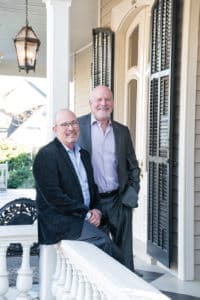
Chapman Williams (left) and Carter Skinner (right). Photo by Jennifer Robertson.

Skinner and Williams have called the historic Oakwood neighborhood home for over two decades. In 2001, their current home’s Second Empire tower, sloping mansard roof and soaring 12-foot ceilings enticed them to move from a home they had built and lived in for six years on the corner of East and Franklin Streets.

“I love the long hall,” Skinner says on a tour of the three bedroom, three bath, 3,715- square-foot home’s upstairs. Soft winter sunlight spills into the hall through the arched window of the tower. “And I love this room, I think this master bed and bath suite is beautiful. It’s a big little house; it has a lot of volume, but not a lot of rooms.”

When Skinner and Williams moved into the home nearly 17 years ago, the couple quickly set to work on renovations. They created a spacious downstairs kitchen and family room suite through an addition, as well as an attached master bathroom out of a tiny fourth bedroom upstairs. They added new plumbing and electrical wiring, crown molding and mantels in the parlor-turned-dining room. Williams, a semi-retired interior designer, upholstered the home’s walls and made all the draperies.

“It was very spartan on the inside,” says Skinner, a residential designer, of the home before the six-month renovation process. Outside, the couple created a stunning English-style back garden that’s overlooked by an old pecan tree. A coat of paint and a new roof freshened up the home’s exterior in the last year.
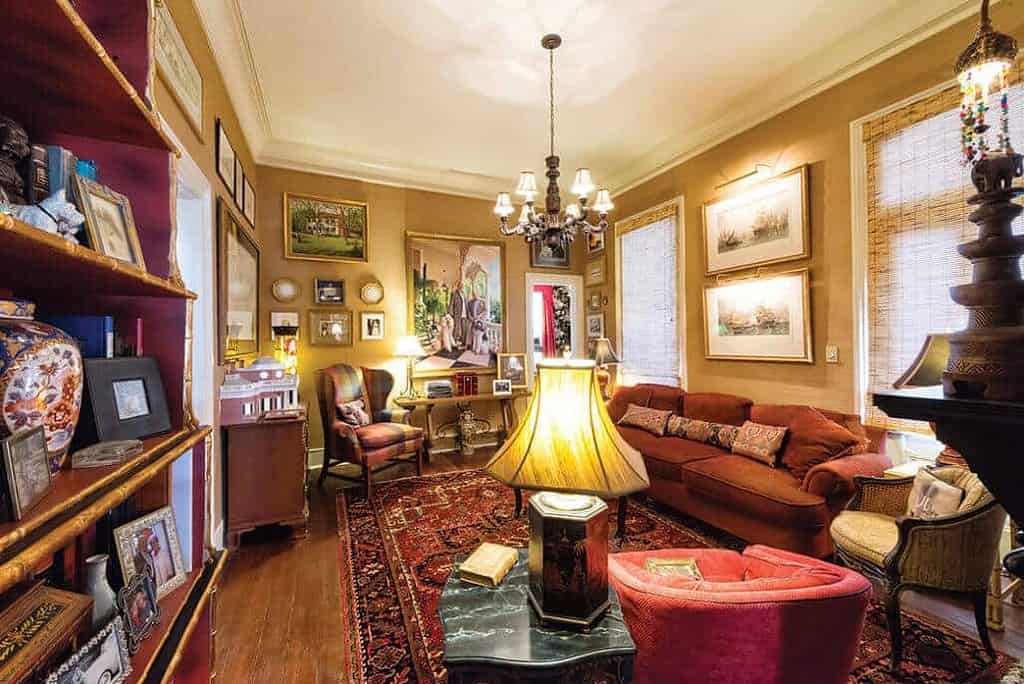
Photo by Jennifer Robertson.
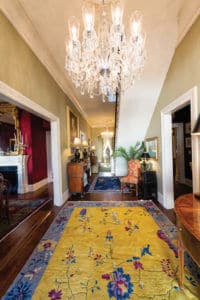
Photo by Jennifer Robertson.

A plaque next to the home’s front door says the house was built in 1875, but it likely was built a few years later, in 1879. Thomas Briggs—a prominent local builder and owner of downtown’s now-shuttered Briggs Hardware Store—built the home for its original owner, cotton broker Marcellus Parker and his large family. The home, which was converted into rental apartments in the 1950s, remained in the Parker family until 1985.

Skinner and Williams have decorated the home with a mix of pieces they’ve collected over the years and family heirlooms, including a massive gold-framed mirror over the mantel in the dining room—a piece from Skinner’s mother’s side of the family—and framed blueprints of Skinner’s paternal grandfather’s home in Durham. A painting of the couple by Durham artist William Branson overlooks a formal living room/study. And, at the back of the room, a cheekily decorated, closet-like bathroom is tucked away.

The beauty and grandeur of the Second Empire architectural style invokes a glamorous period in French history, during Napoleon III’s reign from 1852-1870. But there’s a reason Second Empire buildings are a rarity in the south. In the U.S., the style became popular in the 1860s, while the region was undergoing Reconstruction following the Civil War. Only the very wealthy could afford to build, and, by the 1880s, the style was falling out of favor, giving way to revival of the Queen Anne style and others.
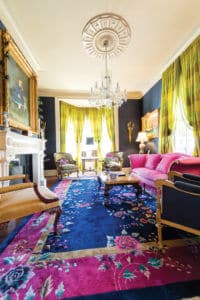
Photo by Jennifer Robertson.

Today, Skinner and Williams look forward to Halloween in Oakwood, where hundreds, if not thousands, of local kids trick-or-treat, and to the holiday Candlelight Tours, where 3,500 people came through their elaborately-decorated home last December.

“We love Oakwood, it’s a real community,” Skinner says. “It’s a really welcoming group of people, a nice mix from different professions and different walks of life.”


