The Beautiful Few

The Beautiful Few

Inside one of Raleigh’s rare Second Empire houses

Most Raleighites are likely familiar with the Second Empire architectural style from the grand, eponymous red brick restaurant on Hillsborough Street. But what they may not know is that there are just a handful of other Second Empire buildings that are also located downtown. The vacant Heck-Andrews house on Blount Street is one of them. And, at 304 Oakwood Ave., Carter Skinner and Chapman Williams are lucky enough to live in another.

Chapman Williams (left) and Carter Skinner (right). Photo by Jennifer Robertson.

Skinner and Williams have called the historic Oakwood neighborhood home for over two decades. In 2001, their current home’s Second Empire tower, sloping mansard roof and soaring 12-foot ceilings enticed them to move from a home they had built and lived in for six years on the corner of East and Franklin Streets.

“I love the long hall,” Skinner says on a tour of the three bedroom, three bath, 3,715- square-foot home’s upstairs. Soft winter sunlight spills into the hall through the arched window of the tower. “And I love this room, I think this master bed and bath suite is beautiful. It’s a big little house; it has a lot of volume, but not a lot of rooms.”

When Skinner and Williams moved into the home nearly 17 years ago, the couple quickly set to work on renovations. They created a spacious downstairs kitchen and family room suite through an addition, as well as an attached master bathroom out of a tiny fourth bedroom upstairs. They added new plumbing and electrical wiring, crown molding and mantels in the parlor-turned-dining room. Williams, a semi-retired interior designer, upholstered the home’s walls and made all the draperies.

“It was very spartan on the inside,” says Skinner, a residential designer, of the home before the six-month renovation process. Outside, the couple created a stunning English-style back garden that’s overlooked by an old pecan tree. A coat of paint and a new roof freshened up the home’s exterior in the last year.

Photo by Jennifer Robertson.

Photo by Jennifer Robertson.

A plaque next to the home’s front door says the house was built in 1875, but it likely was built a few years later, in 1879. Thomas Briggs—a prominent local builder and owner of downtown’s now-shuttered Briggs Hardware Store—built the home for its original owner, cotton broker Marcellus Parker and his large family. The home, which was converted into rental apartments in the 1950s, remained in the Parker family until 1985.

Skinner and Williams have decorated the home with a mix of pieces they’ve collected over the years and family heirlooms, including a massive gold-framed mirror over the mantel in the dining room—a piece from Skinner’s mother’s side of the family—and framed blueprints of Skinner’s paternal grandfather’s home in Durham. A painting of the couple by Durham artist William Branson overlooks a formal living room/study. And, at the back of the room, a cheekily decorated, closet-like bathroom is tucked away.

The beauty and grandeur of the Second Empire architectural style invokes a glamorous period in French history, during Napoleon III’s reign from 1852-1870. But there’s a reason Second Empire buildings are a rarity in the south. In the U.S., the style became popular in the 1860s, while the region was undergoing Reconstruction following the Civil War. Only the very wealthy could afford to build, and, by the 1880s, the style was falling out of favor, giving way to revival of the Queen Anne style and others.

Photo by Jennifer Robertson.

Today, Skinner and Williams look forward to Halloween in Oakwood, where hundreds, if not thousands, of local kids trick-or-treat, and to the holiday Candlelight Tours, where 3,500 people came through their elaborately-decorated home last December.

“We love Oakwood, it’s a real community,” Skinner says. “It’s a really welcoming group of people, a nice mix from different professions and different walks of life.”

Crunch Time

Crunch Time

If Raleigh is to be chosen as a Major League Soccer expansion city, the ball needs to be rolling on securing its stadium location—and it needs to be rolling now.

In December, the MLS announced that Nashville will be home to the 24th team in the nation’s highest professional soccer league. The next expansion city is expected to be announced soon, with the final two to be revealed by the end of the year.

Meanwhile, Raleigh-based professional men’s soccer team North Carolina FC is getting its ducks in a row to win an expansion slot.

So who’s making that happen, and how?

North Carolina FC owner Steve Malik is leading the effort. He said back in November that plans to bring a $150 million soccer stadium to 13 acres of state-owned land at the north end of downtown Raleigh would have to be finalized by the end of the first quarter of 2018.

It’s up to Malik and his project partner, developer John Kane, to negotiate an agreement with the state to use what now houses North Carolina’s state government complex to build a sports arena and associated amenities. That would involve tearing down buildings and constructing 750,000 square feet of condos and hotel rooms, office and retail space, and adding parking and public transport infrastructure.

Negotiations between the club and the state go through the N.C. Department of Administration, which manages the state’s real estate portfolio. The Council of State, a nine-member body of popularly elected officials, will then hear a presentation around the proposal and vote on whether to approve it.

If the Council of State approves the project, the city and county will potentially come onboard to help with funding transit and infrastructure around the site. So far the negotiations have been kept secret, so it’s not clear where each party is in the process. Whether Malik will look for an alternative location for the stadium in the Triangle if the downtown proposal falls through is under wraps as well.

“We are working diligently with all interested parties to ensure that the project becomes a reality,” says North Carolina FC’s communications director Marco Rosa of bringing a soccer stadium downtown. “We know MLS prefers stadia in vibrant, downtown urban settings and this is what we are working towards.”

Here’s a look at the predicted economic impact of a MLS stadium in downtown Raleigh. The numbers are good, but the clock is surely ticking.

By the Numbers: Average Annual Economic Impact and Net Present Value (NPV) Over 17 Years*

North Carolina: $262M in annual economic activity, 1,960 jobs, $5.6M annual state tax revenue, $2.8B NPV

Wake County: $213M in annual economic activity, 1,470 jobs, $5.5M in local tax revenue, $2B NPV

Downtown Raleigh: $181M in economic activity, 700 jobs, $5M in local tax revenue, $1.5B NPV

*Source: Economic Leadership LLC

Puppy Luxe

Puppy Luxe

Erica Preo was on a business trip in Pesaro, an Italian beach town located on the Adriatic, when she got the idea for her company, Pantofola. The Raleigh resident and dog lover wanted to combine her passions for pets and for design with Italian luxury craftsmanship; soon after, her line of leather dog accessories was born, and recently, Pantofola branched out to include coordinating purses for doggy owners.

Pantofola products, which include colorful collars and leashes, are crafted in Milan, with Italian leather from Tuscany and solid brass custom hardware from the Lombardy region. Prices range from $265 to $425 and Preo considers her products the “Bentley” of dog accessories.

“We’re certainly not for every dog owner,” she says, “but those who seek something extra special are never disappointed.”

This fall, Pantofola launched a small crossbody bag called the Passeggiata. At 8×7 inches, the soft, buttery leather purse is perfect for toting only the essentials, including keys and mobile phone, and if you’re bringing your pet along, it’s great for stashing necessities such as treats and doggy pickup bags. The Passeggiata comes in five colors, so you can coordinate it with your pup’s collar and leash if you like; an off-white lining and interior pocket make it easy to access the purse’s contents with one hand while you’re holding a leash in the other.

While Pantofola products are no doubt luxurious for both pet and owner, it’s the company’s charitable giving that makes it stand out. For every sale, Pantofola donates 20 percent to an individual dog rescue organization that the company selects each quarter. Past recipients include Pilots N Paws, Marley’s Mutts, The Devoted Barn and Susie’s Senior Dogs.

“People love getting presents, and people love their dogs,” says Preo. “We do always wonder who the lucky recipient might be: a dachshund, beagle or Frenchie? A little mixed breed pup by the name of Max? We’ll probably never know but it’s always fun to imagine the possibilities.”

Check out Pantofola’s pup accessories at pantofola-mia.com.

Blue Ridge Beauty

Blue Ridge Beauty

Blowing Rock is a tiny town of around 1,000 people, sprawled across the two western counties of Watauga and Caldwell on North Carolina’s Blue Ridge Parkway. Named for an unusual rock formation that juts 3,000 feet over the Johns River gorge, what Blowing Rock lacks in size it more than makes up for with its quaint charm and natural beauty. Sprawling mountain views, windy cliffs and a storybook village make the town a family destination as well as a nature lover’s paradise, perfect for exploring as well as relaxing.

Before Moravians and Scots-Irish pioneers settled Blowing Rock in the mid-eighteenth century, the town was home to Cherokee and Catawba Native American tribes. A site of guerrilla warfare between the Confederate and Union armies during the Civil War, many veterans settled with their families in the area after the war and travelers from the eastern part of the state began to visit Blowing Rock during the summer months, seeking respite from the heat. The town is now one of the nation’s premier tourist destinations.

Legend has it that before the town was settled, a Cherokee man was called to battle while meeting his lover from a rival Chickasaw tribe. Distraught, the man threw himself off of the namesake blowing rock, down into the gorge. The Chickasaw maiden prayed to the Great Spirit to return her lover to her and the Great Spirit obliged, blowing him up out of the gorge and back onto the rock to be with her. Could the story possibly be true? Visit the blowing rock and decide for yourself.


STAY

Chetola Resort and Spa

Chetola Resort 

Known as “one of the best stays in the Blue Ridge,” accommodations include Chetola Lodge, condominiums ranging from one to four bedrooms and the historic Bob Timberlake Inn. chetola.com

Blowing Rock Ale House & Inn

One block off of Main Street, The Blowing Rock Ale House and Inn features Blowing Rock’s first micro-brewery and a lovely five-room inn. Each guest room has a beer-themed name—Wheat, Stout, Hops, Pint and Amber.
blowingrockbrewing.com

Meadowbrook Inn

Only one block from Blowing Rock’s main street this boutique hotel offers cozy yet spacious rooms with great amentities including a complimentary hot breakfast. meadowbrook-inn.com

EAT

Bistro Roca 

Southern American bistro food in the fully renovated, legendary Antler’s Bar, offering lunch, dinner and brunch. The menu includes lobster mac & cheese, wood-fired pizzas and favorites like the grilled hanger steak, low country boil and wood-fired mountain trout. bistroroca.com

Canyons of the Blue Ridge

Canyons of the Blue Ridge

Dine on great food while enjoying breathtaking views of the beautiful Johns River gorge. Lunch and dinner include southwestern dishes such as beef enchiladas, chimichangas and soft tacos but also chef specials, including the chicken Maui or salmon platter. canyonsbr.com

Blowing Rock Market

Often called “the nicest gas station in America,” the gourmet market/gas station opened in the 1940s as an Esso service stop. Today it offers gourmet cheeses, meats, coffee and more than 800 wines. blowingrockmarkets.com

DRINK

Town Tavern

The sports bar and restaurant on Main Street is open every day for lunch, dinner and later. The tavern offers cocktails and local craft beers with their “world famous wings” and NC barbecue. towntavernbr.com

Blowing Rock Ale House

This state-of-the-art boutique brewery produces nearly 30 different craft beers that you can enjoy by the pint, growler or keg. blowingrockbrewing.com

Blowing Rock Ale House

DO

Moses H. Cone Memorial Park

Cone Park, as the locals call it, is a preserved country estate that belongs to a conservationist, with 25 miles of hiking trails. The home houses the Parkway Craft Center which features handmade crafts from hundreds of regional artists. blueridgeheritage.com/attractions-destinations/moses-cone-manor 

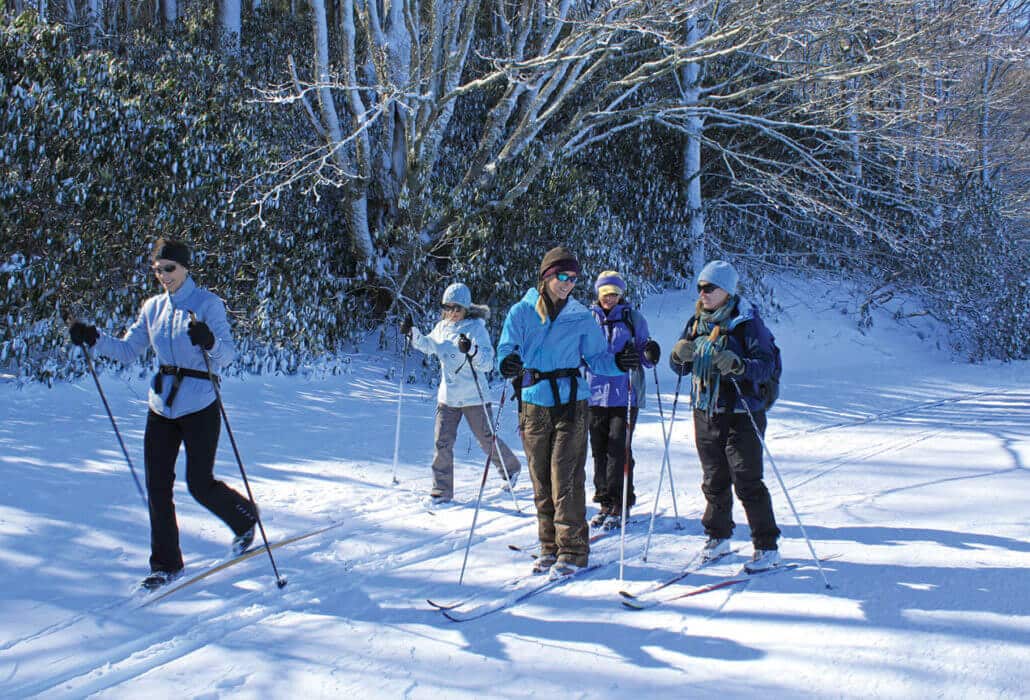
Skiing at Moses H. Cone Memorial Park

Appalachian Ski Mountain

Appalachian Ski Mountain was the first ski area to open in North Carolina’s High Country in 1962. It is open from November to March with 10 slopes including two terrain parks for day and night skiing plus outdoor ice skating. They offer ski and snowboard rentals, and it is home to the Southeast’s ski school offering classes and private lessons. appskimtn.com

Hawksnest Snowtubing & Zipline

This park is one of the largest for snow tubing with more than 30 lanes spread over four different areas. The park makes its own snow, while two carpet lifts bring you back to the top of the hill. It also offers one of the nation’s largest ziplines with more than 4 miles and 20 cables where you’ll travel over trees, creeks and a lake. hawksnesttubing.com

Blowing Rock WinterFest

Enjoy the best part of winter January 25-28 with the icy Polar Plunge in Chetola Lake, WinterPaws Dog Show, WinterFashion Show, ice carving, Appalachian State University’s Snowflake parade and, of course, the Winter Beer Garden. blowingrockwinterfest.com

2018…The Year of The Warehouse District

2018…The Year of The Warehouse District

From the cranes and crews at the Dillon and Union Station to the drilling and demolition at the old Cafe de los Muertos, construction is rampant all over downtown’s Warehouse District. It’s no secret that the artsy, industrial area—lined with train tracks, dotted by red brick buildings and home to some of the best-loved Raleigh staples— is undergoing a major renaissance. Recently, it’s attracted national attention, appearing in the travel, food and entertainment website Thrillist’s roundup of 12 neighborhoods in the country “about to get crazy popular.”

Here, we take a look at what’s opening soon in the district that’s bordered by Morgan Street and Western Blvd. to the north and south. Though it has some stiff competition from other up-and-coming neighborhoods downtown (we’re looking at you, N. Person Street), we think 2018 will be the Warehouse District’s year, with the potential to be one of downtown’s most transformative neighborhoods.

What’s on the horizon:

Union Station, 510 W. Martin St.

A multi-modal passenger train and bus station, replacing the existing Amtrak Station on Cabarrus Street and serving as a key component to Wake County’s forthcoming transit plan.

Opening early 2018

ncdot.gov/projects/raleighunionstation/

The Dillon, 223 S. West St. 

An 18-story office tower with retail space and two six-story apartment buildings. National clothing retailer Urban Outfitters has signed on to lease space, as well as local tenants including Heirloom Brewshop, a coffee, tea and sake bar.

Opening in 2018

thedillonraleigh.com

A Place at the Table, 300 W. Hargett St.

Raleigh’s first pay-what-you-can restaurant, where people can enjoy healthy meals and fellowship in a community setting, no matter their means.

Opening late 2017/early 2018

tableraleigh.org

Morgan Street Food Hall, 411 W. Morgan St.

A 20,000 square-foot venue with more than 60 food stalls, shops and restaurants, plus seating and event space.

Opening early 2018

morganfoodhall.com

Father and Son Antiques, 302 S. West St.

The venerable and eclectic Raleigh institution will make its new home in the former Flanders Gallery.

Re-opening early 2018

facebook.com/Father-and-Son